


Gate Valve vs Ball Valve: Key Differences, Applications, and Selection Guide
Choosing between a gate valve and a ball valve is one of the most common decisions in piping system design, fluid control, and industrial maintenance. Although both valves are widely used to start or stop flow, they are designed with different internal structures, operating principles, sealing performance, and application priorities. Selecting the wrong valve can lead to pressure loss, leakage, slow operation, premature wear, or unnecessary maintenance costs.
This article explains the difference between gate valve and ball valve in a practical, professional way. It compares structure, working principle, flow control performance, sealing ability, pressure drop, durability, maintenance, cost, and typical applications. Whether you are designing a water pipeline, oil and gas system, chemical process line, HVAC network, or general industrial piping system, understanding gate valve vs ball valve performance will help you make a better engineering decision.
What Is a Gate Valve?
A gate valve is a linear motion valve that uses a gate-shaped disc to open or close the flow path. When the handwheel is turned, the stem moves the gate up or down. In the fully open position, the gate is lifted out of the flow passage, allowing fluid to pass through the valve body. In the fully closed position, the gate moves down into the seat and blocks the flow.
Gate valves are mainly designed for isolation service. They are not ideal for throttling because the partially open gate can vibrate, erode, or become damaged under high-velocity flow. However, when fully open, a gate valve usually provides a straight-through flow path with minimal obstruction. This makes gate valves suitable for large pipelines where low pressure drop is important.
Common gate valve materials include cast iron, ductile iron, carbon steel, stainless steel, bronze, and alloy steel. Depending on the working environment, gate valves may be manufactured with resilient seats, metal seats, rising stems, non-rising stems, bolted bonnets, pressure seal bonnets, or wedge gate designs. Because of their strong structure and suitability for large diameters, gate valves are frequently used in water supply, wastewater treatment, power plants, petrochemical pipelines, and general industrial systems.
What Is a Ball Valve?
A ball valve is a quarter-turn rotary valve that uses a hollow, perforated ball to control flow. When the hole through the ball is aligned with the pipeline, fluid passes through the valve. When the handle is turned 90 degrees, the solid side of the ball blocks the flow. This simple and fast operation is one of the biggest advantages of a ball valve.
Ball valves are well known for tight shutoff, compact design, and reliable sealing. The sealing system usually includes soft seats made from materials such as PTFE, reinforced PTFE, PEEK, or other engineered polymers. For higher temperature, high pressure, or severe service conditions, metal-seated ball valves may be used.
Compared with a gate valve, a ball valve generally offers faster operation, better shutoff performance, and easier automation. Ball valves are available in floating ball, trunnion mounted, full port, reduced port, three-piece, two-piece, top-entry, and multi-port designs. They are widely used in oil and gas, chemical processing, natural gas distribution, water treatment, HVAC, compressed air, marine systems, and many automated process applications.
Main Differences Between Gate Valve and Ball Valve
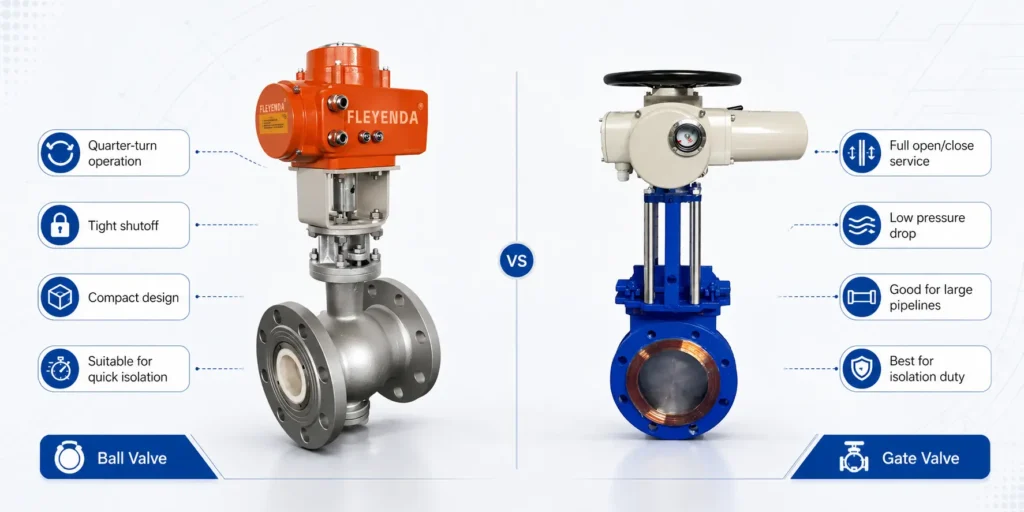
The most important difference in the gate valve vs ball valve comparison is the movement of the closing element. A gate valve uses vertical linear motion, while a ball valve uses 90-degree rotary motion. This difference affects operating speed, sealing performance, flow resistance, service life, and maintenance requirements.
| Comparison Item | Gate Valve | Ball Valve |
|---|---|---|
| Operating Principle | Linear movement of a gate disc | Quarter-turn rotation of a hollow ball |
| Operation Speed | Slower, requires multiple turns | Fast, usually opens or closes with a 90-degree turn |
| Primary Function | On/off isolation in large pipelines | Quick shutoff and reliable flow control |
| Sealing Performance | Good, but may wear over time | Excellent, especially with soft seats |
| Pressure Drop | Very low when fully open | Low for full port design; higher for reduced port design |
| Throttling Suitability | Not recommended | Limited throttling possible, but not always ideal |
| Maintenance | May require more maintenance in dirty or corrosive service | Generally low maintenance |
| Automation | Possible, but slower and more complex | Easy to automate with pneumatic or electric actuators |
Flow Performance and Pressure Drop
Flow performance is a major factor when choosing between a gate valve and a ball valve. A fully open gate valve provides an almost unobstructed flow path. This is especially valuable in large-diameter pipelines where pressure loss must be minimized. For water transmission lines, fire protection systems, and long-distance pipelines, the low pressure drop of a gate valve can be a clear advantage.
A full port ball valve also provides excellent flow capacity because the bore of the ball is approximately the same size as the pipe. In this case, the pressure drop is also very low. However, reduced port ball valves have a smaller flow opening, which can create higher resistance. Reduced port designs are often acceptable in utility lines, compact systems, or applications where cost and space are more important than maximum flow capacity.
Neither gate valves nor standard ball valves are typically the first choice for precise throttling. A gate valve can suffer from vibration and seat damage when used partially open. A ball valve can handle some degree of flow adjustment, but frequent throttling may damage soft seats or reduce control accuracy. For accurate flow regulation, globe valves, control valves, or characterized ball valves may be more suitable.
Sealing, Operation, and Reliability
In applications where tight shutoff is critical, the ball valve often has an advantage. The ball presses against the valve seats, creating a strong seal that can prevent leakage effectively. This makes ball valves a preferred choice for gas service, fuel systems, chemical lines, and other applications where leakage must be minimized.
Gate valves can also provide reliable shutoff, especially when properly selected and maintained. However, because the gate and seat surfaces may be affected by corrosion, deposits, or wear, sealing performance can decline over time. In systems with sediment, slurry, or dirty media, particles may become trapped in the seating area and prevent complete closure.
Operation speed is another important difference. A gate valve requires several turns of the handwheel to move from fully open to fully closed. This is acceptable in applications where the valve is operated infrequently. A ball valve, by contrast, can be opened or closed quickly with a quarter turn. This makes it ideal for emergency shutoff, frequent operation, and automated systems.
Typical Applications
Common Gate Valve Applications
Gate valves are commonly used in systems where the valve is either fully open or fully closed. They are especially common in large pipelines and infrastructure projects. Typical gate valve applications include municipal water supply, wastewater treatment plants, irrigation systems, power generation facilities, oil pipelines, fire protection networks, and industrial isolation lines.
A gate valve is often selected when full bore flow, low pressure drop, and long-term open service are required. In underground piping systems, non-rising stem gate valves are often used because they save vertical space. In high-pressure and high-temperature systems, steel gate valves with appropriate bonnet and seat designs may be used to meet demanding service requirements.
Common Ball Valve Applications
Ball valves are widely used in applications that require quick operation, tight sealing, and compact design. Common ball valve applications include natural gas pipelines, oil and fuel systems, chemical processing lines, compressed air systems, HVAC equipment, water treatment units, marine systems, food and beverage processing, and automated process control.
Because ball valves are easy to automate, they are frequently used with electric actuators, pneumatic actuators, and control accessories. A trunnion mounted ball valve is often selected for large size or high-pressure service, while a floating ball valve is commonly used for smaller pipelines and moderate pressure applications.
How to Choose Between Gate Valve and Ball Valve
The best valve choice depends on system requirements rather than a simple universal rule. When comparing gate valve vs ball valve options, engineers should evaluate the media type, pressure rating, temperature range, pipe size, flow requirements, operating frequency, sealing requirement, installation space, maintenance access, and automation needs.
Choose a gate valve when the system requires full open or full closed isolation, especially in large-diameter pipelines. A gate valve is a strong option when low pressure drop is important and the valve will not be operated frequently. It is also suitable for many water, steam, oil, and general industrial services, provided that the media does not contain excessive solids that could affect the seating surfaces.
Choose a ball valve when the system requires quick operation, tight shutoff, compact size, and easy automation. A ball valve is usually better for gas service, chemical lines, utility systems, and applications where the valve is operated regularly. For critical shutoff applications, a high-quality ball valve can deliver excellent sealing performance with relatively low maintenance.
Cost should also be considered. For small and medium sizes, ball valves are often cost-effective because of their compact structure and simple operation. For very large diameters, gate valves may be more economical depending on material, pressure class, and design standard. However, purchase price should not be the only factor. Long-term reliability, downtime risk, leakage risk, and maintenance cost are often more important than initial valve cost.
Conclusion
Both gate valve and ball valve designs play important roles in modern piping systems. A gate valve is best suited for full open or full closed isolation in large pipelines where low pressure drop is required. A ball valve is better for fast operation, tight sealing, compact installation, and automated control.
In simple terms, the gate valve is a strong choice for large-scale isolation service, while the ball valve is a practical choice for quick shutoff and reliable sealing. By understanding the differences between gate valve and ball valve performance, engineers, contractors, and purchasing teams can select the right valve for safer operation, better efficiency, and longer service life.