


Industrial Valve Automation Guide
What is Actuator Valve?
An actuator valve is an automated valve assembly that uses an actuator to open, close, or regulate the flow of liquids, gases, steam, oil, chemicals, and other process media. In industrial automation, the actuator valve is widely used to improve flow control accuracy, operational safety, process efficiency, and remote-control capability.
What Is an Actuator Valve?
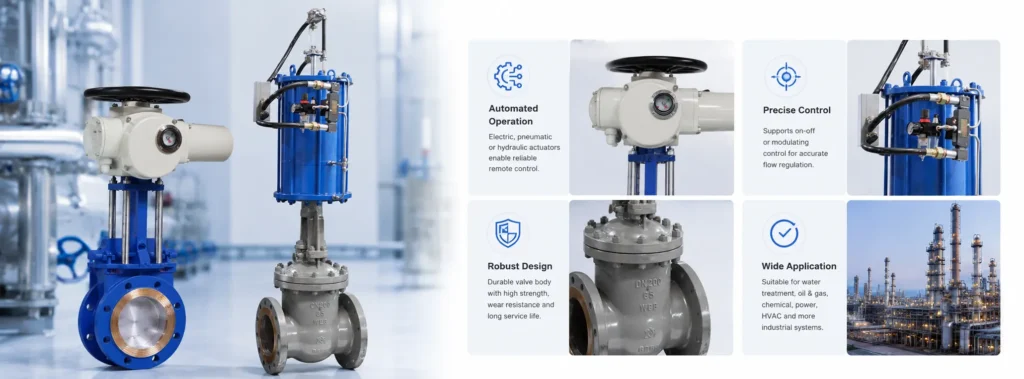
An actuator valve, also called an actuated valve, is a combination of a valve body and an actuator. The valve body controls the flow path, while the actuator provides the mechanical force required to move the valve element. Instead of relying on manual operation, an actuator valve receives energy and control signals to operate automatically.
The valve body may be a ball valve, butterfly valve, gate valve, globe valve, plug valve, or diaphragm valve. The actuator may be electric, pneumatic, or hydraulic. When these two parts are correctly matched, the actuator valve can perform on-off isolation, emergency shutdown, flow regulation, pressure control, or process automation.
In practical engineering, an actuator valve is not selected only by pipe size. Engineers must consider medium type, pressure class, temperature, flow rate, torque requirement, control mode, fail-safe position, installation environment, communication signal, and maintenance accessibility. A reliable actuator valve must be designed as a complete automation package.
How Does an Actuator Valve Work?
An actuator valve works by converting electric power, compressed air, or hydraulic pressure into mechanical motion. This motion drives the valve stem and changes the position of the internal closure element, such as a ball, disc, gate, plug, or globe plug. As the valve position changes, the flow is opened, closed, or adjusted.
The working process usually starts from a control command. A PLC, DCS, control panel, sensor, or remote operating system sends a signal to the actuator. The actuator then moves the valve to the required position. In a simple on-off actuator valve, the valve only moves between fully open and fully closed. In a modulating actuator valve, the actuator can stop at intermediate positions to control flow rate, pressure, temperature, or liquid level.
Many actuator valve assemblies include feedback devices. Limit switches confirm open and closed positions. Position transmitters provide real-time valve position. Valve positioners improve modulating accuracy. Solenoid valves control pneumatic air supply. Manual overrides allow local operation during power or air failure. These accessories make the actuator valve safer and more suitable for demanding industrial systems.
Main Components of an Actuator Valve
A complete actuator valve normally includes the valve body, actuator, mounting bracket, stem coupling, sealing components, control accessories, and feedback devices. Each component affects the safety, reliability, and performance of the actuator valve.
| Component | Function | Engineering Importance |
|---|---|---|
| Valve Body | Contains the flow passage and pressure boundary | Determines pressure class, material compatibility, leakage performance, and flow capacity |
| Actuator | Provides torque or thrust to operate the valve | Must be sized correctly according to valve torque, pressure drop, safety factor, and operating conditions |
| Stem and Coupling | Transfers motion from actuator to valve stem | Ensures accurate alignment and reliable mechanical operation |
| Seals and Packing | Prevent internal and external leakage | Must match temperature, medium, chemical compatibility, and shutoff requirement |
| Control Accessories | Receive signals, control movement, and provide feedback | Improve automation, diagnostics, safety, and remote monitoring |
Common Types of Actuator Valve
The most common actuator valve types are electric actuator valve, pneumatic actuator valve, and hydraulic actuator valve. Each type has different advantages depending on the power source, response speed, control accuracy, torque requirement, safety level, and installation environment.
| Actuator Valve Type | Power Source | Main Advantages | Typical Applications |
|---|---|---|---|
| Electric Actuator Valve | Electric power | Accurate positioning, easy wiring, digital control, suitable for remote automation | Water treatment, HVAC, power plants, irrigation, general industrial automation |
| Pneumatic Actuator Valve | Compressed air | Fast response, simple structure, reliable operation, suitable for many process plants | Chemical plants, refineries, food processing, pharmaceutical production, packaging lines |
| Hydraulic Actuator Valve | Hydraulic pressure | High torque, strong thrust, stable operation for large-size or high-pressure valves | Oil and gas pipelines, marine systems, hydropower stations, heavy-duty industrial systems |
Electric Actuator Valve
An electric actuator valve uses an electric motor and gearbox to drive the valve stem. It is commonly selected where stable power is available and precise position control is required. Electric actuator valves can support on-off control, modulating control, local operation, remote control, and intelligent communication.
Electric actuator valves are often equipped with torque switches, limit switches, manual handwheels, position indicators, heaters, and overload protection. For outdoor or harsh environments, the enclosure rating should be carefully selected, such as IP67, IP68, NEMA 4, or NEMA 4X depending on project requirements.
Pneumatic Actuator Valve
A pneumatic actuator valve uses compressed air to operate the valve. Pneumatic actuators are widely used because they are fast, durable, and simple to maintain. They are especially common in process industries where compressed air systems already exist.
Pneumatic actuator valves may be single-acting or double-acting. A single-acting actuator uses spring return to move the valve to a safe position when air pressure is lost. A double-acting actuator uses air pressure for both opening and closing. Pneumatic actuator valves often work with solenoid valves, air filter regulators, positioners, and limit switch boxes.
Hydraulic Actuator Valve
A hydraulic actuator valve uses pressurized hydraulic fluid to generate high force. It is suitable for large valves, high differential pressure, emergency shutdown systems, and heavy-duty applications. Compared with electric and pneumatic types, hydraulic actuator valves can provide very high torque in a compact design.
However, hydraulic actuator valves require hydraulic power units, fluid cleanliness management, pressure control, and leakage prevention. They are commonly used in oil and gas transmission, offshore platforms, marine systems, and high-pressure industrial pipelines.
Actuator Valve by Valve Body Design
The term actuator valve can refer to many valve body structures. Different valve bodies provide different flow characteristics, sealing performance, pressure capability, and control accuracy.
| Valve Body Type | Motion Type | Best Use | Key Feature |
|---|---|---|---|
| Ball Actuator Valve | Quarter-turn rotary | On-off isolation | Fast operation, tight shutoff, low pressure drop |
| Butterfly Actuator Valve | Quarter-turn rotary | Large pipe size flow control | Compact design, lightweight, cost-effective for large diameters |
| Gate Actuator Valve | Linear or multi-turn | Pipeline isolation | Low flow resistance when fully open |
| Globe Actuator Valve | Linear motion | Modulating control | Good throttling performance and accurate flow regulation |
| Plug Actuator Valve | Quarter-turn rotary | Chemical and severe service | Strong sealing and suitable for difficult media |
Important Engineering Parameters for Actuator Valve Selection
Selecting the right actuator valve requires a technical evaluation of both the valve and actuator. The following parameters are especially important in industrial projects.
1. Torque Sizing
Torque sizing is one of the most critical steps in actuator valve selection. The actuator must provide enough torque to open and close the valve under the highest expected differential pressure. Required torque may increase because of seat friction, media buildup, temperature changes, corrosion, long-term wear, and infrequent operation.
For safety, engineers normally apply a service factor or safety margin to the calculated valve torque. If the actuator is undersized, the actuator valve may fail to operate completely. If it is oversized, it may increase cost, weight, and mechanical stress.
2. Control Mode
An actuator valve can be designed for on-off control, modulating control, or emergency shutdown service. On-off control is used when the valve only needs to open or close. Modulating control is used when the valve must regulate process variables. Emergency shutdown actuator valves are designed to move to a predefined safe position quickly and reliably.
3. Fail-Safe Position
Fail-safe function is essential in many actuator valve applications. A fail-open actuator valve moves to the open position when power or air supply is lost. A fail-close actuator valve moves to the closed position. A fail-last actuator valve remains in its last position. The correct fail-safe position depends on process safety analysis and system design.
4. Cv Value and Flow Capacity
Cv value indicates the flow capacity of a valve. For a modulating actuator valve, Cv selection affects control accuracy and stability. If the valve is oversized, it may operate near the closed position and cause poor control. If the valve is undersized, it may not provide enough flow capacity. Correct Cv calculation helps ensure stable process performance.
5. Shutoff Class and Leakage Requirement
Different actuator valve applications require different leakage performance. Isolation valves may require tight shutoff, while control valves may follow a specified shutoff class. Seat material, valve design, pressure rating, and actuator closing force all affect shutoff performance.
Common Control Signals for Actuator Valve
Modern actuator valve systems can use different control signals depending on automation requirements. The signal type should match the plant control system and the required valve function.
| Control Signal | Application | Actuator Valve Function |
|---|---|---|
| Open / Close Signal | Basic isolation service | Moves the actuator valve fully open or fully closed |
| 4-20 mA | Industrial process control | Provides proportional modulating control |
| 0-10 V | Building automation and HVAC | Controls valve opening percentage based on voltage input |
| Digital Communication | Smart plant and remote monitoring | Supports diagnostics, position feedback, alarms, and network control |
| Pneumatic Signal | Traditional process control | Controls pneumatic actuator valve position through air pressure |
Materials Used in Actuator Valve Construction
Material selection has a direct impact on actuator valve life and safety. Common valve body materials include cast iron, ductile iron, carbon steel, stainless steel, bronze, brass, duplex stainless steel, and special alloys. For corrosive chemicals, stainless steel or alloy materials may be required. For water systems, ductile iron or carbon steel may be suitable depending on pressure and coating requirements.
Seal materials must also match the medium and temperature. EPDM is often used for water and some chemical services. NBR is suitable for oil and fuel applications. PTFE provides strong chemical resistance. Metal seats may be used for high temperature, abrasive media, or severe service. A professional actuator valve supplier should confirm compatibility between the medium, valve body, seat, seal, and stem materials.
Where Is an Actuator Valve Used?
An actuator valve is used in almost every industry that requires automated fluid control. In water treatment plants, actuator valves control intake, filtration, dosing, backwash, sludge handling, and distribution. In oil and gas systems, actuator valves are installed in pipelines, tank farms, compressor stations, metering skids, and emergency shutdown systems.
Chemical plants use actuator valves to control acids, alkalis, solvents, steam, and process fluids. HVAC systems use actuator valves for chilled water, hot water, steam, and air-handling control. Power plants use actuator valves for cooling water, feedwater, fuel gas, steam, and auxiliary systems. Food, beverage, and pharmaceutical facilities use actuator valves for hygienic processing, cleaning-in-place systems, filling lines, and batch control.
| Industry | Typical Actuator Valve Application | Common Requirement |
|---|---|---|
| Water Treatment | Filter control, backwash, chemical dosing, pump station isolation | Corrosion resistance, reliable operation, remote control |
| Oil and Gas | Pipeline isolation, emergency shutdown, tank farm control | High torque, fail-safe design, explosion-proof options |
| Chemical Processing | Acid, alkali, solvent, and steam control | Chemical compatibility, sealing performance, process safety |
| HVAC | Chilled water, hot water, and steam control | Modulating control, energy efficiency, building automation integration |
| Power Generation | Cooling water, feedwater, fuel, steam, and auxiliary systems | High reliability, temperature resistance, stable operation |
Benefits of Using an Actuator Valve
The main benefit of an actuator valve is automation. Automated valve operation reduces manual labor and improves response speed. Operators can control valves from a central control room, which is especially useful for large plants, hazardous areas, underground pipelines, elevated installations, and remote sites.
An actuator valve also improves safety. In emergency conditions, the valve can move to a predefined fail-safe position. In hazardous media applications, remote operation reduces human exposure. In high-pressure or high-temperature systems, automated operation helps avoid dangerous manual intervention.
Process consistency is another major advantage. A modulating actuator valve can maintain stable flow, pressure, temperature, or level based on control system commands. This improves product quality, energy efficiency, and process repeatability. For industries with strict quality and safety requirements, actuator valve reliability is essential.
Actuator Valve Installation and Maintenance
Correct installation is necessary for reliable actuator valve performance. The actuator and valve stem must be properly aligned. Mounting brackets and couplings should follow the correct standard, such as ISO 5211 for many quarter-turn actuator valve assemblies. The actuator should be protected from vibration, flooding, excessive heat, and corrosive environments.
Maintenance should include visual inspection, leakage checks, fastener tightening, signal testing, actuator travel testing, and feedback verification. For pneumatic actuator valves, clean and dry air is important. Air filter regulators should be inspected regularly. For electric actuator valves, technicians should check wiring, limit switches, torque settings, enclosure seals, and manual override operation. For hydraulic actuator valves, fluid cleanliness, pressure stability, hose condition, and leakage control are critical.
A good maintenance program records actuator valve cycle counts, opening and closing time, abnormal noise, vibration, torque trends, and position errors. These records help predict failures before they cause shutdowns.
Common Actuator Valve Problems
Common actuator valve problems include failure to open, failure to close, slow response, air leakage, incorrect feedback, unstable modulation, seal wear, stem corrosion, actuator overload, and control signal failure. Many problems are caused by poor sizing, incorrect material selection, dirty air supply, poor installation alignment, or lack of maintenance.
Troubleshooting should start with basic checks. Confirm the power supply or air supply. Verify control signals. Inspect the actuator mounting and coupling. Check whether the valve is mechanically stuck. Review pressure, temperature, and medium conditions. If the actuator valve is used in modulating service, check the positioner calibration and feedback signal.
FAQ About Actuator Valve
What is the purpose of an actuator valve?
The purpose of an actuator valve is to automate valve operation. It opens, closes, or regulates flow without manual operation, helping improve safety, control accuracy, and process efficiency.
Is an actuator valve the same as a control valve?
Not exactly. A control valve is designed for continuous process regulation, while an actuator valve may be used for on-off isolation, modulating control, or emergency shutdown. Many control valves are actuator valves, but not all actuator valves are control valves.
What is the difference between electric and pneumatic actuator valve?
An electric actuator valve uses electric power and is suitable for precise positioning and digital automation. A pneumatic actuator valve uses compressed air and is valued for fast response, simple structure, and reliable operation in process industries.
How do you choose the right actuator valve?
To choose the right actuator valve, evaluate medium, pressure, temperature, valve type, torque requirement, Cv value, control signal, fail-safe position, enclosure rating, material compatibility, and maintenance conditions.
Conclusion
An actuator valve is a key component in industrial automation and fluid control. By combining a valve body with an electric, pneumatic, or hydraulic actuator, it enables automatic, safe, and accurate control of liquids, gases, steam, oil, and chemicals.
A professional actuator valve selection should consider valve body type, actuator torque, control mode, fail-safe function, material compatibility, pressure class, temperature range, shutoff requirement, installation environment, and maintenance strategy. When correctly selected and maintained, an actuator valve can improve plant safety, reduce manual operation, enhance process stability, and deliver long-term value for industrial systems.