


What Is Pneumatic Ball Valve?
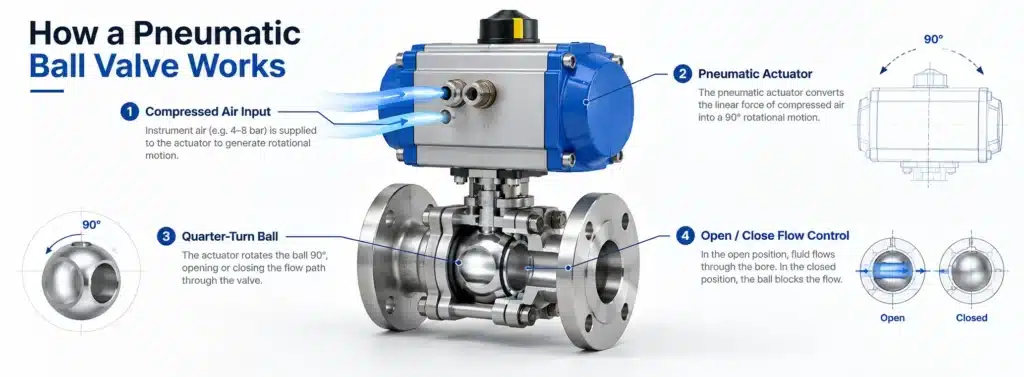
A pneumatic ball valve is a ball valve operated automatically by compressed air through a pneumatic actuator. Instead of using a manual lever, air pressure drives the actuator, rotates the valve stem, and turns the internal ball to open, close, or position the flow passage.
Pneumatic ball valves are widely used in industrial automation because they combine the reliable shut-off characteristics of a ball valve with fast pneumatic operation. They are commonly installed in water treatment systems, chemical plants, oil and gas facilities, pump skids, process equipment, and production lines.
A typical pneumatic ball valve includes the valve body, ball, stem, seats, pneumatic actuator, mounting bracket, and coupling. Additional control accessories such as a solenoid valve, filter regulator, limit switch, or positioner may be added depending on the automation requirements.
This guide explains how a pneumatic ball valve works, its main types, double-acting and spring-return actuators, control accessories, industrial applications, and the most important factors to consider before selecting one.
A pneumatic ball valve should be selected as a complete valve-and-actuator assembly. Valve torque, air pressure, process medium, seat material, control function, and failure position all affect reliable operation.
What Is a Pneumatic Ball Valve?
A pneumatic ball valve is an automated quarter-turn valve that uses compressed air to rotate a ball inside the valve body.
The ball contains a bore or flow passage. When the bore is aligned with the pipeline, fluid can pass through the valve. When the ball rotates approximately 90 degrees, the solid portion of the ball blocks the flow passage.
Pneumatic operation replaces the manual valve handle with an air-powered actuator. This allows the valve to be controlled remotely from a PLC, DCS, control panel, or another automation system.
Because the ball requires only quarter-turn movement, pneumatic ball valves can provide fast and repeatable operation compared with many multi-turn valve designs.
How Does a Pneumatic Ball Valve Work?
A pneumatic ball valve converts compressed-air pressure into rotary motion.
In a common rack-and-pinion actuator, compressed air pushes internal pistons. The piston movement rotates a pinion connected to the valve stem, which then turns the ball.
The valve normally moves between fully open and fully closed positions through approximately 90 degrees.
Typical Operating Sequence
- The PLC or control system sends an electrical command.
- A solenoid valve directs compressed air to the pneumatic actuator.
- Air pressure moves the internal actuator mechanism.
- The actuator rotates the ball valve stem.
- The pneumatic ball valve opens or closes.
- A limit switch can provide position feedback to the control system.
For proportional control, a pneumatic positioner can control intermediate actuator positions. A V-port ball valve is usually more suitable than a conventional round-port ball valve where accurate throttling is required.
Main Components of a Pneumatic Ball Valve
Ball Valve Body
The valve body contains the pressure and process medium. Stainless steel, carbon steel, plastic, and lined constructions may be selected according to the application.
Ball and Seats
The ball controls the flow passage while the valve seats create the sealing interface around the ball.
PTFE is widely used for soft-seated pneumatic ball valves, while reinforced polymers, PEEK, and metal seats may be selected for higher-temperature or more demanding applications.
Valve Stem
The stem transfers rotary movement from the pneumatic actuator to the internal ball.
Stem dimensions and allowable torque must be considered during actuator sizing.
Pnömatik Aktüatör
The pneumatic actuator converts compressed air into rotational torque.
Rack-and-pinion actuators are widely used for small and medium pneumatic ball valves, while scotch-yoke actuators can provide higher torque for larger and more demanding valves.
Mounting Bracket and Coupling
The mounting bracket and coupling connect the pneumatic actuator to the valve stem and maintain correct mechanical alignment.
ISO 5211 interfaces are commonly used for quarter-turn valve automation.
Double-Acting vs Spring-Return Pneumatic Ball Valve
Pneumatic ball valves are commonly available with either double-acting or spring-return actuators.
Double-Acting Pneumatic Ball Valve
A double-acting pneumatic actuator uses compressed air to move the valve in both directions.
Air is supplied to one side of the actuator to open the valve and to the opposite side to close it.
Double-acting pneumatic ball valves are commonly selected for general industrial automation where reliable compressed air is continuously available.
Spring-Return Pneumatic Ball Valve
A spring-return actuator uses compressed air for movement in one direction and internal spring force in the opposite direction.
When the relevant air pressure is removed, the spring drives the pneumatic ball valve toward a predefined position.
Depending on the valve and actuator arrangement, this can provide fail-close or fail-open operation.
| Factor | Double Acting | Spring Return |
|---|---|---|
| Opening | Compressed air | Compressed air or spring, depending on setup |
| Closing | Compressed air | Spring return available |
| Fail-Safe | Requires suitable pneumatic circuit | Defined return position available |
| Typical Use | General industrial automation | Safety-related shutdown applications |
Common Pneumatic Ball Valve Types
2-Way Pneumatic Ball Valve
A 2-way pneumatic ball valve has one inlet and one outlet and is mainly used for automatic pipeline isolation.
This is one of the most common pneumatic ball valve configurations for water, oil, gas, process liquids, and industrial utilities.
3-Way Pneumatic Ball Valve
A 3-way pneumatic ball valve is used for flow diversion, source selection, and automatic process routing.
L-port and T-port constructions provide different flow paths, so the required valve-position diagram should be confirmed before ordering.
V-Port Pneumatic Ball Valve
A V-port pneumatic ball valve uses a shaped ball opening that changes the available flow area progressively as the ball rotates.
This construction is more suitable for proportional flow control than a conventional full-port pneumatic ball valve.
High-Pressure Pneumatic Ball Valve
High-pressure pneumatic ball valves are designed for industrial systems where pressure and differential pressure place greater loads on the valve seats and actuator.
Correct torque sizing becomes especially important in these applications.
Plastic Pneumatic Ball Valve
UPVC, CPVC, PP, and PVDF pneumatic ball valves may be selected for water treatment and compatible corrosive chemical applications.
Chemical concentration, pressure, and temperature should always be checked against the selected body and sealing materials.
Pneumatic Ball Valve Control Accessories
Solenoid Valf
The solenoid valve receives an electrical command and directs compressed air into the pneumatic actuator.
Filter Regulator
A filter regulator helps remove contaminants from the air supply and maintains the required actuator pressure.
Limit Switch Box
A limit switch box provides valve-position feedback to the PLC or DCS.
Pneumatic Positioner
A pneumatic positioner is used when the valve needs to operate at controlled intermediate positions rather than only fully open or fully closed.
Positioners are commonly used with V-port pneumatic ball valves for modulating flow control.
Manual Override
A manual override can provide manual operation during commissioning, maintenance, or selected emergency conditions.
Where Are Pneumatic Ball Valves Used?
Su Arıtma
Pneumatic ball valves are used for process-water isolation, filtration sequencing, chemical dosing, and automated equipment switching.
Kimyasal İşleme
Pneumatic ball valves can automate chemical transfer and isolation when valve materials are compatible with the process medium.
Petrol ve Doğal Gaz
High-pressure and trunnion-mounted pneumatic ball valves can be used for demanding pipeline and process isolation duties.
Pump Systems
Pneumatic ball valves support pump isolation, bypass switching, and automated equipment-skid sequences where rapid operation is required.
Industrial Process Automation
Pneumatic ball valves integrate easily with PLC and DCS systems through solenoid valves, position switches, and pneumatic positioners.
How to Select a Pneumatic Ball Valve
Pneumatic ball valve selection should start with the process conditions rather than actuator size alone.
- Process medium and chemical concentration
- Valve size: DN / NPS
- Normal and maximum operating pressure
- Maximum differential pressure
- Minimum and maximum temperature
- 2-way, 3-way, or V-port configuration
- Threaded, flanged, union, or sanitary connection
- Valve body and seat materials
- Required valve torque
- Available compressed-air pressure
- Double-acting or spring-return actuator
- Required fail-open or fail-close position
- Solenoid valve requirements
- Limit switch and feedback requirements
- On/off or modulating operation
- Required control signal
- Project quantity and delivery requirements
Pneumatic actuator sizing should use the minimum reliable air pressure available at the actuator. Valve torque should be evaluated under the most demanding expected operating condition rather than normal conditions only.
Fleyenda Pneumatic Ball Valve Solutions
Fleyenda supplies pneumatic ball valve solutions for heavy-duty pipeline isolation and proportional process control. Different valve constructions and actuator configurations can be selected according to operating pressure, required torque, medium, flow function, and automation requirements.
FAW-Q
Trunnion Ball
AW Pneumatic
Heavy-Duty Isolation
FAW-Q · HEAVY-DUTY PNEUMATIC BALL VALVE
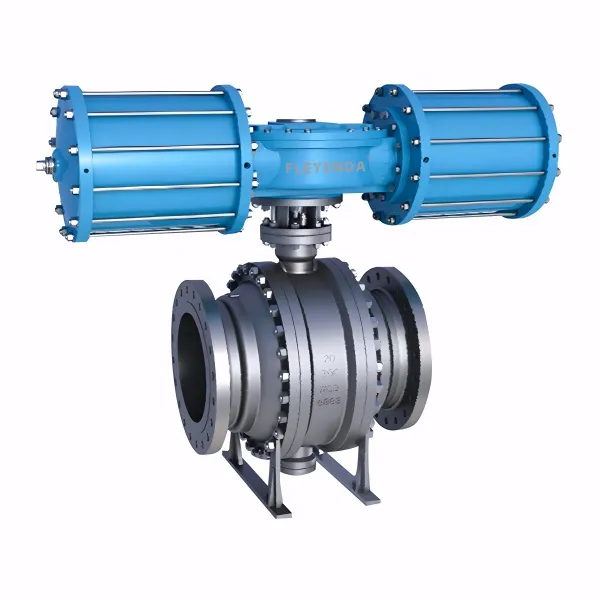
The FAW-Q is a heavy-duty pneumatic ball valve designed for large-diameter and high-pressure pipeline isolation.
Its trunnion-supported ball is mechanically supported rather than relying entirely on the valve seats to absorb process loading. This construction is suitable for demanding applications where differential pressure and valve size significantly increase required operating torque.
The valve is paired with an AW pneumatic actuator capable of producing the higher torque required for large quarter-turn valves.
Double-acting and spring-return arrangements can be selected according to the required automation and shutdown philosophy.
Typical applications:
oil and gas pipelines, pump stations, high-pressure process lines, industrial utilities, large-diameter isolation, and automated shutdown systems.
| Model | FAW-Q | Boyut Aralığı | DN50–DN600 / 2″–24″ |
| Pressure | Class 150–2500 / PN16–PN420 | Temperature | -29°C to +425°C |
| Gövde Malzemesi | Carbon Steel / Stainless Steel | Connection | Flanged |
| Aktüatör | AW Pneumatic Actuator | Function | Double Acting / Spring Return |

FAT-VQ-F
V-Port Ball
Modülasyon
Flow Regulation
FAT-VQ-F · PNEUMATIC CONTROL BALL VALVE
The FAT-VQ-F is a pneumatic ball valve developed for proportional flow control rather than simple open-close isolation.
Its V-shaped ball creates a more progressive relationship between valve position and available flow area, providing better controllability than a conventional round-port pneumatic ball valve.
When equipped with an appropriate pneumatic positioner, the actuator can move the ball to controlled intermediate positions according to the process-control signal.
This makes the FAT-VQ-F suitable for applications where the valve must regulate flow rather than only isolate the pipeline.
Typical applications:
industrial water regulation, chemical processing, process-liquid control, compatible pulp and slurry systems, and automated control loops.
| Model | FAT-VQ-F | Boyut Aralığı | DN15–DN200 / 1/2″–8″ |
| Pressure | PN16–PN40 / 150–600 PSI | Temperature | -20 °C ile +180 °C arası |
| Gövde Malzemesi | CF8 / CF8M Paslanmaz Çelik | Connection | ANSI / DIN / JIS Flanged |
| Aktüatör | Double Acting / Spring Return | Control | Positioner / 4–20 mA |
Common Pneumatic Ball Valve Problems
| Problem | Possible Cause | What to Check |
|---|---|---|
| Valve does not fully open | Low air pressure or insufficient actuator torque | Air pressure and actuator sizing |
| Slow valve operation | Restricted supply or exhaust flow | Solenoid valve, tubing, regulator and speed controls |
| Internal leakage | Seat wear or unsuitable material | Seat condition, ball surface and medium compatibility |
| No PLC feedback | Limit switch or wiring issue | Switch adjustment and electrical wiring |
| Incorrect fail position | Wrong actuator or pneumatic circuit configuration | Spring arrangement and actuator mounting |
Need a Pneumatic Ball Valve for Your Project?
Selecting the correct pneumatic ball valve requires matching the valve body, seats, actuator torque, and control accessories to the actual process conditions.
Fleyenda supports industrial applications including water treatment, chemical processing, oil and gas, pump systems, process utilities, and automated production equipment.
Send your valve size, medium, pressure, temperature, air pressure, actuator function, control requirements, and quantity for technical selection.
Pneumatic Ball Valve FAQs
What is a pneumatic ball valve?
A pneumatic ball valve is a quarter-turn ball valve operated by compressed air through a pneumatic actuator. It is commonly used for automatic pipeline isolation and flow control.
How does a pneumatic ball valve work?
Compressed air enters the actuator and creates rotary movement. The actuator turns the valve stem and ball approximately 90 degrees to open or close the flow passage.
What air pressure does a pneumatic ball valve require?
The required air pressure depends on actuator design and valve torque. Actuator sizing should use the minimum reliable compressed-air pressure available at the valve location.
What is the difference between double acting and spring return?
Double-acting actuators use compressed air in both directions. Spring-return actuators use compressed air in one direction and spring force for the return movement.
Can a pneumatic ball valve be fail closed?
Yes. A suitable spring-return actuator can be configured so the valve moves toward the closed position when the required air supply is removed.
Can a pneumatic ball valve control flow?
Yes. A V-port pneumatic ball valve combined with a suitable positioner is normally more appropriate for proportional flow regulation than a conventional round-port isolation valve.
Can a pneumatic ball valve connect to a PLC?
Yes. A solenoid valve can receive PLC commands, limit switches can provide position feedback, and a pneumatic positioner can be used for modulating control.
Where are pneumatic ball valves used?
Common applications include water treatment, chemical plants, oil and gas facilities, pump systems, process utilities, and automated industrial equipment.
How do I choose a pneumatic ball valve?
Specify the process medium, valve size, pressure, temperature, connection, materials, required torque, available air pressure, actuator type, fail position, and control accessories.
Conclusion: Understanding Pneumatic Ball Valves
A pneumatic ball valve combines the fast quarter-turn operation of a ball valve with the automation capability of a compressed-air actuator.
Pneumatic ball valves are widely used for industrial isolation, switching, and flow-control applications because they can provide rapid response, remote operation, and easy integration with PLC or DCS systems.
A 2-way pneumatic ball valve is suitable for many isolation applications, while a 3-way valve provides flow-routing functions and a V-port pneumatic ball valve is better suited to proportional regulation.
Reliable performance depends on correct selection of the valve body, seats, actuator torque, air pressure, actuator function, and automation accessories.
Treating the pneumatic ball valve as a complete engineered valve-and-actuator assembly is the most reliable approach for long-term industrial automation.