


Pneumatically Actuated Butterfly Valves: Working Principle, Types & Selection Guide
Pneumatically actuated butterfly valves combine a butterfly valve with a pneumatic actuator to provide fast, automatic flow isolation or regulation using compressed air. They are widely used in water treatment, chemical processing, HVAC, power generation, industrial equipment and process pipelines where reliable quarter-turn valve automation is required.
Although these valves appear relatively simple, correct selection involves more than choosing the nominal pipe size. Valve design, seat material, differential pressure, process temperature, required fail position, available air pressure, actuator torque and control accessories all influence the final valve package.
What Are Pneumatically Actuated Butterfly Valves?
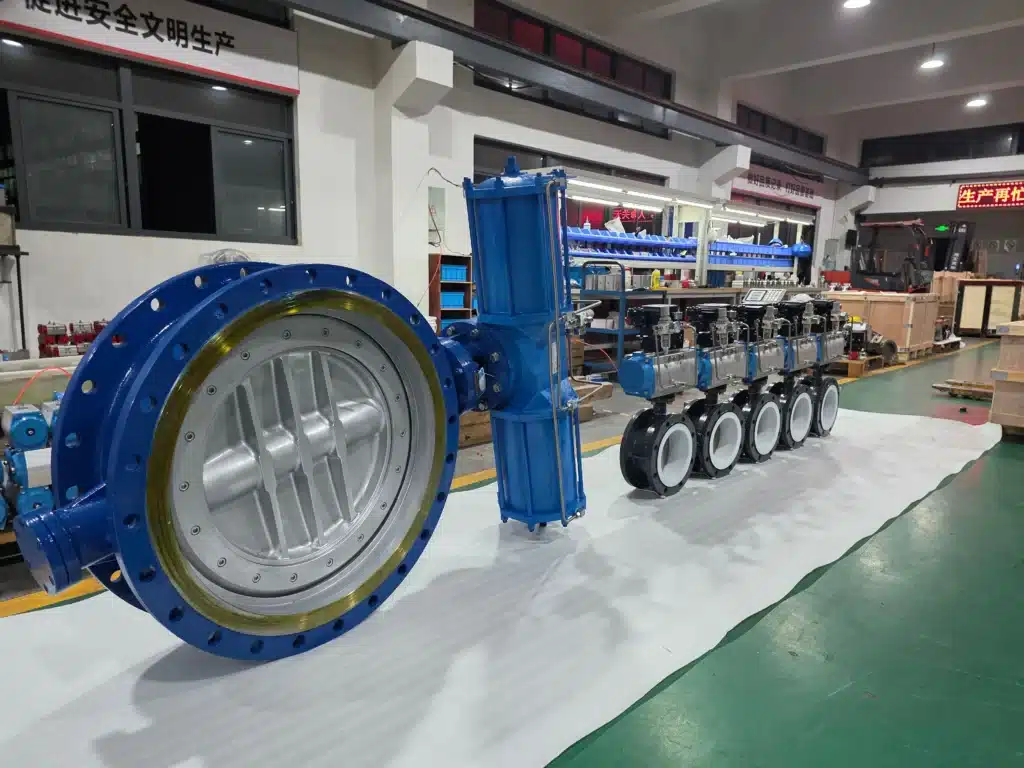
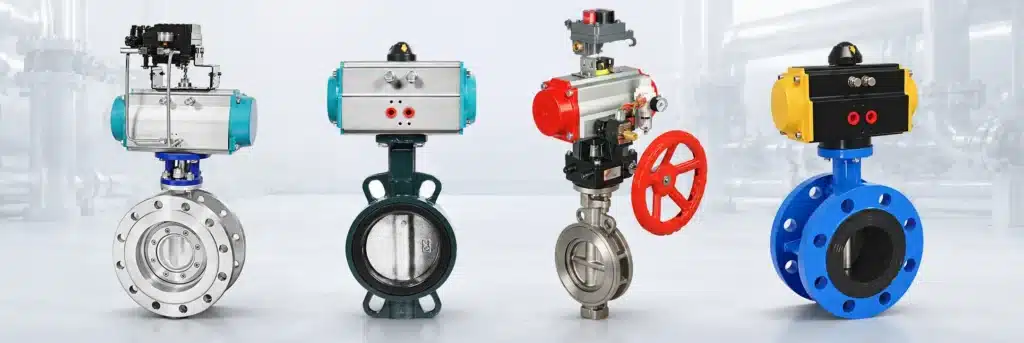
Pneumatically actuated butterfly valves are automated quarter-turn valves consisting of a butterfly valve body, internal disc, shaft and pneumatic rotary actuator. The valve controls the process fluid, while the actuator converts compressed-air pressure into rotational torque.
When the actuator rotates the valve shaft, the butterfly disc changes its angle inside the pipeline. In a typical isolation application, the disc moves approximately 90 degrees between fully closed and fully open positions.
Because butterfly valves require only quarter-turn movement, pneumatic actuation provides a compact and relatively fast automation solution compared with many multi-turn valve designs.
The same basic arrangement may also be described as a pneumatic butterfly valve, air actuated butterfly valve or butterfly valve with pneumatic actuator.
How Do Pneumatically Actuated Butterfly Valves Work?
The working principle begins when compressed air enters the pneumatic actuator. Internal pistons or another actuator mechanism convert this pressure into rotary motion, producing torque at the actuator output shaft.
The actuator is connected to the butterfly valve shaft through a direct mounting interface or mounting bracket and coupling. As the actuator turns, the valve disc rotates inside the body and changes the available flow area.
Control Command
A PLC, DCS, switch, solenoid valve or process controller sends an open, close or positioning command.
Compressed Air Enters the Actuator
Air is directed into the correct actuator chamber through a solenoid valve or pneumatic positioner.
Air Pressure Generates Torque
The actuator converts pneumatic pressure into rotational mechanical torque.
The Valve Shaft Rotates
The actuator output rotates the connected butterfly valve stem or shaft.
The Disc Changes Position
The internal butterfly disc moves toward the open, closed or intermediate control position.
The actual operating speed depends on actuator size, air pressure, tubing diameter, solenoid flow capacity, exhaust restriction and valve load. A pneumatic actuator should therefore be selected as part of the complete system rather than as an isolated component.
Single-Acting vs Double-Acting Pneumatically Actuated Butterfly Valves
One of the most important decisions when selecting pneumatically actuated butterfly valves is whether the application requires a double-acting actuator or a single-acting spring-return actuator.
Double-Acting Pneumatic Butterfly Valve
A double-acting pneumatic actuator uses compressed air to move the valve in both directions. Air pressure is supplied to one chamber to rotate the valve toward one position and to the opposite chamber to reverse the movement.
This design is commonly used for standard automated isolation when a defined spring-return failure position is not required.
Single-Acting Spring-Return Butterfly Valve
A single-acting actuator uses compressed air to move the valve in one direction and mechanical springs to return it when air pressure is removed.
Depending on actuator assembly and process requirements, the valve can be configured as fail-close or fail-open. A spring-return actuator should not automatically be assumed to fail closed.
| Feature | Double Acting | Spring Return |
|---|---|---|
| Actuation | Compressed air in both directions | Air in one direction, spring force in the other |
| Fail Position | Depends on system design | Can be configured fail-open or fail-close |
| Actuator Size | Often more compact for a given valve torque | May require a larger actuator because spring force affects available torque |
| Utilisation type | General automated isolation | Processes requiring a defined position after air failure |
Rack-and-Pinion vs Scotch Yoke Pneumatic Actuators
Rack-and-pinion and Scotch yoke mechanisms are both widely used to automate butterfly valves. The correct choice depends on required torque, actuator size, valve characteristics and operating conditions.
| Factor | Rack-and-Pinion | Scotch Yoke |
|---|---|---|
| Operating Principle | Linear piston movement drives racks that rotate a central pinion. | Linear piston movement acts through a yoke to produce angular rotation. |
| Torque Profile | Generally balanced across the stroke. | Can provide a torque profile suited to higher torque at selected travel positions. |
| Construction | Compact and widely used. | Often selected for larger or more demanding applications. |
| Applications courantes | General butterfly and ball valve automation. | Large valves and higher-torque applications. |
There is no universal valve diameter at which one actuator mechanism automatically becomes mandatory. The actuator should be selected by comparing its torque output with the actual valve torque requirement at the available air pressure.
Concentric, Double-Offset and Triple-Offset Butterfly Valves
The valve geometry has a major influence on torque, seat wear, sealing performance, pressure capability and temperature range.
Concentric Butterfly Valve
In a concentric butterfly valve, the shaft passes approximately through the center of the disc and valve body. The disc remains in contact with the resilient seat during much of its rotation.
This design is widely used with pneumatic actuators in water treatment, HVAC, compressed air and general industrial utility applications.
Double-Offset Butterfly Valve
A double-offset design moves the shaft away from the central sealing geometry. This reduces rubbing between the disc and seat as the valve opens and closes.
Double-offset butterfly valves are commonly considered where pressure, temperature or operating frequency exceeds the practical range of a basic concentric valve.
Triple-Offset Butterfly Valve
A triple-offset butterfly valve introduces additional sealing geometry to minimize sliding contact between the sealing surfaces.
Metal-seated triple-offset butterfly valves are often used for steam, high-temperature gas, hydrocarbons and severe industrial service.
However, the term triple offset alone should not be interpreted as a guarantee of zero leakage. Shutoff performance depends on the actual valve design, seat construction, test standard and specified leakage class.
EPDM, NBR, PTFE and Metal-Seated Butterfly Valves
Seat material is one of the most important factors when selecting pneumatically actuated butterfly valves because the seat directly affects media compatibility, operating temperature, sealing performance and valve torque.
| Matériau des sièges | Typical Advantage | Applications courantes | Important Consideration |
|---|---|---|---|
| EPDM | Good water and weather resistance | Water treatment, HVAC, cooling water | Not suitable for many petroleum oils and hydrocarbon services |
| NBR | Good resistance to many oils | Air, oil and selected industrial fluids | Temperature and chemical compatibility must be checked |
| PTFE | Excellente résistance aux produits chimiques | Acids, alkalis, solvents and corrosive liquids | Pressure and temperature limits depend on valve construction |
| Metal Seat | High-temperature and severe-service capability | Steam, hot gas, thermal oil and demanding process systems | Leakage class should be confirmed for the actual valve |
Seat selection should always be based on the exact medium, concentration, temperature and pressure rather than general assumptions about material compatibility.
How to Size Pneumatic Actuators for Butterfly Valves
Correct actuator sizing is essential for reliable pneumatically actuated butterfly valves. The actuator must provide enough torque to move and seat the valve under the most demanding expected operating condition.
Valve torque should be evaluated throughout the complete stroke rather than using nominal valve diameter as the only sizing parameter.
Breakaway Torque
The torque required to begin moving the valve from a stationary or seated position.
Running Torque
The torque required while the disc moves through the intermediate portion of the stroke.
Seating Torque
The torque required as the disc reaches the final closed sealing position.
Differential Pressure
Pressure acting across the disc can influence dynamic and seating torque.
Seat Friction
EPDM, PTFE and metal-seated butterfly valves can have very different torque characteristics.
Minimum Air Pressure
The actuator must be sized at the lowest reliable plant air pressure rather than only the nominal compressor pressure.
A fixed 20%, 30% or 40% torque safety factor should not automatically be applied to every application. Long periods without operation, deposits, sludge, temperature changes, process contamination and valve aging can all influence the appropriate engineering margin.
Air Pressure Requirements for Pneumatically Actuated Butterfly Valves
Pneumatic actuators require a stable supply of clean compressed air within the specified pressure range. Industrial systems commonly operate with several bar of air pressure, but the correct operating pressure depends on actuator design and required valve torque.
Actuator sizing should always be based on the minimum air pressure expected at the actuator during actual plant operation. Compressor discharge pressure alone does not represent the pressure available at every valve.
Pressure losses can occur because of long tubing runs, undersized tubing, restrictive fittings, small solenoid valves, clogged filters and simultaneous air demand elsewhere in the plant.
Air quality also matters. Water, oil and contamination inside the air supply can damage seals, solenoid valves and actuator components over time.
Solenoid Valves, Limit Switches, Positioners and Air Preparation
A complete pneumatic butterfly valve assembly often includes several automation accessories in addition to the valve and actuator.
| Accessory | Fonction | Typical Application |
|---|---|---|
| Électrovanne | Controls the direction of compressed air entering the actuator. | Automatic ON/OFF control |
| Limit Switch Box | Provides electrical feedback for open and closed positions. | PLC and remote monitoring |
| Filter Regulator | Filters compressed air and maintains controlled pressure. | Industrial pneumatic systems |
| Pneumatic Positioner | Positions the valve according to a pneumatic control signal. | Modulating flow control |
| Electro-Pneumatic Positioner | Converts an electrical control signal into pneumatic positioning. | 4–20 mA process control |
| Manual Override | Allows manual valve operation where required. | Maintenance and emergency operation |
ON/OFF vs Modulating Pneumatically Actuated Butterfly Valves
ON/OFF Pneumatic Butterfly Valve
ON/OFF operation is used when the process only requires the valve to be fully open or fully closed. A solenoid valve controls air supply to the actuator, while a limit switch box can provide position feedback to the plant control system.
Modulating Pneumatic Butterfly Valve
Modulating pneumatically actuated butterfly valves use a positioner to move and hold the disc at intermediate angles.
Electro-pneumatic positioners commonly receive a control signal such as 4–20 mA and adjust actuator pressure until the valve reaches the requested position.
Wafer, Lug and Flanged Pneumatic Butterfly Valves
| Connection | Design | Motif de sélection courant |
|---|---|---|
| Wafer | Valve is mounted between pipeline flanges. | Compact size, low weight and economical installation. |
| Lug | Valve body includes lugs around the perimeter. | Selected piping arrangements and maintenance requirements. |
| À bride | Valve body includes integral pipeline flanges. | Large pipelines and robust industrial service. |
Connection type should be selected together with pipeline flange standard, pressure class, face-to-face dimensions and maintenance requirements.
Applications of Pneumatically Actuated Butterfly Valves
Water & Wastewater Treatment
Pneumatic butterfly valves are widely used for raw water, filtration, treated water, backwash, sludge and wastewater isolation.
Chemical Processing
PTFE-seated and corrosion-resistant configurations can be used for compatible acids, alkalis, solvents and chemical solutions.
HVAC Systems
Automated butterfly valves are used in chilled-water, cooling-water and heating-water circulation systems.
Power & Energy
Suitable valve designs can be used for cooling water, utilities, steam-support systems and high-temperature process lines.
Food & Beverage
Appropriately designed sanitary or food-compatible butterfly valves can automate process and utility piping.
Industrial Equipment
OEM skids, filtration systems, dosing equipment and process machinery commonly use pneumatically actuated valves for automatic flow control.
Fleyenda Pneumatically Actuated Butterfly Valves
Fleyenda provides pneumatic butterfly valve configurations for water treatment, chemical processing, industrial utilities, corrosive media, high-temperature service and large-diameter pipeline automation.
Pneumatic Wafer PTFE Butterfly Valve
A compact pneumatically actuated butterfly valve with PTFE sealing for selected chemical, corrosive and clean-fluid applications.
- Wafer connection
- PTFE sealing
- Double-acting actuator option
- Spring-return actuator option
- ON/OFF or control accessories available
Pneumatic Stainless Steel Flanged PTFE Butterfly Valve
A stainless steel pneumatic butterfly valve for selected corrosive liquids and industrial chemical-processing applications.
- Stainless steel construction
- PTFE seat
- Flanged connection
- Double acting or spring return
- Position feedback options
Pneumatic Hard-Seated Butterfly Valve
Metal-seated pneumatic butterfly valve configurations are available for selected steam, gas, oil and elevated-temperature industrial pipelines.
- Hard-seat construction
- Industrial pressure options
- Wafer or flanged designs
- High-temperature applications
- Pneumatic automation accessories
AW Pneumatically Actuated Flanged Butterfly Valve
A heavy-duty pneumatic butterfly valve package designed for large valve sizes and higher actuator torque requirements.
- Large-diameter valve configurations
- AW pneumatic actuator
- Double acting or spring return
- Positioner options
- Limit switch and solenoid options
How to Select Pneumatically Actuated Butterfly Valves
Identify the Process Medium
Define whether the valve will handle water, air, chemicals, steam, oil, wastewater, slurry or another process fluid.
Confirm Valve Size
Specify DN or NPS according to the piping system and required flow capacity.
Determine Pressure
Confirm normal operating pressure, maximum pressure and maximum differential pressure.
Determine Temperature
Process temperature affects seat, seal, disc and body material selection.
Select Seat Material
Choose EPDM, NBR, PTFE or metal construction according to chemical and thermal compatibility.
Select Valve Connection
Confirm wafer, lug or flanged construction and the required flange standard.
Select Actuator Function
Choose double acting or spring return according to the required failure position.
Determine Required Torque
Use actual valve torque data together with differential pressure and minimum available air pressure.
Choose Control Mode
Specify simple ON/OFF operation or modulating control with a suitable positioner.
Select Accessories
Define requirements for solenoid valves, limit switches, filter regulators, positioners and manual overrides.
Common Problems with Pneumatically Actuated Butterfly Valves
Valve Does Not Open
Check actual actuator air pressure, solenoid operation, tubing restrictions, actuator torque and whether the valve is mechanically stuck.
Valve Moves Too Slowly
Check air-line diameter, filter condition, solenoid flow capacity, exhaust restriction and actuator size.
Valve Does Not Fully Close
Inspect travel adjustment, seat condition, deposits, disc alignment and available actuator torque.
Seat Deteriorates Quickly
Verify chemical compatibility, operating temperature and whether excessive disc-seat friction is present.
Position Feedback Is Incorrect
Inspect limit-switch adjustment, wiring and the mechanical connection between the actuator and feedback device.
Valve Cycles Inconsistently
Check air-pressure fluctuations, contamination, solenoid performance, positioner calibration and control-signal stability.
Frequently Asked Questions About Pneumatically Actuated Butterfly Valves
What are pneumatically actuated butterfly valves?
Pneumatically actuated butterfly valves are quarter-turn butterfly valves operated by pneumatic actuators that use compressed air to rotate the valve shaft and disc.
What is the difference between a pneumatic butterfly valve and an electric butterfly valve?
A pneumatic butterfly valve uses compressed air to create valve movement, while an electric butterfly valve uses an electric motor and gearbox. The better option depends on plant utilities, operating speed, control requirements and failure strategy.
How much air pressure does a pneumatic butterfly valve require?
The required air pressure depends on actuator size, valve torque and actuator design. The actuator should be sized using the minimum pressure expected at the installation point.
What is the difference between single-acting and double-acting pneumatic actuators?
A double-acting actuator uses compressed air for both opening and closing. A single-acting actuator uses compressed air in one direction and mechanical springs in the other.
Can pneumatically actuated butterfly valves control flow?
Yes. A suitable butterfly valve equipped with a pneumatic or electro-pneumatic positioner can operate at intermediate disc positions for modulating service.
Which butterfly valve seat is suitable for water?
EPDM is commonly selected for many water-treatment and HVAC applications, although actual water chemistry and temperature should always be checked.
Which butterfly valve seat is suitable for chemicals?
PTFE is commonly considered for many corrosive chemical services, but chemical concentration, temperature and valve materials must be checked for compatibility.
How do you size a pneumatic actuator for a butterfly valve?
Compare the valve’s breakaway, running and seating torque requirements with the actuator’s available torque at the minimum expected air pressure, then apply an engineering margin appropriate to the service conditions.
What happens when the air supply fails?
A spring-return actuator can move the valve toward a predefined fail-open or fail-close position. A standard double-acting actuator does not provide the same mechanical spring-return function.
Are pneumatically actuated butterfly valves suitable for large pipelines?
Yes. Butterfly valves are widely used in larger pipelines because their compact quarter-turn design can provide lower weight and installation space than many alternative valve types.
Select the Valve, Actuator and Accessories as One System
Pneumatically actuated butterfly valves provide an efficient solution for automated isolation and flow control across water treatment, chemical processing, HVAC, utilities and industrial equipment.
Reliable performance depends on matching the valve design, seat material, process pressure, differential pressure, actuator torque, minimum air pressure, failure position and control accessories to the actual operating conditions.
Rather than selecting an actuator only by valve diameter or applying a fixed torque multiplier, the complete valve and actuator package should be evaluated as one engineered system.
Fleyenda supplies pneumatically actuated butterfly valve solutions for general water service, corrosive media, high-temperature pipelines and large-diameter industrial automation.