


What Does a Check Valve Do?
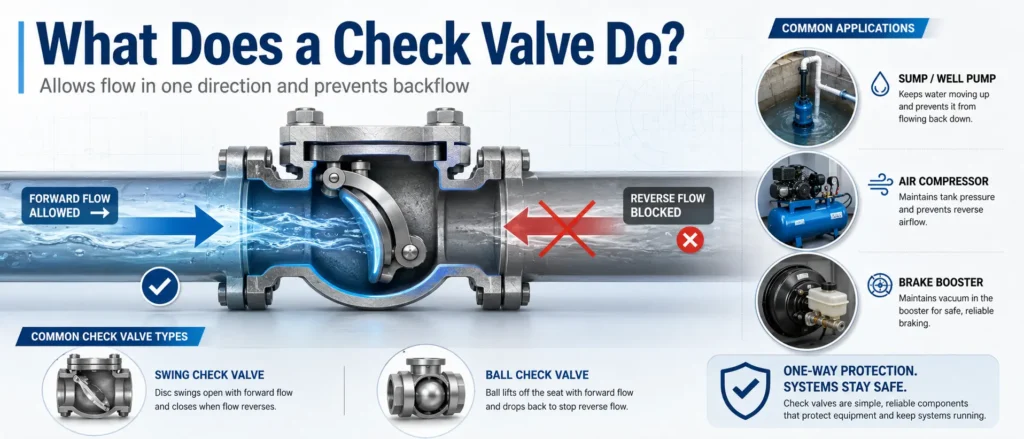
A check valve is a simple but essential flow-control device designed to allow fluid or gas to move in one direction while preventing reverse flow. In many systems, backflow can cause contamination, pressure loss, equipment damage, water hammer, pump failure, or unsafe operating conditions. That is why check valves are widely used in plumbing, water supply, wastewater systems, compressed air lines, automotive brake systems, industrial piping, and pump installations.
When people search for what is a check valve, they are usually trying to understand how such a small component can protect an entire system. The answer is that a check valve works automatically. It does not normally require a handle, actuator, or electrical signal. Instead, it responds to flow direction and pressure. When forward pressure is strong enough, the internal disc, ball, flap, or spring-loaded element opens. When flow stops or begins moving backward, the valve closes to block reverse flow.
What Is a Check Valve?
A check valve is also commonly called a one way check valve, check valve one way valve, or check non return valve. These names describe the same basic function: flow is permitted in one direction and stopped in the opposite direction. In other words, it is a non-return device that helps maintain system pressure and protects equipment from reverse movement of liquid or gas.
Unlike gate valves, ball valves, or butterfly valves that are usually opened and closed manually or automatically by an actuator, check valves operate based on differential pressure. This makes them especially useful in systems where backflow prevention must happen immediately and automatically. For example, a pump may push water upward through a pipe. Once the pump stops, gravity may try to pull the water back down. A check valve closes and keeps the water from flowing backward into the pump.
The basic components of a check valve usually include a body, seat, closure element, and sometimes a spring. The closure element may be a disc, flap, ball, piston, or diaphragm depending on the design. Although the structure is simple, correct selection is important because different check valves perform better under different flow rates, pressures, fluids, and installation positions.
How Does a Check Valve Work?
A check valve works by reacting to the pressure difference between the inlet and outlet. When inlet pressure is higher than outlet pressure, the valve opens and allows flow to pass through. When the pressure drops, stops, or reverses, the internal closing element returns to the seat and blocks backflow.
One important concept is cracking pressure. Cracking pressure is the minimum upstream pressure required to open the valve. Some check valves have very low cracking pressure and open easily, while others require more force because they use stronger springs or heavier internal parts. In applications such as an air compressor check valve, cracking pressure and sealing performance are critical because compressed air must not leak backward into the compressor pump or tank line.
Another important factor is closing speed. A valve that closes too slowly may allow reverse flow before sealing. A valve that closes too quickly may cause water hammer, which is a pressure shock inside the piping. For this reason, selecting the correct check valve type is not only about pipe size. It also depends on flow velocity, media characteristics, pressure, orientation, and system behavior.
Main Functions of Check Valves
The primary function of a check valve is backflow prevention, but its practical value is broader than that. In a water system, check valves can protect pumps, maintain prime, reduce pressure loss, and prevent contaminated water from returning to a clean supply. In an air system, they can keep compressed air stored in the correct section of the system. In automotive applications, they can help preserve vacuum for braking assistance.
A properly installed check valve can also improve system reliability. For example, a sump pump check valve prevents discharged water from draining back into the sump pit after the pump shuts off. Without it, the pump may cycle more often, waste energy, and wear out faster. Similarly, a well pump check valve helps hold water in the drop pipe and maintains pressure in the water supply system, reducing pump start frequency and helping protect the pump from unnecessary stress.
| Function | Why It Matters | Common Example |
|---|---|---|
| Prevent reverse flow | Stops fluid or gas from moving backward and damaging equipment | Check non return valve in a pump discharge line |
| Protect pumps | Reduces reverse rotation, water hammer, and repeated cycling | Sump pump check valve or well pump check valve |
| Maintain pressure | Keeps pressure from escaping backward through the system | Air compressor check valve |
| Improve safety | Helps prevent contamination or pressure-related failures | Double check valve in water protection systems |
| Support system efficiency | Reduces wasted energy and unnecessary equipment operation | One way check valve in plumbing and industrial piping |
Common Types of Check Valves
There are several types of check valves, and each design has advantages for specific operating conditions. The most suitable option depends on the media, pressure, installation direction, space limitations, and maintenance requirements.
Swing Check Valve
A swing check valve uses a hinged disc or flap that swings open when forward flow passes through and swings closed when the flow stops or reverses. This type is widely used in water and wastewater systems because it offers low resistance to flow. However, it usually requires enough space and proper orientation to operate effectively. Swing check valves are common in larger pipelines where full flow capacity is important.
Ball Check Valve
A ball check valve uses a ball as the closing element. When fluid flows forward, the ball moves away from the seat. When flow reverses, the ball returns to the seat and seals the passage. Ball check valves are often used in wastewater, slurry, small pump systems, and applications where simple construction and resistance to clogging are useful.
Double Check Valve
A double check valve contains two check mechanisms in one assembly. It provides an added level of backflow protection compared with a single valve. Double check valves are often used in water supply and backflow prevention applications where extra reliability is required. If one internal check mechanism fails or leaks slightly, the second one can still help prevent reverse flow.
Spring-Loaded Check Valve
A spring-loaded design uses a spring to push the disc or poppet closed. This allows the valve to close quickly and makes it suitable for horizontal, vertical, or compact installations, depending on the model. These valves are often used in industrial equipment, compressed air systems, and applications where fast closing is needed.
Check valve – the right design should always match the system’s pressure, flow, and media conditions. Choosing only by price or pipe diameter can lead to noise, vibration, leakage, premature wear, or poor backflow prevention.
Typical Applications of Check Valves
Check valves are found in many everyday and industrial systems. In residential plumbing, they help protect water lines, pumps, and appliances. In industrial systems, they protect expensive equipment and maintain process stability. In automotive systems, they can support safe braking performance.
Sump Pump Check Valve
A sump pump check valve is installed on the discharge pipe of a sump pump. Its job is to stop water from flowing back into the sump basin after the pump turns off. This prevents the pump from repeatedly handling the same water and helps extend pump life. It can also reduce noise and improve drainage efficiency.
Well Pump Check Valve
A well pump check valve is used in water well systems to keep water from draining back into the well when the pump stops. This helps maintain system pressure and reduces pump cycling. In some installations, multiple check valves may be used at different points, but spacing and placement should follow system design requirements to avoid pressure surges.
Air Compressor Check Valve
An air compressor check valve prevents compressed air stored in the tank from flowing back into the pump head or discharge tube. If this valve fails, the compressor may struggle to restart, leak air, or run inefficiently. A faulty compressor check valve can also create unusual hissing sounds or cause pressure loss after shutdown.
Brake Booster Check Valve
A brake booster check valve, sometimes searched as a booster brake check valve, is used in vehicles with vacuum-assisted braking systems. It helps hold vacuum inside the brake booster so braking assistance remains available when engine vacuum drops. If this valve fails, the brake pedal may feel hard, and braking effort may increase. Because braking is a safety-critical system, any suspected issue should be inspected promptly by a qualified technician.
Check Valve Symbol and Flow Direction
The check valve symbol is used in piping diagrams, hydraulic schematics, pneumatic drawings, and engineering plans to show where a check valve is installed and which direction flow is allowed. Although symbols can vary slightly by standard or industry, they usually indicate a one-way flow path and a blocking element that prevents reverse flow.
On the physical valve body, manufacturers usually mark the permitted flow direction with an arrow. This arrow is extremely important. Installing a check valve backward will prevent normal flow and can cause system malfunction. Before installation, the technician should confirm the arrow direction, pipe orientation, pressure rating, material compatibility, and accessibility for future inspection.
In engineering drawings, the check valve symbol also helps maintenance teams understand system logic. For example, a one way check valve in a pump discharge line shows that the pump can send fluid into the system, but system pressure should not return through the pump. In compressed air or hydraulic circuits, the symbol helps identify pressure retention and safety-control points.
How to Choose the Right Check Valve
Selecting the correct check valve requires more than matching pipe diameter. A good selection considers the type of fluid or gas, operating pressure, temperature, flow rate, installation position, pressure drop, cracking pressure, and required sealing performance. Material compatibility is also important. Brass, stainless steel, PVC, cast iron, bronze, and engineered plastics are common materials, but not every material is suitable for every fluid or environment.
For clean water systems, a swing check valve, spring check valve, or ball check valve may be appropriate depending on the layout. For wastewater or sump pump systems, clog resistance and easy service are important. For compressed air, tight sealing and pressure rating matter. For a brake booster check valve, automotive compatibility and safety standards are essential.
The installation orientation must also be considered. Some check valves work only in horizontal lines, while others can be installed vertically if flow direction is upward. A valve that depends heavily on gravity, such as some swing designs, may not perform correctly if installed in the wrong position. Spring-loaded check valves are often more flexible because the spring assists closure regardless of gravity.
Installation and Maintenance Tips
A check valve should be installed in the correct direction, in the correct location, and with enough straight pipe when recommended by the manufacturer. It should not be forced into misaligned piping because stress can distort the valve body or affect sealing. In pump systems, the valve should be placed where it can prevent backflow without creating excessive pressure spikes.
Regular inspection is important, especially in systems with dirty water, minerals, debris, or high cycling frequency. Common signs of check valve problems include reverse flow, pressure loss, pump short cycling, banging noises, vibration, leakage, reduced flow, or equipment restart difficulty. In a sump system, water returning to the pit after shutdown may indicate a failed sump pump check valve. In a compressor, air leaking backward may point to a faulty air compressor check valve.
Maintenance may involve cleaning debris from the seat, replacing worn seals, tightening connections, or replacing the entire valve. Some check valves are serviceable, while others are designed as replaceable components. For critical applications, preventive replacement may be more cost-effective than waiting for failure.
Conclusion
So, what does a check valve do? A check valve allows flow in one direction and prevents reverse flow. This simple function protects pumps, preserves pressure, improves efficiency, reduces contamination risk, and supports safe operation in many systems. Whether it is a sump pump check valve, well pump check valve, air compressor check valve, ball check valve, swing check valve, double check valve, or brake booster check valve, the purpose remains the same: keep flow moving the right way.
Understanding how check valves work makes it easier to choose the right valve for a specific application. The best valve is not always the largest or cheapest one. It is the one that matches the system’s flow direction, pressure, media, installation position, and safety requirements. When selected and installed correctly, a check valve provides reliable, automatic protection with minimal maintenance.