


Industrial Valve Guide
Ball Valve Types and Applications: A Practical Guide for Industrial Systems
A ball valve is one of the most widely used shut-off valves in modern industrial piping systems. Known for fast operation, reliable sealing, and long service life, ball valves are used across oil and gas, chemical processing, power generation, water treatment, district heating, marine, and many other industries. Choosing the right ball valve type is essential for safety, efficiency, and long-term system performance.
What Is a Ball Valve?
A ball valve is a quarter-turn valve that uses a spherical closure element to start, stop, or control the flow of liquid, gas, or steam. The ball has a hole, commonly called the bore or port, through its center. When the bore is aligned with the pipeline, media can flow through the valve. When the ball is rotated 90 degrees, the solid part of the ball blocks the flow path and provides shut-off.
The main reason industrial users choose a ball valve is its ability to provide tight sealing with simple operation. Compared with many other valve designs, ball valves usually require less operating torque, have a compact structure, and can perform well in high-pressure, high-temperature, and corrosive service conditions when properly selected.
Key Advantages of Ball Valves
Ball valves are popular because they combine mechanical simplicity with dependable sealing performance. For many applications, a ball valve can deliver bubble-tight shut-off, quick opening and closing, and minimal pressure drop, especially when a full-bore design is used.
Fast Quarter-Turn Operation
A ball valve can be fully opened or closed with a 90-degree turn, making it ideal for emergency shut-off, automated control, and systems requiring frequent operation.
Reliable Sealing
Soft-seated and metal-seated ball valves can provide excellent sealing performance depending on temperature, pressure, media type, and service conditions.
Low Flow Resistance
Full-port ball valves allow media to pass through with very little pressure loss, which is important for pipelines where flow efficiency matters.
Wide Industrial Compatibility
Ball valves can be manufactured in carbon steel, stainless steel, alloy steel, duplex steel, and other materials to handle water, gas, oil, chemicals, steam, and aggressive media.
Main Ball Valve Types
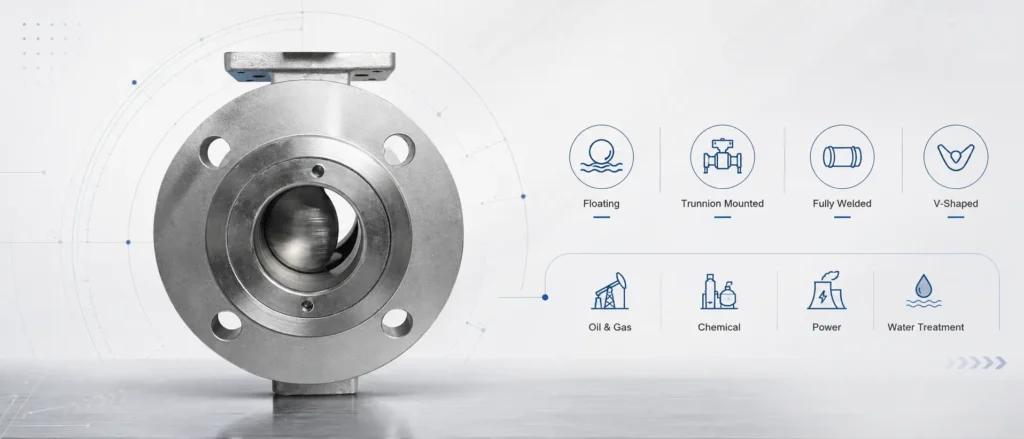
Although the operating principle is similar, not every ball valve is designed for the same service. The four major industrial types are floating ball valves, trunnion mounted ball valves, fully welded ball valves, and V-shaped ball valves. Understanding their design differences helps engineers, procurement teams, and plant operators select the right valve for each application.
1. Floating Ball Valve
A floating ball valve is one of the most common ball valve designs for low to medium pressure applications. In this structure, the ball is not fixed by a lower support. Instead, it is held in position by two valve seats. When pressure enters the valve, the ball moves slightly downstream and presses against the seat, creating a tight seal.
Floating ball valves are compact, cost-effective, and easy to maintain. They are commonly available in two-piece and three-piece body designs. A two-piece floating ball valve is suitable for general shut-off service, while a three-piece design allows easier maintenance because the center body can often be removed without disturbing the pipeline connection.
Typical Applications of Floating Ball Valves
Floating ball valves are widely used in water systems, compressed air lines, fuel gas systems, chemical processing, HVAC systems, and general industrial pipelines. They are also suitable for skid-mounted equipment, storage tank outlets, utility service, and smaller-diameter process lines.
However, floating ball valves are not always the best choice for very large sizes or extremely high-pressure systems. As pressure increases, the ball is pushed harder against the downstream seat, which can increase operating torque and seat wear. In these conditions, a trunnion mounted ball valve is usually preferred.
2. Trunnion Mounted Ball Valve
A trunnion mounted ball valve, also known as a fixed ball valve, is designed for larger sizes, higher pressures, and demanding industrial services. Unlike a floating ball valve, the ball in a trunnion design is mechanically supported by an upper stem and a lower trunnion. This fixed support prevents the ball from moving under pressure.
Because the ball is fixed, the seats move toward the ball to create sealing. This design significantly reduces operating torque and improves stability in high-pressure pipelines. Trunnion mounted ball valves are often equipped with advanced features such as double block and bleed, emergency sealant injection, anti-static devices, fire-safe design, and cavity pressure relief.
Typical Applications of Trunnion Mounted Ball Valves
Trunnion mounted ball valves are commonly used in oil and gas transmission pipelines, natural gas processing plants, refineries, petrochemical units, LNG facilities, power plants, and high-pressure water or steam service. They are especially suitable for large-diameter pipelines where safety, sealing performance, and operating torque are major concerns.
For pipeline isolation, the trunnion mounted ball valve is often selected because it can handle severe pressure conditions while maintaining reliable shut-off. In critical service, operators may require API, ASME, ISO, or project-specific compliance to ensure that the valve meets design, testing, fire safety, and leakage requirements.
3. Fully Welded Ball Valve
A fully welded ball valve is designed with a welded body structure instead of a bolted body. This construction eliminates potential external leakage paths through body joints, making it highly suitable for buried pipelines, long-distance transmission lines, district heating networks, and applications where maintenance access is limited.
The fully welded ball valve is often used when long service life, low maintenance, and excellent sealing integrity are required. Since the body is welded into a compact and strong pressure-containing shell, the valve can withstand external loads, pipeline stress, and underground installation conditions better than many conventional bolted-body valves.
Typical Applications of Fully Welded Ball Valves
Fully welded ball valves are widely used in natural gas pipelines, crude oil pipelines, city gas networks, underground utility systems, district heating, thermal power systems, and other infrastructure projects. Their leak-resistant body design makes them especially valuable in applications where environmental protection and operational safety are priorities.
In district heating systems, a fully welded ball valve can provide reliable isolation for hot water networks. In gas transmission, it helps reduce the risk of fugitive emissions from body joints. For buried service, extended stems, gear operators, and customized end connections can be supplied to match project requirements.
4. V-Shaped Ball Valve
A V-shaped ball valve, also called a V-port ball valve or V-notch ball valve, is designed for applications that require more accurate flow regulation than a standard on/off ball valve. Instead of a round bore, the ball has a V-shaped opening. As the valve rotates, the V-port creates a controlled flow area, allowing the valve to provide better throttling performance and more stable flow control.
The V-shaped ball valve combines the shut-off advantages of a conventional ball valve with the control capability of a regulating valve. This makes it suitable for processes where flow needs to be adjusted rather than simply opened or closed. The V-notch design can also create a shearing action between the ball and the seat, which helps handle media containing fibers, pulp, slurry, or suspended solids.
Typical Applications of V-Shaped Ball Valves
V-shaped ball valves are widely used in chemical processing, pulp and paper, wastewater treatment, food processing, power generation, mining, textile production, and industrial automation systems. They are often installed in pipelines where precise flow control, reliable shut-off, and resistance to clogging are required.
In pulp and paper plants, a V-port ball valve can help control pulp flow and media containing fibers. In wastewater treatment, it can regulate sludge, chemicals, and process water. In chemical plants, it is used for dosing, mixing, and flow adjustment where stable control is important. For automated systems, V-shaped ball valves are commonly combined with pneumatic or electric actuators and positioners to achieve accurate process control.
Compared with a standard floating ball valve, a V-shaped ball valve is better suited for throttling service. However, valve material, seat design, actuator selection, and control requirements should be carefully evaluated based on pressure, temperature, media characteristics, and required flow performance.
Ball Valve Applications Across Industrial Sectors
The versatility of the ball valve makes it a key component in many industrial systems. Different industries have different requirements for pressure class, temperature range, material compatibility, sealing type, operation mode, and certification. Below are some of the most common ball valve application areas.
Oil and Gas
In upstream, midstream, and downstream oil and gas operations, ball valves are used for pipeline isolation, wellhead service, gas gathering, compressor stations, metering stations, refineries, and storage facilities. Trunnion mounted ball valves and fully welded ball valves are frequently selected for high-pressure and long-distance transmission systems.
Chemical and Petrochemical Processing
Chemical plants require valves that can handle corrosive, toxic, flammable, or high-purity media. Stainless steel, duplex stainless steel, alloy, and lined ball valves may be used depending on the fluid. Seat material selection is especially important because chemical compatibility affects sealing performance and service life.
Power Generation
Power plants use ball valves in cooling water systems, fuel gas systems, auxiliary steam lines, feedwater treatment, and general utility service. In high-temperature or erosive applications, metal-seated ball valves may be chosen for better durability.
Water and Wastewater Treatment
Ball valves are used in water intake, filtration, chemical dosing, sludge treatment, desalination, and distribution systems. For water service, corrosion resistance, low maintenance, and easy operation are often more important than extreme pressure capability.
Marine and Shipbuilding
Marine applications require valves that can resist saltwater corrosion, vibration, and limited installation space. Ball valves are used in fuel systems, ballast systems, seawater cooling, bilge systems, and onboard utility lines.
District Heating and Utility Networks
Fully welded ball valves are widely used in district heating networks because they offer strong body integrity, good insulation compatibility, and long service life in buried or semi-buried pipelines.
Industrial Automation and Flow Control
In automated process systems, ball valves can be equipped with pneumatic, electric, or hydraulic actuators for remote operation. V-shaped ball valves are especially useful where accurate flow regulation is required, while standard ball valves are commonly used for fast isolation and safety shut-off.
How to Select the Right Ball Valve
Selecting the right ball valve requires more than choosing a size and pressure rating. Engineers should evaluate the complete operating environment, including fluid type, working pressure, temperature, flow rate, installation position, operation frequency, safety requirements, and maintenance expectations.
- Valve size and pressure class: Confirm pipeline size, pressure rating, and applicable standards.
- Body material: Choose carbon steel, stainless steel, alloy steel, or special materials based on corrosion and temperature.
- Seat material: Select PTFE, RPTFE, PEEK, metal seats, or other options according to media and temperature.
- Valve structure: Use floating ball valves for general service, trunnion mounted ball valves for high pressure or large size, fully welded ball valves for buried or low-maintenance service, and V-shaped ball valves for flow control or throttling applications.
- End connection: Choose flanged, welded, threaded, or socket-weld ends based on pipeline design.
- Operation method: Consider lever, gearbox, pneumatic actuator, electric actuator, or hydraulic actuator.
- Compliance requirements: Check whether the project requires fire-safe design, anti-static design, fugitive emission control, NACE compliance, or specific inspection documents.
Ball Valve Maintenance and Service Life
A properly selected ball valve can provide many years of reliable operation, but maintenance practices still matter. Regular inspection should include checking external leakage, stem sealing, actuator function, operating torque, and seat performance. For automated valves, limit switches, solenoid valves, air supply, and control signals should also be tested periodically.
In critical applications, preventive maintenance is better than reactive repair. Operators should keep records of valve operation cycles, service conditions, inspection results, and any leakage or torque changes. This information helps identify wear patterns and supports better valve selection for future projects.
Conclusion
The ball valve is a reliable and versatile valve solution for industrial flow control and isolation. Floating ball valves are practical and economical for general low to medium pressure service. Trunnion mounted ball valves provide stronger performance for high-pressure, large-diameter, and critical pipeline applications. Fully welded ball valves offer excellent body integrity for buried pipelines, gas transmission, district heating, and low-maintenance infrastructure systems. V-shaped ball valves are ideal when accurate flow regulation and throttling performance are required.
By understanding the differences between these ball valve types and matching them with the correct industrial application, engineers and buyers can improve system safety, reduce downtime, and achieve long-term operating value. Whether the project involves oil and gas, chemical processing, power generation, water treatment, marine service, district heating, or automated flow control, choosing the right ball valve is a key step toward reliable flow management.