


Valve Selection Guide
Ball Valve vs Gate Valve: Key Differences, Applications, and Selection Guide
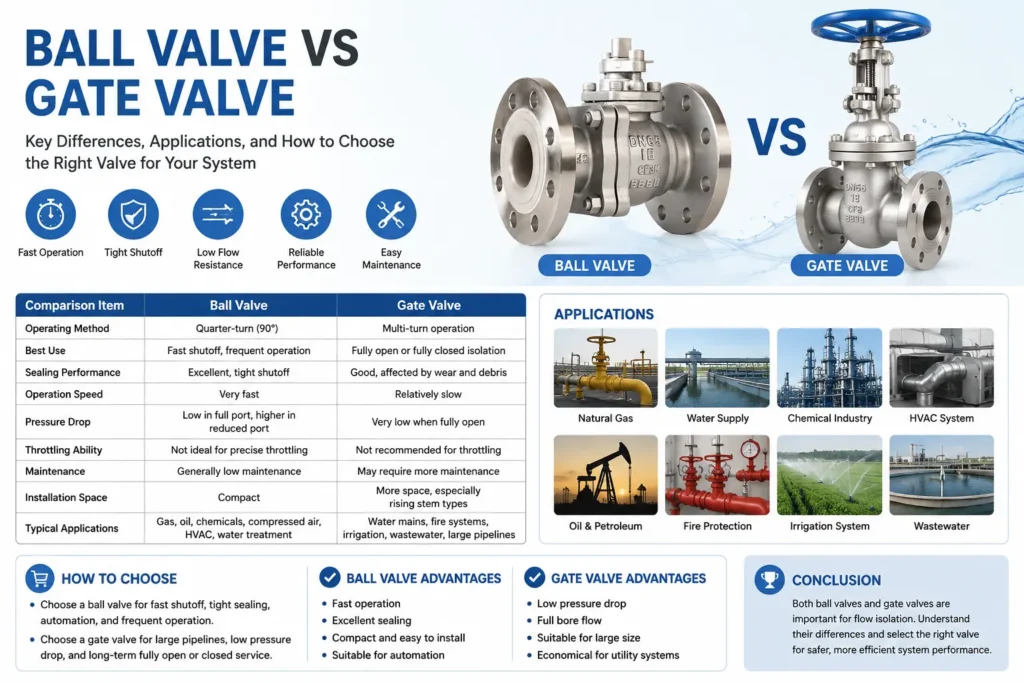
When comparing a ball valve vs gate valve, the right choice depends on how the valve will be used in the piping system. Both valves are mainly designed for on/off isolation, but they work in different ways and perform differently under pressure, temperature, flow, and maintenance conditions. A ball valve is known for fast quarter-turn operation and tight shutoff, while a gate valve is valued for low pressure drop and full-flow service in large pipelines. This guide explains the working principles, advantages, disadvantages, comparison points, and typical applications of ball valves and gate valves so you can choose the most suitable valve for your project.
What Is a Ball Valve?
A ball valve is a quarter-turn valve that uses a hollow rotating ball to control the flow of liquid or gas. When the hole in the ball is aligned with the pipe, the valve is open. When the ball is rotated 90 degrees, the solid side of the ball blocks the flow and the valve is closed. This simple structure makes ball valves fast, reliable, and easy to operate.
Ball valves are widely used in water, oil, gas, compressed air, chemical, HVAC, and industrial process systems. They are especially suitable for applications that require quick shutoff, frequent operation, and strong sealing performance. Common ball valve types include floating ball valves, trunnion mounted ball valves, full port ball valves, reduced port ball valves, three-way ball valves, and actuated ball valves.
One major advantage of a ball valve is its excellent sealing ability. Many ball valves use soft seats such as PTFE, RPTFE, or other engineered materials to create a tight seal around the ball. This makes them a preferred choice for gas lines, fuel systems, chemical pipelines, and other applications where leakage control is important.
What Is a Gate Valve?
A gate valve is a linear-motion valve that uses a gate or wedge to start and stop flow. The gate moves up and down inside the valve body when the handwheel or actuator is operated. When the gate is fully raised, the valve is open and media can flow through the pipeline. When the gate is fully lowered, the valve is closed and the flow is blocked.
Gate valves are mainly used for fully open or fully closed service. They are not recommended for throttling because a partially open gate can cause vibration, turbulence, erosion, and seat damage. For this reason, gate valves are usually selected as isolation valves instead of flow control valves.
Gate valves are common in municipal water supply, wastewater treatment, irrigation, fire protection, oil pipelines, shipbuilding, power plants, and large industrial piping systems. When fully open, the gate is lifted out of the flow path, which creates very low flow resistance and helps maintain system efficiency.
Ball Valve vs Gate Valve: Quick Comparison Table
| Comparison Item | Ball Valve | Gate Valve |
|---|---|---|
| Operating Method | Quarter-turn operation, usually 90 degrees | Multi-turn handwheel or linear actuator operation |
| Internal Design | Uses a rotating ball with a bore through the center | Uses a gate or wedge that moves up and down |
| Best Function | Fast on/off shutoff | Full open or full closed isolation |
| Sealing Performance | Excellent sealing, suitable for tight shutoff | Good sealing, but more affected by debris and wear |
| Operation Speed | Very fast | Relatively slow |
| Pressure Drop | Low in full port designs, higher in reduced port designs | Very low when fully open |
| Throttling Use | Not ideal for precise throttling | Not recommended for throttling |
| Maintenance | Generally low maintenance | May need more maintenance in dirty or sediment-heavy systems |
| Installation Space | Compact and easy to install | May require more vertical space, especially rising stem types |
| Typical Applications | Gas, oil, chemicals, compressed air, HVAC, water treatment | Water mains, fire systems, irrigation, wastewater, large pipelines |
Main Difference 1: Operation Speed
The most obvious difference between a ball valve and a gate valve is operation speed. A ball valve opens or closes with a simple 90-degree turn. This allows operators to shut off flow quickly in emergency situations or during routine maintenance. The handle position also clearly shows whether the valve is open or closed.
A gate valve requires multiple turns to move the gate from fully open to fully closed. This slower operation is acceptable in many water and utility systems, especially when the valve is not operated frequently. However, it is less convenient in applications that require quick isolation, rapid response, or frequent valve cycling.
Main Difference 2: Shutoff and Leakage Control
Ball valves usually provide better shutoff performance than gate valves. The ball and seat design allows the valve to seal tightly with minimal leakage. This is one reason ball valves are widely used in natural gas lines, fuel systems, chemical processing equipment, and compressed air systems.
Gate valves can also provide reliable isolation, but their sealing performance depends on the condition of the gate, seats, stem, and internal sealing surfaces. If scale, sand, rust, or other debris collects near the seat area, the gate may not close completely. Over time, wear and corrosion can also reduce the sealing performance of a gate valve.
Main Difference 3: Flow Resistance and Pressure Drop
Gate valves are often selected for applications where low pressure drop is important. When fully open, the gate moves out of the flow path, allowing media to pass through with minimal obstruction. This makes gate valves suitable for large-diameter pipelines, water distribution systems, and long-distance transmission lines.
Ball valves can also provide low pressure drop, especially full port ball valves. A full port ball valve has a bore size close to the pipe diameter, allowing smooth flow through the valve. However, reduced port ball valves have a smaller flow opening and may create more resistance. Therefore, when comparing pressure drop, the specific valve design must be considered.
Main Difference 4: Throttling Ability
Neither a standard ball valve nor a gate valve is ideal for precise throttling. A standard ball valve can technically be left partially open, but this may create turbulence, noise, seat wear, and unstable flow. For accurate control, a control valve, globe valve, or specially designed characterized ball valve is usually a better option.
A gate valve should not be used for throttling. When the gate is partially open, fluid can strike the gate surface and cause vibration, erosion, and damage to the seating area. Gate valves perform best when they are either fully open or fully closed.
Main Difference 5: Maintenance and Service Life
Ball valves are generally low-maintenance when used with clean and compatible media. Their simple quarter-turn design reduces operating complexity. However, the soft seats inside a ball valve may be damaged by abrasive particles, high temperature, or chemically incompatible media. Proper material selection is important for long service life.
Gate valves are durable and suitable for many heavy-duty systems, but they can be more sensitive to sediment and corrosion. Deposits may collect in the lower part of the valve body and prevent the gate from closing fully. Packing leakage, stem corrosion, and difficult handwheel operation are also common issues in older gate valves.
Advantages of Ball Valves
- Fast quarter-turn operation for quick opening and closing.
- Excellent shutoff performance for gas and liquid systems.
- Compact structure that saves installation space.
- Easy visual indication of open or closed position.
- Suitable for frequent operation and automation.
- Available in many materials, pressure ratings, and connection types.
Disadvantages of Ball Valves
- Not ideal for precise throttling or continuous flow regulation.
- Soft seats may be affected by high temperature or abrasive media.
- Large-size or high-pressure ball valves can be more expensive.
- Improper material selection may cause seat damage, corrosion, or leakage.
Advantages of Gate Valves
- Very low pressure drop when fully open.
- Suitable for large-diameter pipelines.
- Good for long-term fully open or fully closed isolation service.
- Available in a wide range of sizes and pressure classes.
- Often economical for large water, utility, and pipeline systems.
- Full-bore flow path helps maintain system efficiency.
Disadvantages of Gate Valves
- Slow operation compared with ball valves.
- Not suitable for throttling service.
- Debris or sediment may prevent complete closure.
- May require more installation space than ball valves.
- Sealing surfaces can wear over time.
- Less convenient for frequent operation.
Application Comparison
| Application | Recommended Valve | Reason |
|---|---|---|
| Natural gas line | Ball valve | Fast shutoff and tight sealing are important for safety. |
| Compressed air system | Ball valve | Quick isolation and low leakage are preferred. |
| Chemical processing line | Ball valve | Good sealing and multiple material options support chemical service. |
| Municipal water main | Gate valve | Low pressure drop and full-bore flow are useful for large pipelines. |
| Fire protection system | Gate valve | Commonly used for normally open or normally closed isolation. |
| Irrigation system | Gate valve | Suitable for large flow and low resistance service. |
| Machine isolation | Ball valve | Quarter-turn operation is faster and easier for operators. |
| Large oil pipeline | Gate valve or ball valve | The final choice depends on pressure, size, automation, sealing class, and cost. |
How to Choose Between a Ball Valve and a Gate Valve
Choose a ball valve if your system requires fast shutoff, tight sealing, compact installation, frequent operation, or automation. Ball valves are usually better for gas, fuel, compressed air, chemical, HVAC, and process systems where reliable shutoff is critical.
Choose a gate valve if your system requires low pressure drop, full-bore flow, large pipeline isolation, and infrequent operation. Gate valves are commonly used in water mains, irrigation lines, wastewater systems, fire protection networks, and other utility pipelines where the valve normally stays fully open or fully closed.
Before making a final decision, consider the media type, working pressure, operating temperature, valve size, connection type, material compatibility, installation space, maintenance access, and total cost of ownership. A valve with a lower purchase price may not be the best choice if it creates leakage, downtime, higher maintenance cost, or poor system performance.
Which Valve Is Better?
There is no universal winner in the ball valve vs gate valve comparison. A ball valve is better when the system needs fast operation, tight shutoff, low maintenance, and frequent use. A gate valve is better when the system needs full-flow isolation, low pressure drop, and economical performance in large pipelines.
For most small and medium-sized industrial systems, ball valves are often preferred because they are compact, easy to operate, and highly reliable for shutoff service. For large water distribution systems and long-distance pipelines, gate valves remain a practical and widely used solution.
FAQ About Ball Valve vs Gate Valve
Can a ball valve replace a gate valve?
In many small and medium-sized systems, a ball valve can replace a gate valve if the pressure, temperature, size, material, and connection requirements are suitable. However, in large pipelines where low pressure drop and cost are major concerns, a gate valve may still be the better choice.
Can a gate valve be used for throttling?
A gate valve is not recommended for throttling. It should be used only in fully open or fully closed positions. Partial opening can cause vibration, erosion, seat wear, and unstable flow.
Is a ball valve good for water?
Yes, ball valves are widely used for water systems. Brass, stainless steel, PVC, and carbon steel ball valves are common choices depending on the pressure, temperature, and water quality.
Which valve has better sealing?
In general, a ball valve provides better sealing than a gate valve, especially in gas and chemical applications. The soft seat design of many ball valves helps achieve tight shutoff.
Conclusion
Ball valves and gate valves are both important isolation valves, but they are designed for different working conditions. A ball valve uses a rotating ball to provide fast quarter-turn operation and excellent shutoff. A gate valve uses a gate or wedge to provide low pressure drop and full-flow isolation.
When choosing between a ball valve and a gate valve, focus on the actual system requirements. For quick operation, tight sealing, automation, and frequent use, choose a ball valve. For large pipelines, low pressure drop, and long-term open or closed service, choose a gate valve. Understanding these differences will help you select the right valve for safer, more efficient, and more reliable piping system performance.