


Understanding Stainless Steel Valves
Stainless steel valves are widely used in industrial piping systems where corrosion resistance, cleanliness, durability, and long-term reliability are important. However, whether stainless steel valves are “better” depends on the working medium, pressure, temperature, installation environment, budget, and performance requirements. In many demanding applications, stainless steel valves offer clear advantages over cast iron, ductile iron, carbon steel, brass, and bronze valves. In other cases, a different material may be more economical and fully suitable for the system.
A stainless steel valve is a valve manufactured with stainless steel as the main pressure-containing material. Common valve types include stainless steel ball valves, gate valves, butterfly valves, globe valves, check valves, plug valves, needle valves, and control valves. These valves are used to start, stop, regulate, or prevent reverse flow in pipelines carrying water, steam, oil, gas, chemicals, food-grade fluids, pharmaceuticals, seawater, and other industrial media.
Stainless steel is selected mainly because of its corrosion resistance and mechanical strength. Unlike ordinary carbon steel, stainless steel contains chromium, which forms a passive oxide layer on the surface. This protective layer helps resist rust and chemical attack under suitable conditions. Depending on the alloy grade, stainless steel valves can also provide excellent resistance to oxidation, high temperature, low temperature, and aggressive process media.
In valve manufacturing, stainless steel is not a single material. Different grades have different properties. The most commonly used stainless steels for valves include 304, 304L, 316, 316L, duplex stainless steel, and special alloy stainless steels. Choosing the right grade is just as important as choosing stainless steel itself.
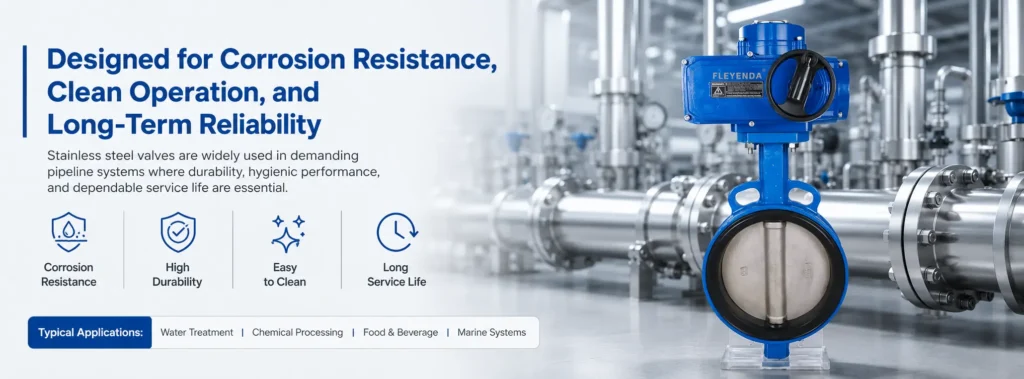
Why Stainless Steel Valves Are Often Preferred
Stainless steel valves are often preferred in systems where failure could lead to contamination, leakage, safety risks, or high maintenance costs. Their main advantage is not simply that they look cleaner or more premium. The real value lies in their ability to maintain performance in corrosive, hygienic, high-pressure, or high-temperature environments.
For example, in chemical processing plants, a valve may be exposed to acids, alkalis, solvents, chlorides, or mixed process fluids. In food and beverage systems, the valve must resist corrosion while maintaining sanitary conditions. In marine environments, valves may be exposed to moisture, salt spray, or seawater. In these applications, stainless steel valves can provide longer service life and lower risk of premature failure compared with lower-cost materials.
Stainless steel valves are also suitable for applications where cleanliness is critical. The smooth surface of stainless steel helps reduce contamination and makes cleaning easier. This is why stainless steel valves are commonly used in food processing, beverage production, pharmaceutical manufacturing, biotechnology, clean steam systems, and water purification systems.
Main Advantages of Stainless Steel Valves
Excellent Corrosion Resistance
Corrosion resistance is the most important advantage of stainless steel valves. In humid environments, corrosive industrial atmospheres, chemical systems, and clean water applications, stainless steel can resist rust better than carbon steel or cast iron. This helps extend valve service life and reduces the risk of leakage caused by material degradation.
Grade 304 stainless steel is suitable for many general-purpose applications, including clean water, air, mild chemicals, and food-grade systems. Grade 316 stainless steel contains molybdenum, which improves resistance to chloride corrosion. For marine service, seawater exposure, coastal installations, and many chemical applications, 316 or 316L stainless steel is often a better choice.
High Strength and Durability
Stainless steel valves offer good mechanical strength and impact resistance. They can withstand demanding working conditions, including pressure fluctuations, vibration, thermal cycling, and harsh operating environments. Compared with cast iron valves, stainless steel valves are less brittle and more suitable for applications where mechanical stress or temperature variation may occur.
In high-pressure systems, stainless steel ball valves, gate valves, and globe valves are commonly selected because they provide both strength and corrosion resistance. When properly designed, manufactured, and installed, stainless steel valves can deliver stable performance over a long service period.
Good High-Temperature and Low-Temperature Performance
Stainless steel valves can perform well across a wide temperature range. They are used in steam systems, hot water pipelines, thermal oil systems, cryogenic service, and process lines with changing temperatures. The actual temperature limit depends on the stainless steel grade, valve design, pressure rating, seat material, gasket material, and packing material.
For high-temperature service, metal-seated stainless steel valves or valves with suitable high-temperature sealing materials may be required. For low-temperature or cryogenic service, special design features may be necessary to ensure safe operation and prevent material embrittlement or sealing failure.
Hygienic and Easy to Clean
Stainless steel valves are widely used in industries that require hygienic processing. Their smooth surfaces are easier to clean and less likely to retain contaminants. Sanitary stainless steel ball valves, butterfly valves, diaphragm valves, and check valves are commonly used in food, beverage, dairy, pharmaceutical, and cosmetic production lines.
In sanitary applications, stainless steel valves are often polished internally and externally. They may use clamp connections, cavity-free designs, food-grade seals, and clean-in-place or steam-in-place compatibility. These design features help maintain product purity and reduce cleaning time.
Long Service Life
Although stainless steel valves usually have a higher initial cost, they often provide better long-term value in demanding environments. A lower-cost valve may fail earlier due to corrosion, erosion, or material degradation. Replacing failed valves can cause downtime, labor costs, production loss, and safety risks. In such cases, stainless steel valves can reduce total lifecycle cost.
Long service life is especially valuable in systems where valves are difficult to access, installed in critical process lines, or exposed to aggressive media. Choosing stainless steel may help reduce maintenance frequency and improve system reliability.
Limitations of Stainless Steel Valves
Stainless steel valves are not always the best option. The most obvious limitation is cost. Stainless steel materials and manufacturing processes are generally more expensive than cast iron, ductile iron, brass, or standard carbon steel. For ordinary water systems, irrigation, low-pressure HVAC lines, or non-corrosive service, a stainless steel valve may be unnecessary.
Another limitation is that stainless steel is not immune to all corrosion. Under certain conditions, it can suffer from pitting corrosion, crevice corrosion, stress corrosion cracking, or galvanic corrosion. Chloride-rich environments, stagnant seawater, poor drainage, high temperature, and incorrect material selection can all increase corrosion risk.
Stainless steel valves also require proper installation and maintenance. If carbon steel tools contaminate the surface, rust staining may occur. If the valve is installed with incompatible metals without considering galvanic effects, corrosion may accelerate. If the wrong grade is selected for a chemical medium, premature failure may still happen.
304 vs 316 Stainless Steel Valves
Two of the most common stainless steel grades used in valves are 304 and 316. Both are austenitic stainless steels and both offer good corrosion resistance, but they are not identical. The main difference is that 316 stainless steel contains molybdenum, which improves resistance to chloride attack and certain chemical environments.
304 stainless steel valves are suitable for many general industrial and clean water applications. They are commonly used in food processing, beverage systems, air lines, mild chemical systems, and general-purpose pipelines. 316 stainless steel valves are preferred when the valve is exposed to seawater, coastal environments, chlorides, stronger chemicals, or more aggressive corrosion conditions.
| Material Grade | Main Features | Advantages | Typical Applications |
|---|---|---|---|
| 304 Stainless Steel | General-purpose austenitic stainless steel with good corrosion resistance. | Cost-effective, hygienic, suitable for mild environments and clean media. | Water, air, food processing, beverage systems, mild chemicals, general industrial service. |
| 304L Stainless Steel | Low-carbon version of 304 stainless steel. | Better resistance to intergranular corrosion after welding. | Welded piping systems, sanitary processing, chemical lines with moderate corrosion risk. |
| 316 Stainless Steel | Contains molybdenum for improved chloride and chemical resistance. | Better corrosion resistance than 304 in marine and chloride-containing environments. | Marine systems, chemical processing, coastal installations, wastewater, high-purity water. |
| 316L Stainless Steel | Low-carbon version of 316 stainless steel. | Excellent weldability and improved corrosion resistance around welded areas. | Pharmaceutical, food-grade, chemical, marine, and high-purity process systems. |
| Duplex Stainless Steel | Mixed austenitic-ferritic structure with high strength and strong corrosion resistance. | High strength, good chloride resistance, excellent performance in demanding conditions. | Seawater systems, offshore platforms, chemical processing, desalination plants. |
Stainless Steel Valves vs Other Valve Materials
To decide whether stainless steel valves are better, it is useful to compare them with other common valve materials. Each material has its own strengths and suitable applications. The best choice is not always the most expensive material, but the material that matches the operating conditions and lifecycle requirements.
| Valve Material | Main Advantages | Limitations | Best Use Cases |
|---|---|---|---|
| Stainless Steel | Excellent corrosion resistance, high strength, hygienic surface, long service life. | Higher initial cost, grade selection is important, not immune to all corrosion. | Chemical processing, food and beverage, marine, pharmaceutical, water treatment, oil and gas. |
| Carbon Steel | Strong, cost-effective for high-pressure and high-temperature service. | Requires corrosion protection in many environments. | Oil, gas, steam, power plants, industrial pipelines with non-corrosive media. |
| Cast Iron | Economical, suitable for many low-pressure water applications. | Brittle compared with steel, limited corrosion and impact resistance. | Water supply, HVAC, irrigation, low-pressure municipal systems. |
| Ductile Iron | Stronger and tougher than cast iron, good value for water systems. | Needs coating or lining for corrosion protection in aggressive environments. | Municipal water, wastewater, fire protection, large-diameter pipelines. |
| Brass / Bronze | Good corrosion resistance in water, easy machining, economical for small sizes. | Limited pressure, temperature, and chemical compatibility compared with stainless steel. | Plumbing, domestic water, small industrial systems, low to medium pressure service. |
| Plastic | Lightweight, corrosion-resistant, economical for certain chemicals. | Lower pressure and temperature capacity, limited mechanical strength. | Water treatment, chemical dosing, irrigation, low-pressure corrosive service. |
When Are Stainless Steel Valves the Better Choice?
Stainless steel valves are usually the better choice when the system requires corrosion resistance, hygienic performance, high durability, or compatibility with demanding media. They are especially valuable in applications where valve failure could cause contamination, leakage, downtime, or safety problems.
In chemical processing, stainless steel valves are used because many chemicals can damage carbon steel or iron valves. In food and beverage production, stainless steel is preferred because it supports sanitary operation and easy cleaning. In marine and coastal environments, stainless steel valves provide better resistance to moisture and salt exposure, especially when 316 or duplex stainless steel is selected.
Stainless steel valves are also recommended for high-purity water systems, pharmaceutical process lines, clean steam, laboratory systems, and corrosive wastewater applications. In these systems, contamination control and material stability are critical.
When Stainless Steel Valves May Not Be Necessary
Stainless steel valves may not be necessary for every project. In standard municipal water pipelines, ductile iron valves may provide excellent performance at a lower cost. In ordinary HVAC systems, cast iron or ductile iron valves are often sufficient. In residential plumbing or small water systems, brass valves may be more economical and easier to install.
For high-pressure steam or non-corrosive oil and gas service, carbon steel valves may offer a strong and cost-effective solution. If corrosion is not a major concern and the system does not require hygienic performance, stainless steel may increase project cost without providing significant practical benefits.
Therefore, stainless steel valves should not be selected only because they are considered premium. They should be selected because the working conditions justify their advantages.
Important Factors When Selecting Stainless Steel Valves
Choosing the right stainless steel valve requires more than selecting the material grade. The valve type, pressure rating, temperature range, connection method, sealing material, actuator type, and applicable standards must also be considered.
Working Medium
The first factor is the medium flowing through the valve. Clean water, seawater, steam, oil, gas, acids, alkalis, solvents, food-grade liquids, and pharmaceutical fluids all have different compatibility requirements. The stainless steel grade and sealing material must be suitable for the actual medium.
Pressure and Temperature
The valve must be rated for the system pressure and temperature. A stainless steel body alone does not guarantee suitability for high-temperature or high-pressure service. Seat materials, gaskets, packing, bolts, and actuator components must also match the operating conditions.
Valve Type
Different valve types serve different purposes. Stainless steel ball valves are suitable for fast shut-off. Stainless steel gate valves are suitable for pipeline isolation with low pressure drop. Stainless steel globe valves are better for throttling and flow control. Stainless steel butterfly valves are compact and economical for larger pipe sizes. Stainless steel check valves prevent reverse flow.
Connection Method
Stainless steel valves are available with threaded, flanged, welded, clamp, and wafer connections. Threaded connections are common for small-size valves. Flanged connections are suitable for industrial pipelines and easier maintenance. Welded connections provide strong sealing for critical systems. Clamp connections are common in sanitary applications.
Seat and Seal Materials
The sealing materials must be compatible with the medium and temperature. PTFE, RPTFE, EPDM, NBR, FKM, graphite, and metal seats are commonly used depending on the application. Incorrect seal selection can cause leakage even if the stainless steel body is suitable.
Common Stainless Steel Valve Applications
Stainless steel valves are used in a wide range of industries. In water treatment plants, they are used for filtration systems, reverse osmosis systems, dosing lines, and high-purity water distribution. In chemical plants, they control corrosive fluids, solvents, acids, alkalis, and process media. In food and beverage production, they are installed in dairy lines, beverage filling systems, brewing equipment, and cleaning systems.
In the pharmaceutical industry, stainless steel valves are used in clean steam, purified water, injection water, and process transfer lines. In marine systems, they are used for seawater cooling, ballast systems, fuel systems, and deck piping. In oil and gas facilities, stainless steel valves may be selected for corrosive fluids, sour service, offshore platforms, and special process conditions.
Stainless steel valves are also used in semiconductor manufacturing, pulp and paper, mining, power generation, textile processing, environmental engineering, and general industrial production where corrosion resistance and reliability are required.
Maintenance Tips for Stainless Steel Valves
Stainless steel valves require less corrosion-related maintenance than many other materials, but they still need proper care. Regular inspection should include checking for leakage, surface contamination, packing condition, actuator operation, bolt tightness, and signs of corrosion around crevices or joints.
During installation and maintenance, carbon steel tools or grinding dust should not contaminate stainless steel surfaces. If iron particles remain on the surface, rust staining can occur. For sanitary valves, cleaning procedures should be followed carefully to prevent product contamination and microbial buildup.
Valves used in chemical, marine, or high-temperature environments should be inspected more frequently. If corrosion, leakage, or operating difficulty is found, the valve should be repaired or replaced before failure affects the system.
Conclusion: Are Stainless Steel Valves Better?
Stainless steel valves are better in many applications, especially where corrosion resistance, hygiene, strength, durability, and long service life are required. They are an excellent choice for chemical processing, food and beverage production, pharmaceutical systems, marine environments, high-purity water, and many demanding industrial services.
However, stainless steel valves are not automatically the best choice for every pipeline. For ordinary water, HVAC, irrigation, or non-corrosive service, cast iron, ductile iron, carbon steel, brass, or plastic valves may provide better cost performance. The best valve material should always be selected according to the medium, pressure, temperature, environment, maintenance requirements, and total lifecycle cost.
In short, stainless steel valves are better when the application demands their advantages. They deliver strong value when corrosion resistance, cleanliness, safety, and reliability are critical. For professional valve selection, the key is not simply choosing stainless steel, but choosing the correct stainless steel grade, valve type, sealing material, and design standard for the actual working conditions.