


304 vs 316 Stainless Steel Ball Valves
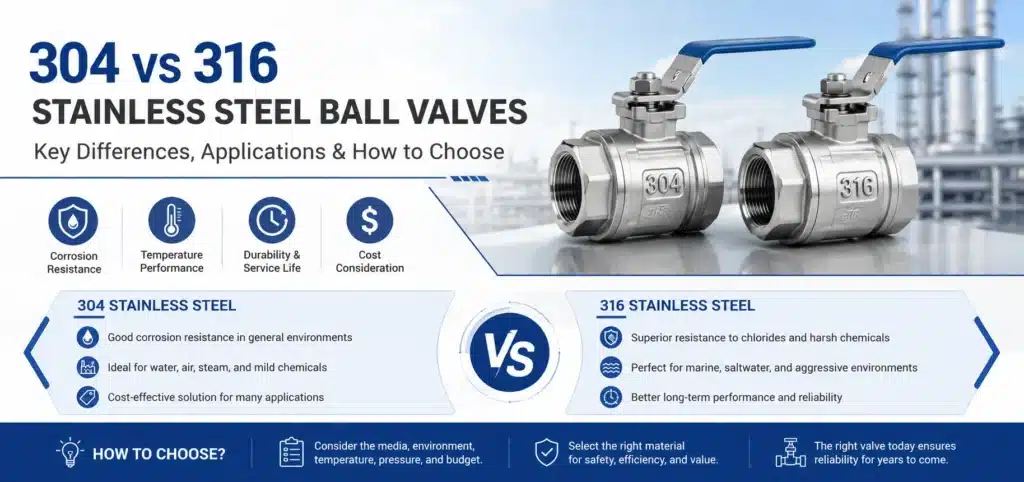
Choosing the right stainless steel ball valve is essential for maintaining system reliability, controlling maintenance costs, and preventing premature valve failure. Two of the most widely used materials for stainless steel ball valves are 304 and 316 stainless steel.
Although these materials have a similar appearance and share many mechanical properties, they do not provide the same level of corrosion resistance. Their performance can vary significantly in chemical processing, water treatment, food production, marine environments, and other industrial applications.
This guide explains the main differences between 304 and 316 stainless steel ball valves and helps buyers determine which material is more suitable for a specific application.
What Is a Stainless Steel Ball Valve?
A stainless steel ball valve is a quarter-turn valve that uses a rotating ball to control the flow of liquids or gases. The ball contains a bore through its center. When the bore is aligned with the pipeline, the media can flow through the valve. When the ball is rotated by 90 degrees, the flow path is blocked.
Stainless steel ball valves are commonly selected because they provide reliable shutoff, low flow resistance, fast operation, and good corrosion resistance. They are available in many designs, including one-piece, two-piece, and three-piece construction.
Other common options include full-port and reduced-port designs, threaded and flanged connections, manual handles, pneumatic actuators, and electric actuators.
The performance of a stainless steel ball valve depends on more than its design. The stainless steel grade used for the valve body, ball, stem, and other wetted components can directly affect service life and corrosion resistance.
304 vs 316 Stainless Steel Ball Valve
| Comparison | 304 Stainless Steel Ball Valve | 316 Stainless Steel Ball Valve |
|---|---|---|
| Material type | Chromium-nickel austenitic stainless steel | Chromium-nickel austenitic stainless steel containing molybdenum |
| General corrosion resistance | Good in mild industrial and indoor environments | Better in many corrosive and chloride-containing environments |
| Chloride resistance | Limited resistance to pitting caused by chlorides | Improved resistance to chloride pitting and crevice corrosion |
| Marine and coastal use | Suitable for limited exposure under controlled conditions | Generally more suitable for coastal and salt-containing environments |
| Typical applications | Water, air, utilities, light industrial systems, and general processing | Chemical processing, food production, pharmaceutical systems, coastal plants, and demanding industrial service |
| Initial cost | Lower | Higher |
| Primary advantage | Economical performance in mild environments | Greater corrosion resistance in more demanding environments |
What Is the Main Difference Between 304 and 316 Stainless Steel?
The most important difference between 304 and 316 stainless steel is the addition of molybdenum in 316 stainless steel. Molybdenum improves resistance to localized corrosion, particularly pitting and crevice corrosion caused by chlorides.
Chlorides can be found in seawater, brine, cleaning chemicals, food ingredients, industrial process fluids, and coastal air. When chloride exposure is present, a 316 stainless steel ball valve normally provides better protection than a 304 stainless steel ball valve.
However, 316 stainless steel is not completely resistant to corrosion. Its performance still depends on temperature, chloride concentration, pH level, oxygen content, surface condition, deposits, and exposure time.
Warm and stagnant chloride solutions can be particularly aggressive. In severe chloride service, hot seawater, concentrated brine, or highly corrosive chemical applications, a higher-alloy material may be required.
Advantages of a 304 Stainless Steel Ball Valve
A 304 stainless steel ball valve offers good general corrosion resistance and is usually more economical than a comparable 316 valve. It is widely used in applications where the operating environment is relatively mild and chloride exposure is low.
Common applications for 304 stainless steel ball valves include:
- Clean water systems
- Treated water pipelines
- Compressed air systems
- Indoor utility piping
- General industrial equipment
- Compatible oils and fuels
- Low-corrosion process fluids
- Drainage and equipment isolation
For these applications, 304 stainless steel can provide a practical balance between corrosion resistance, mechanical strength, availability, and purchase price.
Using 316 stainless steel is not always necessary. When the media and environment do not contain aggressive chemicals or significant chloride levels, a 304 stainless steel ball valve may provide reliable long-term performance at a lower cost.
Advantages of a 316 Stainless Steel Ball Valve
A 316 stainless steel ball valve is normally selected for more demanding environments. Its improved corrosion resistance makes it suitable for systems that contain chlorides, chemicals, cleaning agents, or process fluids that may cause localized corrosion.
Common applications for 316 stainless steel ball valves include:
- Chemical processing systems
- Petrochemical equipment
- Food and beverage production
- Dairy and brewing systems
- Pharmaceutical processing
- Water treatment equipment
- Coastal industrial facilities
- Outdoor equipment exposed to salt-containing air
- Systems that require frequent chemical cleaning
The higher initial cost of a 316 stainless steel ball valve may be justified when corrosion could result in leakage, contamination, production downtime, frequent maintenance, or premature replacement.
In these situations, the more important comparison is total operating cost rather than purchase price alone.
Is 316 Stainless Steel Suitable for Seawater?
316 stainless steel is commonly described as a marine-grade stainless steel because it performs better than 304 in many salt-containing environments. However, this description can be misleading.
A 316 stainless steel ball valve may be suitable for limited seawater exposure, coastal air, splash zones, or controlled applications. It is not automatically suitable for continuous immersion in seawater, warm seawater, stagnant seawater, or systems with narrow crevices.
These conditions can increase the risk of pitting, crevice corrosion, and other forms of material degradation. For continuous or demanding seawater service, duplex stainless steel, super duplex stainless steel, or another corrosion-resistant alloy may be more appropriate.
Important Factors When Selecting a Stainless Steel Ball Valve
1. Process Media
The first step is to identify the liquid or gas passing through the valve. Buyers should consider the main process fluid as well as additives, contaminants, cleaning agents, and temporary flushing chemicals.
A material that performs well with clean water may not be suitable for acids, brine, solvents, oxidizing chemicals, or concentrated cleaning solutions.
2. Chloride Concentration
Chloride exposure is one of the most important factors when comparing a 304 vs 316 stainless steel ball valve. Higher chloride levels generally increase the risk of pitting and crevice corrosion.
Deposits and evaporation can also concentrate chlorides on the valve surface. This means that even an environment with moderate chloride levels may become more aggressive over time.
3. Operating Temperature
Corrosion can become more severe as temperature increases. A stainless steel ball valve that performs well at room temperature may have a shorter service life when exposed to hot process fluids.
Temperature also affects the valve seats, stem seals, packing, and actuator components. The complete valve assembly must be suitable for the expected operating temperature.
4. Operating Pressure
The pressure rating of a stainless steel ball valve depends on the valve size, body design, end connection, wall thickness, seat material, manufacturing standard, and operating temperature.
Buyers should review the manufacturer’s pressure and temperature ratings rather than selecting a valve based only on body material.
5. Seat and Seal Materials
The valve body may be made from 304 or 316 stainless steel, but the seat and seal materials must also be compatible with the process media.
Common ball valve seat materials include PTFE, reinforced PTFE, PEEK, and other engineered polymers. Each material has different limits for pressure, temperature, wear resistance, and chemical compatibility.
6. Connection Type
Stainless steel ball valves are available with threaded, socket-weld, butt-weld, flanged, sanitary clamp, and other connection types. The correct connection depends on the pipeline standard, pressure level, maintenance requirements, and installation method.
7. Maintenance Requirements
A three-piece stainless steel ball valve is often preferred when the valve must be inspected, cleaned, or repaired regularly. The center section can usually be removed without completely removing the pipe connections.
A one-piece or two-piece ball valve may be more economical for general applications where frequent maintenance is not required.
What Are 304L and 316L Stainless Steel?
304L and 316L are low-carbon versions of 304 and 316 stainless steel. The letter L indicates a reduced carbon content.
Low-carbon grades are commonly used for welded components because they help reduce the risk of intergranular corrosion in the heat-affected area around a weld.
Whether a valve requires 304L or 316L depends on the manufacturing process, welding procedure, service environment, and applicable project specification.
For critical applications, buyers should request material certificates, pressure test records, valve specifications, and traceability documents from the stainless steel ball valve manufacturer.
How to Verify the Material Grade
The material grade should be clearly identified on the valve body, product documentation, packaging, or material certificate. However, markings alone may not be sufficient for critical industrial projects.
Positive material identification testing may be used to verify the alloy composition. Buyers should also confirm the material of the ball, stem, body, end caps, and other wetted components.
A valve advertised as a 316 stainless steel ball valve may not necessarily use 316 stainless steel for every internal component. The complete material specification should be reviewed before ordering.
Frequently Asked Questions
Is 316 stainless steel always better than 304?
No. 316 stainless steel provides better corrosion resistance in many chloride-containing and chemical environments, but it also costs more. For mild applications, 304 stainless steel may provide the required performance at a lower cost.
Can a 304 stainless steel ball valve be used outdoors?
Yes. A 304 stainless steel ball valve can be used outdoors when the atmosphere is not highly corrosive. Coastal air, de-icing salts, chemical fumes, and frequent exposure to salt water may make 316 stainless steel a more suitable choice.
Can a 304 ball valve be replaced with a 316 ball valve?
In many cases, yes. The replacement valve must have the correct size, connection type, pressure rating, temperature rating, flow capacity, seat material, dimensions, and operating method.
Does a 316 stainless steel ball valve last longer?
It may last longer in corrosive or chloride-containing environments. In mild environments, the difference in service life may be small. Valve life also depends on pressure, temperature, operating frequency, media cleanliness, seat material, and maintenance.
Is a 316 stainless steel ball valve suitable for seawater?
A 316 stainless steel ball valve may be suitable for limited or controlled seawater exposure, but it is not automatically suitable for continuous immersion, warm seawater, stagnant seawater, or severe chloride conditions. Duplex or super duplex stainless steel may be required for demanding seawater applications.
How can I verify whether a valve is made from 304 or 316 stainless steel?
Check the valve body marking, product specification, material certificate, and supplier documentation. Positive material identification testing may also be used when alloy verification and material traceability are required.
Conclusion
A 304 stainless steel ball valve is generally suitable for clean water, compressed air, indoor utilities, compatible oils, and mild industrial applications. It offers good general corrosion resistance and a lower initial cost.
A 316 stainless steel ball valve is usually the better option for chemical processing, food production, pharmaceutical systems, coastal environments, chloride-containing media, and applications that require improved resistance to pitting and crevice corrosion.
The final selection should be based on the process media, chemical concentration, chloride level, operating temperature, pressure, valve design, seat material, connection type, and maintenance requirements.
Providing complete operating information to the valve manufacturer is the most reliable way to select the correct stainless steel ball valve and reduce the risk of corrosion, leakage, and early replacement.