


Industrial Pipeline Valve Guide
Types Of Pipeline Valve
A pipeline valve is an essential component used to start, stop, regulate, direct, or protect the flow of liquids, gases, steam, slurry, and other process media. Pipeline valves are widely installed in water treatment plants, metallurgical facilities, oil and gas systems, chemical plants, power stations, mining projects, and other large industrial engineering systems. Selecting the correct valve type helps improve process stability, reduce energy loss, protect equipment, and maintain safe pipeline operation.
What Is a Pipeline Valve?
A pipeline valve is a mechanical device installed in a piping system to control the movement of process media. Depending on its design, a valve may provide complete isolation, flow throttling, pressure regulation, reverse-flow prevention, emergency shutoff, or overpressure protection.
Large engineering projects often include pipelines with different diameters, pressure classes, temperatures, materials, and fluid characteristics. A water treatment pipeline may transport clean water, sewage, sludge, chemicals, or compressed air. A metallurgical plant may handle cooling water, high-temperature gas, oxygen, steam, slurry, and abrasive particles. An oil pipeline may transport crude oil, refined fuel, lubricating oil, natural gas, or petroleum products.
Because operating conditions vary significantly, no single pipeline valve can satisfy every application. Engineers must select the valve structure, body material, seat material, pressure rating, connection type, and actuator according to actual process requirements.
Main Applications of Pipeline Valves
Pipeline valves are used throughout industrial infrastructure and large-scale engineering projects. Their functions vary according to the transported medium, operating pressure, process temperature, required control accuracy, and system safety requirements.
| Application Industry | Typical Media | Common Valve Functions | Frequently Used Valve Types |
|---|---|---|---|
| Water Treatment | Clean water, wastewater, sewage, sludge, chemicals, and air | Isolation, flow regulation, backflow prevention, and sludge discharge | Butterfly Valve, Gate Valve, Ball Valve, Check Valve, and Knife Gate Valve |
| Metallurgy | Cooling water, steam, gas, oxygen, slurry, and high-temperature media | Process isolation, cooling control, gas regulation, and abrasive-media handling | Ball Valve, Butterfly Valve, Globe Valve, Gate Valve, and Knife Gate Valve |
| Oil and Gas | Crude oil, natural gas, fuel oil, refined products, and hydrocarbons | Emergency shutoff, pressure control, flow isolation, and reverse-flow prevention | Ball Valve, Gate Valve, Check Valve, Control Valve, and Safety Valve |
| Chemical Processing | Acids, alkalis, solvents, corrosive liquids, and process gases | Accurate control, corrosion-resistant isolation, and pressure protection | Ball Valve, Globe Valve, Diaphragm Valve, Control Valve, and Check Valve |
| Power Generation | Steam, cooling water, boiler feedwater, fuel, and condensate | High-pressure isolation, steam regulation, and equipment protection | Gate Valve, Globe Valve, Check Valve, Control Valve, and Safety Valve |
| Mining and Slurry | Mineral slurry, tailings, abrasive water, mud, and solid-containing fluids | Slurry isolation, discharge control, and wear-resistant flow handling | Knife Gate Valve, Pinch Valve, Ball Valve, and Slurry Check Valve |
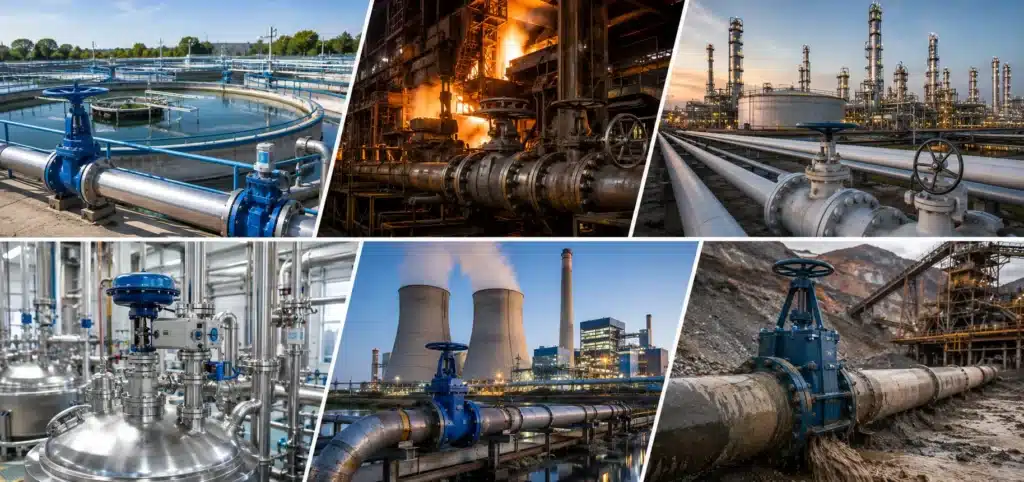
Pipeline Valves in Water Treatment Systems
Water treatment is one of the largest application areas for pipeline valve products. Municipal water plants, wastewater treatment facilities, desalination systems, pumping stations, irrigation projects, and industrial water networks require valves in almost every process section.
A Butterfly Valve is frequently installed in large-diameter water pipelines because it is compact, lightweight, economical, and easy to automate. Gate valves are commonly used for main pipeline isolation, while Ball Valve products are suitable for smaller pipes, chemical dosing systems, compressed-air lines, and applications requiring tight shutoff.
Wastewater and sludge pipelines may contain suspended solids, fibers, sand, and other contaminants. A Knife Gate Valve is often selected because its sharp gate can pass through or cut into thick media. Check valves are normally installed after pumps to prevent reverse flow and protect pumping equipment when the system stops.
Pipeline Valves in Metallurgical Engineering
Metallurgical plants contain complex pipeline systems serving blast furnaces, steelmaking units, rolling mills, cooling systems, gas treatment equipment, oxygen stations, and material-handling processes. These systems may operate under high pressure, elevated temperature, severe vibration, or highly abrasive conditions.
Cooling-water pipelines commonly use Butterfly Valve, Gate Valve, and Check Valve designs. Gas and oxygen systems may require specially cleaned Ball Valve or Globe Valve products with compatible sealing materials. High-temperature pipelines often require metal-seated valves, extended bonnets, heat-resistant alloys, and suitable stem packing.
Slurry and dust-containing systems require a pipeline valve with a clear flow passage and strong resistance to erosion. Knife gate valves, ceramic-lined valves, hard-seated ball valves, and specialized butterfly valves may be used according to the concentration and particle size of the transported medium.
Pipeline Valves in Oil and Gas Projects
Oil and gas engineering includes production fields, gathering systems, long-distance transmission pipelines, storage terminals, refineries, pumping stations, compressor stations, and loading facilities. Reliability and sealing performance are particularly important because the transported media may be flammable, hazardous, or operated at high pressure.
A full-bore Ball Valve is widely used for oil and gas pipeline isolation because it offers tight shutoff, low pressure loss, and fast quarter-turn operation. Trunnion-mounted ball valves are commonly selected for large diameters and high-pressure service. Full-bore designs also allow cleaning pigs and inspection tools to pass through the pipeline.
Gate valves are used where a straight flow passage and minimal pressure resistance are required. Check valves prevent reverse flow at pump and compressor outlets. Control valves regulate pressure, flow rate, liquid level, or temperature, while safety valves and pressure relief valves protect pipelines and process equipment from excessive pressure.
Common Types of Pipeline Valve
Ball Valve
A Ball Valve uses a spherical closure element with a central bore. Rotating the ball by 90 degrees opens or closes the flow passage. Ball valves provide rapid operation, reliable sealing, and relatively low flow resistance.
This pipeline valve is widely used in water supply, oil and gas, chemical processing, metallurgy, heating systems, and industrial utility pipelines. Floating ball valves are suitable for many small and medium sizes, while trunnion-mounted ball valves are commonly used for large-diameter and high-pressure pipelines.
Butterfly Valve
A Butterfly Valve uses a circular disc mounted on a rotating shaft. The valve opens or closes through quarter-turn movement. Its short face-to-face dimension and low weight make it particularly suitable for large-diameter pipeline systems.
Butterfly valves are commonly installed in water treatment, cooling-water systems, firewater networks, power plants, metallurgical facilities, and low-pressure gas pipelines. Concentric designs are economical for general service, while double-offset and triple-offset designs provide improved sealing for higher pressure and temperature conditions.
Globe Valve
A Globe Valve controls flow through a movable disc or plug that travels toward or away from a stationary seat. Its internal flow path provides good throttling performance and accurate control, although it normally creates a higher pressure drop than a gate or ball valve.
Globe valves are widely used in steam systems, boiler pipelines, chemical plants, power stations, oil processing units, and applications requiring frequent flow adjustment. They can be operated manually or equipped with pneumatic, electric, or hydraulic actuators.
Check Valve
A Check Valve permits flow in one direction and closes automatically when the flow reverses. It does not normally require an external actuator. The valve is commonly installed downstream of pumps, compressors, and process equipment.
Common designs include swing check valves, lift check valves, dual-plate check valves, piston check valves, ball check valves, and axial-flow check valves. Correct selection is important because an unsuitable Check Valve may cause slamming, vibration, pressure surges, or excessive pressure loss.
Gate Valve
A Gate Valve opens by lifting a gate completely out of the flow passage. When fully open, it provides a nearly straight pipeline bore and low flow resistance. It is mainly designed for fully open or fully closed operation.
Gate valves are widely used in water supply, oil pipelines, power stations, chemical plants, and general industrial systems. They should not normally be used for long-term throttling because partially open operation may cause vibration, erosion, and damage to the gate and sealing surfaces.
Knife Gate Valve
A Knife Gate Valve uses a thin, sharp-edged gate that moves vertically through the valve body. It is designed for pipelines carrying sludge, slurry, pulp, powder, wastewater, and fluids containing suspended solids.
Knife gate valves are widely used in wastewater treatment, mining, mineral processing, paper production, power generation, and metallurgical engineering. The compact structure and unobstructed flow passage help reduce clogging, but the valve pressure rating is often lower than that of a standard industrial Gate Valve.
Control Valve
A Control Valve continuously adjusts its opening according to a signal from a process controller. It can regulate pipeline flow, pressure, temperature, or liquid level. Control valves are important in automated water treatment systems, refineries, chemical plants, power stations, and metallurgical production lines.
The valve body, trim, actuator, and positioner must be selected according to required flow capacity and control accuracy. Incorrect sizing can lead to unstable regulation, cavitation, noise, erosion, or insufficient process capacity.
Safety Valve
A Safety Valve or pressure relief valve protects a pipeline or pressure vessel from overpressure. It opens automatically when the system pressure reaches a predetermined set value and releases fluid until safe conditions are restored.
Safety valves are commonly used in steam pipelines, boilers, pressure vessels, oil systems, gas equipment, pumps, compressors, and chemical processing units. The set pressure, discharge capacity, back pressure, material, and outlet arrangement must be properly engineered.
Plug Valve
A Plug Valve uses a cylindrical or tapered plug containing a flow passage. Like a ball valve, it normally operates through quarter-turn movement. Plug valves can provide rapid isolation and are available in lubricated, non-lubricated, sleeved, and eccentric designs.
This valve type is used in oil, gas, chemical, wastewater, and slurry pipelines. Eccentric plug valves are particularly common in municipal water and wastewater systems because they can handle contaminated media and provide reliable shutoff.
Diaphragm Valve
A Diaphragm Valve uses a flexible diaphragm to separate the operating mechanism from the process fluid. This structure reduces leakage paths and prevents the fluid from contacting the stem and bonnet components.
Diaphragm valves are suitable for corrosive chemicals, ultrapure water, wastewater, pharmaceutical processes, and fluids containing small solid particles. The diaphragm material must be compatible with the transported medium and operating temperature.
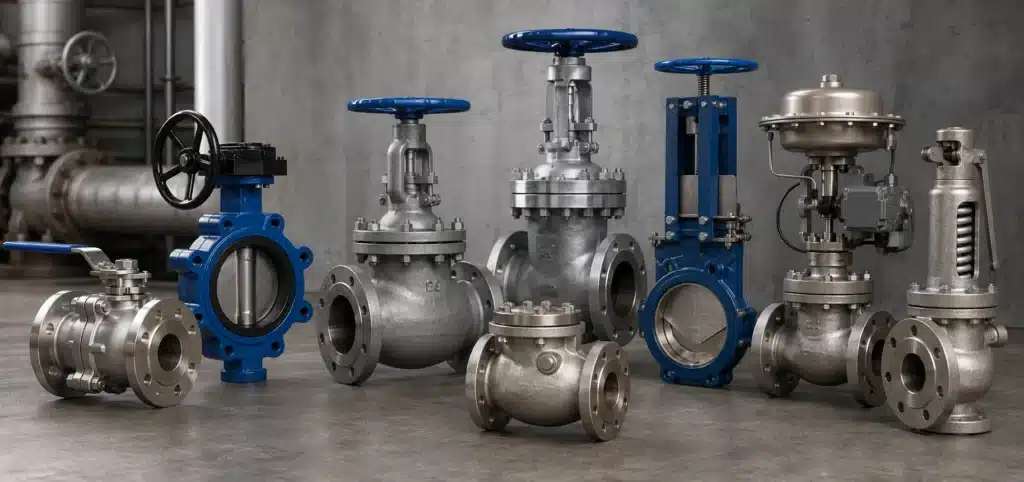
Pipeline Valve Type Comparison
| Valve Type | Primary Function | Flow Resistance | Throttling Ability | Typical Applications |
|---|---|---|---|---|
| Ball Valve | Isolation and emergency shutoff | Low | Limited in standard designs | Oil, gas, water, chemicals, and industrial utilities |
| Butterfly Valve | Isolation and moderate regulation | Low to moderate | Moderate | Water treatment, cooling water, and large-diameter pipelines |
| Globe Valve | Flow throttling and regulation | High | Excellent | Steam, power, chemical, and process control systems |
| Check Valve | Reverse-flow prevention | Depends on design | Not applicable | Pump outlets, compressor lines, and transfer pipelines |
| Gate Valve | Full-open or full-closed isolation | Very low when open | Poor | Water, oil, power, and general industrial pipelines |
| Knife Gate Valve | Slurry and solid-containing media isolation | Low | Limited | Mining, wastewater, metallurgy, pulp, and slurry systems |
| Control Valve | Automatic process regulation | Designed according to control duty | Excellent | Automated industrial and process pipelines |
| Safety Valve | Overpressure protection | Closed during normal operation | Not applicable | Boilers, vessels, pumps, compressors, and pressure systems |
How to Select the Right Pipeline Valve
Selecting the correct pipeline valve requires a complete understanding of process conditions. Choosing a valve only according to pipe diameter may result in poor sealing, unstable control, excessive pressure loss, rapid wear, or unsafe operation.
- Identify the process medium, including density, viscosity, corrosiveness, toxicity, and solid content.
- Confirm the minimum, normal, and maximum operating pressure and temperature.
- Determine whether the valve is required for isolation, throttling, reverse-flow prevention, pressure relief, or emergency shutdown.
- Check the required pipeline diameter, pressure class, flow capacity, and acceptable pressure drop.
- Select suitable body, trim, seat, seal, packing, and gasket materials.
- Confirm the required leakage class and shutoff performance.
- Choose flanged, threaded, welded, wafer, lug, or other connection types.
- Determine whether manual, pneumatic, electric, or hydraulic actuation is required.
- Evaluate fire-safe, anti-static, corrosion-resistant, abrasion-resistant, and low-emission requirements.
- Consider installation space, maintenance access, lifecycle cost, and spare-part availability.
Pipeline Valve Materials
Pipeline valve materials must be compatible with the operating medium and environmental conditions. Cast iron and ductile iron are widely used in water and wastewater systems. Carbon steel is common in oil, gas, power, and general industrial pipelines. Stainless steel provides improved corrosion resistance for chemical, food, water, and marine applications.
Alloy steel, duplex stainless steel, nickel alloys, titanium, ceramics, rubber linings, and fluoropolymer linings may be required for high-temperature, corrosive, abrasive, or severe-service applications. Internal components such as the ball, disc, gate, stem, seat, and packing may use different materials from the valve body.
Manual and Automated Pipeline Valves
A pipeline valve may be operated manually with a lever, handwheel, or gearbox. Manual operation is suitable for valves that are used infrequently and can be safely accessed by plant personnel.
Pneumatic actuators provide rapid operation and are widely used in automated process plants. Electric actuators are suitable for remote pipeline systems and locations where electrical power is readily available. Hydraulic actuators can generate high operating torque and are commonly used for large-diameter oil and gas valves or emergency shutdown applications.
Automated valve assemblies may include positioners, solenoid valves, limit switches, pressure regulators, local control stations, position indicators, and communication devices. These accessories allow the pipeline valve to communicate with a programmable logic controller, distributed control system, or safety instrumented system.
Inspection and Maintenance
Regular inspection helps ensure that each pipeline valve remains safe and reliable. Operators should check for external leakage, damaged coatings, corrosion, loose bolts, abnormal noise, packing wear, actuator faults, and unexpected changes in operating torque.
Isolation valves should be opened and closed periodically where operating procedures permit. Control valves should be tested for positioning accuracy and smooth movement. Check valves should be inspected for sticking, internal wear, and delayed closure. Safety valves require scheduled testing and verification of their set pressure.
Maintenance frequency should reflect operating severity, fluid cleanliness, valve cycle frequency, environmental conditions, manufacturer recommendations, and project safety procedures. Maintaining accurate inspection records can help identify recurring problems before they cause shutdowns or equipment damage.
Conclusion
A pipeline valve is a fundamental part of every large industrial piping system. Water treatment, metallurgy, oil and gas, chemical processing, power generation, mining, and other engineering projects all depend on correctly selected valves to isolate equipment, regulate flow, prevent backflow, handle abrasive media, and protect systems from excessive pressure.
Ball Valve, Butterfly Valve, Globe Valve, Check Valve, Gate Valve, Knife Gate Valve, Control Valve, Safety Valve, Plug Valve, and Diaphragm Valve products each offer different operating characteristics. By evaluating fluid properties, pipeline pressure, temperature, flow rate, control requirements, material compatibility, and maintenance conditions, engineers can select a pipeline valve solution that provides safe, efficient, and reliable long-term operation.
Frequently Asked Questions
Which pipeline valve is best for complete isolation?
A Ball Valve or Gate Valve is commonly used for complete pipeline isolation. Ball valves provide fast quarter-turn operation and tight shutoff, while gate valves provide a low-resistance, straight-through flow passage when fully open.
Which valve is suitable for large water pipelines?
A Butterfly Valve is often selected for large water pipelines because it is compact, lightweight, economical, and available in large diameters. Gate valves may also be used when a full-bore flow passage is required.
Which pipeline valve is suitable for slurry?
A Knife Gate Valve is commonly used for sludge, slurry, pulp, wastewater, and fluids containing suspended solids. Pinch valves and specialized slurry valves may also be suitable for highly abrasive media.
What is the difference between a Gate Valve and a Globe Valve?
A Gate Valve is primarily designed for fully open or fully closed isolation and creates low flow resistance when open. A Globe Valve is designed for flow throttling and regulation but normally produces a greater pressure drop.