


Types Of Actuator Valve
Actuator valves are essential components in industrial automation. They allow valves to open, close, or regulate flow automatically without requiring an operator to turn a handwheel or lever. Among the different types of actuator valve systems available, pneumatic actuator valves and electric actuator valves are the two most widely used solutions.
Both technologies can automate ball valves, butterfly valves, gate valves, globe valves, plug valves, dampers, and other flow-control equipment. However, they differ significantly in power source, speed, control accuracy, fail-safe behavior, installation requirements, maintenance, and operating cost. Understanding these differences is essential when selecting an actuator for power generation, water treatment, chemical processing, oil and gas, HVAC, manufacturing, food production, or other industrial applications.
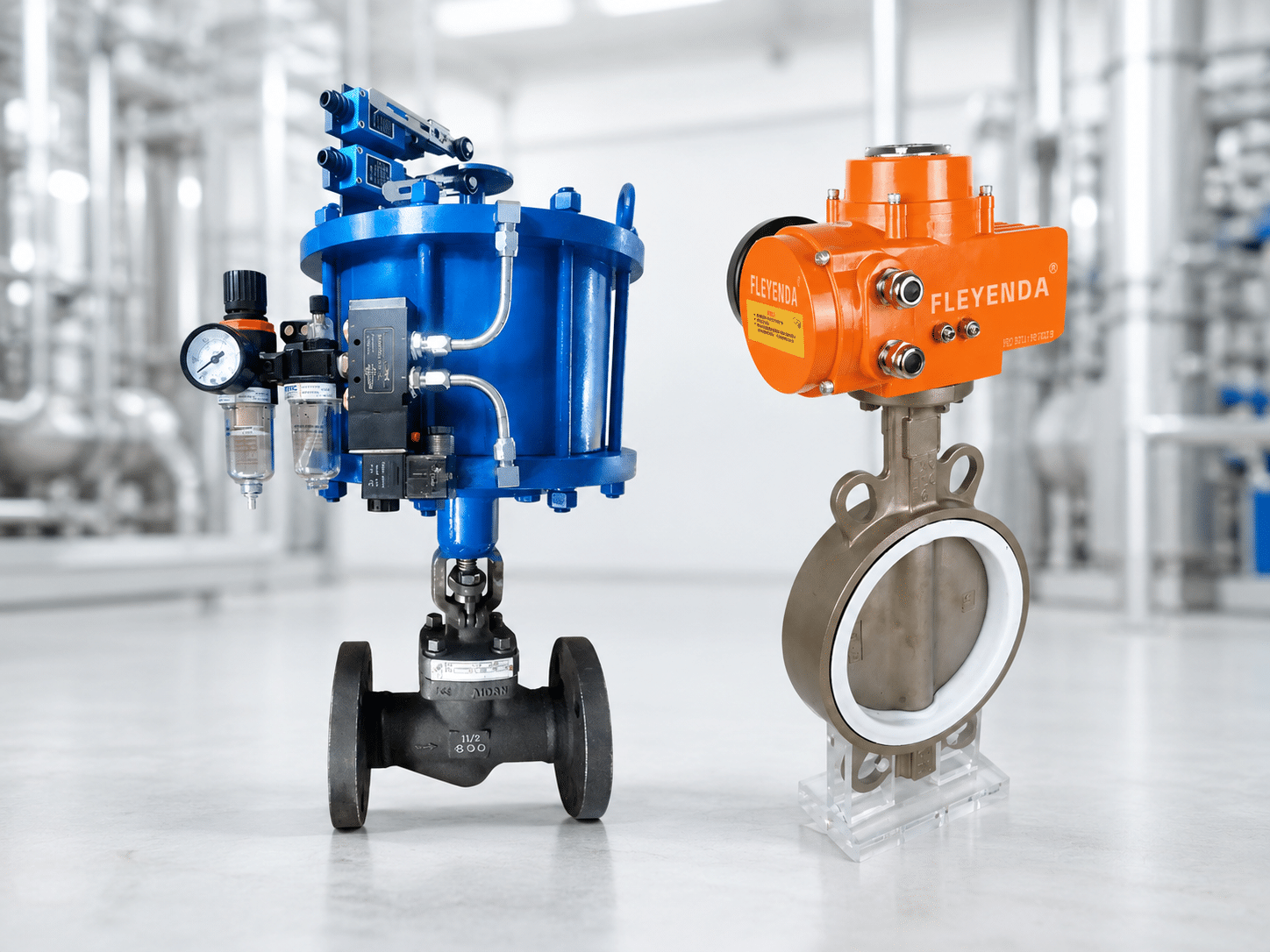
What Is an Actuator Valve?
An actuator valve, more accurately called an actuated valve, is a valve equipped with a mechanical device that provides the torque or thrust required to move the valve closure element. The actuator receives an air, electrical, or control signal and converts that input into mechanical motion.
The valve controls the flow of the process medium, while the actuator supplies the force needed to operate the valve. Depending on the valve design, the actuator may rotate a shaft through approximately 90 degrees, turn a threaded stem through multiple revolutions, or move a stem in a straight line.
A complete automated valve assembly may contain more than the valve and actuator. Common accessories include solenoid valves, positioners, limit switches, position transmitters, air filter regulators, local control stations, manual overrides, communication modules, mounting brackets, and shaft couplings.
The Two Main Types of Actuator Valve
Pneumatic and electric actuators can perform many of the same valve-automation tasks, but they create motion in different ways. A pneumatic actuator uses compressed air, while an electric actuator uses an electric motor and internal transmission system.
| Feature | Pneumatic actuator valve | Electric actuator valve |
|---|---|---|
| Power source | Compressed air or pressurized gas | AC or DC electrical power |
| Typical movement | Quarter-turn or linear | Quarter-turn, multi-turn, or linear |
| Operating speed | Usually fast | Usually slower but highly controllable |
| Fail-safe option | Simple mechanical spring-return designs | Spring, battery, capacitor, or backup-power options |
| Control accuracy | Good with a suitable positioner | Very good with integrated electronic controls |
| Required infrastructure | Air compressor, piping, filtration, and controls | Electrical supply, wiring, and protection |
| Common applications | Fast process control and emergency shutdown | Remote operation and precise positioning |
Pneumatic Actuator Valves
A pneumatic actuator converts the energy of compressed air into mechanical movement. Air pressure acts on a piston or diaphragm, producing linear force. The actuator mechanism then transfers this force directly to a linear valve stem or converts it into rotary torque for a quarter-turn valve.
Pneumatic actuator valves are widely used because they are relatively simple, fast, durable, and suitable for frequent operation. They are especially common in facilities that already have a reliable instrument-air system.
Spring-Return Pneumatic Actuators
A spring-return actuator, also called a single-acting actuator, uses compressed air to move the valve in one direction and a mechanical spring to move it in the opposite direction. When the air supply is removed, the spring automatically drives the valve to its predetermined safety position.
Depending on the process requirement, a spring-return actuator may be configured as fail closed or fail open. A fail-closed valve moves to the closed position when air pressure is lost. A fail-open valve moves to the open position.
Spring-return pneumatic actuator valves are frequently used in emergency shutdown systems, fuel-gas lines, steam systems, chemical dosing equipment, cooling-water circuits, and other applications where the valve must move to a safe position following a loss of utility pressure or control signal.
Double-Acting Pneumatic Actuators
A double-acting pneumatic actuator uses compressed air to move the actuator in both directions. Air is supplied alternately to opposite sides of the piston, allowing the valve to open and close without relying on a return spring.
Double-acting actuators can provide high and relatively balanced torque in both directions. They may also be smaller than a comparable spring-return unit because no large internal spring pack is required.
However, a standard double-acting actuator does not automatically move to a defined position when the air supply fails. The valve may remain in its last position unless the system includes an air reservoir, external fail-safe device, or another stored-energy solution.
Rack-and-Pinion Pneumatic Actuators
Rack-and-pinion actuators are widely used to automate quarter-turn ball, butterfly, and plug valves. Inside the actuator, compressed air moves one or two pistons fitted with straight gear teeth. These racks engage a central pinion gear connected to the valve shaft.
As the pistons move, the pinion rotates and turns the valve. Rack-and-pinion actuators are compact, economical, and suitable for a wide range of general industrial applications. They are available in both double-acting and spring-return configurations.
Scotch-Yoke Pneumatic Actuators
A scotch-yoke actuator converts the linear movement of a piston into rotary movement through a yoke mechanism. Its torque output changes throughout the stroke, often providing higher torque near the open and closed positions.
This torque characteristic can be beneficial for large ball, butterfly, and plug valves that require increased breakaway torque to move from a fully seated position. Scotch-yoke actuators are common in pipelines, terminals, power plants, chemical facilities, and oil and gas installations.
Pneumatic Diaphragm Actuators
A pneumatic diaphragm actuator uses air pressure acting against a flexible diaphragm. The resulting linear movement operates the stem of a globe valve or another linear control valve.
Diaphragm actuators are widely used for modulating process control because they can respond smoothly to changes in air pressure. They are commonly combined with a valve positioner that compares the control signal with the actual valve position and adjusts the air supply accordingly.
Pneumatic Piston Actuators
Pneumatic piston actuators use a rigid piston rather than a flexible diaphragm. They can often operate at higher air pressure and generate greater thrust from a compact cylinder.
Piston actuators may be used on control valves, large isolation valves, steam valves, and applications that require high force, long travel, or rapid operation.
Advantages of Pneumatic Actuator Valves
- Fast operation: Pneumatic actuators can open or close valves rapidly, making them suitable for emergency isolation and high-cycle processes.
- Simple fail-safe design: A spring-return mechanism can move the valve to a defined position without electrical backup power.
- High cycle capability: Properly selected pneumatic actuators can perform frequent operating cycles.
- Compact construction: High force and torque can be generated from a relatively compact assembly.
- Suitable for harsh process areas: Pneumatic systems can be designed for wet, dusty, corrosive, and hazardous environments.
- Simple local equipment: The actuator mechanism may contain fewer electronic components than an intelligent electric actuator.
Limitations of Pneumatic Actuator Valves
- Air infrastructure: The facility needs compressors, dryers, filters, regulators, piping, and air-distribution equipment.
- Air quality requirements: Moisture, oil, particles, or pressure fluctuations can affect actuator and accessory performance.
- Energy losses: Leaks and inefficient compressed-air generation can increase operating costs.
- Maintenance points: Tubing, fittings, seals, solenoid valves, and positioners require periodic inspection.
- Long-distance installation: Extending an air network to an isolated valve can be more difficult than installing electrical wiring.
- Positioning variation: Friction, air compressibility, and changing supply pressure may affect modulating accuracy unless a suitable positioner is used.
Electric Actuator Valves
An electric valve actuator uses an electric motor to produce mechanical movement. The motor typically drives gears that reduce speed and increase torque. Internal switches, sensors, torque controls, and electronic modules stop the actuator at the required position and protect the valve from excessive force.
Electric actuators are available for on-off isolation, intermediate positioning, and continuous modulating control. They can be connected to conventional hardwired signals, industrial networks, or digital asset-management systems.
Quarter-Turn Electric Actuators
Quarter-turn electric actuators rotate the valve shaft through approximately 90 degrees. They are commonly used with ball valves, butterfly valves, plug valves, and dampers.
These actuators are widely used in water systems, HVAC installations, industrial utilities, chemical dosing systems, processing equipment, and remote flow-control stations. Internal travel switches stop the motor at the open and closed positions, while mechanical stops or torque controls may provide additional protection.
Multi-Turn Electric Actuators
Multi-turn electric actuators rotate their output through multiple revolutions. They are typically used to operate gate valves, globe valves, sluice gates, and other equipment requiring several turns to complete the full stroke.
Depending on the valve design, a multi-turn actuator may transmit both torque and axial thrust. Rising-stem gate valves, for example, require the actuator arrangement to accommodate the movement of the valve stem while generating sufficient seating and unseating force.
Multi-turn electric actuators are common in power stations, water-treatment plants, cooling-water systems, pipelines, tank farms, and large industrial utility networks.
Linear Electric Actuators
A linear electric actuator produces straight-line movement and transmits thrust to the valve stem. It may use a screw mechanism, linear thrust unit, or another method of converting motor rotation into axial movement.
Linear electric actuators are often used with globe control valves, small process valves, dampers, dosing equipment, and applications where compressed air is unavailable.
On-Off Electric Actuators
An on-off electric actuator moves the valve between fully open and fully closed positions. It is suitable for isolation, filling, draining, routing, and batch-control functions where intermediate flow regulation is unnecessary.
On-off actuators normally receive a simple open or close command. Limit switches, position sensors, or digital feedback signals confirm whether the requested valve position has been reached.
Modulating Electric Actuators
A modulating electric actuator moves the valve to intermediate positions in response to a control signal. The actuator may continuously adjust the valve to control flow, pressure, temperature, tank level, or another process variable.
Modulating duty is more demanding than occasional open-close operation. The actuator must be designed for the expected number of starts, running time, positioning frequency, and control accuracy. An actuator intended only for isolation duty should not be used for continuous modulation unless its duty rating permits it.
Fail-Safe Electric Actuators
A conventional electric actuator may stop in its last position when electrical power is lost. When a defined fail position is necessary, the actuator can be equipped with a spring-return mechanism, battery backup, capacitor-based energy storage, an uninterruptible power supply, or another emergency power arrangement.
The selected fail-safe method must provide sufficient stored energy to move the valve under the worst expected process pressure, temperature, friction, and seating load.
Advantages of Electric Actuator Valves
- No compressed-air system: Electric actuators can be installed where instrument air is unavailable or uneconomical.
- Accurate positioning: Integrated motor controls and position sensors support precise intermediate movement.
- Digital communication: Intelligent actuators can provide position, torque, alarm, diagnostic, and operating data.
- Remote installation: Electrical cabling can be practical for pipelines, reservoirs, pumping stations, and isolated process areas.
- Multiple motion types: Electric actuators are available for quarter-turn, multi-turn, and linear valves.
- Controlled operating speed: The movement can be selected to reduce pressure surges, water hammer, or process instability.
- Reduced air leakage: Electric systems eliminate air tubing and pneumatic accessory leakage at the valve location.
Limitations of Electric Actuator Valves
- Slower emergency movement: Standard motor-operated actuators may be slower than pneumatic systems.
- Fail-safe complexity: Moving the valve after power loss normally requires stored energy or backup power.
- Electrical protection: Motors and electronics must be protected against moisture, heat, corrosion, dust, and voltage problems.
- Duty-cycle limits: Excessive starts or continuous modulation can overheat an incorrectly selected motor.
- More complex electronics: Intelligent controls may require specialized commissioning and diagnostic skills.
- Initial cost: Advanced electric actuators may have a higher purchase price than basic pneumatic units.
Pneumatic vs. Electric Actuator Valve: How to Choose
The correct selection depends on the complete process requirement rather than one general advantage. Engineers should compare the available utilities, valve load, required operating speed, duty cycle, safety position, control accuracy, environmental conditions, and total lifecycle cost.
Choose Pneumatic When
- The valve must operate very quickly.
- A simple mechanical fail-safe action is required.
- Reliable instrument air is already available.
- The valve cycles frequently.
- The process requires high thrust or quarter-turn torque.
- Plant technicians already maintain pneumatic controls.
Choose Electric When
- No compressed-air network is available.
- The valve is installed in a remote location.
- Precise positioning or slow controlled movement is required.
- Digital diagnostics and communication are important.
- The application uses a multi-turn gate or globe valve.
- Reducing pneumatic leakage and infrastructure is a priority.
Industrial Applications
Power Generation
Power plants use pneumatic and electric actuator valves in boiler systems, cooling-water circuits, steam systems, fuel handling, water treatment, emissions-control equipment, and turbine auxiliaries. Electric multi-turn actuators are often used on large gate and globe valves, while pneumatic actuators are common where fast control or fail-safe action is required.
Water and Wastewater Treatment
Water facilities automate intake valves, filter valves, chemical dosing systems, pump isolation valves, sludge lines, and distribution networks. Electric actuators are practical for remote pumping stations and reservoirs, while pneumatic actuators are frequently used inside treatment plants with centralized compressed-air systems.
Oil, Gas, and Chemical Processing
Pneumatic actuator valves are widely used for process control and emergency shutdown because of their rapid response and spring-return capability. Electric actuators may be selected for remote pipeline valves, tank terminals, utility systems, and installations where compressed air is unavailable or where reducing gas-powered pneumatic emissions is an objective.
HVAC and Building Services
Electric quarter-turn and linear actuators are commonly fitted to control valves and dampers in heating, ventilation, and cooling systems. Pneumatic actuators remain in use in large industrial HVAC installations, particularly where an existing air-control infrastructure is available.
Manufacturing and Industrial Automation
Automated production lines use both actuator types for cooling water, compressed air, vacuum, steam, cleaning fluids, dosing systems, and raw-material handling. Pneumatic actuators are suitable for fast repetitive movements, while electric actuators provide convenient programmable positioning and machine-control integration.
Key Selection Factors
- Valve type: Determine whether the valve requires quarter-turn, multi-turn, or linear movement.
- Torque or thrust: Calculate operating, breakaway, seating, and unseating requirements under worst-case conditions.
- Safety position: Decide whether the valve should fail open, fail closed, or remain in its last position.
- Operating speed: Consider emergency response, water hammer, pressure surge, and process-control requirements.
- Duty cycle: Define the number of operations, starts per hour, running time, and modulation frequency.
- Available utilities: Confirm air pressure and quality or electrical voltage, phase, and frequency.
- Control method: Specify on-off commands, analog positioning signals, fieldbus communication, or digital networking.
- Environment: Evaluate temperature, water ingress, corrosion, vibration, dust, hazardous gases, and outdoor exposure.
- Valve interface: Verify flange dimensions, drive coupling, shaft size, stem arrangement, and mounting orientation.
- Maintenance: Consider technician skills, spare parts, diagnostic tools, access, and expected service life.
Frequently Asked Questions
Which is better, a pneumatic or electric actuator valve?
Neither type is universally better. Pneumatic actuators are often preferred for fast operation, frequent cycling, and simple spring-return safety action. Electric actuators are often preferred for remote locations, precise positioning, multi-turn valves, and digital monitoring.
Can pneumatic actuators control valve position accurately?
Yes. A pneumatic actuator equipped with a suitable positioner can provide accurate modulating control. Performance depends on actuator sizing, valve friction, air quality, supply stability, positioner capability, and correct calibration.
What happens to an electric actuator during a power failure?
A standard electric actuator usually stops in its current position. A spring-return unit, battery, capacitor, backup generator, or uninterruptible power supply may be used when the valve must move to a defined safety position.
Can an electric actuator operate a ball valve?
Yes. Quarter-turn electric actuators are commonly used with ball, butterfly, and plug valves. The actuator must provide sufficient breakaway and running torque for the selected valve and process conditions.
What is the difference between on-off and modulating actuators?
An on-off actuator moves the valve between fully open and fully closed positions. A modulating actuator repeatedly moves the valve to intermediate positions to regulate a process variable such as flow, pressure, temperature, or level.
Conclusion: Understanding the Main Types Of Actuator Valve
Pneumatic and electric actuators are the two main technologies used to automate industrial valves. Pneumatic actuator valves use compressed air and offer fast movement, high cycle capability, and straightforward spring-return fail-safe operation. Their main configurations include spring-return, double-acting, rack-and-pinion, scotch-yoke, diaphragm, and piston actuators.
Electric actuator valves use a motor and gear system to produce quarter-turn, multi-turn, or linear movement. They provide precise positioning, convenient remote operation, and extensive control and diagnostic capabilities without requiring a compressed-air network.
The best actuator cannot be selected from power source alone. A reliable automated valve package must match the valve movement, torque or thrust, operating speed, duty cycle, fail-safe requirement, control architecture, environment, and maintenance strategy of the application. Correct sizing and complete assembly testing are essential for safe, efficient, and long-term valve operation.