


Sanitary Ball Valves Selection Guide
Choosing the right sanitary ball valves is essential for maintaining hygienic fluid handling, reliable flow control and efficient cleaning in food processing, beverage production, dairy manufacturing and pharmaceutical systems. Material grade, valve configuration, connection type, seat design and actuation method all influence long-term performance. This guide explains how to select stainless steel sanitary ball valves according to actual process conditions, compares different valve configurations and introduces a three-way Tri-Clamp electric ball valve for automated sanitary pipelines.
How to Select Sanitary Ball Valves
Before choosing a sanitary ball valve, evaluate these six important specifications:
01
Valve ConfigurationTwo-way shutoff or three-way flow diversion.
02
Gövde MalzemesiSS304 or SS316L according to corrosion requirements.
03
Seat MaterialPTFE and other compatible sealing materials.
04
Bağlantı TürüTri-Clamp, welded or other hygienic connections.
05
Çalışma KoşullarıPressure, temperature and cleaning cycles.
06
Actuation MethodManual, pneumatic or electric operation.
3-Way Tri-Clamp Sanitary Electric Ball Valve
The FLE-Q-3S is designed for hygienic process pipelines requiring automated flow selection, diversion and routing. Its stainless steel construction, cavity-filled PTFE seat arrangement and quick-release Tri-Clamp connections provide an integrated solution for compatible food, beverage, dairy and sanitary process applications.

Nominal Size
Working Pressure
Sıcaklık
Gövde Malzemesi
Three-Way Flow Routing
Three-port configuration for selecting, diverting or routing fluid between connected process lines.
Tri-Clamp Connection
Quick-release hygienic connections simplify installation, disassembly, inspection and maintenance.
Stainless Steel Construction
SS304 and SS316L body options with a cavity-filled PTFE seat arrangement.
Electric Actuation
DC24V, AC110V and AC220V options with ON/OFF, regulating and intelligent control configurations.
The FLE-Q-3S combines sanitary pipeline connections with electric quarter-turn operation. It is suitable for process equipment requiring automated switching between connected flow paths. The actual flow pattern should be confirmed against the required port diagram and selected valve configuration.
1. What Are Sanitary Ball Valves?
Sanitary ball valves are quarter-turn flow control devices designed for hygienic fluid handling systems. They use a rotating ball with an internal passage to control the movement of liquid through a pipeline. When the passage aligns with the pipeline, the valve opens. A 90-degree rotation changes the position of the ball and closes or redirects the flow, depending on the valve configuration.
Unlike conventional industrial ball valves, sanitary ball valves are selected with particular attention to product-contact materials, internal surface condition, connection design, sealing geometry and cleaning requirements. These factors are important in applications where contamination risks, product residue and cleaning efficiency must be carefully controlled.
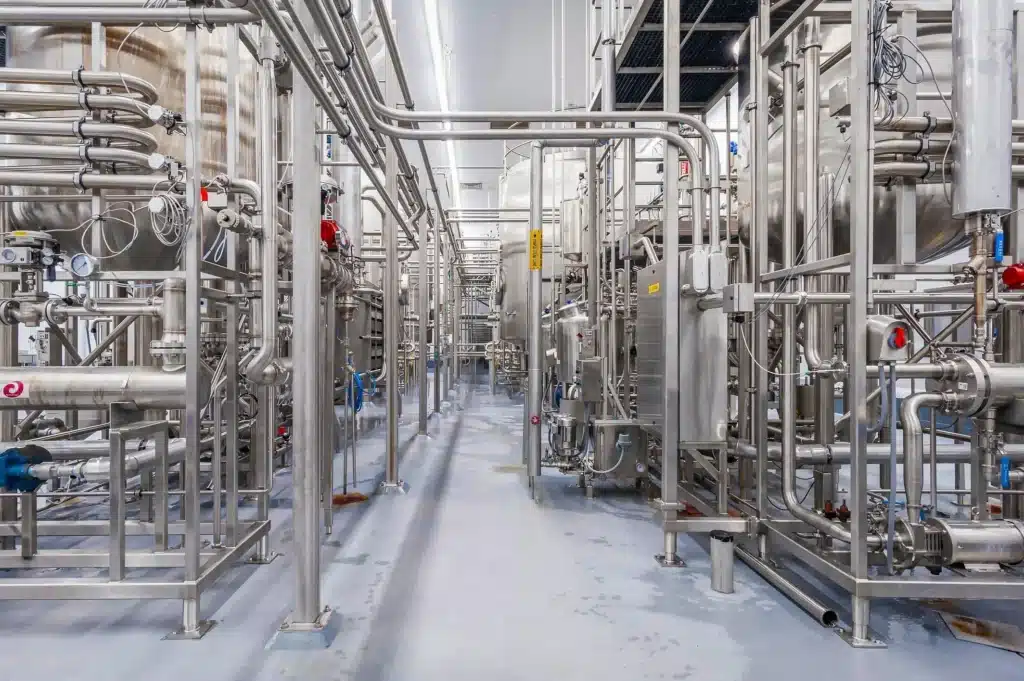
Stainless steel sanitary ball valves are widely used in food and beverage production, dairy processing, pharmaceutical manufacturing, biotechnology equipment and other hygienic fluid systems. They can provide pipeline isolation, tank selection and automated flow routing according to the process requirements.
However, stainless steel construction alone does not make a valve suitable for every sanitary application. The complete wetted assembly, including the valve body, ball, seats, stem seals and gaskets, must be compatible with the product medium and cleaning procedures.
2. Different Types of Sanitary Ball Valves
Understanding sanitary ball valve configurations is the first step in selecting the correct product. The main differences involve the number of ports, internal ball geometry and actuation method.
2.1 Two-Way Sanitary Ball Valves
A two-way sanitary ball valve has one inlet and one outlet. Its main function is to start or stop fluid flow within a pipeline. When the ball passage aligns with the pipeline, the valve opens. When the ball rotates 90 degrees, the passage closes.
Two-way sanitary ball valves are commonly used in product transfer lines, tank outlets, filling equipment, liquid distribution systems and hygienic isolation points. They are suitable when the process requires straightforward shutoff rather than multiple flow paths.
2.2 Three-Way Sanitary Ball Valves
Three-way sanitary ball valves have three connection ports and are designed for flow selection, diversion or routing. They allow process engineers to control the direction of fluid between connected pipelines without installing several independent two-way valves.
There are two common three-way ball configurations:
- L-Port Ball Valve: Generally connects a common port to one of two alternative ports, allowing flow selection or diversion.
- T-Port Ball Valve: Can provide different flow routing or combining arrangements, depending on the internal passage and switching positions.
The actual flow paths depend on the internal ball geometry. Before ordering a three-way sanitary ball valve, engineers should confirm the common port, inlet and outlet positions, and the required flow path at each actuator position. A simple pipeline diagram or P&ID can help prevent configuration mistakes.
2.3 Manual, Pneumatic and Electric Sanitary Ball Valves
Sanitary ball valves can also be classified according to their actuation method.
- Manual Sanitary Ball Valves: Operated by a handle and suitable for local isolation points where automatic switching is not necessary.
- Pneumatic Sanitary Ball Valves: Use compressed air to achieve automatic operation. They are suitable for production lines with an available pneumatic supply.
- Electric Sanitary Ball Valves: Use electric actuators for remote operation and integration with PLC control systems. They are useful when automated flow switching and centralized control are required.
The correct actuation method depends on switching frequency, control requirements, available utilities, operating environment and the required process sequence.
3. How to Select Stainless Steel Sanitary Ball Valve Materials
Material selection is one of the most important considerations when purchasing stainless steel sanitary ball valves. The valve body must resist corrosion from the process medium and remain suitable for the cleaning chemicals used in the production facility.
SS304 and SS316L are two commonly selected stainless steel grades for sanitary valve construction.
| Malzeme | Main Characteristics | Selection Considerations |
|---|---|---|
| SS304 | Good general corrosion resistance and mechanical properties in many ordinary processing environments. | Suitable for compatible food, beverage and general sanitary applications. |
| SS316L | Contains molybdenum and has a low carbon content, providing improved resistance to certain corrosive environments. | Consider for more demanding chemical exposure and applications involving chloride-containing media. |
SS304 is often sufficient for general hygienic applications where the process medium and cleaning chemicals are relatively mild. SS316L is frequently preferred when greater corrosion resistance is required, especially in more demanding cleaning environments.
However, choosing SS316L does not automatically guarantee compatibility with every process chemical. Concentration, temperature, exposure time and cleaning frequency should all be evaluated before confirming the material grade.
Seat and Seal Material Selection
Seat and sealing materials directly affect the leakage performance, operating torque, chemical compatibility and service life of sanitary ball valves.
- PTFE: Offers broad chemical resistance and low friction. It is commonly used for ball valve seats in compatible sanitary applications.
- EPDM: Frequently considered for water-based media and selected cleaning environments, subject to chemical and temperature compatibility.
- FKM: Can be suitable for certain oils, chemicals and temperature conditions, depending on the formulation.
- Silicone: Used in selected hygienic sealing applications where elasticity and temperature characteristics meet process requirements.
Not every sanitary ball valve supports all these materials. Always request the complete wetted-material specification and verify compatibility with both the production medium and the cleaning cycle.
4. Tri-Clamp vs. Welded Sanitary Ball Valve Connections
The connection type determines how sanitary ball valves are installed, removed and maintained. It must match the existing pipeline dimensions and the hygiene requirements of the processing system.
Tri-Clamp Sanitary Ball Valves
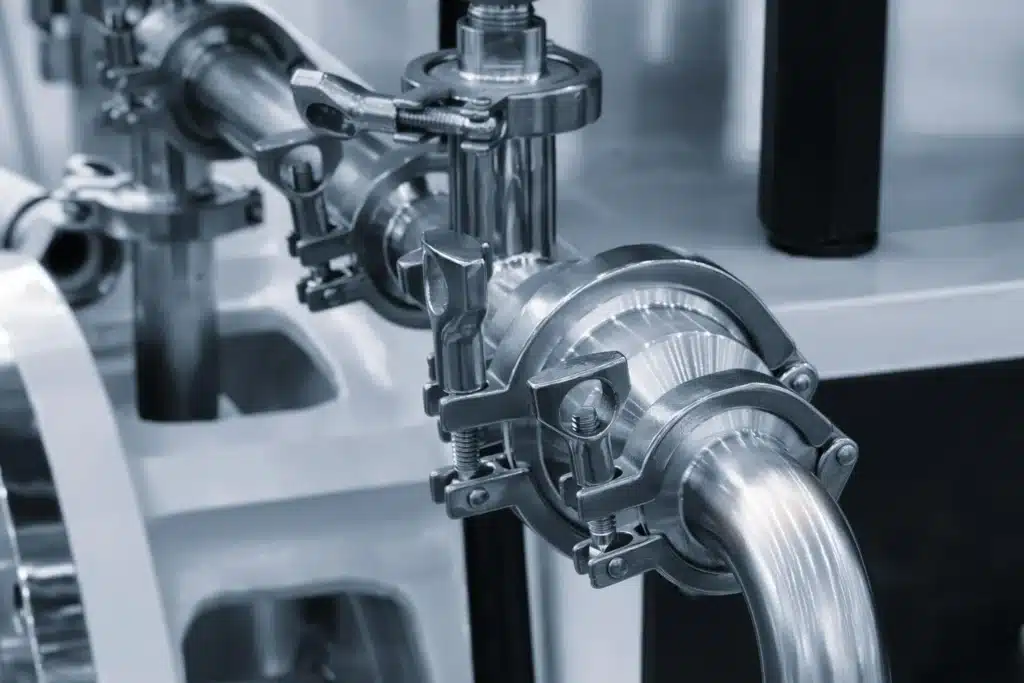
Tri-Clamp connections, also known as Tri-Clover-style clamp connections, are widely used in sanitary processing systems. A gasket is positioned between the mating ferrules and secured using a clamp assembly.
The main advantage of Tri-Clamp connections is convenient installation and disassembly. Maintenance personnel can remove the valve for inspection, cleaning or replacement without cutting the pipeline. This makes Tri-Clamp sanitary ball valves particularly useful in equipment requiring regular maintenance access.
Welded Sanitary Ball Valves
Welded sanitary connections provide a permanent connection between the valve and pipeline. They are suitable for installations where frequent disassembly is unnecessary and a continuous hygienic pipeline arrangement is preferred.
Welded connections require suitable welding procedures and attention to internal weld quality, alignment and surface restoration.
| Bağlantı Türü | Main Advantage | Tipik Uygulama |
|---|---|---|
| Tri-Clamp | Quick installation and removal | Food processing, dairy and equipment connections |
| Welded | Permanent pipeline integration | Fixed hygienic process pipelines |
When ordering a sanitary Tri-Clamp ball valve, confirm the nominal connection size, actual tube outside diameter, applicable clamp standard and gasket dimensions. A nominal inch size alone may not provide enough information to guarantee pipeline compatibility.
5. Pressure and Temperature Requirements
Working pressure and temperature directly affect the performance of sanitary ball valves. A valve that meets normal production conditions may not be suitable for temporary high-temperature cleaning or pressure fluctuations.
Before choosing a sanitary ball valve, establish the following operating parameters:
- Normal operating pressure and maximum system pressure.
- Normal process temperature and maximum operating temperature.
- Pressure fluctuations during pump startup and shutdown.
- CIP cleaning temperature and chemical concentration.
- SIP temperature and exposure time, if steam sterilization is required.
For applications involving CIP or SIP, verify the temperature and chemical resistance of the complete valve assembly. The stainless steel body may tolerate conditions that exceed the limits of the seat, gasket or stem seal.
Pressure ratings should also be checked against the selected nominal size, connection design, seat material and operating temperature. Do not assume that one pressure rating applies to every size and configuration.
6. FLE-Q-3S Sanitary Ball Valve Technical Specifications
The FLE-Q-3S three-way sanitary electric ball valve combines hygienic Tri-Clamp connections with electric quarter-turn actuation. It is designed for automated pipeline applications requiring flow selection, switching and diversion.
| Model | FLE-Q-3S |
|---|---|
| Vana Tipi | 3-Way Sanitary Electric Ball Valve |
| Nominal Size | ½″–4″ (DN15–DN100) |
| Working Pressure | 0–10 bar (145 psi), subject to size and configuration |
| Working Temperature | -10°C to +120°C, subject to seat and seal selection |
| Gövde Malzemesi | SS304 / SS316L Stainless Steel |
| Bağlantı | Tri-Clamp / Tri-Clover |
| Seat Arrangement | Cavity-Filled PTFE Seats |
| Applicable Media | Water, beverages, dairy, wine, edible oil and compatible CIP/SIP fluids |
| Actuator Type | Electric Quarter-Turn Actuator |
| Gerilim Seçenekleri | DC24V, AC110V, AC220V; other options subject to confirmation |
| Control Options | AÇIK/KAPALI, Ayar, Akıllı |
| Mounting Interface | ISO 5211 |
| Design References | ASME BPE / 3-A, according to supplied configuration |
| Testing References | EN 12266-1 / API 598, according to applicable configuration |
| Protection Rating | IP67 Standard, IP68 Optional |
| Optional Actuator Features | Fail-open / fail-closed reset, over-torque protection, heater, passive contacts and manual override, subject to configuration |
For final selection, request the current technical datasheet to verify size-specific pressure ratings, actuator configuration, wetted materials and applicable documentation.
7. Sanitary Tri-Clamp Ball Valve Dimensions
Connection dimensions are important when replacing existing valves or integrating sanitary ball valves into new process equipment. The following dimensional reference is provided for the FLE-Q-3S connection sizes from 3/4″ to 4″.
| Dimension | 3/4″ | 1″ | 1-1/4″ | 1-1/2″ | 2″ | 2-1/2″ | 3″ | 3-1/2″ | 4″ |
|---|---|---|---|---|---|---|---|---|---|
| Tube OD | Ø19 | Ø25 | Ø32 | Ø38 | Ø51 | Ø63 | Ø76 | Ø89 | Ø102 |
| d | 16.5 | 22 | 28.5 | 35 | 47.5 | 58.2 | 72 | 84.8 | 98.3 |
| D | 50.5 | 50.5 | 50.5 | 50.5 | 64 | 77.5 | 91 | 106 | 119 |
| L | 105 | 126 | 137 | 155 | 184 | 184 | 220 | 240 | 266 |
| L1 | 60 | 61.5 | 69 | 77 | 90 | 92 | 122 | 135 | 150 |
| H | 45 | 48 | 52.5 | 65 | 74 | 84 | 102 | 112 | 122 |
Unit: mm. Dimensions are reference values. Confirm final face-to-face and installation dimensions against the approved drawing for the ordered valve configuration. Contact Fleyenda for a size-specific outline drawing.
8. Electric Actuation and Automation
As food, beverage and pharmaceutical production facilities become increasingly automated, electric sanitary ball valves provide a practical solution for remotely controlled pipeline switching.
An electric actuator rotates the valve ball through a quarter-turn movement. The control system can operate the valve according to process sequences, tank levels, production schedules or signals from other equipment.
When selecting electric sanitary ball valves, consider the following technical requirements:
- Power Supply: Confirm the available AC or DC voltage before selecting the actuator.
- Control Mode: Determine whether ON/OFF operation or modulating control is required.
- Position Feedback: Confirm whether open/closed feedback is required by the PLC.
- Protection Rating: Check the actuator enclosure protection against the installation environment.
- Failure Position: Determine whether a fail-open or fail-closed arrangement is required and supported by the selected actuator.
- Installation: Verify the mounting interface and available installation space.
The FLE-Q-3S offers electric quarter-turn actuation, ISO 5211 mounting and several voltage and control options. Its final actuator arrangement should be matched to the required switching sequence and plant automation system.
9. Applications of Sanitary Ball Valves
Sanitary ball valves are used across industries that require controlled fluid handling and hygienic pipeline design. The correct valve configuration depends on the medium, production process and cleaning requirements.
Food Processing
Stainless steel sanitary ball valves control water, edible oils, liquid ingredients and other compatible food-processing fluids. Tri-Clamp connections provide convenient access for equipment maintenance.
Dairy Production
Sanitary valves are used in milk transfer, product distribution, tank selection and dairy processing equipment. Material compatibility and cleaning procedures are important selection factors.
Beverage Manufacturing
Three-way sanitary ball valves can support automated switching between beverage production lines, storage tanks and filling equipment when the selected port configuration meets process requirements.
Pharmaceutical & Biotech
Hygienic fluid systems require careful consideration of wetted materials, surface condition, sealing arrangements and cleaning validation. Valve documentation should match applicable process requirements.
CIP / SIP Utility Systems
Sanitary ball valves can be used for compatible cleaning-fluid distribution and process utility routing. Always verify the complete valve assembly against the actual cleaning cycle.
Edible Oil Processing
Stainless steel ball valves provide isolation and flow routing for compatible liquid products. Seat and seal selection should consider fluid composition and operating temperature.
10. What to Confirm Before Ordering Sanitary Ball Valves
Providing complete technical information helps manufacturers recommend the correct sanitary ball valve configuration and prepare an accurate quotation.
Process Medium
Identify the fluid type, concentration, viscosity and any cleaning chemicals that may contact the valve. This information helps determine suitable body and sealing materials.
Pipeline Connection
Provide the nominal size, tube outside diameter, Tri-Clamp standard or welded connection requirements. Confirm the dimensions of the existing pipeline before ordering replacement valves.
Flow Configuration
For three-way sanitary ball valves, provide a simple connection diagram showing the common port, inlet and outlet positions. Specify the required flow path at each actuator position.
Çalışma Koşulları
Confirm normal and maximum pressure, operating temperature, cleaning temperature and cleaning chemical concentration. These parameters are necessary for checking the complete valve assembly.
Automation Requirements
Specify the actuator voltage, ON/OFF or modulating control, feedback signals, switching sequence and required failure position. This ensures compatibility with the existing control system.
11. Common Mistakes When Selecting Sanitary Ball Valves
Choosing Stainless Steel Without Checking the Seals
Body material alone does not determine complete chemical compatibility. Seats, gaskets and stem seals must also withstand the process medium and cleaning chemicals.
Ignoring Actual Tri-Clamp Dimensions
Different connection standards and tube dimensions can cause installation problems. Always confirm tube outside diameter, ferrule dimensions and gasket specifications.
Selecting a Three-Way Valve Without a Flow Diagram
Three-way valves can have different internal port arrangements. Selecting a valve based only on its nominal size or three-port description may result in an incorrect flow path.
Ignoring CIP and SIP Conditions
Normal process temperature may be significantly lower than cleaning temperature. Verify seat, gasket and seal limitations under the complete cleaning cycle.
Choosing an Electric Actuator Without Confirming Control Requirements
Voltage, control signal, feedback, operating mode and failure position must be confirmed before ordering. An actuator that cannot communicate with the existing control system may require additional modifications.
12. Frequently Asked Questions About Sanitary Ball Valves
What is the difference between sanitary ball valves and standard industrial ball valves?
Sanitary ball valves are designed for hygienic process applications, with particular attention to wetted materials, internal surface condition, sealing geometry and cleaning requirements. Standard industrial ball valves may prioritize general pressure containment and process control rather than hygienic cleanability.
Are stainless steel sanitary ball valves suitable for food processing?
Yes. Stainless steel sanitary ball valves are commonly used in food processing when the body, seats, seals and connection design are suitable for the product and cleaning procedures. Food-contact material requirements and relevant documentation should be confirmed for the specific configuration.
What is the difference between a two-way and a three-way sanitary ball valve?
A two-way sanitary ball valve has two main ports and is primarily used for opening or closing a pipeline. A three-way sanitary ball valve has three ports and can redirect, select or combine flow paths depending on its internal ball-port design.
Why are Tri-Clamp sanitary ball valves widely used?
Tri-Clamp connections allow relatively quick installation and removal without cutting the pipeline. This makes them convenient for inspection, maintenance and equipment changes in compatible hygienic processing systems.
Should I choose SS304 or SS316L sanitary ball valves?
SS304 is suitable for many general sanitary applications. SS316L provides improved resistance to certain corrosive environments and is often considered for more demanding chemical conditions. The final choice should be based on the actual medium, cleaning chemicals, concentration and temperature.
Can electric sanitary ball valves be integrated with PLC systems?
Yes. Electric sanitary ball valves can be configured for automated control. The required power supply, ON/OFF or modulating control, position feedback and actuator interface should be confirmed against the plant’s PLC requirements.
Can sanitary ball valves be used in CIP and SIP systems?
They can be used in compatible CIP and SIP applications, but suitability depends on the complete valve design, seat and seal materials, cleaning temperature, chemical concentration and exposure time. Confirm the specific configuration before installation.
What information should I provide when requesting a sanitary ball valve quotation?
Provide the required valve size, body material, connection standard, operating pressure, temperature, process medium, cleaning conditions and actuation requirements. For three-way sanitary ball valves, also provide a flow diagram or port connection sketch.
Looking for the Right Sanitary Ball Valves for Your Process?
Whether you need two-way isolation valves or automated three-way sanitary ball valves, Fleyenda can help evaluate valve size, stainless steel material, Tri-Clamp connections and electric actuator configurations according to your application.
Send us your operating conditions, connection dimensions and flow diagram to discuss a suitable valve configuration.
Email: inquiry@fleyendaflow.com