


What Is the Difference Between a Ball Valve and a Gate Valve?
Ball valves and gate valves are both widely used to start or stop the flow of liquids and gases, but they operate differently and perform best in different applications. Understanding the difference between a ball valve and a gate valve can help you choose a safer, more reliable and more cost-effective flow control solution.
Ball Valve vs Gate Valve: The Quick Answer
The main difference between a ball valve and a gate valve is the way each valve controls flow. A ball valve uses a rotating ball with a hole through its center. Turning the handle 90 degrees opens or closes the valve. A gate valve uses a flat or wedge-shaped gate that moves up and down as the handwheel is turned.
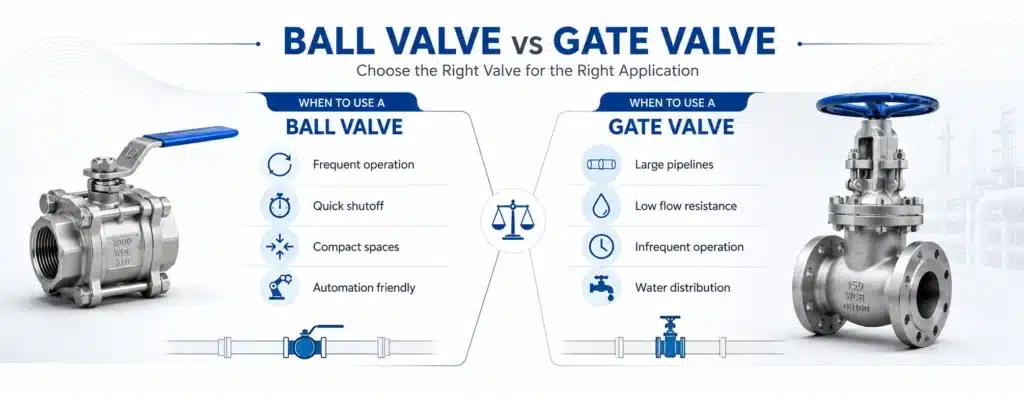
Ball valves provide fast operation, tight sealing and clear open or closed positioning. Gate valves operate more slowly but can provide a straight, low-resistance flow path when fully open. Ball valves are often preferred for frequent shutoff, while gate valves are commonly used in large pipelines that remain fully open or fully closed for long periods.
Simple Selection Rule
Choose a ball valve when you need fast shutoff, reliable sealing and frequent operation. Choose a gate valve when you need full-bore flow in a large pipeline and the valve will not be operated often.
Что такое шаровой кран?
A шаровой кран is a quarter-turn valve that controls flow through a hollow rotating ball. When the hole in the ball is aligned with the pipeline, fluid flows through the valve. When the ball is rotated 90 degrees, the solid side of the ball blocks the passage.
Most manual ball valves use a lever handle. The handle position makes it easy to identify the valve status. When the handle is parallel to the pipe, the valve is normally open. When the handle is perpendicular to the pipe, the valve is closed.
Ball valves are available in brass, stainless steel, carbon steel, PVC and other materials. Common configurations include one-piece, two-piece and three-piece bodies. They may also use threaded, flanged, welded, sanitary or compression connections.
Full Port and Reduced Port Ball Valves
A full port ball valve has an internal opening that is close to the diameter of the connected pipe. This design reduces flow restriction and pressure loss. It is useful in process lines, water systems and applications where pigging or cleaning access is required.
A reduced port ball valve has a smaller internal opening. It is usually more compact and less expensive, but it creates more flow resistance than a full port design.
Advantages of Ball Valves
Ball valves offer fast quarter-turn operation and excellent shutoff performance. Their compact design makes them suitable for limited installation spaces, and their seats can provide a bubble-tight seal in many liquid and gas applications.
Because the ball wipes across the valve seat during operation, ball valves can also perform well in systems that require dependable isolation. Electric or pneumatic actuators can be added to create automated ball valves for remote flow control.
Limitations of Ball Valves
Standard ball valves are primarily designed for fully open or fully closed service. Leaving a standard ball valve partially open for long periods can cause high flow velocity, seat wear and unstable control.
Special V-port ball valves can provide better throttling performance, but a standard full-port ball valve is usually selected for isolation rather than precise flow regulation.
What Is a Gate Valve?
A задвижка controls flow by raising or lowering an internal gate. Turning the handwheel rotates a threaded stem, which moves the gate away from or into the flow passage. When fully open, the gate is lifted out of the pipeline, leaving a relatively straight flow path.
Gate valves are often used in water distribution, wastewater treatment, fire protection, oil and gas pipelines, power generation and large industrial systems. They are especially common in pipelines where the valve remains open for most of its service life.
Common Gate Valve Types
Gate valves may use wedge gates, parallel gates, knife gates or slab gates. A wedge gate creates a tight seal by pressing into angled valve seats. A parallel gate uses two parallel sealing surfaces, while a knife gate has a thin blade designed to cut through thick fluids, slurries or suspended solids.
Gate valves may also be classified as rising-stem or non-rising-stem designs. On a rising-stem gate valve, the stem moves upward as the valve opens. This provides a visible indication of valve position. A non-rising-stem design saves vertical space because the stem rotates without moving upward.
Advantages of Gate Valves
A fully open gate valve normally creates low pressure loss because the gate is moved out of the flow path. This makes it suitable for large pipelines and systems where maintaining flow capacity is important.
Gate valves are available in very large sizes and can be manufactured for high-pressure and high-temperature service. Their design can also support bidirectional flow in many applications.
Limitations of Gate Valves
Gate valves require several turns of the handwheel to open or close, so they operate much more slowly than ball valves. The valve may also require considerable vertical installation space, especially when a rising stem is used.
Gate valves should not normally be used in partially open positions. Throttling can cause vibration, gate movement, erosion and damage to the valve seats. Sediment may also collect in the body cavity and interfere with complete closure.
Key Differences Between Ball Valves and Gate Valves
Operation Speed
A ball valve can be opened or closed with a single 90-degree movement. This is useful for emergency isolation, water shutoff systems and production equipment that requires frequent operation.
A gate valve may require many turns of the handwheel. The slower movement can reduce sudden flow changes, but it is less convenient when rapid shutoff is required.
Sealing Performance
Ball valves are known for tight shutoff. Soft valve seats made from PTFE or other engineered materials press against the polished ball surface and can produce very low leakage rates.
Gate valves can also provide effective isolation, but their sealing surfaces may be more affected by dirt, scale, corrosion and wear. Debris trapped between the gate and seat can prevent complete closure.
Перепад давления
Both valves can provide low pressure loss when fully open. A full port ball valve offers a smooth passage with minimal restriction. A fully open gate valve also leaves most of the flow path unobstructed.
However, reduced port ball valves have smaller internal passages and may create more pressure drop. Valve size and port design should always be checked before purchase.
Space Requirements
Ball valves have compact bodies and usually require limited installation space. The lever handle needs room to rotate, but the valve does not require additional vertical clearance for a moving stem.
Rising-stem gate valves require enough space above the valve for the stem to extend. This can be a disadvantage in underground chambers, ceilings or compact equipment rooms.
Техническое обслуживание
Three-piece ball valves are designed for easier maintenance because the center body can often be removed without disturbing the complete pipeline. Their simple quarter-turn mechanism also reduces the number of moving components.
Gate valves may require more maintenance when sediment, corrosion or seat damage affects movement. Removing and servicing a large gate valve can also require more time and labor.
Typical Ball Valve and Gate Valve Applications
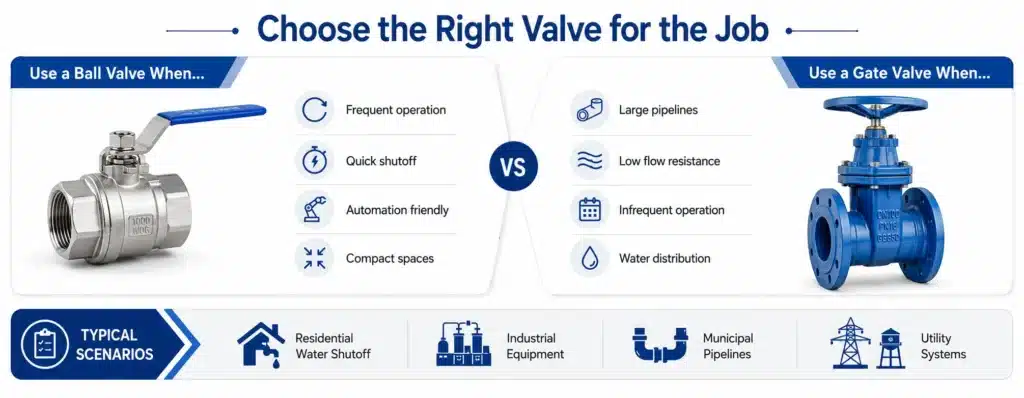
When to Use a Ball Valve
Ball valves are commonly used for residential and commercial water shutoff, compressed air, natural gas, chemical processing, industrial equipment, irrigation and automated process systems.
A ball valve is often the better choice when the valve must be operated regularly, when clear position indication is important or when tight shutoff is required. Motorized and pneumatic ball valves are especially useful in systems controlled by sensors, timers or programmable logic controllers.
When to Use a Gate Valve
Gate valves are frequently installed in municipal water mains, fire protection systems, large industrial pipelines, wastewater facilities, power plants and oil distribution networks.
A gate valve may be preferred when the pipeline diameter is large, pressure loss must remain low and the valve will stay fully open during normal operation. Gate valves can also be economical in larger sizes compared with some ball valve designs.
Residential Water Shutoff
Modern residential water systems commonly use ball valves for the main water shutoff because they are fast, compact and easy to operate. A quarter-turn handle clearly shows whether the water supply is open or closed.
Older plumbing systems may still use gate valves. Over time, these valves can become difficult to operate because of corrosion, mineral buildup or stem wear. For this reason, many replacement projects use ball valves instead.
Industrial Pipeline Isolation
In industrial facilities, the selection depends on pipe size, media, pressure, temperature and operating frequency. Ball valves are widely used for clean fluids, gases and automated isolation. Gate valves are often used in large process lines that require unrestricted flow.
How to Choose Between a Ball Valve and a Gate Valve
1. Consider Operating Frequency
Select a ball valve for frequent operation. A gate valve is more appropriate when the valve will remain in one position for extended periods.
2. Determine the Required Speed
Use a ball valve when rapid shutoff is necessary. Choose a gate valve when slow opening and closing are acceptable.
3. Check the Pipe Size
Ball valves are practical in small and medium sizes, while gate valves are often economical and widely available for large pipelines.
4. Review the Fluid
Confirm that the body, seat, seals and internal components are compatible with water, gas, oil, chemicals, slurry or other process media.
5. Evaluate Installation Space
Ball valves are usually more compact. Gate valves, particularly rising-stem designs, may need additional space above the pipeline.
6. Confirm Pressure and Temperature
Choose a valve with ratings above the maximum system pressure and temperature. Do not select a valve based only on its nominal pipe size.
Can Ball Valves or Gate Valves Control Flow?
Standard ball valves and gate valves are primarily isolation valves. They are intended to operate in fully open or fully closed positions. Using either valve for long-term throttling can cause wear, noise, vibration and unstable flow.
For accurate flow regulation, a globe valve, control valve or specially designed V-port ball valve is usually more suitable. The correct control valve depends on the required flow characteristic, pressure drop and actuator system.
Часто задаваемые вопросы
Which Is Better, a Ball Valve or a Gate Valve?
Neither valve is better in every situation. A ball valve is usually better for fast operation, frequent use and tight shutoff. A gate valve is often better for large pipelines that require low flow restriction.
Can a Ball Valve Replace a Gate Valve?
In many water and general industrial systems, a ball valve can replace a gate valve when the pressure rating, connection size, material and flow capacity are suitable. Installation dimensions should also be checked.
Why Do Gate Valves Fail to Close Completely?
Sediment, mineral deposits, corrosion, damaged seats or a worn stem can prevent the gate from reaching the fully closed position.
Do Ball Valves Restrict Flow?
A full port ball valve creates very little restriction. A reduced port ball valve has a smaller internal opening and produces more pressure loss.
Can a Gate Valve Be Installed in Either Direction?
Many gate valves support bidirectional flow, but the manufacturer’s flow direction and installation instructions should always be confirmed.
Choose the Right Valve for Reliable Shutoff
The difference between a ball valve and a gate valve comes down to operating method, speed, sealing, installation space and application requirements. Ball valves provide quick quarter-turn operation and dependable shutoff, while gate valves provide low-resistance flow in large pipelines.
By reviewing the pipe size, fluid, pressure, temperature, operating frequency and maintenance requirements, you can select a valve that improves system safety, efficiency and service life.