


Valve Knowledge
What Is a Swing Check Valve?
A swing check valve is an automatic valve designed to allow fluid to flow in one direction while preventing reverse flow. It is widely used in water supply, wastewater treatment, oil and gas, power generation, chemical processing, fire protection, and many other industrial piping systems. Because of its simple structure, low pressure loss, and reliable operation, the swing check valve remains one of the most common non-return valve designs used in modern fluid control systems.
What Is a Swing Check Valve?
A swing check valve is a mechanical device that controls the direction of fluid flow inside a pipeline. Its main purpose is to prevent backflow, which occurs when liquid or gas begins moving in the opposite direction from the intended process flow.
Unlike manually operated isolation valves, a swing check valve does not require a handwheel, actuator, operator, or external control system. It opens and closes automatically according to the pressure difference and flow conditions inside the pipeline.
When upstream pressure is higher than downstream pressure, the fluid pushes the valve disc away from the seat. This movement opens the flow passage and allows the medium to move through the valve. When the flow slows down, stops, or reverses, the disc swings back toward the seat and closes the valve.
The word “swing” describes the movement of the closure disc. The disc is connected to a hinge or shaft and rotates away from the valve seat as fluid enters the valve body. This swinging movement creates a relatively open internal flow path, making the valve suitable for applications where high flow capacity and low pressure loss are important.
How Does a Swing Check Valve Work?
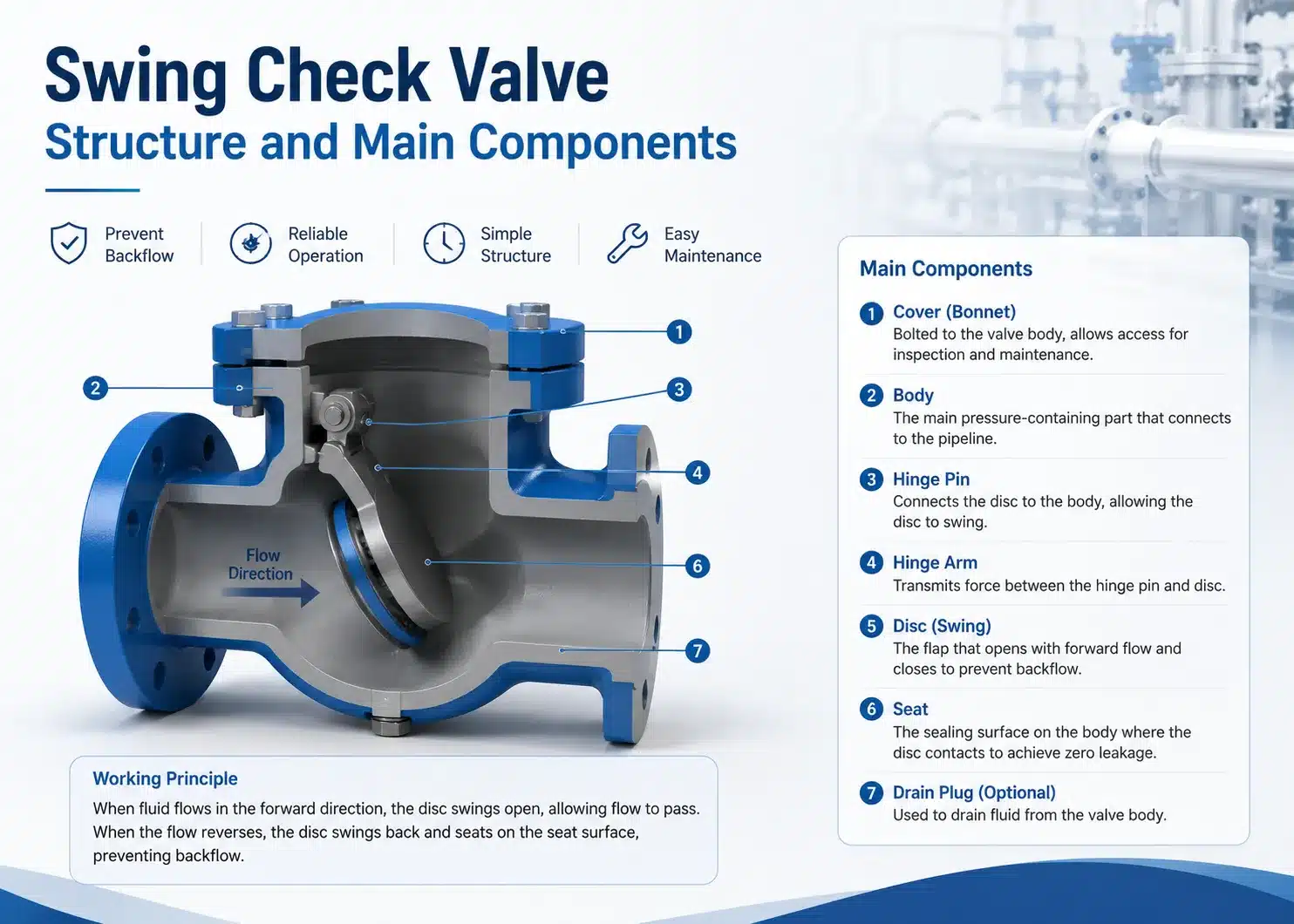
The working principle of a swing check valve is based on differential pressure, fluid velocity, disc weight, and gravity. The valve contains a circular or specially shaped disc mounted on a hinge inside the valve body.
When fluid moves in the correct direction, upstream pressure acts against the disc. Once the force created by the fluid is sufficient to overcome the disc weight and resistance of the hinge, the disc rotates away from the valve seat.
As the disc opens, the fluid passes through the valve body with relatively little obstruction. The actual opening angle depends on the flow rate, pressure difference, disc weight, hinge design, valve size, and installation position.
Under stable operating conditions, the disc remains open without any external power source. When a pump stops or upstream pressure decreases, the forward flow begins to lose momentum. Gravity and reverse pressure then move the disc back toward the valve seat.
Once the disc contacts the sealing surface, the valve blocks reverse flow and helps protect pumps, pipelines, storage tanks, and other process equipment.
The minimum pressure required to begin opening the valve is commonly called cracking pressure. Standard swing check valves normally have a low cracking pressure because their discs can rotate freely around the hinge.
However, the closing response of the valve must be considered carefully. If the disc closes too slowly, reverse flow may develop before the valve reaches the fully closed position. When the disc finally contacts the seat, the sudden impact may produce valve slam, vibration, noise, pressure surges, or water hammer.
Main Components of a Swing Check Valve
Although swing check valves are available in different sizes, materials, pressure classes, and connection types, most models contain the same basic components.
Корпус клапана
The valve body is the main pressure-containing component. It connects the valve to the pipeline and forms the internal passage through which the fluid flows.
Common body materials include cast iron, ductile iron, carbon steel, stainless steel, bronze, duplex stainless steel, and corrosion-resistant alloys. The correct material depends on the fluid, operating temperature, pressure, corrosion risk, and industry requirements.
Disc
The disc is the moving closure component. It swings open when forward pressure acts against it and returns to the valve seat when the flow stops or reverses.
The weight, shape, material, and balance of the disc affect flow resistance, opening pressure, closing speed, sealing performance, and resistance to mechanical wear.
Valve Seat
The valve seat provides the sealing surface between the disc and the valve body. Seats may be made from metal, rubber, elastomer, polymer, or a combination of materials.
Soft-seated swing check valves normally provide tighter shutoff at lower pressure. Metal-seated valves are generally more suitable for high temperatures, abrasive media, dirty fluids, and severe industrial service.
Hinge and Hinge Pin
The hinge assembly allows the disc to rotate between the open and closed positions. It must support the weight of the disc and withstand repeated operating cycles.
Proper alignment is important because corrosion, wear, debris, or hinge deformation can restrict disc movement and prevent the valve from closing correctly.
Bonnet or Cover
The bonnet provides access to the internal valve components. Depending on the valve design, it may be bolted, threaded, welded, or pressure sealed.
A removable bonnet allows operators to inspect and maintain the disc, seat, hinge, and internal surfaces without replacing the entire valve body.
Common Types of Swing Check Valves
Swing check valves can be classified according to their body construction, connection method, disc arrangement, sealing design, and intended service.
Standard Swing Check Valve
A standard swing check valve uses a single hinged disc that rotates through the valve body. It is commonly installed in horizontal pipelines and is widely used in general water, oil, gas, and industrial fluid systems.
Flanged Swing Check Valve
A flanged swing check valve connects directly to mating pipe flanges. Flanged models are frequently used in larger pipe sizes, municipal water systems, pump stations, power plants, refineries, and heavy industrial installations.
The flange standard and pressure class must match the connected pipeline. Common standards include ASME, EN, DIN, BS, and JIS flange systems.
Wafer Swing Check Valve
A wafer swing check valve has a compact body designed to fit between two pipeline flanges. It normally requires less installation space and weighs less than a conventional full-body flanged valve.
This type is useful where equipment weight, installation space, and piping layout are important considerations.
Threaded Swing Check Valve
Threaded swing check valves are generally used in smaller pipelines. They are common in commercial plumbing, irrigation systems, building services, light industrial equipment, and low- to medium-pressure applications.
Tilting Disc Check Valve
A tilting disc check valve is a related design in which the disc rotates around a pivot point located closer to the center of the disc.
This arrangement reduces the distance the disc must travel before closing. As a result, a tilting disc design may respond faster than a conventional swing check valve and may be more suitable for systems with a higher risk of pressure surge.
Counterweighted Swing Check Valve
Some swing check valves include an external lever and counterweight. The counterweight can assist disc closure, adjust the closing response, and reduce the amount of reverse flow that develops before shutoff.
These valves are commonly used in waterworks, pumping stations, wastewater facilities, and large-diameter pipelines where water hammer control is important.
Where Are Swing Check Valves Used?
The swing check valve is suitable for many systems that require automatic backflow prevention and a relatively unrestricted flow path.
Water Supply Systems
Swing check valves are widely used in municipal water networks, building water supply systems, storage tank lines, treatment plants, and distribution pipelines.
They prevent water from flowing backward through pumps or returning to upstream treatment and storage equipment.
Wastewater Treatment
In wastewater treatment facilities, swing check valves help control flow through pumping stations, treatment units, discharge lines, and drainage systems.
Large internal passages and full-port designs may be preferred to reduce the possibility of blockage caused by suspended solids or debris.
Pump Discharge Lines
A swing check valve is commonly installed downstream of a centrifugal pump. When the pump operates, the pressure generated by the pump opens the valve.
When the pump stops, the valve closes and prevents the fluid column from reversing through the pump. This helps protect the pump impeller, shaft, seals, and connected equipment.
Oil and Gas Systems
Carbon steel and stainless steel swing check valves are used in petroleum processing facilities, pipelines, terminals, refineries, storage systems, and gas handling installations.
Pressure class, material compatibility, fire-safe requirements, corrosion allowance, and applicable valve standards are especially important in oil and gas service.
Производство электроэнергии
Power plants use swing check valves in cooling water, boiler feedwater, condensate, fuel, auxiliary water, and process utility systems.
High-temperature or high-pressure applications may require forged steel, alloy steel, pressure-seal bonnets, and metal seating surfaces.
Химическая переработка
In chemical plants, swing check valves may handle corrosive, toxic, reactive, or hazardous media. Body materials, trim materials, gaskets, seats, coatings, and sealing requirements must be matched carefully to the process fluid.
Fire Protection and Irrigation
Swing check valves are also used in fire water systems, sprinkler installations, agricultural irrigation networks, pumping stations, and water storage systems where dependable one-way flow is required.
Advantages of a Swing Check Valve
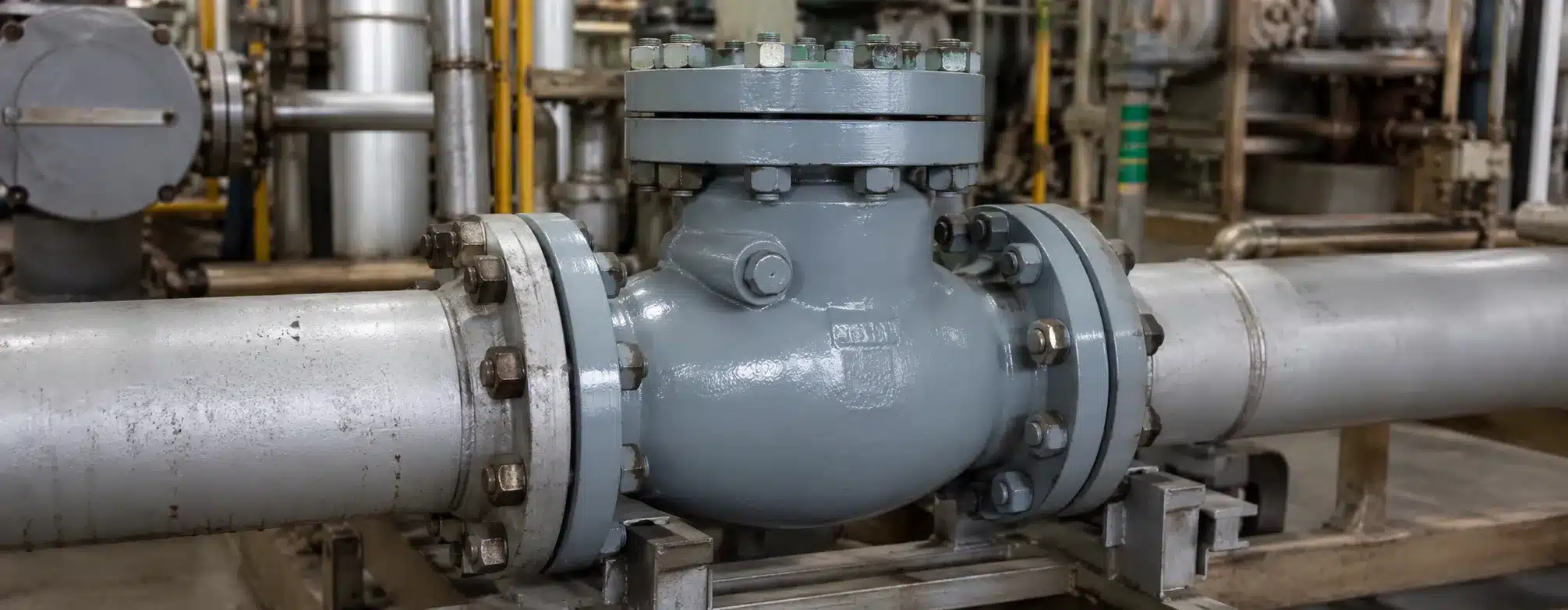
One of the main advantages of a swing check valve is its relatively low flow resistance. When the disc is fully open, it moves away from the main flow path and creates a large internal passage.
This design can reduce pressure loss and pumping energy compared with check valves that place a spring, piston, or closure element directly in the center of the flow path.
A swing check valve also has a mechanically simple structure. A conventional model has relatively few moving parts, which can contribute to long service life when the valve is properly sized, installed, and maintained.
Other important advantages include automatic operation, low cracking pressure, high flow capacity, availability in large pipe sizes, and compatibility with many body and seat materials.
Many swing check valves can be inspected through a removable bonnet without removing the complete valve from the pipeline. This can simplify routine inspection and reduce maintenance time.
Because the valve does not require an actuator or external power source, it can provide a cost-effective way to protect pumps, pipelines, storage equipment, and process systems from reverse flow.
Limitations of a Swing Check Valve
Despite its advantages, a swing check valve is not suitable for every fluid system. Its disc requires sufficient flow velocity to reach and remain in a stable open position.
In systems with very low, pulsating, or unstable flow, the disc may remain partially open. It may repeatedly move toward and away from the seat, causing chattering, noise, hinge wear, and sealing surface damage.
The relatively long travel distance of a conventional swing disc may also result in slower closure. If the flow reverses rapidly, the fluid may gain reverse velocity before the disc reaches the seat.
When the disc finally closes, the sudden interruption of reverse flow can produce valve slam, vibration, pressure surges, or water hammer.
Swing check valves may also be unsuitable for fluids containing large quantities of fibers, heavy solids, sticky materials, or deposits. Contamination can become trapped between the disc and seat and prevent complete shutoff.
Installation orientation is another important limitation. Most conventional swing check valves perform best in horizontal pipelines with the bonnet facing upward.
Vertical installation may be acceptable when the flow direction is upward, but the valve manufacturer should confirm that the specific design is suitable for that orientation.
How to Select the Right Swing Check Valve
Selecting the correct swing check valve requires more than simply matching the nominal pipe diameter. Engineers, contractors, plant operators, and buyers should evaluate the complete operating conditions.
Flow Rate and Fluid Velocity
The valve should be sized so that normal flow keeps the disc in a stable open position. A valve selected only according to pipe size may be too large for the actual operating flow.
An oversized swing check valve may operate partially open, causing disc flutter, impact, hinge wear, noise, and premature seat damage.
Maximum Operating Pressure
The selected pressure class must meet or exceed the maximum system pressure. Potential surge pressure and water hammer pressure should also be considered.
Common valve ratings include PN10, PN16, PN25, PN40, Class 150, Class 300, and higher pressure classes for demanding industrial service.
Fluid Characteristics
The type of medium has a major influence on valve selection. Water, steam, oil, natural gas, chemicals, wastewater, slurry, and compressed air have different requirements.
The medium determines suitable body materials, seat materials, internal coatings, gasket materials, corrosion resistance, and sealing construction.
Operating Temperature
Temperature affects body material strength, gasket performance, coating durability, and seat compatibility.
Resilient seats may be suitable for ambient-temperature water systems, while steam, thermal oil, and high-temperature process applications may require metal seating.
Тип подключения
Available end connections include flanged, threaded, wafer, socket-weld, and butt-weld designs.
The selected connection should match the piping standard, pressure class, maintenance strategy, available installation space, and service environment.
Required Sealing Performance
Not every swing check valve provides bubble-tight sealing. The acceptable leakage rate should be defined according to the process and applicable testing standard.
Soft-seated valves normally provide tighter sealing at lower differential pressure. Metal-seated valves generally offer better resistance to high temperature, erosion, abrasion, and repeated mechanical impact.
Closing Characteristics
For systems with rapid pump shutdown, long discharge lines, high fluid velocity, or significant surge risk, a standard swing check valve may not provide the best closing response.
A counterweighted, damped, tilting disc, axial-flow, or non-slam check valve may provide faster and more controlled closure.
Применимые стандарты
Depending on the industry and destination market, swing check valves may be designed, manufactured, inspected, and tested according to API, ASME, EN, DIN, BS, AWWA, or ISO standards.
Buyers should verify design standards, pressure-temperature ratings, face-to-face dimensions, flange compatibility, material certification, inspection documentation, and pressure testing requirements.
Swing Check Valve Installation Guidelines
Correct installation has a direct influence on valve performance, service life, and system reliability.
Before installation, inspect the valve body, disc, seat, hinge, and internal cavity. Remove packaging materials, dirt, welding slag, rust, scale, and other foreign objects from the connected pipeline.
The flow arrow marked on the valve body must point in the same direction as the normal process flow. Installing the valve in the wrong direction will prevent correct operation.
For horizontal installation, the bonnet should normally face upward. This orientation allows the disc to move freely and enables gravity to assist during closure.
The hinge shaft should remain in the orientation recommended by the manufacturer. Rotating the valve body into an unsuitable position may cause uneven disc movement or prevent complete closure.
When installing a swing check valve in a vertical pipeline, normal flow should generally move upward. Downward vertical flow may cause the disc to remain open or close unpredictably.
The valve should be installed a suitable distance from pumps, elbows, reducers, control valves, and other components that create severe turbulence. Disturbed flow can cause unstable disc movement and increase mechanical wear.
Large valves should be supported independently so that excessive pipeline weight and bending loads are not transferred to the valve body.
Flanges must be aligned before tightening the bolts. Bolts should be tightened gradually and evenly according to the recommended tightening pattern.
After installation, the system should be commissioned gradually. Operators should check for external leakage, unusual vibration, impact noise, and unstable disc behavior.
Maintenance and Troubleshooting
A properly selected swing check valve can operate reliably for many years, but periodic inspection is still necessary.
The appropriate maintenance interval depends on fluid cleanliness, pressure, temperature, flow stability, operating frequency, corrosion conditions, and service severity.
Common inspection points include seat wear, disc damage, hinge pin wear, corrosion, gasket leakage, internal deposits, loose fasteners, and restricted disc movement.
The disc should rotate freely without excessive looseness. The seating surfaces should remain clean, aligned, and free from deep scratches, erosion, or impact damage.
Reverse Leakage
If the valve leaks in the reverse direction, possible causes include dirt on the seat, a damaged sealing surface, disc misalignment, corrosion, hinge wear, or insufficient differential pressure.
The valve may need to be cleaned, adjusted, resurfaced, or fitted with replacement internal components.
Valve Slam
If the valve produces a loud impact during pump shutdown, the system may be experiencing valve slam.
Possible solutions include reviewing the valve size, increasing normal operating velocity, changing the valve location, adjusting pump shutdown characteristics, or selecting a faster-closing check valve design.
Disc Chattering
Repeated chattering often indicates that the valve is oversized or operating under unstable flow conditions.
In this condition, the disc does not remain fully open and repeatedly moves inside the body. Long-term chattering can damage the disc, hinge, seat, bonnet, and connected piping.
Failure to Open
If the valve does not open fully, possible causes include insufficient upstream pressure, low flow velocity, hinge corrosion, internal deposits, an incorrect installation direction, or mechanical obstruction.
Swing Check Valve vs Other Check Valve Designs
A swing check valve is one of several valve designs used to prevent reverse flow. Each design has different performance characteristics.
Swing Check Valve vs Lift Check Valve
A swing check valve normally offers a more open flow path and lower pressure loss than a lift check valve. However, a lift check valve may be more suitable for high-pressure applications and systems with higher flow velocity.
Swing Check Valve vs Spring Check Valve
A swing check valve normally has a lower cracking pressure because it does not require the fluid to compress a spring.
A spring-loaded check valve generally closes faster and may be installed in more orientations. It may therefore be better suited to systems where rapid closure is required.
Swing Check Valve vs Dual Plate Check Valve
A conventional swing check valve generally has a larger body and a heavier disc. A dual plate check valve is more compact and uses two spring-assisted plates.
Dual plate designs may reduce closing time and installation weight, while conventional swing check valves remain popular because of their simple structure and broad availability in large sizes.
Swing Check Valve vs Ball Check Valve
A ball check valve uses a moving ball instead of a hinged disc. Ball check valves may be suitable for wastewater, slurry, and fluids containing suspended solids.
Swing check valves are often preferred for clean liquids and large pipelines where low pressure loss is a priority.
Часто задаваемые вопросы
Can a Swing Check Valve Be Installed Vertically?
Some swing check valves can be installed in vertical pipelines, but the normal flow direction should generally be upward. Upward flow helps push the disc open, while gravity assists the disc during closure.
The valve manufacturer should confirm whether the specific model is approved for vertical installation.
Does a Swing Check Valve Reduce Pressure?
Every valve creates some pressure loss. However, a fully open swing check valve normally has relatively low resistance because the disc moves away from the main flow path.
The actual pressure drop depends on the valve size, internal geometry, flow rate, fluid density, and disc opening angle.
Why Does a Swing Check Valve Slam?
Valve slam occurs when reverse flow develops before the disc reaches the closed position. When the disc finally strikes the seat, the sudden interruption of reverse flow creates impact, noise, vibration, and a possible pressure surge.
Oversizing, rapid pump shutdown, unstable flow, high fluid velocity, and poor valve location can increase the risk of slam.
Can a Swing Check Valve Be Used for Steam?
A swing check valve can be used for steam when its body, disc, seat, trim, gasket, pressure class, and temperature rating are suitable for the operating conditions.
Metal-seated carbon steel, stainless steel, or alloy steel valves are commonly selected for higher-temperature steam service.
What Is the Difference Between a Swing Check Valve and a Non-Return Valve?
A non-return valve is a general category of automatic valves designed to prevent reverse flow. A swing check valve is one specific type of non-return valve that uses a hinged disc as its closure component.
Can a Swing Check Valve Be Installed Near a Pump?
A swing check valve is often installed on a pump discharge line, but it should not always be positioned immediately beside the pump outlet.
Sufficient straight pipe may be required to reduce turbulence and allow stable disc movement. The correct installation distance depends on the pump, piping arrangement, valve design, and manufacturer recommendations.
How Long Does a Swing Check Valve Last?
The service life of a swing check valve depends on material selection, flow conditions, operating frequency, fluid cleanliness, pressure, temperature, and maintenance quality.
A correctly sized and properly maintained valve can remain in service for many years. Oversizing, chattering, corrosion, abrasive media, and frequent valve slam can significantly reduce its service life.
Заключение
A swing check valve is a simple and effective automatic valve used to prevent reverse flow in piping systems. Its hinged disc opens under forward fluid pressure and closes when the flow stops or changes direction.
The design offers low pressure loss, high flow capacity, simple construction, broad material availability, and relatively easy maintenance. These advantages make swing check valves suitable for water, wastewater, oil and gas, chemical processing, power generation, irrigation, fire protection, and many general industrial applications.
However, correct sizing, installation orientation, material selection, and closing characteristics are essential. An improperly selected valve may experience disc chattering, reverse leakage, hinge wear, valve slam, or water hammer.
When choosing a swing check valve, engineers and buyers should consider the fluid type, flow rate, fluid velocity, pipe size, operating pressure, temperature, end connection, sealing requirement, installation position, and applicable industry standards.
A properly engineered swing check valve can protect pumps, reduce backflow risk, improve process reliability, and provide dependable long-term service throughout the piping system.