


Water Valve Automation
How Can We Open or Close a Water Supply Valve Remotely?
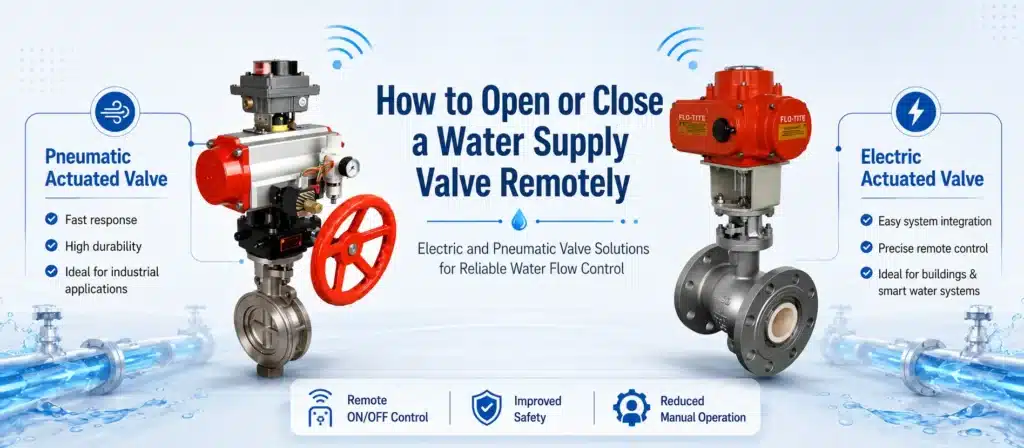
Remote control of water supply valves is widely used in buildings, industrial plants, irrigation systems, water treatment facilities, and smart water management networks. By using electric or pneumatic actuated valves, operators can open, close, or monitor water flow without manually operating the valve on site.
Why Remote Valve Control Matters
A remote water supply valve allows users to control water flow from a control panel, PLC, SCADA system, building management system, or smart controller. This improves response speed, reduces manual labor, and helps prevent water damage caused by leaks, overpressure, or system failures.
In practical applications, the most common solutions are electric actuated valves and pneumatic actuated valves. Both options can provide reliable remote operation when they are correctly selected, installed, and maintained.
Electric Actuated Valves
An electric actuated valve uses an electric actuator to drive the valve mechanism. When the actuator receives a control signal, it opens or closes the valve automatically. Electric actuators are commonly used with ball valves, butterfly valves, and gate valves in water supply systems.
How Electric Valves Work
The actuator converts electrical energy into mechanical movement. Depending on the design, it may rotate a ball valve, move a butterfly disc, or drive a stem mechanism. Common power options include 24V DC, 110V AC, and 220V AC. Many electric actuators also provide open and close position feedback for remote monitoring.
Typical Applications
Electric actuated valves are suitable for smart buildings, HVAC systems, water treatment equipment, irrigation systems, residential water shutoff systems, and unmanned pump rooms. They are especially useful where electrical power is available but compressed air is not.
Main Advantages of Electric Actuated Valves
- Easy integration with PLC, BMS, IoT, and smart control systems
- No compressed air system required
- Available with position feedback and manual override
- Suitable for precise and stable remote water control
Pneumatic Actuated Valves
A pneumatic actuated valve uses compressed air to open or close the valve. The actuator converts air pressure into mechanical motion, usually rotary movement for ball valves and butterfly valves. A solenoid valve is often used to control the air direction, enabling remote operation through an electrical signal.
How Pneumatic Valves Work
In a pneumatic control system, compressed air enters the actuator and moves the internal piston or rack-and-pinion mechanism. This movement turns the valve stem and changes the valve position. The control signal usually activates a solenoid valve, which directs air to the actuator.
Double-Acting and Spring-Return Actuators
Pneumatic actuators are commonly divided into double-acting and spring-return types. A double-acting actuator uses air pressure to both open and close the valve. A spring-return actuator uses air pressure in one direction and a spring mechanism in the other direction, allowing the valve to return to a predefined safe position when air pressure is lost.
Main Advantages of Pneumatic Actuated Valves
- Fast opening and closing speed
- Strong output force and high durability
- Suitable for frequent operation
- Good choice for industrial environments with compressed air supply
Electric vs. Pneumatic Valves: Which Is Better?
There is no single best option for every water supply system. Electric actuated valves are usually preferred for buildings, automation systems, and applications where simple wiring and digital control are required. Pneumatic actuated valves are often selected for industrial sites where compressed air is already available and fast, frequent, or fail-safe operation is important.
| Factor | Electric Actuated Valve | Pneumatic Actuated Valve |
|---|---|---|
| Power Source | Electric power | Compressed air |
| Installation | Simpler where power is available | Requires air compressor and air lines |
| Response Speed | Moderate | Fast |
| Best For | Buildings, HVAC, irrigation, smart water systems | Industrial plants, water treatment, process automation |
| Fail-Safe Option | Battery backup or spring-return actuator | Spring-return actuator |
Key Selection Factors
To achieve reliable remote water valve control, engineers should evaluate the full system instead of focusing only on the actuator type. Important factors include valve size, pressure rating, flow rate, actuator torque, control signal, installation environment, operating frequency, and maintenance access.
- Confirm pipe size, water pressure, and required flow capacity.
- Select a valve body material suitable for the water quality and environment.
- Ensure the actuator torque is sufficient under real working conditions.
- Choose the correct control voltage or signal type.
- Consider manual override, position feedback, and emergency shutoff functions.
- Use waterproof, weatherproof, or explosion-proof components when required.
Conclusion
Opening or closing a water supply valve remotely can be achieved effectively with either electric actuated valves or pneumatic actuated valves. Electric valves are convenient, easy to integrate, and well suited for building and smart water applications. Pneumatic valves provide fast response, strong performance, and reliable operation in industrial environments.
For the best result, the valve, actuator, control system, and working conditions should be evaluated together. A properly designed remote valve control system can improve safety, reduce maintenance workload, and provide better control over water supply operations.