


5 Types Of Flow Control Valve
A flow control valve is one of the most important components in industrial piping systems, process plants, water treatment facilities, HVAC systems, power stations, chemical production lines, and oil and gas applications. Its primary function is to regulate, start, stop, or direct the movement of fluid through a pipeline. Depending on the valve design, a flow control valve can provide simple on-off isolation, accurate throttling, pressure control, backflow prevention, or emergency shutoff.
Choosing the right type of flow control valve is not only a matter of pipe size or pressure rating. Engineers must also consider fluid characteristics, operating temperature, pressure drop, sealing requirements, flow direction, maintenance conditions, automation needs, and long-term service life. A valve that performs well in a clean water system may not be suitable for steam, slurry, corrosive chemicals, high-viscosity media, or high-cycle operation.
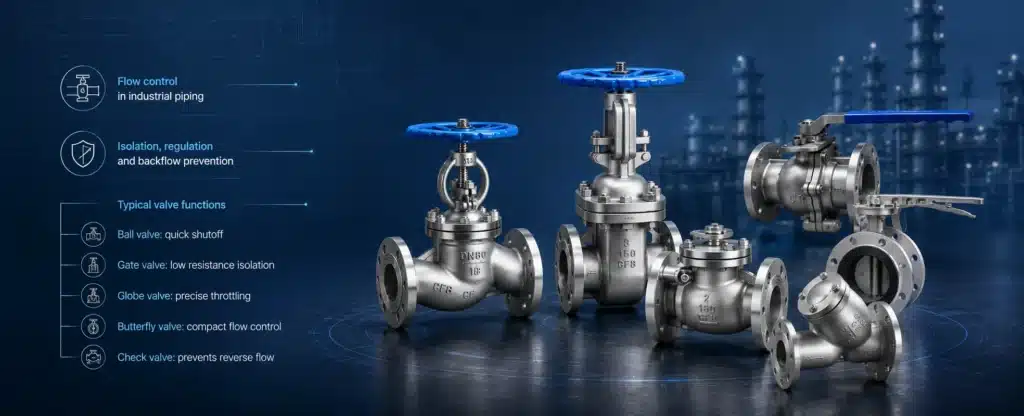
Among the many valve designs available, five common types are widely used across industries: ball valve, gate valve, globe valve, butterfly valve, and check valve. Each type has its own flow control characteristics, strengths, limitations, and best-use scenarios. Understanding these differences helps buyers, engineers, and maintenance teams select the most reliable and cost-effective valve for their system.
What Is a Flow Control Valve?
A flow control valve is a mechanical device used to manage the flow rate, pressure, or direction of liquid, gas, steam, or slurry inside a piping system. By changing the position of the valve closure element, the valve changes the available flow area and influences how much medium can pass through.
In practical applications, a flow control valve may be manually operated with a handle, lever, handwheel, or gearbox. It may also be automated with pneumatic, electric, or hydraulic actuators. Automated flow control valves are commonly used in process control systems where accurate and repeatable operation is required.
The main purposes of a flow control valve include:
- Starting or stopping fluid flow
- Regulating flow rate
- Controlling pressure or pressure drop
- Preventing reverse flow
- Protecting pumps, compressors, meters, and pipelines
- Improving process stability and operational safety
Comparison Table: 5 Common Types of Flow Control Valve
| Valve Type | Main Function | Flow Control Ability | Key Advantages | Common Applications |
|---|---|---|---|---|
| Ball Valve | On-off isolation and quick shutoff | Good for shutoff; limited for precise throttling | Fast operation, tight sealing, low pressure drop | Water, gas, oil, chemical lines, utility systems |
| Gate Valve | Full open or full close isolation | Poor for throttling | Low flow resistance, suitable for large pipelines | Water supply, fire protection, oil and gas pipelines |
| Globe Valve | Flow regulation and throttling | Excellent for precise control | Accurate adjustment, stable control performance | Steam, cooling water, fuel oil, process control systems |
| Butterfly Valve | Isolation and moderate flow regulation | Good for general control | Compact, lightweight, cost-effective for large sizes | HVAC, water treatment, seawater, power plants |
| Check Valve | Backflow prevention | Automatic directional control | Protects equipment from reverse flow | Pump discharge lines, wastewater, chemical systems |
1. Ball Valve
A ball valve is a quarter-turn flow control valve that uses a spherical ball with a hole through its center to control fluid movement. When the hole is aligned with the pipeline, fluid flows through the valve. When the ball is rotated 90 degrees, the hole becomes perpendicular to the flow path and the valve closes.
Ball valves are widely known for their fast operation and excellent sealing performance. Because the flow path is relatively straight when fully open, a ball valve usually creates a low pressure drop compared with many other valve types. This makes it suitable for applications where high flow capacity and reliable shutoff are required.
Advantages of Ball Valves
The most important advantage of a ball valve is tight shutoff. Soft-seated ball valves can provide bubble-tight sealing in many clean fluid applications. Metal-seated ball valves are also available for high-temperature, abrasive, or severe service conditions. Another major benefit is easy operation. A simple 90-degree turn allows the valve to move from fully open to fully closed.
Ball valves are commonly used in water systems, compressed air lines, natural gas pipelines, petroleum systems, chemical processing, and general industrial service. They are also easy to automate with electric or pneumatic actuators, making them suitable for remote operation and emergency shutdown systems.
Limitations of Ball Valves
Although a ball valve can partially open to reduce flow, it is not usually the best choice for precise throttling. Long-term throttling may damage the seat, especially when high velocity, cavitation, flashing, or abrasive particles are present. For accurate flow regulation, a globe valve or a specially designed control valve is often more suitable.
In summary, a ball valve is an excellent flow control valve for fast shutoff, low leakage, and low pressure drop, but it should be selected carefully when continuous throttling is required.
2. Gate Valve
A gate valve is a linear-motion valve that uses a gate or wedge-shaped disc to start or stop flow. When the gate is lifted completely, the valve provides an unobstructed flow path. When the gate is lowered, it blocks the flow. Gate valves are mainly designed for fully open or fully closed operation.
One of the key advantages of a gate valve is low flow resistance. When fully open, the gate is removed from the flow path, allowing fluid to pass through with minimal pressure loss. This makes gate valves suitable for large-diameter pipelines and systems where pressure drop must be kept low.
Advantages of Gate Valves
Gate valves are durable and suitable for many industrial services, including water distribution, fire protection, oil and gas transmission, irrigation systems, and power plant piping. They are often chosen for applications where the valve remains open or closed for long periods and does not require frequent adjustment.
Gate valves are available in different designs, such as rising stem, non-rising stem, solid wedge, flexible wedge, and parallel slide types. Material options include cast iron, ductile iron, carbon steel, stainless steel, bronze, and alloy steel, depending on pressure, temperature, and fluid compatibility.
Limitations of Gate Valves
A gate valve is not recommended for throttling. If the valve is left partially open, the gate may vibrate due to fluid turbulence. This can cause wear, noise, erosion, and damage to the sealing surfaces. In addition, gate valves generally require more operating turns than quarter-turn valves, so opening and closing speed is slower.
For systems that need simple isolation with very low pressure loss, a gate valve is a reliable option. However, for accurate flow control, other valve types should be considered.
3. Globe Valve
A globe valve is one of the most effective types of flow control valve for throttling and regulation. It uses a movable plug or disc and a stationary seat to control flow. Unlike a gate valve, the flow path inside a globe valve changes direction, which creates higher pressure drop but allows more precise flow adjustment.
Globe valves are commonly used where flow needs to be frequently adjusted rather than simply turned on or off. Their design allows operators to control the opening position more accurately, making them suitable for process systems that require stable flow, pressure, or temperature control.
Advantages of Globe Valves
The main advantage of a globe valve is its excellent throttling capability. It offers better control accuracy than ball valves, gate valves, and many standard butterfly valves. The disc and seat design can be modified for different control characteristics, including linear, equal percentage, or quick opening performance in engineered control applications.
Globe valves are widely used in steam systems, cooling water lines, boiler feedwater, fuel oil systems, chemical processing, condensate lines, and general process control. They are also suitable for applications where frequent operation is expected.
Limitations of Globe Valves
The main disadvantage of a globe valve is higher pressure drop. Because the flow changes direction inside the valve body, more energy is lost compared with straight-through valves. Globe valves may also be heavier and more expensive than simpler isolation valves of the same size and pressure class.
Despite these limitations, the globe valve remains one of the best choices when reliable and repeatable flow regulation is required. For many engineers, it is the preferred flow control valve for throttling service.
4. Butterfly Valve
A butterfly valve is a quarter-turn valve that uses a rotating disc to control flow. The disc is mounted on a shaft in the center of the pipe. When the disc is parallel to the flow direction, the valve is open. When the disc is perpendicular to the flow direction, the valve is closed.
Butterfly valves are popular because they are compact, lightweight, and cost-effective, especially in large pipe sizes. Compared with gate valves or globe valves, butterfly valves usually require less installation space and are easier to operate. They can be manually operated with a lever or gearbox, or automated with pneumatic, electric, or hydraulic actuators.
Advantages of Butterfly Valves
A butterfly valve is suitable for both isolation and moderate flow regulation. It performs well in water treatment plants, HVAC systems, cooling water circuits, seawater systems, power plants, shipbuilding, food processing, and general industrial piping.
There are several butterfly valve designs, including concentric, double-offset, and triple-offset types. Concentric butterfly valves are commonly used for low-pressure water and general service. Double-offset and triple-offset butterfly valves provide better sealing performance, lower wear, and improved suitability for higher temperature or more demanding applications.
Limitations of Butterfly Valves
Because the disc remains in the flow path even when fully open, a butterfly valve creates some flow resistance. It may also be less suitable for applications requiring extremely precise throttling unless it is specifically designed as a control butterfly valve. In high-pressure or high-velocity systems, proper sizing is important to avoid noise, vibration, cavitation, or seat damage.
Overall, a butterfly valve is a practical flow control valve when the system requires compact structure, fast operation, large-size availability, and economical installation.
5. Check Valve
A check valve is a flow control valve designed to allow fluid to flow in only one direction. Unlike ball valves, gate valves, globe valves, and butterfly valves, most check valves operate automatically. They open when forward flow pressure is sufficient and close when flow stops or reverses.
The primary purpose of a check valve is backflow prevention. Reverse flow can damage pumps, compressors, meters, filters, and process equipment. It can also cause contamination, water hammer, pressure surges, and unsafe operating conditions. Therefore, check valves play an essential protective role in many piping systems.
Common Types of Check Valves
Common check valve designs include swing check valves, lift check valves, spring-loaded check valves, dual plate check valves, and ball check valves. A swing check valve uses a hinged disc that opens with forward flow and closes when flow reverses. A lift check valve uses a guided disc or piston that moves vertically. A spring-loaded check valve uses spring force to assist closing and reduce reverse flow response time.
Advantages and Limitations of Check Valves
Check valves are widely used on pump discharge lines, water supply systems, wastewater treatment, chemical plants, fire protection systems, and compressor outlets. They help protect equipment and maintain flow direction without manual operation.
However, check valves must be carefully sized and installed. If the valve is too large, the disc may not open fully, causing vibration, noise, and premature wear. If the valve closes too slowly, reverse flow and water hammer may occur. Selection should consider flow velocity, cracking pressure, installation orientation, fluid properties, and system dynamics.
How to Choose the Right Flow Control Valve
Selecting the correct flow control valve requires a clear understanding of operating conditions and performance expectations. A valve should not be selected only by price or appearance. The wrong valve may cause leakage, unstable control, excessive pressure drop, frequent maintenance, or even system failure.
The following factors should be evaluated before choosing a valve:
- Fluid type: Water, steam, gas, oil, chemical, slurry, or corrosive medium
- Pressure and temperature: Maximum and minimum operating conditions
- Flow requirement: On-off service, throttling, automatic control, or backflow prevention
- Pipe size and connection: Flanged, threaded, welded, wafer, lug, or clamp connection
- Material compatibility: Body, trim, seat, seal, and gasket materials
- Operation method: Manual, electric, pneumatic, hydraulic, or self-acting
- Maintenance access: Installation space and service requirements
- Industry standards: Applicable design, testing, and safety requirements
For fast shutoff and tight sealing, a ball valve is often a strong choice. For large pipelines requiring low pressure drop, a gate valve may be suitable. For precise throttling, a globe valve is usually preferred. For compact and economical large-size applications, a butterfly valve is widely used. For preventing reverse flow, a check valve is essential.
Final Thoughts
A flow control valve plays a critical role in maintaining safe, stable, and efficient operation in industrial piping systems. Ball valves, gate valves, globe valves, butterfly valves, and check valves each serve different functions. No single valve type is ideal for every application, so understanding their working principles and limitations is essential.
In professional valve selection, engineers should balance flow control performance, sealing reliability, pressure drop, installation space, material compatibility, operating frequency, and total lifecycle cost. By choosing the right flow control valve for the right service conditions, users can improve system reliability, reduce maintenance costs, and ensure long-term operational safety.