


What Is a Rotary Actuator? Types, Working Principle & Selection Guide
A rotary actuator is a device that produces rotational motion and torque to operate equipment such as ball valves, butterfly valves, plug valves and dampers. In industrial valve automation, rotary actuators are commonly used for quarter-turn movement, typically rotating the valve approximately 90° between open and closed positions.
Rotary actuators can be powered electrically, pneumatically or hydraulically. Electric rotary actuators are especially common where remote control, precise positioning, PLC integration and operation without a compressed-air system are required.
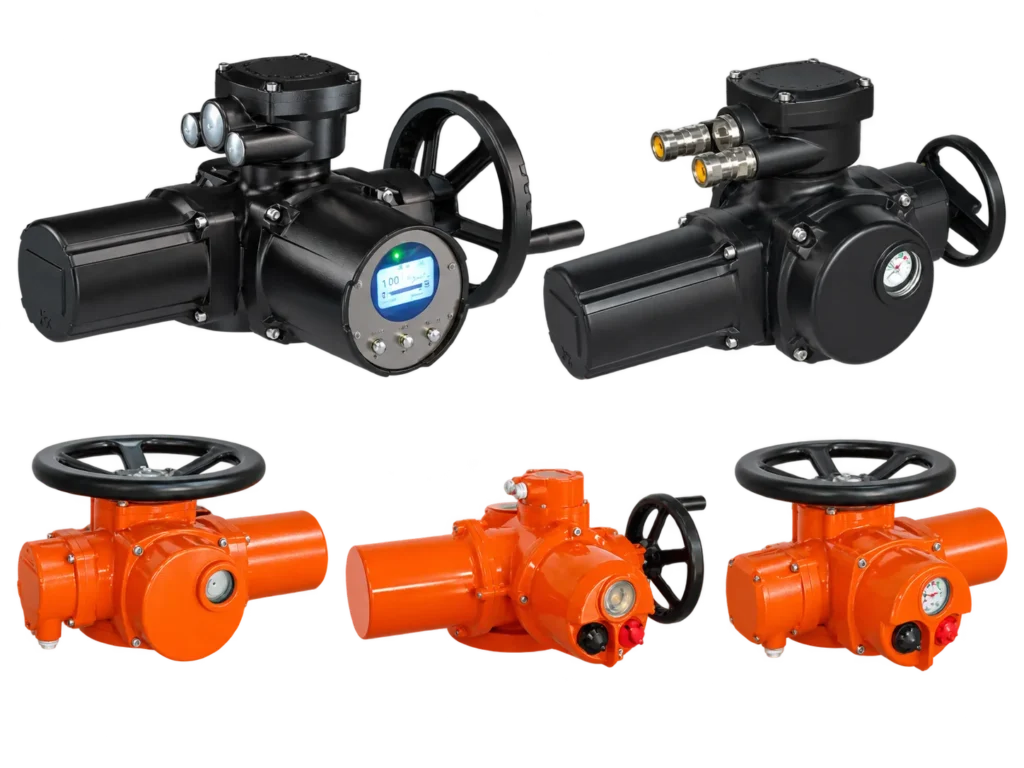
What Is a Rotary Actuator?
A rotary actuator is a mechanical drive device designed to create angular movement around an axis. Instead of producing straight-line motion like a linear actuator, it produces rotational output that can turn a shaft, stem, disc, ball or other rotating component.
In industrial flow-control systems, the term rotary actuator commonly refers to an actuator mounted on a quarter-turn valve. The actuator applies torque to the valve stem and rotates the closure element into the required position.
For example, a ball valve normally requires approximately 90 degrees of rotation between fully open and fully closed. A butterfly valve operates in a similar way: the actuator rotates the valve shaft, which changes the position of the internal disc.
Rotary actuator technology is therefore widely used in automated piping systems where valves need to be opened, closed, positioned or controlled without direct manual operation.
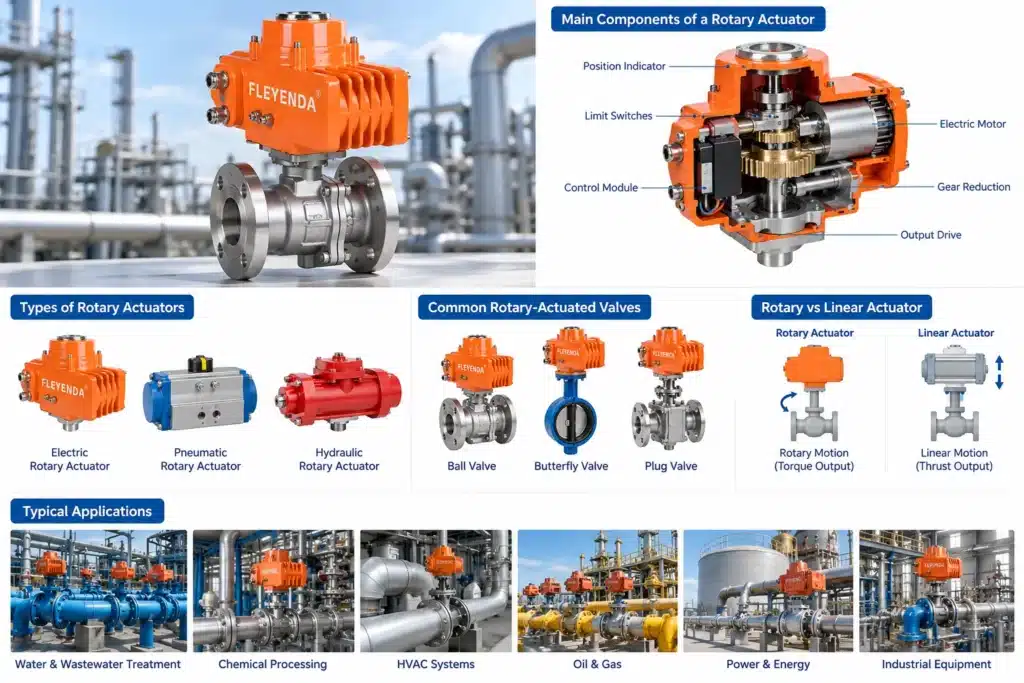
How Does a Rotary Actuator Work?
The operating principle depends on the actuator power source, but the basic objective is the same: generate enough torque to rotate the connected shaft through a defined angle.
In an electric rotary actuator, an electric motor produces rotational motion. Because the motor normally operates at a higher speed and lower torque than the valve requires, a gear reduction system converts this motor output into slower movement with higher usable torque.
The actuator output drive then transfers the torque to the valve stem. Internal limit switches, position sensors or electronic controls determine when the required travel position has been reached.
Control Command
A switch, PLC, DCS or control system sends an open, close or positioning signal to the actuator.
Power Conversion
The electric motor, pneumatic mechanism or hydraulic system converts available energy into mechanical movement.
Torque Generation
The actuator develops enough output torque to overcome valve seat friction, differential pressure and mechanical resistance.
Rotary Movement
The actuator output shaft rotates the valve stem toward the required angular position.
Position Confirmation
Limit switches, encoders or position sensors confirm when the required valve position has been reached.
Types of Rotary Actuators
Rotary actuators can be classified according to their power source and internal operating mechanism. The correct type depends on available utilities, required torque, operating speed, control accuracy and installation environment.
Electric Rotary Actuator
An electric rotary actuator uses an electric motor and gear reduction system to produce rotational torque. It is widely used where electricity is readily available and remote or automatic valve control is required.
Electric rotary actuators can support ON/OFF control, modulating positioning, status feedback and communication with industrial automation systems.
Pneumatic Rotary Actuator
A pneumatic rotary actuator uses compressed air to generate rotational motion. Rack-and-pinion and Scotch yoke designs are common in industrial valve automation.
Pneumatic actuators are often selected where rapid cycling, simple spring-return fail-safe operation or integration with an existing compressed-air system is important.
Hydraulic Rotary Actuator
Hydraulic rotary actuators use pressurized hydraulic fluid and are particularly useful when very high torque is required. They are commonly found in heavy-duty industrial equipment, energy infrastructure and specialized automation systems.
Quarter-Turn vs Multi-Turn Actuators
One of the most important distinctions in valve automation is the difference between quarter-turn and multi-turn movement.
| Feature | Quarter-Turn Rotary Actuator | Multi-Turn Actuator |
|---|---|---|
| Typical Movement | Approximately 0–90° | Multiple complete rotations |
| Primary Output | Rotary torque | Rotary torque that may also create linear stem movement |
| Typical Valves | Ball valves, butterfly valves and plug valves | Gate valves and globe valves |
| Travel | Short angular movement | Multiple shaft revolutions |
| Common Applications | Water treatment, HVAC, chemical processing and industrial automation | Power plants, steam systems, pipelines and large isolation valves |
A rotary actuator is therefore not simply another name for every valve actuator. The term usually refers to equipment designed primarily for angular rotational movement, especially quarter-turn applications.
Main Components of an Electric Rotary Actuator
| Component | Funktion | Selection Consideration |
|---|---|---|
| Electric Motor | Generates the initial rotational movement. | Voltage, thermal protection and operating duty. |
| Gear Reduction | Reduces motor speed and increases usable output torque. | Mechanical efficiency, durability and required torque. |
| Output Drive | Transfers actuator torque to the valve stem. | Valve interface and mounting dimensions. |
| Limit Switches | Define open and closed travel positions. | Adjustment range and feedback requirements. |
| Torque Protection | Protects the valve and actuator from excessive mechanical resistance. | Availability and adjustment depend on actuator design. |
| Position Indicator | Shows actuator or valve position. | Local indication and remote feedback requirements. |
| Manual Override | Allows manual operation during commissioning or power failure. | Accessibility and operating method. |
| Actuator Housing | Protects internal electrical and mechanical components. | IP rating, corrosion resistance and hazardous-area requirements. |
ON/OFF, Modulating and Intelligent Rotary Actuators
Electric rotary actuators can provide different levels of control depending on the automation requirements of the process.
ON/OFF Rotary Actuator
An ON/OFF rotary actuator moves the valve between two primary positions: fully open and fully closed. This configuration is commonly used for pipeline isolation, equipment shutoff, automatic switching and process interlocks.
Modulating Rotary Actuator
A modulating rotary actuator positions the valve at intermediate angles rather than only at the end positions. Industrial electric actuators may receive analog control signals such as 4–20 mA or 0–10 V from a PLC, controller or process instrument.
This allows valve position to change according to flow rate, pressure, temperature, liquid level or another process variable.
Intelligent Rotary Actuator
Intelligent rotary actuators add electronic positioning, diagnostics, remote monitoring and communication functions. Depending on the actuator configuration, RS485, Modbus or other communication protocols can be used to exchange operating information with the control system.
Rotary Actuator vs Linear Actuator
| Factor | Rotary Actuator | Linear Actuator |
|---|---|---|
| Motion | Angular or rotational movement | Straight-line movement |
| Primary Output | Torque | Thrust or force |
| Typical Valves | Ball, butterfly and plug valves | Globe, diaphragm and other linear-stem valves |
| Travel | Commonly around 90° for quarter-turn valves | Measured as linear stroke |
| Main Selection Parameter | Required torque | Required thrust and stroke |
This distinction is important because torque and thrust are different engineering parameters. A quarter-turn valve generally requires an actuator capable of delivering adequate rotational torque, while a linear-stem valve requires sufficient axial thrust.
Electric vs Pneumatic Rotary Actuator
| Factor | Electric Rotary Actuator | Pneumatic Rotary Actuator |
|---|---|---|
| Power Source | Electrical power | Druckluft |
| Required Infrastructure | Electrical wiring and controls | Air compressor, tubing and accessories |
| Position Control | Electronic positioning is readily available | Usually requires a pneumatic or electro-pneumatic positioner |
| Operating Speed | Depends on motor and gearbox configuration | Often relatively fast |
| Fail-Safe Option | Requires spring, capacitor, battery or other fail-safe design | Spring-return configurations are widely available |
| Typische Anwendungsbereiche | Remote sites, water treatment, HVAC and automated equipment | Chemical plants, frequent cycling and compressed-air facilities |
Neither technology is universally better. The correct choice depends on available plant utilities, operating frequency, required speed, failure strategy, maintenance capability and lifecycle cost.
How to Size a Rotary Actuator
Torque is one of the most important rotary actuator selection parameters. An actuator must provide sufficient output torque to operate the valve under actual process conditions rather than only under ideal conditions.
The selection process normally starts with the valve manufacturer’s required breakaway, running or seating torque. Engineers should then consider the conditions that can increase torque during operation.
Valve Size
Larger valves generally require greater operating torque because the closure element, stem and sealing surfaces are larger.
Differential Pressure
The pressure difference across a closed valve can significantly affect the torque required to start and complete valve movement.
Seat Material
Seat design and friction influence breakaway, running and seating torque.
Process Medium
Viscous liquids, suspended solids, deposits, crystallization and contamination can increase mechanical resistance.
Betriebstemperatur
Temperature can affect seat characteristics, seals, lubrication and actuator output performance.
Betriebsfrequenz
Frequent cycling creates greater thermal and mechanical demand on the actuator than occasional isolation service.
A torque margin is normally used when matching a rotary actuator to a valve. However, there is no single percentage that should automatically be applied to every valve. The appropriate margin should be determined from valve torque data, actuator performance and actual process conditions.
What Rotation Angle Does a Rotary Actuator Need?
Most industrial ball valves and butterfly valves use approximately 90 degrees of travel. For this reason, the most common rotary valve actuator is a quarter-turn actuator that moves between approximately 0° and 90°.
Other equipment may require different angular travel. Dampers, diverter mechanisms and specialized valves can require 180° rotation or another defined angle.
The actuator travel should therefore match the actual valve or equipment requirement rather than assuming that every rotary actuator application requires exactly the same movement.
IP67, IP68 and Explosion-Proof Rotary Actuators
Industrial rotary actuators are often installed outdoors, in humid treatment plants, near process equipment or in other demanding environments. The actuator housing must therefore provide protection appropriate to the installation.
IP67 Rotary Actuator
An IP67 rotary actuator provides strong dust protection and protection against temporary water immersion under the conditions defined by the applicable ingress-protection standard. It is commonly used for many outdoor and industrial installations.
IP68 Rotary Actuator
IP68 electric rotary actuators are used where more demanding protection against water ingress is required. Because IP68 conditions can vary by product, the actual immersion depth, duration and manufacturer’s test conditions should be confirmed before selection.
Explosion-Proof Rotary Actuator
Oil and gas, chemical processing and other hazardous locations may require certified explosion-protected electric actuators. The required certification should match the hazardous-area classification specified by the project.
IP rating and explosion protection are not the same. IP protection addresses ingress of dust and water, while explosion-protection certification addresses ignition risks in hazardous atmospheres.
Why Rotary Actuator Duty Cycle Matters
An electric motor generates heat whenever the actuator operates. If the actuator cycles more frequently than its design permits, internal temperature can increase and thermal protection may activate.
A pipeline isolation valve that operates only a few times each day has very different requirements from a modulating valve that continuously adjusts position during production.
Rotary actuator duty cycle should therefore be selected according to operating frequency, actuator load and ambient temperature. There is no universal duty-cycle percentage that is suitable for every actuator or application.
How Fast Should a Rotary Actuator Operate?
Actuation time is another important selection parameter. Faster valve movement is not automatically better.
Fast operation may be required in some emergency isolation systems or process sequences. In water pipelines, however, closing a large valve too quickly can increase the risk of hydraulic surge or water hammer.
The correct opening and closing time should therefore be selected according to process requirements, pipeline hydraulics, valve size and equipment protection rather than simply choosing the fastest available actuator.
Rotary Electric Actuator Options from Fleyenda
Fleyenda provides quarter-turn electric rotary actuator solutions for ball valves, butterfly valves, dampers and industrial automation systems, with multiple torque, control and environmental-protection configurations.
FLE Series Electric Rotary Actuator
The FLE Series is designed for 0–90° quarter-turn valve automation and can be paired with ball valves, butterfly valves and other compatible rotary equipment. Different torque, voltage and control configurations are available for industrial applications.
- 50–3000 Nm listed torque range
- 0–90° quarter-turn operation
- AC220V, AC110V and DC24V options
- ON/OFF and modulating configurations
- 4–20 mA and 0–10 V options
- ISO 5211 mounting interface
- IP67 and selected IP68 configurations
QT Series Rotary Electric Actuator
The QT Series is designed for quarter-turn industrial valve automation where remote control, modulating positioning, feedback and more advanced communication functions may be required.
- 50–3000 Nm listed torque range
- 90° ±5° rotation
- ON/OFF, modulating and intelligent control
- 4–20 mA and 0–10 V
- RS485 / Modbus options
- IP68 configurations
- Selected explosion-proof options
Where Are Rotary Actuators Used?
Wasser- und Abwasseraufbereitung
Rotary actuators automate butterfly valves and ball valves used for filtration, pumping, backwash, dosing and distribution systems.
Chemische Verarbeitung
Electric and pneumatic rotary valve actuators provide remote isolation and process control for compatible chemical pipelines.
HVAC Systems
Quarter-turn actuators are used on ball valves, butterfly valves and dampers in chilled-water, hot-water and ventilation systems.
Öl und Gas
Motor-operated quarter-turn valves are used for remote pipeline isolation, utility systems and automated process control.
Industrial Equipment
Rotary actuators can be integrated into skids, machinery and OEM equipment requiring automatic valve operation.
Power and Energy
Electric rotary actuators can automate cooling-water, auxiliary and process valves where remote operation is required.
How to Choose the Right Rotary Actuator
Identify the Required Motion
Confirm whether the application requires a 90° quarter-turn actuator or another angular travel range.
Determine Required Torque
Use actual valve breakaway and operating torque data together with maximum process conditions.
Choose the Power Source
Select electric, pneumatic or hydraulic actuation according to available site utilities and operating requirements.
Select the Control Mode
Choose ON/OFF, modulating or intelligent operation according to the required level of process automation.
Confirm Operating Speed
Match actuator travel time to process requirements and consider possible hydraulic effects.
Check Duty Cycle
Confirm that the actuator is designed for the expected number and frequency of operating cycles.
Specify Voltage
Match the actuator power supply to the electrical system used by the plant or equipment.
Define Feedback Requirements
Determine whether the control system requires open/close feedback, analog position feedback or communication data.
Check Environmental Protection
Select suitable ingress protection, corrosion resistance and hazardous-area certification for the installation.
Confirm Valve Interface
Check mounting flange, bolt pattern, shaft dimensions and ISO 5211 compatibility where applicable.
Rotary Actuator Selection Mistakes to Avoid
Selecting Only by Valve Size
Two valves with the same nominal diameter can require very different torque depending on valve construction, seat design and pressure.
Using a Fixed Torque Safety Factor
A single torque multiplier cannot account for every valve, pressure, medium and operating condition. Actual valve torque data should be used whenever possible.
Ignoring Duty Cycle
A frequently modulating actuator experiences greater thermal loading than an actuator used only for occasional isolation.
Choosing the Fastest Actuator
High-speed operation is useful in some applications but can create unwanted process or hydraulic effects in others.
Ignoring Failure Position
Critical applications should define whether the valve needs to fail open, fail closed or remain in its last position if power is lost.
Confusing IP Rating with Explosion Protection
Ingress protection and hazardous-area certification address different risks and should be evaluated separately.
Frequently Asked Questions About Rotary Actuators
What is a rotary actuator?
A rotary actuator converts electrical, pneumatic or hydraulic energy into rotational mechanical motion. In industrial valve automation, it commonly produces torque to operate ball valves, butterfly valves and plug valves.
What is a quarter-turn rotary actuator?
A quarter-turn rotary actuator normally rotates approximately 90 degrees and is commonly used with ball valves and butterfly valves.
What is an electric rotary actuator?
An electric rotary actuator uses an electric motor and gear system to generate controlled rotational torque. It can provide ON/OFF, modulating or intelligent valve control depending on configuration.
What is the difference between a rotary actuator and a linear actuator?
A rotary actuator produces angular movement and torque, while a linear actuator produces straight-line movement and thrust.
Which valves use rotary actuators?
Ball valves, butterfly valves and plug valves are among the most common industrial valves operated by rotary actuators.
Can a rotary actuator control valve position?
Yes. A modulating electric rotary actuator can position a suitable valve at intermediate angles according to signals such as 4–20 mA or 0–10 V.
How do I select rotary actuator torque?
Start with the valve manufacturer’s breakaway and operating torque data, then evaluate differential pressure, seat friction, process medium, temperature and operating frequency before selecting an appropriate actuator margin.
What is ISO 5211?
ISO 5211 defines mounting interfaces for part-turn valve actuator attachments. Valve and actuator compatibility should still be confirmed by checking flange dimensions, bolt patterns and drive interfaces.
Can a rotary actuator be installed outdoors?
Yes. The actuator housing and cable entries must provide suitable protection for the actual outdoor environment. IP67 or IP68 configurations may be selected according to project requirements.
What happens to an electric rotary actuator during a power failure?
A standard actuator may remain in its last position. Applications requiring a defined failure position need a suitable fail-safe actuator design such as spring return, capacitor-assisted return or another stored-energy solution.
Select the Rotary Actuator Around the Valve and Process
A rotary actuator is a fundamental component of industrial valve automation, but reliable operation depends on more than selecting an actuator with enough nominal torque. Valve construction, differential pressure, rotation angle, operating speed, duty cycle, control mode, power supply, mounting interface and installation environment all affect the final actuator selection.
For quarter-turn valves such as ball valves and butterfly valves, electric rotary actuators provide a practical solution for remote operation, PLC integration, ON/OFF isolation and modulating control.
Fleyenda provides rotary electric actuator solutions for industrial valve automation, including ON/OFF, modulating, intelligent, waterproof and selected explosion-protected configurations.