


Gate Valves for Reliable Pipeline Isolation
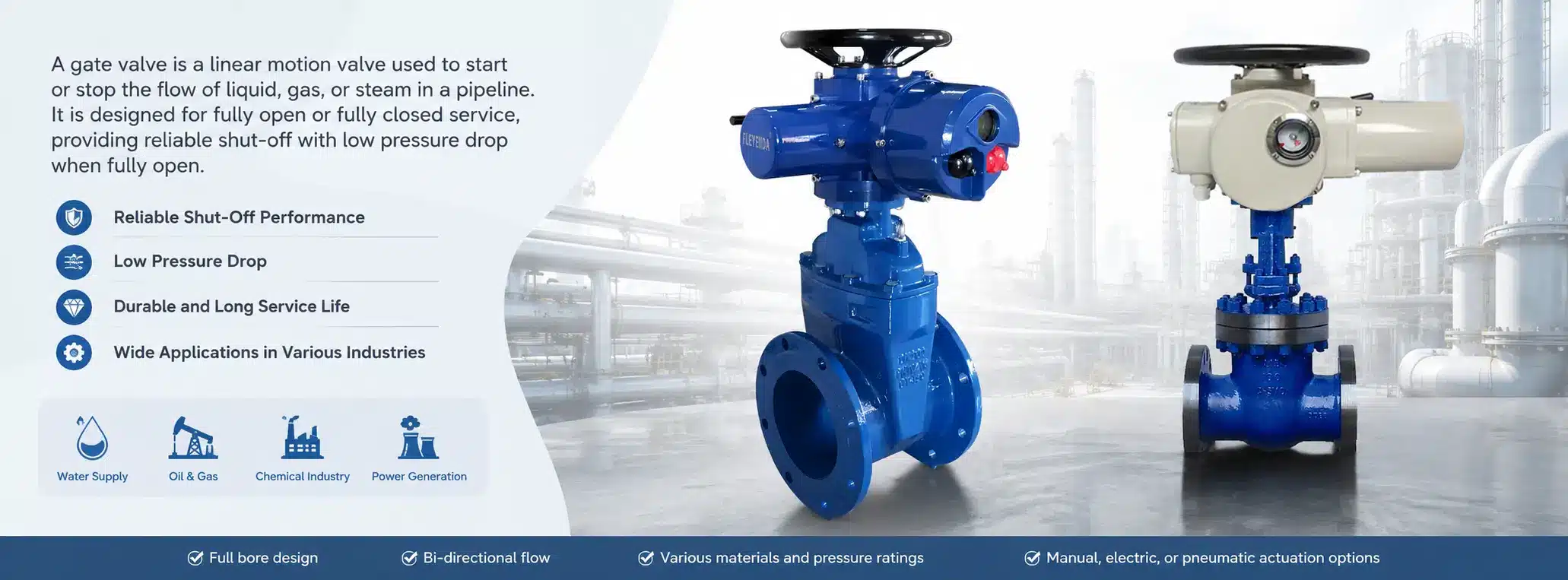
A gate valve is a linear motion valve designed to start or stop the flow of liquid, gas, steam, or other media in a pipeline. It is mainly used for fully open or fully closed service, making it one of the most reliable shut-off valves in industrial piping systems. Because of its low flow resistance, strong sealing capability, and suitability for large-diameter pipelines, the gate valve is widely used in water supply, oil and gas, chemical processing, power generation, marine engineering, HVAC systems, and general industrial applications.
What Is a Gate Valve?
A gate valve controls flow by raising or lowering a gate-shaped closure element inside the valve body. When the gate is lifted, the flow passage opens and the medium can pass through the valve. When the gate is lowered, it blocks the passage and stops the flow. This simple operating principle gives the gate valve excellent shut-off performance in pipeline isolation applications.
Unlike ball valves or butterfly valves, which usually operate with a quarter-turn movement, most gate valves require multiple turns of a handwheel or actuator to complete the opening or closing process. This slower operation is acceptable in many systems because gate valves are typically installed where stable shut-off and low pressure loss are more important than fast switching.
A gate valve is not normally used for precise flow regulation. When it remains partially open for a long time, high-velocity flow may damage the gate and seat surfaces, causing vibration, erosion, leakage, or reduced service life. For this reason, gate valves are recommended for full-open and full-close operation rather than throttling service.
How Does a Gate Valve Work?
The working process of a gate valve is based on vertical movement. The main parts include the valve body, gate, seats, stem, bonnet, packing, gasket, and operating device. When the handwheel or actuator turns the stem, the gate moves upward or downward inside the valve body. Once the gate is fully raised, the valve reaches the open position. Once the gate is fully lowered against the seats, the valve reaches the closed position.
In the fully open position, the gate is usually removed from the flow path. This creates a straight-through passage that allows the medium to flow with minimal resistance. As a result, gate valves can provide a lower pressure drop than many other valve types, especially in large pipeline systems.
In the fully closed position, the gate contacts the seat surfaces to create a seal. Depending on the valve design and application, the sealing structure may be metal seated or resilient seated. Metal seated gate valves are suitable for high-temperature, high-pressure, or heavy-duty service, while resilient seated gate valves are commonly used in water supply, wastewater treatment, and municipal pipeline systems.
Main Components of a Gate Valve
The performance of a gate valve depends on the quality and design of its internal components. Each part plays an important role in pressure resistance, sealing performance, operation, and service life.
Valve Body
The valve body is the main pressure-containing component. It connects directly to the pipeline and houses the internal flow passage. Common body materials include cast iron, ductile iron, carbon steel, stainless steel, alloy steel, bronze, and brass. The correct material should be selected according to the working medium, pressure, temperature, and corrosion conditions.
Gate
The gate is the moving closure element of the valve. It travels vertically to open or close the flow path. Common gate designs include solid wedge, flexible wedge, split wedge, and parallel slide structures. A wedge gate is widely used because it provides strong sealing force and reliable shut-off performance.
Seat
The seat provides the sealing surface against which the gate closes. The seat may be integrated into the valve body or installed as a replaceable ring. Soft-seated designs usually provide tighter shut-off in water systems, while metal-seated designs are preferred for high-temperature, abrasive, or demanding industrial conditions.
Stem
The stem transfers motion from the handwheel or actuator to the gate. Gate valves may use a rising stem or a non-rising stem. A rising stem provides a clear visual indication of valve position, while a non-rising stem is more compact and suitable for underground or limited-space installations.
Bonnet and Packing
The bonnet covers the upper part of the valve body and supports the stem assembly. Packing is installed around the stem to prevent leakage to the atmosphere. A reliable packing system is especially important when the valve is used for steam, gas, oil, chemical media, or other demanding services.
Common Types of Gate Valves
Gate valves are available in different designs to meet various working conditions. The main types are classified by stem structure, seat material, gate design, connection method, and application.
Rising Stem Gate Valve
A rising stem gate valve has a stem that moves upward when the valve opens and downward when the valve closes. This structure allows operators to easily identify whether the valve is open or closed. It is commonly used in above-ground pipelines, industrial plants, water treatment facilities, and power stations.
Non-Rising Stem Gate Valve
A non-rising stem gate valve keeps the stem in a fixed external position while the gate moves internally along the threaded stem. This compact design is suitable for underground pipelines, fire protection systems, and installations where vertical space is limited.
Resilient Seated Gate Valve
A resilient seated gate valve uses a rubber-coated gate or soft sealing material to provide tight shut-off. It is widely used in drinking water supply, wastewater treatment, irrigation, municipal engineering, and fire protection systems. This type usually offers low leakage, low operating torque, and good corrosion resistance.
Metal Seated Gate Valve
A metal seated gate valve uses metal-to-metal contact between the gate and seat. It is suitable for high-temperature, high-pressure, abrasive, or severe service applications. Although it may not provide the same soft sealing effect as a resilient seated design, it offers excellent durability in harsh working environments.
Electric Actuated Gate Valve
An electric actuated gate valve uses an electric actuator to control opening and closing. It is suitable for remote operation, automated pipeline systems, and applications where manual operation is inconvenient. Electric gate valves are often used in water plants, power plants, industrial process lines, and large pipeline networks.
Advantages of Gate Valves
Gate valves are widely used because they offer several important advantages in pipeline systems. Their straight-through flow path and reliable shut-off design make them suitable for many industrial and municipal applications.
- Low pressure drop: When fully open, the gate is removed from the flow path, allowing smooth flow with minimal resistance.
- Reliable shut-off: A properly selected and installed gate valve can provide dependable pipeline isolation.
- Suitable for large pipelines: Gate valves are commonly used in medium and large-diameter pipeline systems.
- Bidirectional flow capability: Many gate valve designs can handle flow from either direction.
- Wide material selection: Gate valves are available in ductile iron, cast iron, carbon steel, stainless steel, bronze, and alloy materials.
- Simple and durable structure: The design is easy to understand, inspect, maintain, and repair.
Limitations of Gate Valves
Although gate valves are reliable shut-off valves, they also have some limitations. The most important limitation is that they are not suitable for continuous throttling. If the valve is partially open, the flow may impact the gate and seat surfaces, causing vibration, noise, erosion, and sealing damage.
Gate valves also operate more slowly than ball valves and butterfly valves. A quarter-turn valve can open or close quickly, while a gate valve usually requires multiple turns. Therefore, gate valves are less suitable for systems requiring frequent operation or rapid emergency shut-off.
Another consideration is installation space. Rising stem gate valves need enough vertical clearance for stem movement. In addition, if the medium contains sediment or solid particles, deposits may accumulate inside the valve body and affect sealing performance. Proper system cleaning and regular maintenance are important for long-term reliability.
Gate Valve vs Ball Valve, Butterfly Valve, and Globe Valve
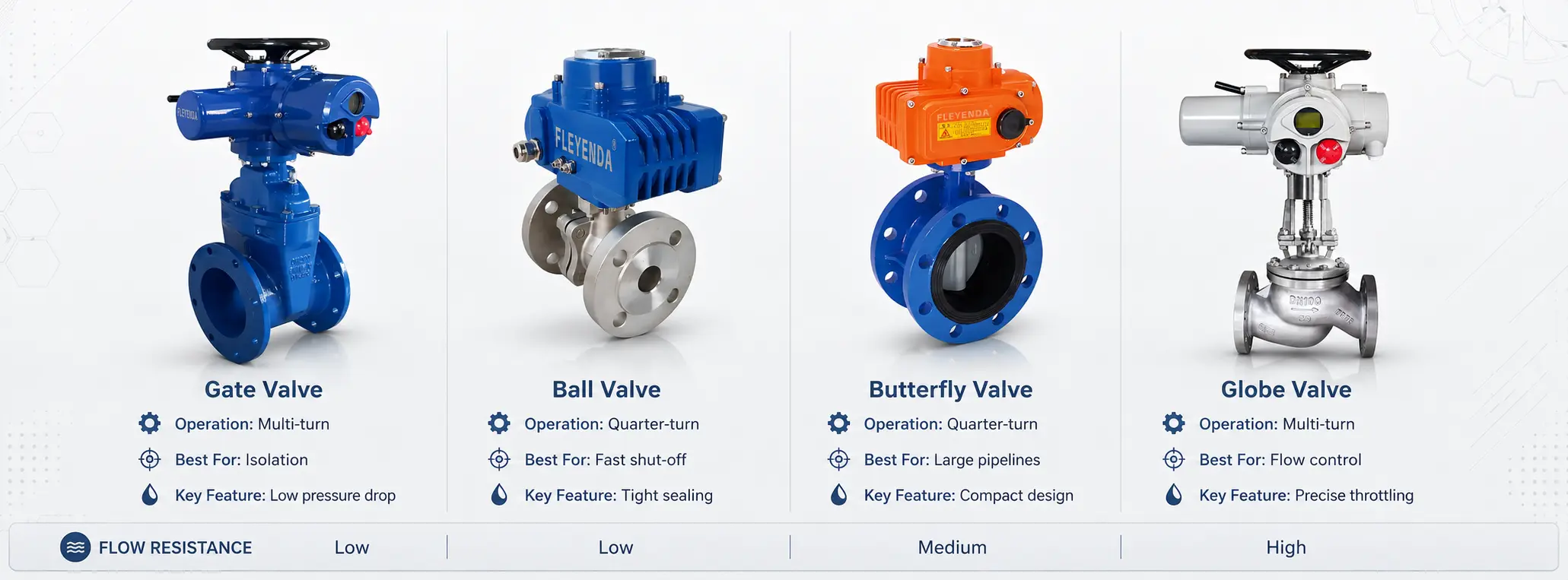
Gate valves, ball valves, butterfly valves, and globe valves are all common industrial valves, but they are designed for different operating purposes. The following comparison helps explain their key differences in structure, operation, advantages, and typical applications.
| Valve Type | Operating Principle | Main Advantages | Limitations | Typical Applications |
|---|---|---|---|---|
| Gate Valve | Uses a vertical gate to open or close the flow path. Best used in fully open or fully closed positions. | Low pressure drop, reliable isolation, suitable for large pipelines, good for long-term open or closed service. | Not suitable for throttling, slower operation, may require more installation space. | Water supply, oil and gas pipelines, power plants, fire protection systems, industrial isolation lines. |
| Ball Valve | Uses a rotating ball with a bore through the center. A quarter-turn movement opens or closes the valve. | Fast operation, tight sealing, compact design, excellent for frequent on-off service. | Less suitable for precise throttling, large-size models may be more expensive. | Gas systems, water lines, chemical pipelines, compressed air, and process equipment. |
| Butterfly Valve | Uses a rotating disc installed in the flow path. A quarter-turn movement controls opening and closing. | Lightweight, compact, economical for large diameters, quick operation. | The disc remains in the flow path, so pressure drop may be higher than a fully open gate valve. | HVAC systems, water treatment, cooling water, marine systems, and large-diameter pipelines. |
| Globe Valve | Uses a movable plug or disc against a seat, with flow changing direction inside the valve body. | Excellent throttling ability, good flow control, reliable shut-off in many process systems. | Higher pressure drop, more energy loss, usually heavier and more complex than gate valves. | Steam systems, control lines, cooling systems, fuel oil systems, and process regulation. |
Typical Applications of Gate Valves
Gate valves are commonly used in pipeline systems where reliable shut-off and low flow resistance are required. In municipal water supply systems, they are installed to isolate pipeline sections during maintenance, inspection, or emergency repair. In wastewater treatment facilities, resilient seated gate valves are often used because they provide dependable sealing in water and sewage service.
In the oil and gas industry, gate valves are used in transmission pipelines, storage terminals, refineries, and process units. Steel gate valves are frequently selected for hydrocarbon service because they can handle high pressure, high temperature, and demanding operating conditions.
In power plants, gate valves are used in boiler feedwater systems, cooling water systems, steam pipelines, and auxiliary systems. Marine and shipbuilding applications use gate valves for ballast systems, bilge lines, cooling water, and fuel handling. Building service systems may also use gate valves in fire protection networks, HVAC pipelines, and main water distribution lines.
How to Select the Right Gate Valve
Selecting the right gate valve requires a clear understanding of the working conditions. The first factor is pipeline size and pressure rating. Common pressure ratings include PN10, PN16, PN25, Class 150, Class 300, and higher classes for special applications. The selected valve must be suitable for the system pressure and temperature.
The second factor is material compatibility. Ductile iron gate valves are commonly used in water systems because they offer good strength and corrosion resistance at a reasonable cost. Carbon steel gate valves are often used in oil, gas, and steam applications. Stainless steel gate valves are preferred for corrosive media, chemical processing, food-grade systems, and marine environments.
The third factor is seat design. Resilient seated gate valves are suitable for clean water and municipal systems, while metal seated gate valves are more suitable for high-temperature, abrasive, or heavy-duty applications. The fourth factor is the operating method. Manual operation is suitable for standard installations, while gearboxes, electric actuators, pneumatic actuators, or hydraulic actuators may be required for larger valves or automated systems.
Installation and Maintenance Tips
Proper installation is essential for the performance and service life of a gate valve. Before installation, the pipeline should be cleaned to remove dirt, welding slag, sand, and other foreign particles. These contaminants may damage the sealing surfaces and cause leakage.
During installation, flange bolts should be tightened evenly to avoid body distortion. The valve should not be used to force misaligned pipes into position. Excessive pipeline stress may damage the valve body or affect sealing performance. For rising stem gate valves, enough vertical space should be reserved for stem movement.
Regular maintenance should include inspection of the stem, packing, gasket, bolts, coating, and operating device. If the valve is not operated for a long period, periodic opening and closing can help prevent sticking. In corrosive environments, external protection and lubrication may be required. If leakage occurs, the possible causes include worn seats, damaged gate surfaces, loose packing, or foreign particles trapped inside the valve.
Conclusion
A gate valve is a reliable shut-off valve designed for pipeline isolation. Its main advantages include low pressure drop, simple structure, strong sealing performance, and suitability for large-diameter pipelines. It is especially useful in systems where the valve remains fully open or fully closed for long periods.
Compared with ball valves, butterfly valves, and globe valves, a gate valve is the preferred choice for applications that require low flow resistance and dependable isolation. Although it is not suitable for continuous throttling, it performs very well in water supply, oil and gas, power generation, fire protection, marine engineering, and general industrial pipeline systems. By selecting the correct material, pressure rating, seat design, and operating method, users can ensure safe, efficient, and long-lasting valve performance.