


Oil Pipeline Valve Guide
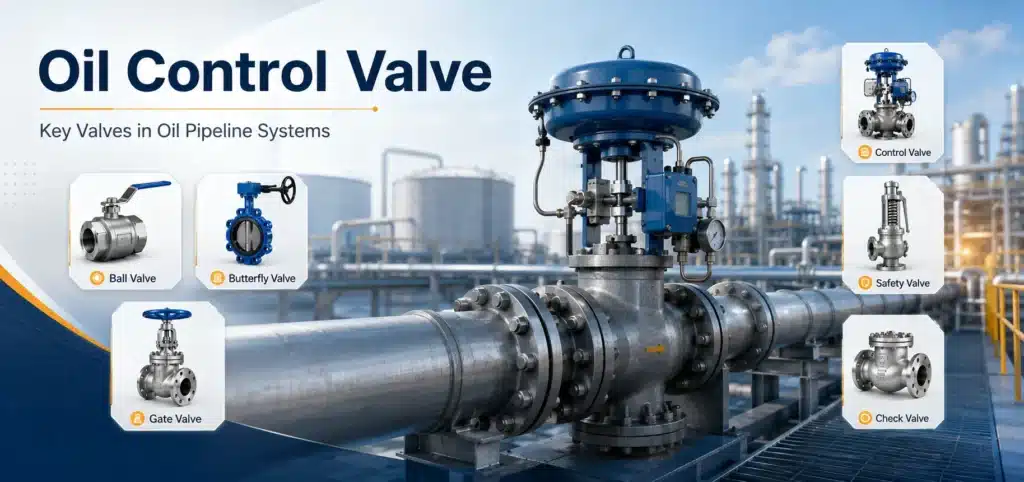
Oil Control Valve
An Oil Control Valve is a critical component in an oil pipeline system. It regulates, isolates, directs, or protects the flow of crude oil, refined petroleum, lubricating oil, fuel oil, and other hydrocarbon fluids. From production fields and storage terminals to refineries and distribution networks, oil valves help maintain stable pressure, accurate flow rates, operational safety, and reliable process control.
What Is an Oil Control Valve?
An Oil Control Valve is designed to control the movement of oil through pipelines, processing equipment, storage facilities, pumping stations, and loading systems. Depending on the application, the valve may start or stop flow, adjust the flow rate, reduce pressure, prevent reverse flow, or release excessive pressure.
Oil pipeline systems often operate under demanding conditions. The fluid may be highly viscous, corrosive, abrasive, flammable, or transported at elevated pressure and temperature. For this reason, an Oil Control Valve must provide dependable sealing, suitable material compatibility, stable operation, and compliance with relevant pipeline and process requirements.
The term Oil Control Valve may refer specifically to a modulating valve used for automatic flow regulation. However, in a complete oil pipeline system, flow control depends on several valve types working together. These commonly include the Ball Valve, Butterfly Valve, Gate Valve, Control Valve, Safety Valve, and Check Valve.
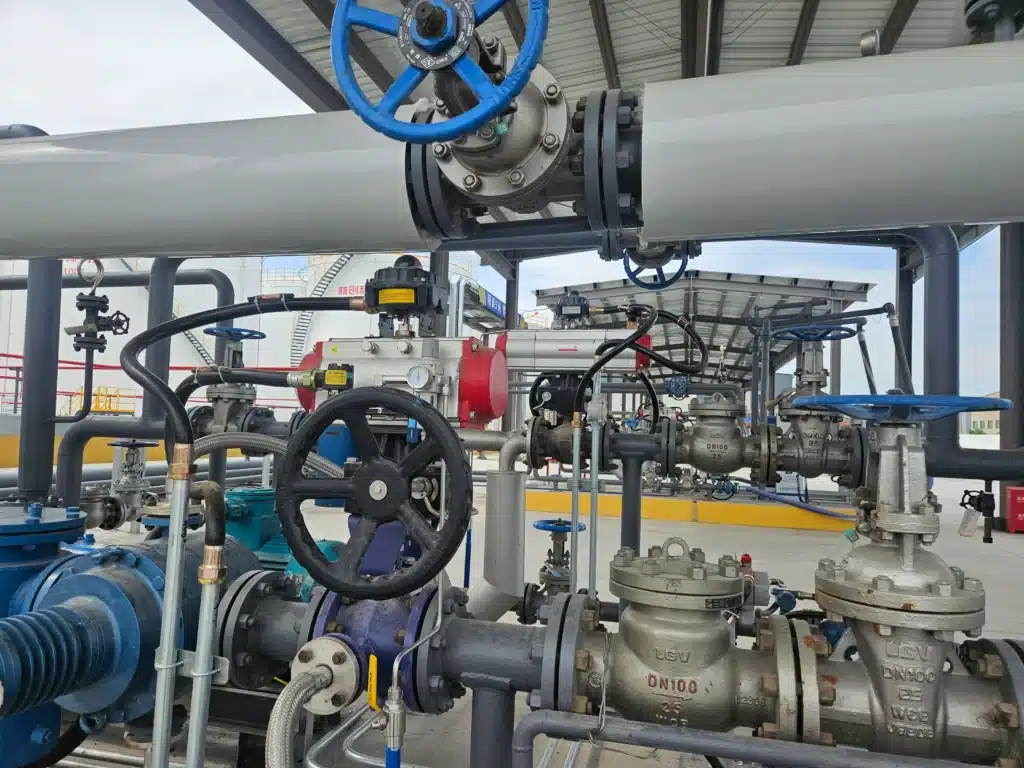
The Role of Valves in an Oil Pipeline System
A modern oil pipeline is more than a single pipe connecting two locations. It may include pumps, filters, separators, storage tanks, metering skids, heating units, pressure control stations, loading arms, and emergency shutdown systems. Valves are installed throughout these areas to keep the process controllable, efficient, and safe.
Isolation valves allow operators to shut down a pipeline section for inspection or maintenance. Modulating valves regulate flow and pressure during normal operation. Non-return valves protect pumps from reverse flow. Pressure protection valves discharge oil or vapor when system pressure exceeds a safe limit. Emergency shutdown valves can quickly stop the movement of flammable liquids when a leak, fire, equipment failure, or abnormal operating condition is detected.
Selecting the correct Oil Control Valve is therefore essential. An unsuitable valve can create excessive pressure loss, unstable flow, internal leakage, cavitation, vibration, premature wear, or an increased risk of pipeline failure.
Main Valve Types Used in Oil Pipelines
| Valve Type | Primary Function | Typical Pipeline Position | Main Advantages | Key Considerations |
|---|---|---|---|---|
| Ball Valve | Fast isolation and emergency shutoff | Main pipelines, pump stations, and tank outlets | Tight sealing, low pressure drop, and rapid operation | Standard designs are not ideal for continuous throttling |
| Butterfly Valve | Isolation and moderate flow regulation | Large-diameter pipelines and terminal systems | Compact, lightweight, and economical | The disc remains inside the flow path |
| Gate Valve | Fully open or fully closed isolation | Long-distance pipelines and storage facilities | Full-bore passage and low flow resistance | Slow operation and unsuitable for throttling |
| Control Valve | Automatic flow, pressure, temperature, or level regulation | Process lines, metering systems, and refinery units | Accurate and responsive process control | Requires correct sizing and actuator selection |
| Safety Valve | Overpressure protection | Pumps, vessels, heaters, and pressurized equipment | Automatic pressure relief | Set pressure and discharge capacity must be verified |
| Check Valve | Reverse-flow prevention | Pump discharge lines and transfer pipelines | Automatic operation without an external actuator | Incorrect selection may cause slamming or pressure surges |
Ball Valve for Oil Pipeline Isolation
A Ball Valve uses a rotating ball with a central bore to open or close the pipeline. When the bore aligns with the pipe, oil flows through the valve with minimal resistance. A quarter-turn rotation moves the ball into the closed position and blocks the flow.
Ball valves are widely used in crude oil pipelines, fuel transfer systems, terminals, tank farms, and emergency shutdown applications. Their tight shutoff capability makes them particularly suitable where leakage control is important. Full-bore Ball Valve designs also allow pipeline inspection tools or cleaning pigs to pass through the valve without a significant restriction.
Floating ball valves are commonly used in smaller sizes, while trunnion-mounted designs are preferred for large diameters and high-pressure service. Soft-seated models provide excellent sealing under normal operating conditions, whereas metal-seated designs may be selected for high-temperature, abrasive, or contaminated oil service.
Although some specialized ball valves can regulate flow, a standard Ball Valve is primarily an isolation device. Keeping it partially open for extended periods can expose the seat and ball surface to high fluid velocity, erosion, and uneven wear.
Butterfly Valve for Large-Diameter Oil Lines
A Butterfly Valve controls flow through a circular disc mounted on a rotating shaft. Its compact construction, low weight, and relatively low installation cost make it attractive for large-diameter oil pipelines, storage terminals, cooling systems, firewater systems, and utility lines.
Resilient-seated Butterfly Valve designs are often used for lower-pressure applications. High-performance double-offset and triple-offset butterfly valves provide improved sealing, reduced seat wear, and better performance under higher pressure and temperature. Triple-offset designs are especially useful where metal seating, low leakage, and fire-safe performance are required.
A Butterfly Valve can be used for isolation and moderate flow regulation. However, the disc remains inside the flow path, creating more resistance than a full-bore Ball Valve or Gate Valve. Required operating torque, flow velocity, vibration, and pressure drop should be evaluated before the valve is selected.
Gate Valve for Full-Bore Pipeline Service
A Gate Valve opens by lifting a gate out of the oil flow path. When fully open, it provides a straight-through passage with low pressure loss. This feature makes the Gate Valve suitable for long-distance oil transmission lines, refinery manifolds, storage tank connections, and other applications that require unrestricted flow.
Gate valves are intended primarily for fully open or fully closed operation. Using a Gate Valve in a partially open position can create high fluid velocity across the gate and seat. This may lead to vibration, erosion, noise, unstable flow, and sealing damage. For accurate throttling, a dedicated Control Valve is generally a better choice.
Common configurations include wedge gate valves, parallel slide gate valves, slab gate valves, and expanding gate valves. Slab and expanding gate designs are frequently used in pipeline service because they can provide a full-bore flow path and reliable isolation.
Because a Gate Valve normally requires several stem turns to open or close, it operates more slowly than a quarter-turn Ball Valve or Butterfly Valve. This slower movement may be suitable for normal isolation but less appropriate for applications requiring immediate emergency shutdown.
Control Valve for Accurate Oil Flow Regulation
A Control Valve is the primary regulating element in an automated oil process. It receives a signal from a controller and continuously changes its opening to maintain a target flow rate, pressure, temperature, liquid level, or other process condition.
In a typical control loop, a transmitter measures the process variable and sends the information to a control system. The controller compares the measured value with the desired set point and sends an output signal to the valve actuator. The Control Valve then moves to the required position to correct the process condition.
Globe-style control valves are commonly selected for precise regulation because their internal trim provides stable throttling characteristics. Rotary control valves, including segmented ball valves and eccentric rotary designs, may be preferred for higher flow capacity, viscous oil, or fluids containing suspended solids.
Correct valve sizing is essential. An oversized Control Valve may operate close to the closed position, creating unstable control, excessive sensitivity, and rapid trim wear. An undersized valve may not achieve the required maximum flow rate. Engineers should evaluate pressure drop, oil viscosity, operating temperature, vapor pressure, required flow range, noise, flashing, and cavitation before finalizing the valve size and trim design.
The actuator must also be matched to the required thrust or torque. Pneumatic, electric, and hydraulic actuators can all be used, depending on available power, operating speed, control accuracy, environmental conditions, and emergency shutdown requirements.
Safety Valve for Overpressure Protection
A Safety Valve protects pipelines, pumps, pressure vessels, heaters, filters, and other equipment from excessive internal pressure. When pressure rises above a predetermined set point, the valve opens automatically and releases fluid to a safe discharge system. It closes again after pressure returns to an acceptable level.
Depending on the application and fluid condition, an oil system may use a safety valve, pressure relief valve, thermal relief valve, or pilot-operated relief valve. Thermal relief valves are particularly important in blocked-in liquid sections. Oil trapped between two closed valves can expand as temperature increases, producing a significant pressure rise even in a relatively small pipeline volume.
The Safety Valve must have the correct set pressure, discharge capacity, material, connection type, and back-pressure capability. Its outlet should lead to an appropriate recovery, flare, drain, or containment system rather than releasing hazardous fluid into an unsafe area.
Periodic inspection and testing are necessary because contamination, corrosion, damaged sealing surfaces, or incorrect adjustment can prevent a Safety Valve from opening at the required pressure.
Check Valve for Reverse-Flow Prevention
A Check Valve allows oil to flow in one direction and automatically closes when the flow reverses. It is commonly installed downstream of pumps to prevent reverse rotation, loss of prime, backflow from storage tanks, and damage caused by sudden changes in pipeline direction.
Common oil pipeline designs include swing check valves, lift check valves, dual-plate check valves, piston check valves, and axial-flow check valves. Each design responds differently to changes in flow velocity, pressure, and pipeline conditions.
Valve closing speed is an important consideration. A Check Valve that closes too slowly may allow substantial reverse flow before shutoff. Rapid closure can reduce reverse flow but may also create a pressure surge if the valve is not correctly matched to the system. Pump characteristics, line length, oil velocity, valve orientation, and transient operating conditions should be considered during selection.
A Check Valve should not be selected only by matching its nominal size to the pipeline. The valve must open fully at the expected operating flow so that it remains stable and does not repeatedly open and close.
How to Select the Right Oil Control Valve
The correct Oil Control Valve should be selected according to actual process conditions rather than nominal pipe size alone. Important operating and design parameters include:
- Oil type, density, viscosity, corrosiveness, and solid content
- Normal, minimum, and maximum flow rates
- Inlet pressure, outlet pressure, and available pressure drop
- Minimum and maximum operating temperatures
- Required shutoff class and acceptable leakage rate
- Pipeline diameter, pressure rating, and connection standard
- Manual, pneumatic, hydraulic, or electric actuation
- Fail-open, fail-closed, or fail-in-place requirements
- Fire-safe, anti-static, low-emission, or emergency shutdown requirements
- Inspection access, maintenance intervals, and spare-part availability
Carbon steel is widely used for oil valve bodies, while stainless steel and alloy materials may be required for corrosive fluids, low temperatures, high temperatures, sour service, or aggressive process conditions. Seats, seals, packing, gaskets, and internal trim must also be compatible with the oil and any chemical additives present in the pipeline.
Connection type is another important consideration. Flanged valves are widely used because they can be removed for inspection or replacement. Welded-end valves reduce the number of potential external leakage points and are often selected for buried pipelines or high-integrity transmission systems.
Actuation and Pipeline Automation
Oil pipeline valves may be operated manually or through automated actuators. Manual handwheels and gear operators are suitable for valves that operate infrequently. Pneumatic actuators provide fast response and are widely used in process plants. Electric actuators are useful where electrical power is readily available and remote operation is required. Hydraulic actuators can generate high torque for large pipeline valves and emergency shutdown service.
Automated valve packages may include positioners, solenoid valves, limit switches, pressure regulators, local indicators, partial-stroke testing devices, and control panels. These accessories allow the Oil Control Valve to communicate with a distributed control system, programmable logic controller, supervisory control system, or safety instrumented system.
For critical applications, the required failure position must be established during system design. A valve may need to fail closed to stop the release of oil, fail open to maintain cooling or circulation, or remain in its last position when power is lost.
Inspection and Maintenance
Regular inspection helps maintain the reliability of every Oil Control Valve in the pipeline. Operators should check for external leakage, packing wear, abnormal noise, actuator problems, corrosion, damaged coatings, loose fasteners, and unexpected changes in operating torque.
Control valves should be tested for positioning accuracy, actuator response, and smooth travel. Safety valves require periodic inspection and set-pressure verification. Check valves should be examined for internal wear, sticking, or delayed closure. Isolation valves should be cycled where operating procedures permit, helping prevent the stem, ball, gate, or disc from becoming seized after long periods of inactivity.
Maintenance intervals should reflect operating severity, fluid cleanliness, valve duty, manufacturer recommendations, and site safety procedures. Accurate inspection and maintenance records can help identify recurring problems before they lead to unplanned shutdowns, production losses, or environmental incidents.
Conclusion
An Oil Control Valve is central to the safe and efficient operation of an oil pipeline system. No single valve design can perform every pipeline function. A Ball Valve provides fast and tight isolation, a Butterfly Valve offers an economical solution for large diameters, and a Gate Valve delivers low-resistance full-bore flow. A Control Valve regulates process conditions, a Safety Valve protects equipment from overpressure, and a Check Valve prevents damaging reverse flow.
By evaluating fluid properties, pressure, temperature, flow rate, actuation, sealing, safety requirements, and maintenance conditions, engineers can select an Oil Control Valve system that improves process stability, reduces leakage, protects equipment, and supports reliable long-term pipeline operation.
Frequently Asked Questions
Which valve is best for shutting off an oil pipeline?
A Ball Valve is often preferred for fast operation and tight shutoff. A Gate Valve may also be suitable when a full-bore flow path and low pressure loss are required.
Can a Butterfly Valve be used for oil?
Yes. A Butterfly Valve can be used for many oil services when its body, disc, shaft, seat, seals, and pressure rating are compatible with the operating conditions.
What is the difference between a Control Valve and a Safety Valve?
A Control Valve continuously regulates normal process conditions. A Safety Valve remains closed during normal operation and opens automatically when pressure exceeds a predetermined safe limit.
Why is a Check Valve installed after an oil pump?
The Check Valve prevents oil from flowing backward when the pump stops, helping protect the pump, prevent reverse rotation, and maintain the intended pipeline flow direction.