


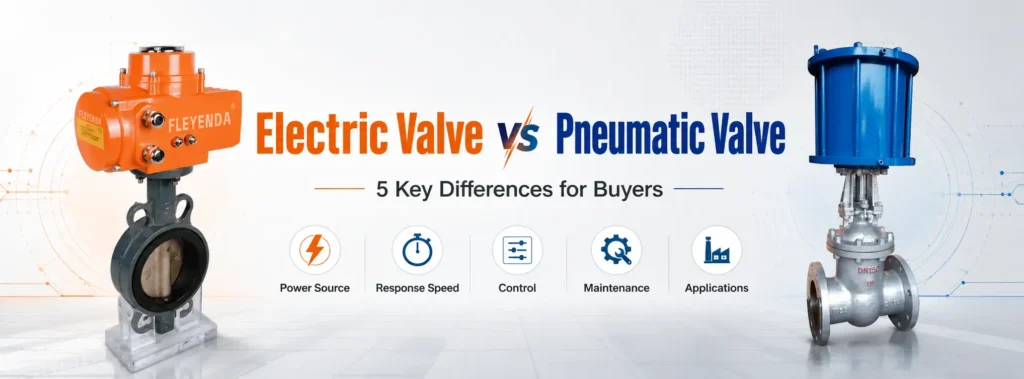
5 Key Differences Between Electric Valve and Pneumatic Valve
Choosing between an electric valve and a pneumatic valve is an important decision for any buyer who needs reliable automatic flow control. Both products can be used to control water, air, gas, oil, steam, chemical liquid, and other media, but they work in different ways and are suitable for different systems.
In many industrial and commercial projects, buyers compare electric valve and pneumatic valve because both can automate the opening, closing, or regulating function of a pipeline. However, the best choice depends on power source, response speed, control accuracy, installation condition, maintenance cost, and working environment.
An electric valve uses electrical power to operate the valve. It may use an electric actuator, motorized actuator, or solenoid mechanism. A pneumatic valve uses compressed air to drive the actuator. This basic difference affects almost every part of the system, from installation cost to long-term maintenance.
Quick answer: An electric valve is usually better for applications that need simple wiring, remote control, low noise, and no compressed air supply. A pneumatic valve is usually better for applications that need fast operation, frequent cycling, and an existing compressed air system.
This guide explains the 5 key differences between electric valve and pneumatic valve from a practical buyer’s perspective. It is written for engineers, purchasing managers, OEM buyers, system integrators, and project owners who need to choose the right valve for water treatment, HVAC, irrigation, automation equipment, chemical processing, food machinery, and other flow control applications.
What Is an Electric Valve?
An electric valve is a valve operated by electricity. The electric power drives an actuator or solenoid to open, close, or adjust the valve position. Depending on the application, an electric valve may be used for simple on/off control or for proportional flow control.
The term electric valve can include several common product designs, such as electric ball valve, electric butterfly valve, electric actuated valve, motorized valve, and solenoid valve. Although these products have different internal structures, they share the same basic feature: the valve movement is controlled by electrical energy.
A typical electric valve may be powered by 12V DC, 24V DC, 24V AC, 110V AC, or 220V AC. Some electric valve actuator designs also support control signals such as 4-20mA, 0-10V, or digital communication for advanced automation. This makes electric valve a practical choice for modern systems that use PLC, controller, timer, sensor, or remote monitoring.
Electric valve is commonly used in water supply, wastewater treatment, HVAC, irrigation, smart water control, industrial equipment, laboratory devices, food and beverage machinery, and OEM automation systems. It is especially useful when compressed air is not available or when the user wants a cleaner and quieter control solution.
What Is a Pneumatic Valve?
A pneumatic valve is a valve operated by compressed air. Instead of using an electric motor or solenoid as the main driving force, the pneumatic actuator uses air pressure to generate movement. The actuator may be mounted on a ball valve, butterfly valve, plug valve, diaphragm valve, or control valve.
Pneumatic valve is widely used in industrial plants because compressed air is common in many factories. It can provide fast movement, strong output force, and reliable operation in high-cycle applications. Pneumatic valve is often used in chemical processing, packaging machinery, production lines, power plants, mining, oil and gas, and heavy industrial automation.
A pneumatic valve system usually needs more than the valve itself. It may require an air compressor, air filter regulator, solenoid pilot valve, tubing, fittings, positioner, limit switch box, and air preparation equipment. This makes the total system more complex than many electric valve installations, especially for small projects or remote sites without compressed air.
Power Source and Installation Requirement
The first and most important difference between electric valve and pneumatic valve is the power source. An electric valve uses electricity. A pneumatic valve uses compressed air. This difference directly affects installation difficulty, project cost, accessory selection, and maintenance planning.
Electric Valve Uses Electrical Power
Electric valve is convenient when electrical power is already available at the installation site. The buyer needs to confirm the correct voltage, wiring method, control signal, actuator torque, and enclosure protection. Common voltage options include 12V DC, 24V DC, 110V AC, and 220V AC.
For example, a 24V DC electric valve is often used in control panels, automation equipment, irrigation controllers, and low-voltage water systems. A 220V AC electric valve may be used in industrial pipelines, building water systems, or HVAC projects. If the electric valve supports feedback signal or modulating control, it can be connected to a PLC or control system for more advanced operation.
In many applications, electric valve installation is relatively simple. The installer only needs to connect the wiring according to the diagram, check the voltage, confirm the open and close signal, and test the valve movement. There is no need to install an air compressor or run air tubing to the valve location.
Pneumatic Valve Uses Compressed Air
Pneumatic valve requires compressed air. This means the system must have a stable air supply with suitable pressure and clean air quality. If the factory already has an air supply network, pneumatic valve can be easy to integrate. If there is no compressed air system, the buyer must consider the cost of compressor, air line, filter regulator, dryer, fittings, and pilot control components.
The air supply must be clean and stable. Moisture, dust, oil, or unstable pressure can affect pneumatic valve performance. For this reason, pneumatic valve installation often requires proper air preparation equipment.
| Item | Electric Valve | Pneumatic Valve |
|---|---|---|
| Main power source | Electricity | Compressed air |
| Typical requirement | Correct voltage and wiring | Air compressor, tubing, air preparation |
| Installation advantage | Simple where power is available | Convenient where compressed air already exists |
| Common buyer concern | Voltage, wiring, waterproof rating | Air pressure, air quality, leakage |
For buyers, the key question is simple: Do you already have compressed air at the installation site? If not, an electric valve is often the easier and more economical choice.
Response Speed and Operating Frequency
The second difference between electric valve and pneumatic valve is response speed. Some systems need fast open and close action. Other systems need smooth and stable movement. Choosing the wrong actuation speed may cause pressure shock, slow production, or unnecessary mechanical stress.
Electric Valve Usually Operates at Moderate Speed
An electric valve, especially a motorized electric valve, usually opens and closes within several seconds. Larger electric valve actuator designs may take longer because the actuator uses a motor and gear system to generate torque. The exact speed depends on valve size, actuator power, torque requirement, and actuator design.
This moderate speed is useful in many water and HVAC applications. When the valve opens or closes too quickly, the pipeline may experience water hammer or pressure shock. A slower electric valve can help reduce sudden flow changes and protect the pipeline, pump, and connected equipment.
For applications such as irrigation, water supply, drainage, heating, cooling, and tank filling, electric valve speed is often sufficient. The buyer does not always need the fastest valve. In many cases, stable operation is more important than high-speed movement.
Pneumatic Valve Usually Operates Faster
Pneumatic valve is often faster because compressed air can move the actuator quickly. A quarter-turn pneumatic valve may open or close in less than one second or within a few seconds, depending on actuator size, air pressure, valve torque, and pilot valve capacity.
Fast response makes pneumatic valve suitable for production lines, packaging machines, filling systems, emergency shutoff, chemical dosing, and high-cycle industrial automation. If the valve must operate many times per minute or many times per hour, pneumatic valve may provide better performance.
However, fast speed is not always an advantage. In liquid pipelines, very fast closing may create water hammer. For this reason, a pneumatic valve may need a speed controller, cushion, or other accessory to adjust movement speed.
Buyer tip: Choose electric valve if you need stable and moderate movement. Choose pneumatic valve if you need fast operation and frequent cycling.
Control Accuracy and Automation Flexibility
The third difference between electric valve and pneumatic valve is control method. Both can be used in automated systems, but they provide different control characteristics. Buyers should consider whether the application needs simple on/off control, position feedback, proportional control, or fail-safe action.
Electric Valve Offers Easy Electrical Control
Electric valve is easy to connect with electrical automation equipment. It can be controlled by a switch, relay, timer, PLC, sensor, smart controller, or building management system. For basic applications, the electric valve only needs open and close control. For advanced applications, it can provide feedback signal, position indication, proportional control, or communication interface.
This makes electric valve suitable for modern automation systems. For example, a water level sensor can send a signal to open or close an electric valve. A PLC can adjust a modulating electric valve according to flow rate, pressure, or temperature. A smart irrigation controller can operate a low-voltage electric valve according to schedule or soil moisture data.
Another advantage is that some electric valve actuator designs can hold position without continuous power consumption after reaching the required position. This can be useful in systems where the valve remains open or closed for long periods.
Pneumatic Valve Can Provide Strong Industrial Control
Pneumatic valve can also be used for accurate process control when combined with proper accessories. A pneumatic control system may include a positioner, air filter regulator, solenoid pilot valve, feedback device, and control signal converter. With the right setup, pneumatic valve can provide stable and responsive control in demanding industrial processes.
However, pneumatic valve control usually depends more on air quality and accessory selection. Since air is compressible, unstable air pressure or poor air preparation may affect control performance. If the system requires accurate positioning, the buyer should select a suitable positioner and make sure the air supply is clean and stable.
In short, electric valve is often easier for electrical automation. Pneumatic valve is often preferred for heavy industrial control where compressed air systems and maintenance support are already available.
Maintenance, Energy Cost, and Long-Term Reliability
Many buyers compare only the purchase price, but the real cost includes installation, accessories, maintenance, downtime, and energy consumption. A low initial price may not mean low total cost. This is especially important when comparing electric valve and pneumatic valve.
Electric Valve Maintenance
Electric valve maintenance usually focuses on wiring, actuator condition, enclosure protection, valve sealing, and control signal. The user should check whether the actuator opens and closes smoothly, whether the manual override works, whether the limit switch feedback is correct, and whether the housing is protected from water or dust.
Electric valve does not require an air compressor or air preparation system. There is no need to check air leakage, air filter, air dryer, or pneumatic tubing. This can reduce maintenance work in small and medium systems.
However, electric valve should be protected from incorrect voltage, moisture, overheating, overload, and wiring mistakes. For outdoor use, the buyer should choose a suitable IP rating. For corrosive environments, the buyer should select proper body material and actuator protection.
Pneumatic Valve Maintenance
Pneumatic valve can be durable and reliable, but the complete air system needs regular inspection. The maintenance team should check air pressure, filter condition, tubing connection, actuator seal, pilot valve function, and air leakage. Poor air quality can reduce service life and cause unstable movement.
Compressed air can also create hidden operating cost. Air leakage is common in many factories, and the compressor consumes energy to maintain pressure. If the plant already has a well-managed compressed air system, pneumatic valve can be cost-effective. If not, the total cost may be higher than expected.
| Maintenance Factor | Electric Valve | Pneumatic Valve |
|---|---|---|
| Main maintenance focus | Wiring, actuator, enclosure, valve seal | Air quality, leakage, tubing, pilot valve, actuator seal |
| Energy concern | Electrical power use | Compressed air generation and leakage |
| Accessory maintenance | Usually less complex | Usually more components |
| Best long-term value | Projects without compressed air | Plants with existing air infrastructure |
For small equipment, remote systems, smart water control, irrigation, and building automation, electric valve often provides lower system complexity. For large industrial plants, pneumatic valve can be economical if compressed air is already available and properly maintained.
Application Environment and Safety Requirement
The fifth difference between electric valve and pneumatic valve is the working environment. Temperature, humidity, dust, vibration, corrosive media, hazardous area, and outdoor exposure all influence the final selection.
Where Electric Valve Is Commonly Used
Electric valve is commonly used in systems that need clean, quiet, and convenient automatic control. It is suitable for water treatment, HVAC, irrigation, building automation, smart water supply, laboratory equipment, food and beverage equipment, and OEM machinery.
In remote or unmanned applications, electric valve is often easier to use because it only needs electrical power and control signal. For example, solar-powered irrigation equipment, battery-powered water control devices, remote drainage stations, and automatic tank filling systems often use low-voltage electric valve.
For outdoor installation, the buyer should choose electric valve with a proper waterproof rating. For high-temperature media, the buyer should confirm temperature rating of the valve body, seal, and actuator. For corrosive liquid, stainless steel, plastic, or special seal material may be required.
Where Pneumatic Valve Is Commonly Used
Pneumatic valve is widely used in industrial environments where compressed air is already available. It is common in chemical plants, refineries, power plants, mining systems, packaging lines, filling machines, and process automation systems.
Pneumatic valve is also popular when fail-safe action is required. A spring-return pneumatic actuator can move the valve to a safe position when air pressure is lost. This is useful in many safety-related systems. Electric valve can also provide fail-safe function, but it may need battery backup, spring-return actuator, or special design.
In hazardous areas, buyers must carefully check certification and safety design. A pneumatic actuator does not use an electric motor as the main driving force at the valve location, but the complete system may still include electrical accessories such as solenoid pilot valve, limit switch, or positioner. Therefore, proper explosion-proof or safety-rated components may still be necessary.
Electric Valve vs Pneumatic Valve: Quick Comparison
| Comparison Item | Electric Valve | Pneumatic Valve |
|---|---|---|
| Driving method | Electrical power drives actuator or solenoid | Compressed air drives actuator |
| Installation | Requires wiring and correct voltage | Requires air supply and pneumatic accessories |
| Speed | Moderate, stable movement | Usually faster |
| Noise | Generally low | May produce air exhaust noise |
| Control | Easy to connect with PLC, timer, sensor, or controller | Good for industrial control with positioner and air system |
| Maintenance | Focus on electrical and sealing condition | Focus on air quality, leakage, and actuator seal |
| Best use | Water system, HVAC, irrigation, remote control, OEM equipment | Production line, chemical plant, high-cycle automation |
When Should You Choose Electric Valve?
You should choose electric valve when your system needs simple electrical control, easy installation, low noise, and no compressed air supply. Electric valve is also a strong choice when the project needs remote operation, smart control, timer control, or integration with a PLC or sensor.
Electric valve is often suitable for the following situations:
- The site does not have compressed air.
- The project needs simple wiring and automatic control.
- The system needs low noise operation.
- The valve does not need very fast cycling.
- The system uses 12V DC, 24V DC, 110V AC, or 220V AC power.
- The application is water treatment, HVAC, irrigation, smart water control, or OEM equipment.
- The buyer wants to reduce air system maintenance.
For many buyers, electric valve is the more convenient option because it reduces the need for extra air equipment. It can also be easier to control in modern electrical automation systems.
When Should You Choose Pneumatic Valve?
You should choose pneumatic valve when your system already has compressed air and needs fast operation, frequent cycling, or strong actuator output. Pneumatic valve is common in factories because compressed air is already part of many industrial production systems.
Pneumatic valve is often suitable for the following situations:
- The factory already has stable compressed air.
- The system needs fast opening and closing.
- The valve operates frequently every day.
- The application needs spring-return fail-safe action.
- The maintenance team is familiar with pneumatic equipment.
- The project is in chemical processing, production line, packaging machinery, or heavy industrial automation.
Pneumatic valve can be a strong choice for industrial plants, but buyers should include the full cost of air supply, accessories, and maintenance in the purchasing decision.
10 Specifications Buyers Should Confirm Before Ordering
Whether you choose electric valve or pneumatic valve, proper specification is critical. A wrong selection can cause leakage, slow response, actuator failure, short service life, or unexpected downtime.
- Valve size: Confirm pipe size, port size, and connection standard.
- Valve type: Confirm ball valve, butterfly valve, solenoid valve, diaphragm valve, or control valve.
- Body material: Choose brass, stainless steel, PVC, UPVC, cast iron, carbon steel, or other suitable material.
- Seal material: Confirm NBR, EPDM, FKM, PTFE, or other seal according to media and temperature.
- Working pressure: Make sure the valve pressure rating matches the pipeline.
- Working temperature: Confirm media temperature and ambient temperature.
- Media type: Specify water, air, gas, oil, steam, chemical liquid, or other media.
- Control type: Confirm on/off control, modulating control, feedback signal, or fail-safe function.
- Power or air supply: For electric valve, confirm voltage. For pneumatic valve, confirm air pressure.
- Installation environment: Confirm indoor, outdoor, waterproof, dustproof, corrosive, or hazardous condition.
Professional recommendation: Do not select electric valve or pneumatic valve only by price. The correct valve should match the media, pressure, temperature, control method, torque requirement, power supply, installation environment, and expected cycle frequency.
FAQ About Electric Valve and Pneumatic Valve
1. Is electric valve better than pneumatic valve?
Electric valve is better when the application needs easy wiring, low noise, remote control, and no compressed air system. Pneumatic valve is better when the application needs fast response, frequent cycling, and existing compressed air. The better option depends on the actual working condition.
2. Can electric valve replace pneumatic valve?
Electric valve can replace pneumatic valve in many applications, especially when compressed air is not available or when electrical control is preferred. Before replacement, the buyer should check valve size, torque, speed, voltage, control signal, fail-safe requirement, and installation environment.
3. Which is easier to install, electric valve or pneumatic valve?
Electric valve is usually easier to install when electrical power is available. Pneumatic valve may require air tubing, air filter regulator, compressor capacity, pilot valve, and pressure adjustment. For a small system or remote site, electric valve is often more convenient.
4. Which has lower maintenance cost?
Electric valve may have lower maintenance cost in systems without compressed air because it does not require air supply maintenance. Pneumatic valve can also be economical in large factories with existing compressed air, but air leakage, filter replacement, and actuator seal maintenance should be considered.
5. Which is more suitable for water control?
Electric valve is commonly used for water control because it is easy to connect with timers, sensors, PLC systems, and smart controllers. It is suitable for irrigation, HVAC, water treatment, automatic drainage, tank filling, and building water systems.
6. Which is better for high-cycle operation?
Pneumatic valve is usually better for high-cycle operation because compressed air can drive the actuator quickly and frequently. Electric valve can be reliable for moderate cycling, but the buyer should confirm the actuator duty cycle before ordering.
Conclusion
Electric valve and pneumatic valve are both important solutions for automatic flow control, but they are designed for different system requirements. The main differences are power source, response speed, control flexibility, installation cost, maintenance demand, and application environment.
If your project needs easy electrical control, low noise, simple installation, remote operation, and no compressed air system, electric valve is often the better choice. It is widely used in water treatment, HVAC, irrigation, smart water control, building automation, and OEM equipment.
If your project needs very fast operation, high-cycle performance, strong actuator force, and your facility already has compressed air, pneumatic valve may be more suitable. It is widely used in industrial automation, chemical processing, production lines, and heavy-duty process control.
Before buying, compare the complete system cost instead of only the valve price. A properly selected electric valve or pneumatic valve can improve system reliability, reduce downtime, and provide safer flow control for your application.
Before contacting a supplier, prepare your valve size, media, working pressure, working temperature, voltage or air pressure, control method, installation environment, and required cycle frequency. These details will help the supplier recommend the right electric valve or pneumatic valve faster and more accurately.