


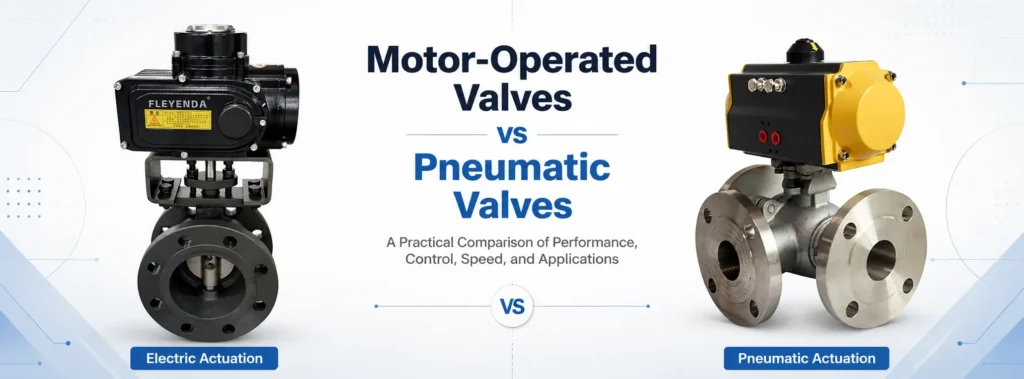
Motor-Operated Valves vs Pneumatic Valves
In industrial flow control systems, choosing between Motor-Operated Valves and pneumatic valves is an important engineering and purchasing decision. Both solutions can automate valve operation, improve process efficiency, reduce manual labor, and support remote control. However, they are powered differently, behave differently, and are suitable for different working conditions.
Motor-Operated Valves use electric actuators to open, close, or modulate valves. Pneumatic valves use compressed air to drive pneumatic actuators. The right choice depends on several factors, including power availability, operating speed, valve size, control accuracy, fail-safe requirements, installation environment, maintenance capability, and total cost of ownership.
Many buyers compare these two options only by actuator price, but that approach can lead to the wrong decision. A pneumatic valve may appear less expensive at first, but it requires compressed air infrastructure. Motor-Operated Valves may have a higher initial actuator cost, but they can be easier to install in locations where electricity is available and compressed air is not. For engineers, plant owners, and procurement teams, the best choice should be based on complete system performance rather than a single component price.
This article provides a practical comparison of Motor-Operated Valves and pneumatic valves. It explains how they work, where they are used, what advantages and limitations they have, and how to select the right valve actuation solution for industrial applications.
What Are Motor-Operated Valves?
Motor-Operated Valves, also known as MOV valves or electric actuator valves, are valves operated by electric actuators. The actuator uses an electric motor to generate torque or linear force, which moves the valve stem, shaft, disc, ball, gate, or plug. These valves are widely used in industrial systems that require remote operation, automatic control, stable positioning, and reliable shutoff.
Motor-operated valve assemblies are commonly used with ball valves, butterfly valves, gate valves, globe valves, plug valves, and other valve types. Depending on the valve design and actuator configuration, they can provide simple on-off control or precise modulating control.
In on-off service, Motor-Operated Valves move between fully open and fully closed positions. In modulating service, they can stop at intermediate positions to regulate flow, pressure, temperature, or liquid level. This flexibility makes them suitable for water treatment plants, power stations, HVAC systems, oil and gas pipelines, chemical processing facilities, marine systems, and many other industrial applications.
Main Components of Motor-Operated Valves
- Electric motor: Provides the driving force for valve movement.
- Gearbox: Reduces motor speed and increases output torque.
- Limit switches: Stop the actuator when the valve reaches the fully open or fully closed position.
- Torque switches: Protect the valve and actuator from excessive torque.
- Manual override: Allows manual operation during power failure or maintenance.
- Control module: Receives control signals and communicates with the control system.
- Position feedback device: Sends valve position information to operators or automation systems.
- Enclosure: Protects internal electrical and mechanical components from dust, water, and environmental damage.
The key benefit of Motor-Operated Valves is that they only require electrical power and control wiring. They do not need an air compressor, air dryer, air tubing, or pneumatic accessories. This makes them especially useful in remote sites, large pipeline systems, municipal water networks, and facilities where compressed air is unavailable or expensive to maintain.
What Are Pneumatic Valves?
Pneumatic valves are automated valves operated by compressed air. A pneumatic actuator converts air pressure into mechanical movement. This movement opens, closes, or modulates the valve. Pneumatic actuators are commonly used with ball valves, butterfly valves, control valves, and other quarter-turn or linear valves.
Pneumatic valves are widely used in process industries because they are fast, reliable, and suitable for frequent cycling. They are also common in hazardous environments when properly configured because the actuator itself does not rely on an electric motor mounted directly on the valve.
However, pneumatic valves are not standalone solutions. A complete pneumatic valve system usually requires an air compressor, air preparation unit, solenoid valve, tubing, fittings, limit switch box, and sometimes a positioner. The reliability of the valve depends heavily on the quality, pressure, and dryness of the compressed air supply.
Main Components of Pneumatic Valve Systems
- Pneumatic actuator: Converts compressed air into rotary or linear movement.
- Solenoid valve: Controls the direction of air flow to the actuator.
- Filter regulator: Cleans and regulates compressed air pressure.
- Positioner: Provides accurate valve positioning in modulating applications.
- Limit switch box: Sends open and closed position feedback.
- Air tubing and fittings: Deliver compressed air to the actuator.
- Spring return mechanism: Allows fail-open or fail-close action when air pressure is lost.
Core Difference: Electric Power vs Compressed Air
The main difference between Motor-Operated Valves and pneumatic valves is the power source. Motor-operated valves use electricity, while pneumatic valves use compressed air. This difference affects installation cost, control performance, operating speed, maintenance requirements, safety behavior, and long-term operating cost.
| Comparison Factor | Motor-Operated Valves | Pneumatic Valves |
|---|---|---|
| Power Source | Electrical power | Compressed air |
| Typical Operating Speed | Moderate to slow, depending on actuator size and gearbox ratio | Fast, especially for on-off applications |
| Installation Requirements | Power cable, control cable, electrical protection | Air compressor, air dryer, tubing, fittings, solenoid valve, air preparation unit |
| Control Capability | Good for on-off control, remote control, and stable modulating control | Excellent for fast response and continuous process control with positioner |
| Fail-Safe Function | Requires battery backup, spring-return electric actuator, or special design | Simple fail-open or fail-close action with spring-return actuator |
| Maintenance Focus | Electrical checks, gearbox inspection, limit switch adjustment, enclosure sealing | Air leakage, seal wear, tubing condition, air quality, solenoid valve function |
| Best Application Areas | Water systems, large valves, remote sites, low-frequency operation, utility systems | Fast cycling, hazardous areas, process control, emergency shutdown systems |
How Motor-Operated Valves Work
When a control signal is sent to the actuator, the electric motor starts rotating. The gearbox reduces the motor speed and increases torque. This torque is transferred to the valve stem or shaft, moving the valve to the required position. Limit switches stop the actuator at the fully open or fully closed position, while torque switches protect the system if the valve is blocked or overloaded.
For modulating applications, Motor-Operated Valves receive analog or digital control signals from a PLC, DCS, or other control system. The actuator adjusts the valve opening percentage according to the signal. A position feedback device reports the actual valve position back to the control system, allowing operators to monitor and adjust the process remotely.
Because motor-operated valves usually consume power mainly during movement, they are efficient for applications where the valve remains in one position for long periods. This is common in isolation, diversion, filling, draining, and pipeline control applications.
How Pneumatic Valves Work
Pneumatic valves operate when compressed air enters the actuator. In a double-acting pneumatic actuator, air pressure is used to move the valve in both opening and closing directions. In a spring-return actuator, air pressure moves the valve in one direction, while a spring returns the valve to a safe position when the air supply is lost.
Pneumatic actuators are often faster than electric actuators. This makes pneumatic valves suitable for applications that require quick opening, quick closing, frequent cycling, or emergency operation. In process control systems, pneumatic control valves with positioners can provide fast and accurate response to changing process conditions.
The main limitation is dependency on compressed air. If the air supply is unstable, wet, contaminated, or leaking, the pneumatic valve may operate slowly, inaccurately, or unreliably. For this reason, air quality management is essential in pneumatic valve systems.
Installation Cost and System Complexity
Installation cost is one of the most important factors when comparing Motor-Operated Valves and pneumatic valves. A pneumatic actuator may have a lower unit price, especially for smaller valves. However, the total system cost can be higher if compressed air infrastructure is not already available.
A pneumatic valve system may require compressors, dryers, filters, regulators, solenoid valves, tubing, fittings, supports, and regular air system maintenance. If these systems already exist in the plant, pneumatic valves can be cost-effective. If they need to be installed only for a small number of valves, the cost may not be justified.
Motor-Operated Valves usually require electrical wiring and control wiring. In many industrial and municipal facilities, electrical power is easier to access than clean compressed air. This is why motor-operated valves are frequently selected for water supply projects, wastewater treatment plants, pumping stations, hydropower facilities, and outdoor pipeline systems.
Practical Buyer Tip
Do not compare only the actuator price. Compare the complete installed cost, including wiring, control panels, compressors, air dryers, tubing, fittings, accessories, spare parts, maintenance labor, energy consumption, and expected downtime risk.
Operating Speed: Which Option Is Faster?
Pneumatic valves are generally faster than Motor-Operated Valves. A pneumatic actuator can often open or close a quarter-turn valve within seconds, and in some small-valve applications, even faster. This makes pneumatic valves ideal for emergency shutoff, frequent cycling, packaging machinery, production lines, and process systems that require quick response.
Motor-Operated Valves usually operate more slowly because the electric motor and gearbox are designed to provide controlled torque rather than instant movement. Large electric actuators may take several seconds or even minutes to complete full travel. In many water and pipeline applications, this slower operation is actually beneficial because it helps reduce water hammer, pressure shock, and mechanical stress.
If speed is the most important requirement, pneumatic valves often have the advantage. If controlled movement, smooth operation, and pressure surge reduction are more important, motor-operated valves may be the better choice.
Control Accuracy and Modulating Performance
Both Motor-Operated Valves and pneumatic valves can support modulating control, but they perform differently. Motor-operated valves with modulating electric actuators can hold a valve position accurately without continuous air consumption. They are suitable for applications where stable position control is required and where the process changes gradually.
Pneumatic control valves, especially those equipped with high-quality positioners, are widely used in process industries. They can respond quickly to changes in pressure, temperature, flow, or level. This makes them suitable for steam control, chemical dosing, pressure regulation, and continuous process control.
For slow or medium-speed control tasks, Motor-Operated Valves can provide reliable performance. For fast and continuous process control, pneumatic valves may provide better dynamic response. The right decision depends on the required control speed, accuracy, stability, and available utilities.
Fail-Safe Performance
Fail-safe performance is a key point in industrial valve selection. A pneumatic valve with a spring-return actuator can be designed to fail open or fail closed when air pressure is lost. This is a simple and reliable mechanical safety function. For example, a valve can automatically close to stop fuel flow or open to release pressure when air supply fails.
Standard Motor-Operated Valves usually stay in their last position when power is lost. This may be acceptable in many water, HVAC, and isolation applications. However, if the valve must move to a safe position during power failure, additional solutions are required. These may include battery backup, supercapacitor backup, spring-return electric actuators, or emergency power systems.
If immediate fail-open or fail-close action is required, pneumatic valves often have a practical advantage. If the system allows the valve to remain in its last position or if backup power is available, Motor-Operated Valves can still be an appropriate solution.
Energy Efficiency and Long-Term Operating Cost
Motor-Operated Valves typically consume electricity during valve movement. Once the valve reaches the desired position, power consumption is usually low, except for control electronics or feedback devices. This can make motor-operated valves energy-efficient in low-frequency applications where valves remain open or closed for long periods.
Pneumatic valves consume energy indirectly through compressed air generation. Compressed air is convenient, but it is often an expensive utility. Air leaks, pressure losses, oversized compressors, poor dryer performance, and inefficient air distribution can significantly increase operating cost.
In plants with a well-maintained compressed air system, pneumatic valves may be economical. In remote or distributed systems without compressed air, Motor-Operated Valves may offer lower long-term operating cost and simpler maintenance.
Maintenance Requirements
Maintenance requirements are different for the two systems. Motor-Operated Valves require inspection of electrical connections, actuator enclosure, limit switches, torque switches, gears, seals, and manual override mechanisms. In outdoor or wet environments, cable entries and enclosure sealing should be checked regularly to prevent moisture damage.
Pneumatic valves require checks for air leakage, actuator seal wear, tubing damage, solenoid valve function, filter regulator condition, and air supply quality. Moisture, oil, or particles in compressed air can damage actuators and positioners. Leaks in tubing or fittings can reduce actuator performance and waste energy.
In remote locations, Motor-Operated Valves may be easier to maintain because they do not require an air network. In process plants with instrument air systems and trained maintenance teams, pneumatic valves may be easier to service and replace.
Environmental and Hazardous Area Considerations
Environment plays an important role in valve actuator selection. Outdoor applications may involve rain, dust, heat, cold, sunlight, vibration, and corrosion. Motor-Operated Valves used outdoors should have suitable enclosure ratings, corrosion-resistant materials, properly sealed cable entries, and protection against condensation.
Pneumatic valves used outdoors should also be protected from corrosion and contamination. In cold climates, compressed air must be dry enough to prevent freezing in air lines and actuators. Poor air drying can cause serious reliability problems in freezing environments.
In hazardous areas, pneumatic actuators are often preferred because they do not contain an electric motor at the valve. However, solenoid valves, positioners, and limit switches may still require hazardous area certification. Motor-Operated Valves can also be used in hazardous areas if they are equipped with explosion-proof or flameproof electric actuators suitable for the site classification.
Application Comparison
Best Applications for Motor-Operated Valves
Motor-Operated Valves are a strong choice when electrical power is available, compressed air is unavailable, valve movement is not extremely frequent, or high torque is required. They are commonly used in utility systems, large pipelines, water treatment projects, and remote automation systems.
- Municipal water supply systems
- Wastewater treatment plants
- Large-diameter pipeline isolation
- Remote pumping stations
- Tank filling and drainage systems
- Power plant auxiliary systems
- HVAC and building automation systems
- Irrigation and water distribution networks
- Marine and offshore utility systems
- Industrial systems with low or medium operating frequency
Best Applications for Pneumatic Valves
Pneumatic valves are a strong choice when fast operation, frequent cycling, or spring-return fail-safe action is required. They are often used in process plants where compressed air is already available as a standard utility.
- Chemical processing systems
- Oil and gas facilities
- Steam control systems
- Emergency shutdown systems
- Fast on-off automation
- High-cycle production lines
- Hazardous area installations
- Process control valves with positioners
- Food and beverage processing equipment
- Packaging and automated machinery
Cost Comparison: Initial Price vs Lifetime Value
The initial cost of pneumatic actuators can be attractive, especially for smaller valves. However, the full cost depends on the entire pneumatic system. If the plant already has clean and stable compressed air, pneumatic valves may offer good value. If the project needs new compressors, dryers, tubing, fittings, and air preparation equipment, the total cost can increase significantly.
Motor-Operated Valves may have a higher actuator price, but they can reduce the need for pneumatic infrastructure. They are often more economical in systems where valves are spread across a large area, such as water networks, remote pipelines, and outdoor treatment facilities.
From a lifetime value perspective, buyers should consider purchase cost, installation cost, commissioning time, energy consumption, spare parts, service intervals, maintenance skill requirements, and downtime risk. A valve solution that is slightly more expensive at the beginning may be more reliable and cost-effective over its service life.
Decision Guide: Which One Should You Choose?
Choose Motor-Operated Valves when you need remote electrical control, high torque, stable positioning, low-frequency operation, or automation in locations without compressed air. Choose pneumatic valves when you need fast response, frequent cycling, simple spring-return fail-safe action, or integration into an existing compressed air system.
| Project Requirement | Recommended Solution | Reason |
|---|---|---|
| No compressed air available | Motor-Operated Valves | They only require electrical power and control wiring. |
| Very fast opening and closing | Pneumatic Valves | Pneumatic actuators generally provide faster response. |
| Large valve with high torque demand | Motor-Operated Valves | Electric actuators with gearboxes can provide high output torque. |
| Simple fail-open or fail-close action | Pneumatic Valves | Spring-return pneumatic actuators offer reliable mechanical fail-safe action. |
| Remote pipeline or outdoor water system | Motor-Operated Valves | Electrical automation is often easier than installing air supply lines. |
| High-frequency cycling | Pneumatic Valves | Pneumatic actuators are suitable for frequent operation. |
| Long holding periods with low energy use | Motor-Operated Valves | They typically consume power mainly during valve movement. |
Key Questions to Ask Before Buying
Before selecting between Motor-Operated Valves and pneumatic valves, engineers and buyers should define the actual operating conditions. Valve automation should not be selected only by valve size or actuator price. The actuator must match the process requirement, valve torque, environment, safety function, and maintenance capability.
- Is compressed air already available at the installation site?
- Is electrical power stable and easy to access?
- Does the valve need on-off control or modulating control?
- How fast must the valve open or close?
- How many times will the valve operate per day?
- What is the required fail-safe position during power or air failure?
- Is the installation area hazardous, wet, dusty, corrosive, or outdoor?
- What communication or feedback signal is required?
- What is the valve torque under actual pressure conditions?
- Who will maintain the valve after installation?
Common Selection Mistakes
1. Comparing Only the Actuator Price
One common mistake is comparing only the actuator price. A pneumatic actuator may look cheaper, but it requires compressed air equipment and accessories. Motor-Operated Valves may appear more expensive, but they can reduce infrastructure cost in systems where electricity is already available.
2. Ignoring Valve Torque Requirements
Valve torque changes with pressure, temperature, media type, seal material, and operating condition. If the actuator is undersized, the valve may fail to open or close properly. For Motor-Operated Valves, incorrect torque selection can cause motor overload, incomplete travel, or damage to internal components.
3. Forgetting Fail-Safe Requirements
Some systems require the valve to move to a safe position during power or air failure. This requirement should be defined before actuator selection. Pneumatic spring-return actuators provide simple fail-safe action. Motor-operated valves may need additional backup systems to achieve the same function.
4. Overlooking the Installation Environment
Outdoor, marine, chemical, dusty, or humid environments require proper actuator protection. Motor-Operated Valves need suitable enclosure ratings and sealed electrical connections. Pneumatic valves need corrosion-resistant materials and clean, dry air. Poor environmental protection can shorten actuator life and increase downtime.
Conclusion
Motor-Operated Valves and pneumatic valves are both reliable solutions for industrial valve automation, but they are not interchangeable in every application. Motor-operated valves are powered by electricity and are well suited for remote operation, large valves, stable positioning, low-frequency movement, and systems without compressed air. Pneumatic valves are powered by compressed air and are well suited for fast response, frequent cycling, process control, and simple fail-safe operation.
For water treatment plants, pumping stations, utility pipelines, HVAC systems, and remote installations, Motor-Operated Valves often provide a practical and cost-effective solution. For chemical plants, oil and gas facilities, steam systems, production lines, and emergency shutdown systems, pneumatic valves may be the better choice.
The best decision should be based on complete system analysis. Consider power source, compressed air availability, valve size, operating speed, control mode, fail-safe function, environment, maintenance resources, and lifetime cost. When these factors are clearly evaluated, choosing between Motor-Operated Valves and pneumatic valves becomes much easier and more reliable.
Motor-Operated Valves are better for remote electrical control, high torque, stable positioning, and locations without compressed air. Pneumatic valves are better for fast cycling, quick response, and simple fail-safe operation.
Motor-Operated Valves are often preferred in water treatment systems because they are easy to integrate with electrical control panels and do not require compressed air infrastructure.
Pneumatic actuators usually operate faster than electric motor actuators. They are commonly used where quick opening and closing are required.
Yes. Motor-Operated Valves with modulating electric actuators can receive analog or digital control signals and adjust valve position according to process requirements.
It depends on the site. Motor-Operated Valves avoid air leaks and compressed air maintenance, but they require electrical and mechanical inspection. Pneumatic valves are simple and fast, but they need clean, dry air and regular checks for leaks, seals, and pneumatic accessories.
Buyers should provide valve type, valve size, pressure rating, media, temperature, required torque, control mode, power supply, operating frequency, installation environment, and required feedback signal. This information helps ensure that the selected motor-operated valve assembly is reliable and suitable for the application.FAQ: Motor-Operated Valves vs Pneumatic Valves
Are Motor-Operated Valves better than pneumatic valves?
Which valve type is better for water treatment systems?
Which actuator type operates faster?
Can Motor-Operated Valves be used for modulating control?
Which solution has lower maintenance?
What information should buyers provide before selecting Motor-Operated Valves?