


Corrosion-Resistant Valve Solutions
PTFE Lined Ball Valve Solutions for Sulfuric Acid Pipelines
In sulfuric acid production, transfer, storage, dosing, and treatment systems, valves are not simple pipeline accessories. They are critical control points that determine whether an acid pipeline can operate safely, reliably, and continuously. A PTFE Lined Ball Valve is designed for these demanding corrosive conditions by combining the mechanical strength of a metal valve body with the chemical resistance of a PTFE lining, helping sulfuric acid pipeline systems achieve reliable shutoff, corrosion protection, and long-term operational stability.
Why Valves Matter in Sulfuric Acid Pipelines
In sulfuric acid pipeline systems, valves are the most frequently operated and most safety-sensitive components. Pumps, tanks, reactors, filters, dosing skids, loading stations, and neutralization units all depend on valves to isolate, divert, start, stop, and control acid flow. When a valve performs correctly, the pipeline can run smoothly. When a valve leaks, jams, corrodes, or fails to close, the whole system may face downtime, equipment damage, worker safety risks, and environmental hazards.
Sulfuric acid is widely used in chemical manufacturing, mining, fertilizer production, metal processing, wastewater treatment, battery manufacturing, and power plant chemical systems. These industries often require continuous acid transfer under corrosive, high-risk operating conditions. A valve installed in this type of service must do more than simply open and close. It must resist corrosion, maintain sealing performance, withstand pipeline pressure, tolerate process fluctuations, and remain operable after long periods of exposure to aggressive media.
This is why valve material selection becomes one of the most important engineering decisions in sulfuric acid pipelines. A standard carbon steel valve may provide mechanical strength, but it cannot always provide sufficient corrosion resistance. Stainless steel may work in some chemical services, but sulfuric acid compatibility depends heavily on concentration and temperature. High-alloy valves may offer excellent corrosion resistance in certain severe conditions, but their cost can be high. A PTFE Lined Ball Valve provides a practical alternative by using a strong metal body for pressure-bearing strength while protecting the wetted surfaces with PTFE.
For sulfuric acid service, the valve is not only a commodity item. It is a corrosion-control device, a safety barrier, and a process reliability component. Choosing the right valve can reduce leakage risk, extend maintenance intervals, protect downstream equipment, and improve the stability of the whole acid handling system.
Industry Insight
In sulfuric acid pipelines, valve failure usually starts at the wetted surface. A properly designed PTFE lined ball valve helps isolate the metal body from the acid, reducing corrosion risk while keeping the strength and installation convenience of a metal valve structure.
What Is a PTFE Lined Ball Valve?
A PTFE Lined Ball Valve is a quarter-turn shutoff valve whose internal wetted surfaces are protected by PTFE, also known as polytetrafluoroethylene. The outer valve body is usually made from cast steel, ductile iron, stainless steel, or other metal materials. The internal flow path, ball surface, seat contact area, and flange sealing surfaces are lined or protected with PTFE so that the corrosive medium does not directly contact the metal body.
The valve uses a spherical ball with a central bore to control flow. When the bore aligns with the pipeline, sulfuric acid can pass through the valve. When the ball rotates 90 degrees, the solid side of the ball blocks the pipeline and stops the flow. This simple quarter-turn structure gives the PTFE lined ball valve fast operation, reliable shutoff, and easy automation.
The real advantage of this valve is its hybrid construction. The metal shell provides the strength needed for pipeline pressure, flange connection, and mechanical support. The PTFE lining provides resistance against corrosive chemical attack. This makes the PTFE lined ball valve especially useful in acid transfer lines, storage tank outlet lines, dosing systems, pump discharge pipelines, chemical processing units, and plant utility systems where corrosion resistance and tight shutoff are both required.
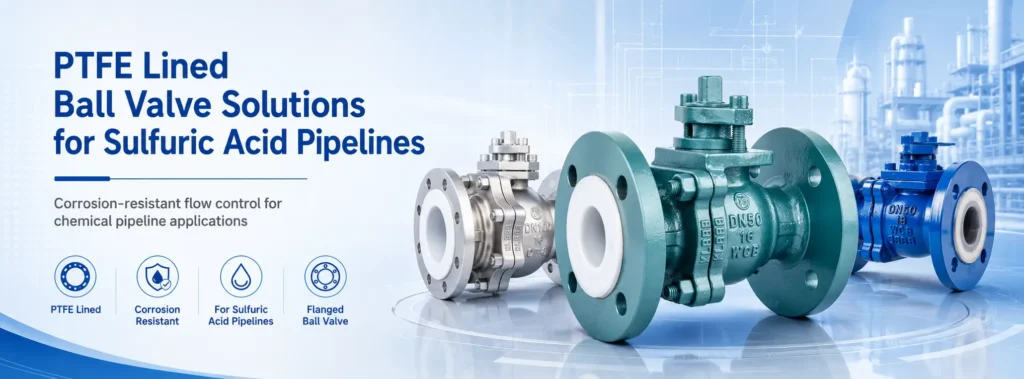
PTFE Lined Ball Valve Product Solution for Sulfuric Acid Pipelines
For sulfuric acid pipelines, a well-designed PTFE lined ball valve should focus on three core requirements: corrosion-resistant wetted surfaces, reliable sealing, and strong pipeline connection. The lining must cover the areas exposed to acid, the seat must maintain shutoff performance, and the valve body must provide enough mechanical strength for industrial installation. This is especially important in chemical plants where valves may operate near pumps, tanks, filters, reactors, and dosing equipment.
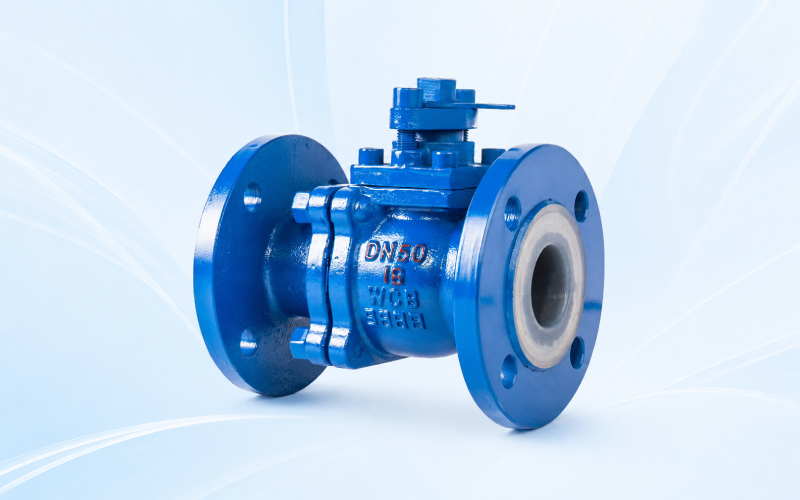
A PTFE lined ball valve used in sulfuric acid service should be selected according to the actual working conditions, not only according to nominal diameter. Important details include acid concentration, temperature, pressure class, flange standard, seat material, lining thickness, actuator type, and inspection requirements. For manual operation, the valve should provide smooth quarter-turn movement and clear open-close indication. For automated operation, the valve can be equipped with a pneumatic actuator or electric actuator to support remote control and plant automation.
Corrosion Protection
PTFE lining helps protect the valve’s wetted surfaces from direct sulfuric acid corrosion.
Tight Shutoff
The ball-and-seat structure provides reliable isolation for acid transfer and process pipelines.
Automation Ready
The valve can be matched with pneumatic or electric actuators for remote operation.
How a PTFE Lined Ball Valve Works
A PTFE lined ball valve works through quarter-turn rotation. The operator, gearbox, pneumatic actuator, or electric actuator rotates the valve stem. The stem drives the lined ball to turn inside the valve body. When the valve is open, the bore through the ball is aligned with the pipeline and sulfuric acid flows through the lined passage. When the valve is closed, the bore is perpendicular to the flow direction and the solid side of the ball blocks the pipeline.
The valve seat plays a critical role in sealing performance. In corrosive acid service, PTFE or reinforced PTFE seats are commonly used because the seat must resist chemical attack while maintaining enough contact pressure against the ball. A good seat design should provide reliable shutoff without creating excessive operating torque. If the seat is poorly supported, it may deform. If the actuator torque is too low, the valve may fail to operate after long-term service. If the lining quality is poor, acid may reach the metal body and cause hidden corrosion.
For sulfuric acid pipelines, the lining is the most important protective barrier. A high-quality PTFE lining should be uniform, continuous, and free from visible defects. The lining should protect the internal flow path and the flange sealing face. This is important because corrosion often begins at weak points, edges, scratches, pinholes, or exposed metal surfaces.
Advantages of PTFE Lined Ball Valves for Sulfuric Acid Service
The first advantage is corrosion resistance. Sulfuric acid can be highly aggressive to many common valve materials, especially when temperature, concentration, or process impurities change. A PTFE lined ball valve helps solve this problem by allowing the acid to contact the PTFE lining instead of the metal body. This can significantly reduce corrosion risk in compatible working conditions.
The second advantage is reliable shutoff. In sulfuric acid transfer systems, valves are often installed at tank outlets, pump suction lines, pump discharge lines, loading stations, and emergency isolation points. These positions require dependable sealing. A PTFE lined ball valve uses a direct ball-and-seat sealing structure, making it suitable for quick isolation and safe shutdown.
The third advantage is cost efficiency. In some acid services, high-alloy valves may be technically suitable but expensive. A lined valve provides a different engineering approach: the metal body provides strength, while the PTFE lining provides corrosion protection. For many sulfuric acid pipelines within suitable temperature and pressure limits, this can deliver a strong balance between performance and cost.
The fourth advantage is flexible operation. PTFE lined ball valves can be supplied as manual valves, gear-operated valves, pneumatic actuated valves, or electric actuated valves. In automated chemical plants, actuator-mounted lined ball valves can be integrated with PLC systems, control cabinets, limit switches, solenoid valves, and remote monitoring systems.
Main Benefits for Acid Pipelines
- Protects wetted surfaces from corrosive sulfuric acid exposure.
- Provides reliable quarter-turn shutoff for process isolation.
- Reduces dependence on expensive alloy valve materials in compatible conditions.
- Supports manual, pneumatic, and electric operation.
- Suitable for acid transfer, dosing, storage, and process pipelines.
- Helps reduce leakage risk and maintenance frequency when properly selected.
Common Types of PTFE Lined Ball Valves
Different sulfuric acid systems require different PTFE lined ball valve configurations. The valve should be selected according to pipe size, pressure, flow rate, installation space, automation requirement, and maintenance strategy.
Flanged PTFE Lined Ball Valve
A flanged PTFE lined ball valve is the most common choice for industrial sulfuric acid pipelines. The flanged connection provides strong installation stability and allows the valve to be removed for inspection or replacement. It is widely used in chemical plants, tank farms, pump stations, fertilizer plants, mining acid systems, and wastewater treatment facilities.
Full-Port PTFE Lined Ball Valve
A full-port design has a bore close to the pipeline diameter, reducing pressure drop and allowing higher flow capacity. This type is suitable for acid transfer pipelines, loading systems, and applications where smooth flow is important.
Reduced-Port PTFE Lined Ball Valve
A reduced-port valve has a smaller bore than the pipeline diameter. It may be more compact and economical. This type can be suitable for auxiliary acid lines, dosing systems, or applications where maximum flow capacity is not the main requirement.
Pneumatic PTFE Lined Ball Valve
A pneumatic PTFE lined ball valve is operated by compressed air. It is commonly used in chemical plants because pneumatic actuators provide fast action, simple control, and reliable performance in automated systems. Accessories such as solenoid valves, limit switches, and position indicators can be added for remote control.
Electric PTFE Lined Ball Valve
An electric PTFE lined ball valve uses an electric actuator. It is suitable for sites where compressed air is unavailable or where electrical automation is preferred. Electric actuators can provide on-off control, position feedback, manual override, and integration with control systems.
How to Select a PTFE Lined Ball Valve for Sulfuric Acid Pipelines
Correct valve selection begins with sulfuric acid concentration. Sulfuric acid behavior can change significantly with concentration and temperature. A valve solution that works in one acid concentration may not be suitable for another. Therefore, engineers should provide the exact acid concentration range, including possible dilution, process contamination, or concentration fluctuation.
Temperature is equally important. Higher temperature may increase corrosion risk, lining stress, seat deformation, and permeation. The PTFE lining, seat, packing, and actuator should all be suitable for the working temperature. For hot acid lines, the valve manufacturer should confirm the recommended temperature limit and installation precautions.
Pressure and flange requirements must also be checked. The metal body must meet pipeline pressure requirements, while the lining must remain stable under pressure and temperature cycles. The flange standard, gasket material, bolt tightening method, and pipe alignment can all affect sealing reliability. Improper installation may damage the lined flange face or cause leakage at the connection.
Flow conditions should not be ignored. If the acid contains suspended particles, crystals, or impurities, erosion and abrasion may affect the lining and seat. If the pipeline has high flow velocity, turbulence may increase wear. If the valve is expected to operate frequently, actuator torque and seat durability become more important.
Selection Checklist
- Confirm sulfuric acid concentration and possible concentration fluctuation.
- Confirm operating temperature, pressure, and flow conditions.
- Check whether PTFE lining is suitable for the actual acid service.
- Select full-port or reduced-port design according to pressure drop and flow demand.
- Confirm flange standard, pressure class, face-to-face dimension, and gasket type.
- Make sure all wetted surfaces are lined or chemically protected.
- Confirm seat, packing, stem, and lining materials.
- Select manual, pneumatic, or electric operation according to automation needs.
- Request pressure test, seat leakage test, lining inspection, and quality documents.
- Confirm maintenance space, spare parts availability, and installation instructions.
Installation and Maintenance Recommendations
Before installing a PTFE lined ball valve, the pipeline should be cleaned to remove welding slag, sand, rust, and hard particles. These contaminants can scratch the lining or damage the seat during operation. The valve should be inspected before installation to confirm that the lining surface and flange sealing face are clean and undamaged.
During installation, the valve should be aligned naturally with the pipeline. Excessive pipe stress may distort the valve body or damage the lined flange face. Bolts should be tightened evenly in a cross pattern. Over-tightening may damage the lining, while under-tightening may lead to flange leakage. The correct gasket material should be selected according to sulfuric acid concentration and temperature.
In operation, PTFE lined ball valves are generally better suited for on-off service than long-term throttling. If the valve remains partially open for a long time, high-velocity acid flow may cause seat wear, lining erosion, vibration, or unstable control. If precise flow regulation is required, a lined control valve may be more suitable than a standard lined ball valve.
Maintenance should include regular leakage inspection, actuator function testing, bolt inspection, position verification, and external corrosion checking. For critical sulfuric acid pipelines, operators should establish a maintenance schedule based on operating severity. Before maintenance, the pipeline must be isolated, depressurized, drained, and handled according to plant safety procedures.
Industrial Applications
PTFE lined ball valves are widely used wherever sulfuric acid must be safely transported, isolated, or controlled. In chemical manufacturing, they are used for acid transfer, reactor feed, neutralization systems, and process isolation. In mining and metallurgy, they are used in leaching systems and acid handling lines. In fertilizer plants, they support acid transfer and raw material processing. In wastewater treatment, they are used for acid dosing and pH adjustment.
These applications all share the same valve requirement: corrosion-resistant shutoff. The valve must protect the pipeline from uncontrolled acid release while maintaining operability under harsh chemical conditions. This is why PTFE lined ball valves have become a common solution for sulfuric acid pipelines in many industrial plants.
Typical Application Areas
- Sulfuric acid transfer pipelines
- Acid storage tank inlet and outlet systems
- Chemical dosing and neutralization units
- Mining leaching and metal processing systems
- Fertilizer and phosphate production plants
- Wastewater treatment and pH adjustment systems
- Battery manufacturing and acid handling systems
- Power plant chemical treatment pipelines
Frequently Asked Questions About PTFE Lined Ball Valves
Is a PTFE Lined Ball Valve suitable for sulfuric acid?
A PTFE Lined Ball Valve can be suitable for many sulfuric acid pipeline applications, but the final selection must consider acid concentration, temperature, pressure, flow velocity, and the valve manufacturer’s compatibility guidance.
Why use a PTFE lined valve instead of a normal metal valve?
In sulfuric acid service, many normal metal valves may suffer corrosion. A PTFE lined valve protects the wetted surfaces with a corrosion-resistant lining while retaining the mechanical strength of a metal body.
Can a PTFE lined ball valve be automated?
Yes. It can be equipped with pneumatic or electric actuators, limit switches, solenoid valves, position indicators, and other control accessories for remote or automatic operation.
Can PTFE lined ball valves be used for throttling?
They are generally recommended for on-off service. Long-term throttling may cause seat wear, lining erosion, vibration, or unstable flow. For accurate flow control, a lined control valve may be more suitable.
Conclusion
In sulfuric acid pipelines, valves are critical safety and reliability components. A PTFE Lined Ball Valve provides a practical solution by combining metal body strength with PTFE lining corrosion resistance. It can help chemical plants, mining operations, fertilizer facilities, wastewater systems, and acid storage areas achieve reliable shutoff and better corrosion control.
The right PTFE lined ball valve should be selected according to sulfuric acid concentration, temperature, pressure, flow conditions, lining quality, seat material, flange standard, and automation requirements. When properly selected, installed, and maintained, it can provide dependable service in corrosive sulfuric acid pipelines and support safer, more efficient industrial operation.