


three way ball valve
A three way ball valve is a multi-port valve designed to control, divert, mix, or isolate fluid flow in piping systems. Compared with a standard two-way ball valve, a three way ball valve has three ports and a specially drilled ball that allows the flow path to be switched between different directions. This makes it a practical solution for water treatment, HVAC systems, chemical processing, food and beverage equipment, compressed air systems, oil transfer, and industrial automation.
For engineers, contractors, OEM manufacturers, and procurement teams, choosing the right three way ball valve requires more than confirming the pipe size. Port configuration, flow pattern, body material, seat material, pressure rating, temperature range, connection type, and driving method all affect valve performance. The most common driving types include manual three way ball valve, electric three way ball valve, and pneumatic three way ball valve.
What Is a three way ball valve?
A three way ball valve uses a rotating ball with an internal flow passage to connect or block different ports. By turning the ball, the valve can change the direction of the medium, mix two flows into one outlet, or divert one flow into two possible outlets. The valve is typically operated by a handle, electric actuator, or pneumatic actuator.
The main advantage of a three way ball valve is its ability to replace multiple two-way valves in one compact design. This helps reduce piping complexity, installation space, leakage points, and maintenance work. In many systems, one three way ball valve can perform switching or distribution functions that would otherwise require two or more separate valves.
Common Flow Patterns of three way ball valve
The internal design of a three way ball valve is usually based on an L-port or T-port ball. These two configurations determine how the flow can be directed through the valve.
| Flow Pattern | Main Function | Typical Application |
|---|---|---|
| L-Port three way ball valve | Diverts flow between two outlet paths | Flow switching, tank selection, equipment bypass |
| T-Port three way ball valve | Diverts, mixes, or distributes flow | Mixing systems, circulation loops, process pipelines |
An L-port three way ball valve is commonly used when the system needs to switch flow from one line to another. A T-port three way ball valve is more flexible and can be used for mixing, diverting, or combining flow depending on the ball position and valve design.
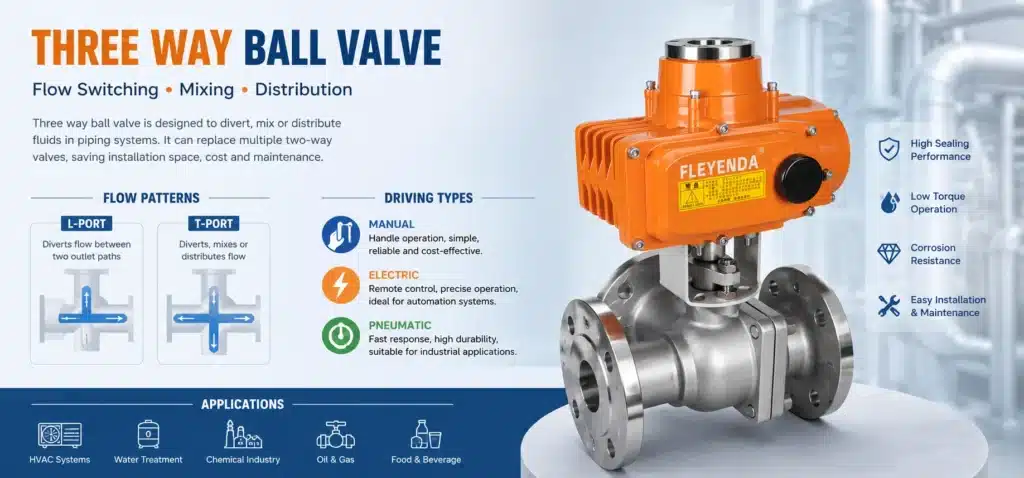
Manual three way ball valve
A manual three way ball valve is operated by a handle or lever. It is simple, reliable, economical, and easy to install. The operator turns the handle to rotate the internal ball and change the flow direction. Manual operation is suitable for systems where flow switching is not frequent or where automatic control is not required.
Manual three way ball valves are widely used in water systems, irrigation lines, laboratory equipment, small process systems, low-pressure chemical pipelines, and maintenance bypass lines. They are also popular because they require no external power source, no control signal, and minimal setup.
When purchasing a manual three way ball valve, buyers should check the handle position, locking option, flow indication, port marking, operating torque, and installation space. For safety-sensitive applications, a lockable handle may help prevent unauthorized operation.
Electric three way ball valve
An electric three way ball valve uses an electric actuator to rotate the valve ball automatically. This type of three way ball valve is suitable for remote control, automatic switching, smart equipment, and building automation systems. The actuator may support on/off control, modulating control, or signal feedback depending on the system requirements.
Electric three way ball valves are commonly used in HVAC systems, water treatment equipment, dosing systems, cooling circuits, industrial automation, and OEM machinery. They are especially useful where the valve needs to be controlled by PLC, BMS, thermostat, sensor, or remote control panel.
Before selecting an electric three way ball valve, buyers should confirm the actuator voltage, control signal, rotation angle, torque output, enclosure rating, wiring method, manual override function, and fail-safe requirements. Common voltages include AC 110V, AC 220V, DC 12V, and DC 24V. For outdoor or humid environments, the actuator protection level is also important.
Pneumatic three way ball valve
A pneumatic three way ball valve is driven by compressed air. It is widely used in industrial automation because it offers fast response, high operating reliability, and strong safety performance in demanding environments. Pneumatic actuation is often preferred where electrical actuation may not be ideal, such as explosive, wet, or high-cycle industrial applications.
Pneumatic three way ball valves are commonly used in chemical processing, food and beverage production, water treatment plants, compressed air systems, oil and gas equipment, and automated process lines. They can be equipped with single-acting or double-acting pneumatic actuators. A single-acting actuator can return the valve to a safe position when air supply is lost, while a double-acting actuator uses air pressure to open and close the valve.
When sourcing a pneumatic three way ball valve, buyers should confirm the air supply pressure, actuator type, torque requirement, solenoid valve compatibility, limit switch box, position indicator, fail-open or fail-close function, and mounting standard. For automated systems, accessories such as air filter regulators, solenoid valves, and position feedback devices may also be required.
Driving Types Comparison
| Driving Type | Advantages | Best For |
|---|---|---|
| Manual three way ball valve | Low cost, simple structure, easy installation, no power required | Basic flow switching and maintenance pipelines |
| Electric three way ball valve | Remote control, automation, signal feedback, precise operation | HVAC, water treatment, smart systems, OEM equipment |
| Pneumatic three way ball valve | Fast response, high cycle life, reliable industrial automation | Chemical plants, process lines, compressed air systems |
Materials for three way ball valve
The material of a three way ball valve should match the medium and working environment. Stainless steel three way ball valves are preferred for corrosive media, chemical applications, food-grade systems, and industrial pipelines. Brass three way ball valves are often used in water, air, and HVAC systems. PVC three way ball valves are lightweight and suitable for low-pressure water treatment, irrigation, and certain chemical systems.
| Material | Key Features | Common Use |
|---|---|---|
| Stainless Steel | High strength, corrosion resistance, long service life | Chemical, food, industrial, water treatment |
| Brass | Cost-effective and suitable for many water applications | HVAC, plumbing, water, air systems |
| PVC | Lightweight, economical, chemical-resistant in low-pressure service | Irrigation, aquaculture, pools, water treatment |
How to Choose the Right three way ball valve
To select the correct three way ball valve, buyers should first define the system function. If the valve only needs occasional switching, a manual three way ball valve may be enough. If remote operation or automatic control is required, an electric three way ball valve is usually suitable. If the system requires fast response, frequent cycling, or industrial automation, a pneumatic three way ball valve may be the better choice.
Buyers should also confirm whether an L-port or T-port design is required. The wrong port configuration may cause incorrect flow direction or system malfunction. In addition, pressure rating, temperature range, seat material, body material, end connection, leakage requirements, and actuator compatibility should be checked before purchasing.
Key Specifications to Confirm Before Purchasing
- Valve size and port configuration
- L-port or T-port flow pattern
- Manual, electric, or pneumatic driving type
- Body material, ball material, and stem material
- Seat and seal material
- Pressure rating and temperature range
- Threaded, flanged, welded, clamp, or socket connection
- Applicable media and chemical compatibility
- Actuator voltage, air pressure, torque, and control signal
- Certification, testing standard, packaging, and lead time
Conclusion
A three way ball valve is a versatile valve solution for flow diversion, mixing, distribution, and system isolation. With L-port and T-port designs, it can simplify pipeline layouts and improve system control flexibility. Depending on the application, buyers can choose a manual three way ball valve, electric three way ball valve, or pneumatic three way ball valve.
For reliable performance, the correct three way ball valve should be selected according to flow pattern, material, pressure, temperature, connection type, medium compatibility, and driving method. Working with a professional valve supplier can help ensure proper selection, stable quality, and long-term system reliability.