


What Is a Cryogenic Valve? Types, Design & Industrial Applications
A cryogenic valve is a specially designed industrial valve used to control, isolate, or direct fluids at extremely low temperatures. Unlike conventional industrial valves, a cryogenic valve must maintain mechanical strength, sealing performance, and reliable operation when exposed to liquefied gases or other low-temperature process media.
Cryogenic valves play an important role in liquefied natural gas (LNG) facilities, industrial gas production, air separation units, liquid nitrogen distribution, liquid oxygen systems, and specialized low-temperature processing equipment.
At cryogenic temperatures, metals contract, sealing materials change their mechanical properties, and trapped liquids can create dangerous pressure increases as they warm and vaporize. These conditions introduce design requirements that are not normally encountered in ambient-temperature valve applications.
This guide explains what a cryogenic valve is, how it works, the main cryogenic valve types, their design features, materials, applicable standards, industrial applications, and the most important factors to consider before purchasing.
A cryogenic valve is not simply a standard valve manufactured from stainless steel. Its complete design, including body, bonnet, seats, seals, pressure-relief arrangements, and testing, must be suitable for the specified minimum operating temperature.
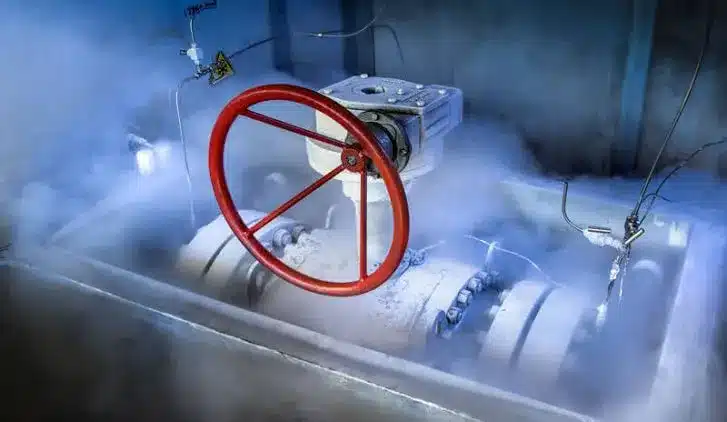
What Is a Cryogenic Valve?
A cryogenic valve is an industrial flow-control device engineered to operate at very low temperatures while maintaining the required pressure containment, shut-off performance, and mechanical reliability.
These valves are commonly used in systems handling liquefied gases, where the process medium is maintained at a temperature far below normal ambient conditions.
Typical examples include valves installed in LNG storage terminals, liquid nitrogen distribution systems, cryogenic storage vessels, and industrial gas processing plants.
The basic purpose of a cryogenic valve is similar to that of a conventional valve: it controls the movement of a fluid through a pipeline. However, the extremely low operating temperature changes the engineering requirements for the valve assembly.
In particular, low temperatures can affect material toughness, sealing contact pressure, operating torque, packing performance, and the pressure generated by trapped cryogenic liquid.
A properly designed cryogenic valve addresses these challenges through suitable materials, extended bonnet construction where required, appropriate sealing systems, controlled pressure-relief arrangements, and testing at the specified low temperature.
What Temperature Can a Cryogenic Valve Handle?
Cryogenic service generally refers to applications involving extremely low temperatures. In industrial valve specifications, low-temperature and cryogenic requirements may begin around -50°C, depending on the applicable standard and service.
Some cryogenic valve designs are qualified for operation down to -196°C. Others are specifically engineered for colder applications, but these require separate verification of materials, design, and testing.
The correct rating must therefore be established from the actual process medium and specified minimum design temperature.
| Cryogenic Medium | Approximate Boiling Temperature | Typical Application |
|---|---|---|
| Liquefied Natural Gas (LNG) | Approximately -162°C | LNG storage, transfer, loading, regasification |
| Liquid Nitrogen (LN2) | -196°C | Industrial gas, freezing, testing, cryogenic systems |
| Liquid Oxygen (LOX) | Approximately -183°C | Air separation, oxygen storage and distribution |
| Liquid Argon | Approximately -186°C | Industrial gas production and distribution |
| Liquid Hydrogen (LH2) | Approximately -253°C | Specialized hydrogen storage and transfer |
These values are approximate normal boiling temperatures at atmospheric pressure. Actual process temperatures depend on composition and operating pressure.
Cryogenic valves rated to -196°C should not automatically be considered suitable for liquid hydrogen at approximately -253°C. Hydrogen service may require additional material, leakage, safety, and testing qualifications beyond the scope of conventional LNG or liquid nitrogen valve designs.
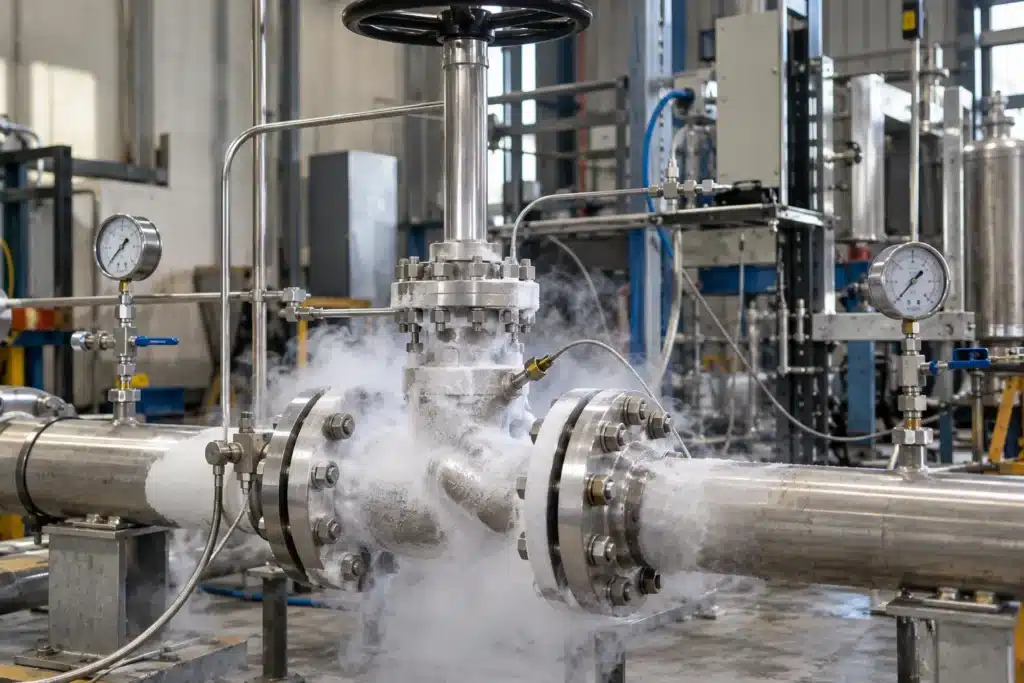
How Does a Cryogenic Valve Work?
A cryogenic valve controls flow by moving a closure element into or away from the flow passage, just like an ordinary industrial valve.
Depending on the valve design, the operating element may be a rotating ball, a rising gate, a globe valve plug, a butterfly disc, or a check valve mechanism.
When the valve is open, cryogenic fluid passes through the valve body. When the valve is closed, the sealing surfaces restrict or stop flow according to the valve’s specified shut-off requirements.
The main difference lies in how the valve remains reliable while the body and internal parts are exposed to extreme cold.
Cryogenic liquid causes thermal contraction of the body, stem, seats, and other internal components. Different materials may contract at different rates, potentially affecting sealing pressure and valve movement.
To address these conditions, cryogenic valves use carefully selected materials and sealing arrangements. Many manually operated and actuated cryogenic valves also feature an extended bonnet that separates the stem packing from the coldest region of the valve.
This helps maintain sealing performance and allows the operating mechanism to function within its specified temperature limits.
Typical Cryogenic Valve Operating Sequence
- The valve receives a manual or automated operating command.
- The stem, shaft, or actuator moves the closure element.
- The flow passage opens, closes, or changes position.
- The cryogenic-rated sealing system maintains the required shut-off performance.
- Body and bonnet construction accommodates the expected low-temperature conditions.
- Any potential pressure accumulation in trapped cavities is addressed by the approved valve and system design.
Key Cryogenic Valve Design Features
A cryogenic valve must address several mechanical and thermal challenges that are less severe in conventional industrial valve applications.
1. Extended Bonnet Design
One of the most recognizable cryogenic valve features is the extended bonnet, sometimes called an extended stem or extended gland arrangement.
The extension creates a greater thermal separation between the extremely cold valve body and the stem packing or operating equipment.
This reduces heat transfer to the packing area and can help keep the packing within its specified service-temperature limits.
The required extension length depends on the valve type, nominal size, installation, insulation or cold-box arrangement, and applicable design standard.
Cryogenic Fluid Zone
Valve Body and Closure
Extended Bonnet
Packing and Operator
2. Low-Temperature Material Selection
Ordinary carbon steel may lose toughness and become susceptible to brittle fracture at sufficiently low temperatures.
Cryogenic valve bodies and pressure-containing components therefore require materials with adequate mechanical properties at the specified minimum design temperature.
Austenitic stainless steels, including suitable 304 and 316 grades, are widely used in many cryogenic applications because of their low-temperature toughness.
However, the complete material specification, heat treatment, impact toughness requirements where applicable, and pressure-temperature rating must be verified.
3. Pressure Relief for Trapped Cryogenic Liquid
A major safety consideration is the potential pressure increase caused by trapped cryogenic liquid.
If liquid remains inside a sealed body cavity or isolated section and begins warming, vaporization and thermal expansion can create substantial pressure.
Suitable valve designs may include a pressure-relief passage, a cavity-relief hole, or a self-relieving seat arrangement.
The selected method must match the flow direction, isolation requirements, and applicable engineering standard. The piping system may also require separate thermal-relief protection.
4. Low-Temperature Sealing System
Cryogenic valve seats and seals must maintain their intended sealing performance after thermal contraction and during repeated cooling and warming cycles.
Depending on the medium and design, the valve may use specially selected polymer seats, spring-energized seals, or metal-seated construction.
The sealing materials must be qualified for the specific fluid, temperature, pressure differential, and leakage requirement.
5. Stem Packing and Operating Torque
Stem packing prevents external leakage along the operating stem. At very low temperatures, inadequate packing design may lead to increased friction, leakage, or damage.
Cryogenic valve construction should consider temperature distribution around the packing and the changes in operating torque or thrust caused by thermal contraction.
Pneumatic and electric actuators should be selected only after confirming the valve’s operating requirements under the intended service conditions.
What Are the Main Types of Cryogenic Valves?
Cryogenic valves are available in several operating designs. Each type serves a different function, and no single valve construction is suitable for every low-temperature application.
Cryogenic Ball Valve
A cryogenic ball valve uses a rotating ball with a drilled flow passage to provide quick quarter-turn isolation.
These valves are commonly considered for cryogenic liquid and gas transfer where compact construction and rapid shut-off are required.
Important selection factors include the cavity-relief design, seat construction, valve pressure rating, stem sealing, and operating torque.
Cryogenic Gate Valve
A cryogenic gate valve uses a rising or non-rising closure element to isolate flow. It is generally intended for fully open or fully closed operation rather than continuous throttling.
Gate valves may be selected for large pipelines and applications requiring low pressure loss when fully open.
The bonnet design, body material, operating thrust, and thermal-relief provisions must be evaluated for cryogenic duty.
Cryogenic Globe Valve
A cryogenic globe valve moves a plug toward or away from a seat. Depending on the design, it can be used for isolation or controlled fluid regulation.
Globe valves are commonly considered in systems that require controlled flow or more frequent adjustment.
Cryogenic globe valves used specifically for control service need an appropriate control-valve design and qualification, which may differ from the requirements for isolation valves.
Cryogenic Butterfly Valve
Cryogenic butterfly valves use a rotating disc to control the flow passage.
Suitable high-performance or triple-offset designs may be used for larger-diameter cryogenic pipelines where compact construction and reduced valve weight are important.
The disc, shaft, bearings, body materials, and seat design must all be suitable for the minimum operating temperature.
Cryogenic Check Valve
A cryogenic check valve allows flow in the intended direction and helps prevent reverse flow.
Check valves can protect cryogenic pumps, transfer lines, and processing equipment from unwanted flow reversal.
Selection should consider opening pressure, pressure loss, flow orientation, closure response, and the potential for reverse-flow transients.
| Valve Type | Primary Function | Typical Cryogenic Application |
|---|---|---|
| Cryogenic Ball Valve | On-off isolation | LNG transfer and process isolation |
| Cryogenic Gate Valve | Full-bore isolation | Storage and transfer pipelines |
| Cryogenic Globe Valve | Isolation or selected flow control | Industrial gas and process systems |
| Cryogenic Butterfly Valve | Large-line isolation | LNG terminals and large process lines |
| Cryogenic Check Valve | Backflow prevention | Cryogenic pump and transfer systems |
What Materials Are Used in Cryogenic Valves?
Materials are among the most important factors affecting cryogenic valve reliability because mechanical properties can change significantly at low temperatures.
Austenitic Stainless Steel
Appropriate austenitic stainless steel grades, such as 304, 304L, 316, and 316L, are frequently used for cryogenic valve components.
These materials can retain useful toughness at low temperatures and are widely available in forged, cast, and fabricated configurations.
The exact grade should be selected according to the process medium, corrosion exposure, pressure, mechanical requirements, and applicable material standard.
Special Low-Temperature Alloys
Other low-temperature materials, including suitable nickel alloys, copper alloys, and aluminum alloys, may be used in specialized cryogenic equipment.
Their suitability depends on the actual design temperature, fluid compatibility, mechanical strength, and construction method.
Seat and Seal Materials
Cryogenic seats and seals may use specially selected fluoropolymers, engineered polymers, metal seating surfaces, or other qualified sealing systems.
The low-temperature rating of a polymer must not be assumed from its general chemical resistance alone.
For liquid oxygen service, the valve must also meet appropriate oxygen-cleanliness and material-compatibility requirements. Materials suitable for LNG or nitrogen are not automatically approved for oxygen.
Where Are Cryogenic Valves Used?
Cryogenic valves are essential wherever extremely cold liquids or gases must be stored, transferred, isolated, or controlled.
1. LNG Storage and Transportation
LNG facilities use cryogenic valves in liquid transfer pipelines, storage tank connections, loading and unloading systems, and regasification installations.
Important requirements include low-temperature sealing, pressure containment, emergency isolation, and suitable materials for LNG service.
2. Air Separation Plants
Air separation units produce oxygen, nitrogen, and argon through low-temperature processing.
Cryogenic valves are used to isolate equipment, manage liquid transfer, and control process flow in cold sections and associated distribution systems.
3. Liquid Nitrogen Systems
Liquid nitrogen is used in industrial freezing, laboratory equipment, material testing, and specialized manufacturing processes.
Cryogenic valves help manage nitrogen transfer between storage, distribution, and consuming equipment.
4. Liquid Oxygen Systems
Liquid oxygen systems require valves designed for cryogenic temperature and oxygen compatibility.
Material selection, cleanliness, contamination control, and operating procedures are especially important because oxygen-enriched environments increase fire hazards.
5. Industrial Gas Storage and Distribution
Cryogenic valves are used in distribution systems for liquefied industrial gases, including suitable tank connections, transfer lines, and processing equipment.
The valve design must match the fluid, operating pressure, installation arrangement, and required leakage performance.
6. Hydrogen and Specialized Energy Systems
Certain hydrogen applications operate at very low temperatures and require specialized valves.
Liquid hydrogen service involves temperatures considerably below the conventional -196°C industrial cryogenic range and requires dedicated engineering qualification.
Cryogenic Valve Testing and Industry Standards
Cryogenic valve testing helps verify performance at the specified low-temperature conditions rather than relying only on ambient-temperature inspection.
ISO 28921
ISO 28921-1:2022 addresses the design, manufacturing, and production testing of specified industrial isolation valves used in low-temperature applications from -50°C down to -196°C.
ISO 28921-2:2015 addresses low-temperature type testing for applicable isolation valves.
The exact scope of these documents must be considered. ISO 28921-1 does not cover every cryogenic valve application, including certain cryogenic vessel valves, safety valves, and control valves.
ANSI/MSS SP-134
ANSI/MSS SP-134-2025 addresses additional requirements for metallic cryogenic-service valves, including materials, design, body or bonnet extensions, manufacturing, examination, and testing.
Its provisions complement applicable valve-specific standards and should be reviewed during specification development.
BS 6364
BS 6364 is another commonly referenced specification for cryogenic-service valves. It addresses design features and testing considerations for valves intended to operate under low-temperature conditions.
What Should Be Verified During Testing?
- Body pressure containment and structural integrity
- Seat leakage at the specified low temperature
- Stem packing and external leakage performance
- Valve operation and torque or thrust under test conditions
- Correct function following cooling and warming cycles where required
- Material records and applicable inspection documentation
Buyers should specify the exact applicable standard, edition, test temperature, acceptance criteria, and required documentation. A general claim of “cryogenic tested” is not a substitute for a traceable test report identifying the tested valve configuration.
Technical reference:
ISO 28921-1:2022
and
MSS SP-134.
How to Select the Right Cryogenic Valve
Selecting a cryogenic valve requires detailed consideration of the fluid, operating temperature, pressure, process function, and safety requirements.
A valve that performs well in normal industrial service may be unsuitable for LNG or liquid nitrogen without specific cryogenic design and qualification.
Step 1: Identify the Cryogenic Medium
Specify whether the fluid is LNG, liquid nitrogen, liquid oxygen, liquid argon, hydrogen, or another substance.
The medium determines material compatibility, cleanliness requirements, and potentially the applicable design standards.
Step 2: Confirm Minimum Design Temperature
Determine the minimum design metal temperature rather than using the approximate boiling temperature alone.
Consider normal operation, startup, shutdown, depressurization, and other credible temperature conditions.
Step 3: Select the Valve Type
Determine whether the required function is on-off isolation, flow regulation, or backflow prevention.
Ball and gate valves are commonly selected for isolation, while suitable globe or specialized control valves can serve regulating applications. Check valves are used for backflow protection.
Step 4: Check Pressure and Size
Specify nominal size, maximum operating pressure, pressure differential, connection standard, and the required pressure-temperature rating.
The valve must accommodate both cryogenic operating conditions and relevant ambient or warm conditions during startup, maintenance, or pressure testing.
Step 5: Evaluate Bonnet and Installation Design
Determine whether an extended bonnet is required and confirm the necessary dimensions for insulation, cold-box construction, or actuator clearance.
Stem orientation and installation arrangement should follow the specific valve design and applicable standard.
Step 6: Confirm Sealing and Pressure Relief
Specify the required seat leakage performance, external leakage limits, packing design, and cavity pressure-relief method.
These requirements are particularly important where liquid can become trapped between closed valve seats or inside isolated piping sections.
Step 7: Request Testing Documentation
Confirm the required cryogenic test standard, test temperature, test medium, inspection records, and material certificates.
If the valve is automated, actuator torque or thrust and the required fail-safe behavior must also be verified under the appropriate operating conditions.
Cryogenic Valve RFQ Checklist
- Process medium and composition
- Minimum design temperature
- Minimum and maximum operating pressure
- Valve type, DN/NPS, and pressure class
- Connection type: flanged, butt-weld, or other
- Body, stem, and seat material requirements
- Extended bonnet or cold-box installation requirements
- Leakage class and cavity pressure-relief arrangement
- Manual, electric, or pneumatic operation
- Applicable standards and required cryogenic test reports
- Quantity and project delivery requirements
Common Cryogenic Valve Problems and How to Prevent Them
Cryogenic valve failures often result from unsuitable materials, inadequate sealing design, incorrect installation, or insufficient attention to thermal effects.
| Problem | Possible Cause | Prevention |
|---|---|---|
| External leakage | Inadequate packing design or thermal contraction | Use qualified packing and appropriate bonnet construction |
| Internal seat leakage | Seat distortion, contraction, or unsuitable sealing materials | Verify low-temperature seat design and leakage testing |
| High operating torque | Thermal contraction, seat loading, or inadequate clearances | Confirm torque at design temperature and actuator sizing |
| Body or component fracture | Insufficient material toughness at low temperature | Select properly qualified cryogenic materials |
| Excessive cavity pressure | Trapped liquid warming and expanding | Provide approved cavity and system thermal-relief measures |
| Actuator malfunction | Cold exposure beyond component ratings | Verify installation temperature, mounting, and actuator protection |
Proper engineering review, material selection, low-temperature testing, and commissioning procedures help reduce these risks.
Frequently Asked Questions About Cryogenic Valves
What is a cryogenic valve used for?
A cryogenic valve is used to isolate, direct, or regulate very cold process fluids. Common applications include LNG storage, liquid nitrogen transfer, air separation plants, and industrial gas systems.
What is the difference between a cryogenic valve and a normal valve?
A cryogenic valve is specifically engineered for low-temperature conditions. Its materials, sealing systems, bonnet design, and pressure-relief arrangements must be suitable for the specified service temperature, unlike a standard valve without cryogenic qualification.
Why do cryogenic valves have extended bonnets?
Extended bonnets increase the thermal separation between the cold valve body and the packing area, helping maintain the packing within its specified service-temperature limits.
Can a stainless steel valve be used for cryogenic service?
Some stainless steel grades are suitable for cryogenic use, but stainless steel construction alone does not qualify a valve. The complete valve design and required testing must also be appropriate.
What temperature is a cryogenic valve rated for?
It depends on the specific design and qualification. Some industrial cryogenic isolation valves are designed for temperatures as low as -196°C, while other applications require different limits or specialized designs.
Can cryogenic ball valves be used for LNG?
Yes, provided the ball valve is specifically designed, material-qualified, and tested for the intended LNG conditions, including pressure, temperature, sealing, and cavity-relief requirements.
What materials are commonly used in cryogenic valves?
Suitable austenitic stainless steels, including certain 304 and 316 grades, are widely used. Other materials may be appropriate depending on the fluid, design temperature, and applicable specifications.
Can cryogenic valves use electric or pneumatic actuators?
Yes. Suitable cryogenic valves can be combined with electric or pneumatic actuators, provided the complete assembly meets the required torque, environmental, control, and failure-response conditions.
Which standards apply to cryogenic valves?
Common references include ISO 28921, ANSI/MSS SP-134, and BS 6364, together with applicable valve product and project specifications. Their scope must be checked for the particular valve and application.
What information is required when buying a cryogenic valve?
Buyers should specify the medium, minimum design temperature, pressure, valve type, size, connection, materials, installation requirements, actuation, leakage criteria, testing standard, and documentation.
Cryogenic Valve Selection and Technical Inquiry
Cryogenic applications require careful engineering evaluation because low-temperature materials, sealing systems, pressure relief, and installation conditions directly affect valve reliability.
If your project involves LNG, liquid nitrogen, industrial gas processing, or another low-temperature medium, provide the application specifications when requesting a valve solution.
Fleyenda can review your project inquiry to discuss applicable valve requirements, configuration options, and the availability of appropriately qualified products and supporting documentation.
Including your P&ID, operating conditions, required standards, and test documentation requirements will help clarify the technical scope.
Need a Cryogenic Valve for Your Project?
Send your operating conditions, valve specifications, and purchasing requirements to Fleyenda for technical discussion.
Conclusion: Choosing the Right Cryogenic Valve
A cryogenic valve is an essential component in industrial systems handling extremely low-temperature liquids and gases. Its purpose is to maintain reliable flow control and pressure containment under conditions that conventional valves may not be designed to withstand.
The most important considerations include material toughness, extended bonnet design, low-temperature sealing, trapped-liquid pressure relief, valve type, and documented testing performance.
Whether the application involves LNG storage, liquid nitrogen distribution, air separation, or another cryogenic process, valve selection should always begin with the actual process conditions and applicable engineering standards.
Proper specification and verification of the complete cryogenic valve assembly can improve operating reliability, support process safety, and reduce the risk of leakage or equipment failure.