


FLEYENDA · INDUSTRIAL VALVE GUIDE
Как работает трёхходовой клапан?
Understand the three way valve working principle, including mixing and diverting flow, L-port and T-port configurations, flow direction, actuator options and industrial applications.
A three way valve is an industrial flow control valve with three connection ports. Unlike a conventional two way valve that controls one inlet and one outlet, a three way valve can manage multiple flow paths within one valve body. Depending on its internal design, it can mix two fluid streams, divert one inlet flow between two outlets, or switch fluid between different pipeline routes.
The three way valve working principle is widely used in HVAC systems, water treatment plants, chemical processing, boiler systems, heat exchangers and industrial automation. Common configurations include three way ball valves, three way control valves, electric three way valves and pneumatic three way valves.
What Is a Three Way Valve?
A three way valve is a valve designed with three pipeline connections, commonly identified as A, B and AB, or by other manufacturer-specific port markings. Its internal flow passage determines how fluid moves between the three connections.
In industrial systems, a three way valve can simplify pipeline arrangements by combining selected flow-routing functions into one assembly. Depending on the design, it may replace multiple two way valves for certain switching or distribution duties. However, the required isolation, leakage and control functions must be considered before replacing independent valves.
| Пункт | Three Way Valve Description |
|---|---|
| Number of Ports | Three pipeline connections |
| Main Functions | Mixing, diverting, switching and bypass routing |
| Common Designs | L-port, T-port, three way ball valve and three way control valve |
| Operating Methods | Manual, electric and pneumatic actuation |
| Типичные области применения | HVAC, water treatment, chemical processing and industrial pipelines |
Как работает трёхходовой клапан?
The working principle of a three way valve depends on its internal construction. In a three way ball valve, an internal ball contains an L-shaped or T-shaped passage. Rotating the ball changes the connection between the three ports.
In a three way control valve, a plug or regulating trim moves inside the valve body to adjust the opening between ports. This allows the valve to regulate flow distribution rather than simply switch between fixed positions.
Fluid Enters the Valve
One or two fluid streams enter through the designated inlet ports, depending on whether the valve is used for diverting or mixing service.
Internal Flow Path Changes
The ball, plug or control trim moves to connect the required ports and isolate or restrict other flow paths.
Fluid Exits Through the Selected Port
The fluid leaves through the designated outlet, or two compatible inlet streams combine into one outlet in a mixing arrangement.
For an automated three way valve, the actuator controls the valve position. An electric actuator uses a motor and gearing, while a pneumatic actuator uses compressed air. A control valve with a positioner can adjust its position according to a control signal.
Three Way Mixing Valve vs. Three Way Diverting Valve
Mixing and diverting are two important operating functions of a three way valve. The difference is the direction in which the fluid moves through the three ports.
| Сравнение | Three Way Mixing Valve | Three Way Diverting Valve |
|---|---|---|
| Flow Direction | Two inlets to one outlet | One inlet to two outlets |
| Typical Port Arrangement | A + B → AB | AB → A + B |
| Основная функция | Combines two fluid streams | Distributes one fluid stream |
| Common Applications | Temperature control, heating loops and fluid blending | Bypass, tank selection and equipment routing |
| Selection Priority | Inlet conditions and mixing requirements | Outlet flow requirements and branch configuration |
L Port Three Way Valve vs. T Port Three Way Valve
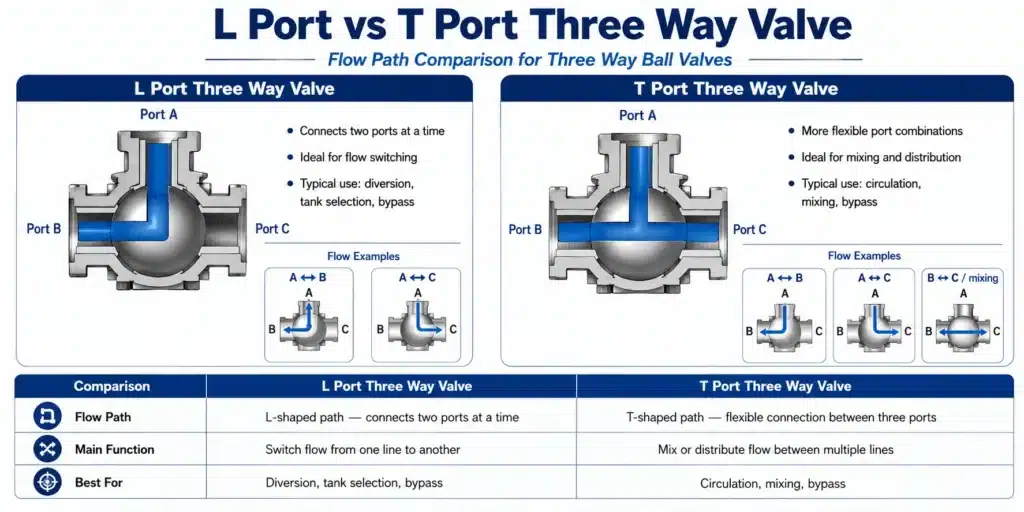
The internal port design is one of the most important factors when selecting a three way ball valve. L-port and T-port configurations have different internal passages and flow-routing capabilities.
L-Port Three Way Valve
An L-port three way valve has an L-shaped passage through the ball. It generally connects two ports at a time and is commonly used to switch one flow between two alternative pipeline paths.
- Flow diversion and route switching
- Tank and equipment selection
- Filter changeover
- Alternative pipeline connections
T-Port Three Way Valve
A T-port three way valve has a T-shaped passage that supports additional port combinations. Depending on the ball drilling and valve position, it can support selected distribution, bypass and mixing arrangements.
- Process distribution
- Selected bypass configurations
- Recirculation systems
- Multi-line flow routing
| Сравнение | L-Port | T-Port |
|---|---|---|
| Internal Passage | L-shaped bore | T-shaped bore |
| Typical Connection | Two ports at a time | Multiple port combinations, depending on design |
| Основная функция | Flow switching and diversion | Distribution, bypass and selected mixing |
| Типичные области применения | Tank selection and alternate outlets | Recirculation and multi-line routing |
For a more detailed comparison, see our Three Way Valve T-Port vs. L-Port Guide.
Industrial Three Way Valve Products
Fleyenda offers different three way valve configurations for industrial flow switching, process regulation and sanitary pipeline applications. The following models represent three distinct operating requirements.
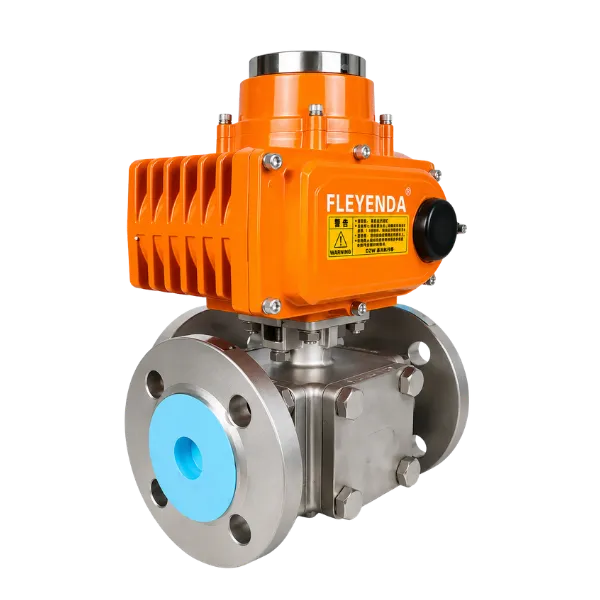
FLE-Q-TF · ELECTRIC ACTUATED
Electric 3-Way Flanged Ball Valve
Designed for automated flow diversion, bypass and multi-line routing in industrial pipelines. L-port and T-port configurations are available according to the required flow path.
- Size: DN15–DN200
- Pressure: PN10–PN40 / ANSI Class 150–300
- Body: CF8 / CF8M / WCB
- Temperature: -20°C to +180°C*
- Connection: DIN / ANSI / JIS Flanged
- Actuation: Electric On/Off / Regulating Options
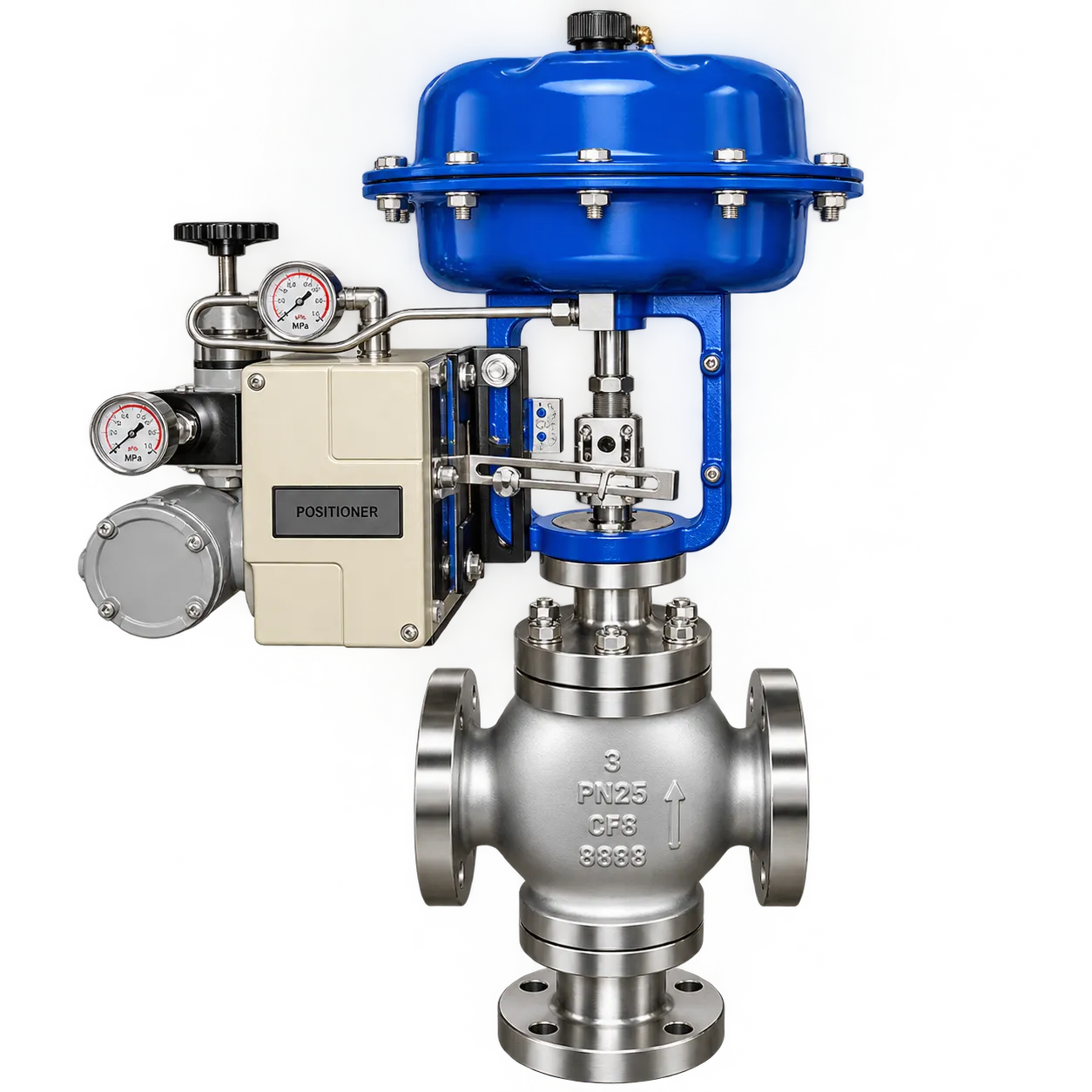
F-ZJHQ · PNEUMATIC CONTROL
3-Way Pneumatic Diaphragm Control Valve
Designed for industrial mixing and diverting control. A pneumatic diaphragm actuator and positioner adjust the internal regulating element according to the required process control signal.
- Size: DN15–DN300
- Pressure: 0.6–6.4 MPa
- Body: Carbon Steel / SS304 / SS316
- Temperature: -20°C to +220°C*
- Diaphragm: PTFE / EPDM
- Actuation: Single / Double Acting

FLE-Q-3S · SANITARY SERIES
3-Way Tri-Clamp Sanitary Electric Ball Valve
A stainless steel three way ball valve for compatible hygienic process lines requiring automated flow selection, diversion and quick-release Tri-Clamp connections.
- Size: DN15–DN100
- Pressure: 0–10 bar
- Body: SS304 / SS316L
- Temperature: -10°C to +120°C*
- Connection: Tri-Clamp / Tri-Clover
- Actuation: Electric On/Off / Regulating Options
Three Way Ball Valve vs. Three Way Control Valve
Although both valves have three ports, a three way ball valve and a three way control valve have different operating mechanisms and control capabilities. Selecting the correct type is important for achieving the required flow performance.
| Сравнение | Трехходовой шаровой кран | Three Way Control Valve |
|---|---|---|
| Internal Structure | Rotating ball with L-port or T-port passage | Control plug or regulating trim |
| Operating Motion | Typically quarter-turn | Typically linear stem movement |
| Основная функция | Switching, diversion and selected distribution | Regulating flow between ports |
| Control Method | Manual, electric or pneumatic actuation | Modulating actuator, often with positioner |
| Типичные области применения | Tank selection, bypass and process routing | Temperature control, flow regulation and fluid mixing |
A standard three way ball valve is generally selected for defined flow-path switching. When a process requires continuous flow regulation or accurate temperature control, a properly sized three way control valve is usually more appropriate.
For additional information, see our 3 Way Valve Control Valve Guide.
Common Types of Three Way Valves
Manual Three Way Valve
A manual three way valve uses a handle or lever to change the internal flow path. It is suitable for local flow switching in applications where remote automation is not required.
Electric Three Way Valve
An electric three way valve uses an electric actuator to change valve position. It supports remote operation, PLC integration and automated switching in industrial pipelines, water treatment equipment and HVAC systems.
Pneumatic Three Way Valve
A pneumatic three way valve uses compressed air to drive the actuator. It is suitable for automated production lines and process systems requiring frequent operation or a defined spring-return position.
Three Way Control Valve
A three way control valve adjusts the flow distribution between ports through a regulating element. It is used for process modulation, fluid blending and temperature control, often with a pneumatic diaphragm actuator and positioner.
Three Way Valve Flow Direction
Correct three way valve flow direction is essential for proper installation and reliable operation. The designated inlet, outlet and common port depend on the valve construction and intended mixing or diverting function.
In a typical three way control valve mixing arrangement, two inlet streams enter through A and B and leave through the common outlet AB. In a typical diverting arrangement, fluid enters through AB and is distributed toward A and B.
For an L-port or T-port three way ball valve, the internal ball drilling and handle or actuator position determine which ports communicate. Port labels should always be checked against the manufacturer’s flow-position diagram.
| Заявка | Typical Flow Arrangement | Important Check |
|---|---|---|
| Mixing Service | Two inlet streams to one outlet | Confirm common outlet and flow direction |
| Diverting Service | One inlet to two alternative outlets | Confirm inlet and both outlet ports |
| Bypass Service | Flow through equipment or bypass line | Confirm every operating position |
| Automated Switching | Port connections change with actuator position | Verify travel stops and feedback signals |
Three Way Valve Materials and Construction
The body material, internal trim, seats and seals must be selected according to process media, pressure, temperature and corrosion conditions.
| Материал | Main Characteristics | Типичные области применения |
|---|---|---|
| Stainless Steel SS304 / SS316 | Corrosion resistance and good mechanical strength | Chemical processing, water treatment and compatible sanitary service |
| Углеродистая сталь | High mechanical strength and pressure capability | Industrial pipelines, oil and gas and steam systems |
| Brass | Good machinability and economical construction | Water, air and selected HVAC systems |
| PVC / CPVC / PP / PVDF | Lightweight and resistant to selected chemicals | Chemical dosing and compatible water treatment applications |
Seat and sealing materials such as PTFE, RPTFE and EPDM should also be reviewed. A corrosion-resistant valve body does not automatically guarantee that the complete valve assembly is compatible with every process fluid.
Industrial Applications of Three Way Valves
HVAC and Heating Systems
Three way mixing and diverting valves are used in chilled-water circuits, heating loops, bypass systems and heat exchanger installations. They help manage water distribution and temperature control according to system requirements.
Очистка воды и сточных вод
Three way valves can route water between filtration units, treatment stages, storage tanks, dosing lines and bypass pipelines. Electric actuation is useful where automated switching is required.
Химическая переработка
Stainless steel three way valves can direct compatible chemicals and process fluids between tanks, reactors, filters and production lines. Material compatibility must be confirmed against the actual fluid concentration and temperature.
Oil, Gas and Industrial Pipelines
Industrial three way ball valves are used for process routing, equipment changeover, recirculation and selected bypass duties. Pressure class, connection standard and valve construction should match the project specification.
Переработка продуктов питания и напитков
Sanitary three way ball valves with Tri-Clamp connections can be used for compatible food, beverage and dairy process lines where hygienic connections and convenient maintenance are required.
How to Select the Right Three Way Valve
Choosing the right three way valve requires more than matching the nominal size to the pipeline. The valve must perform the required flow function under the actual operating conditions.
01 · Define the Function
Determine whether the system requires mixing, diverting, switching, bypass or continuous flow regulation.
02 · Confirm Port Configuration
Specify L-port or T-port where applicable. Provide a flow diagram showing every required connection position.
03 · Identify Process Media
Provide fluid name, composition, concentration, viscosity and any special corrosion or contamination requirements.
04 · Confirm Size and Flow Capacity
Provide pipe size, normal flow rate, maximum flow rate and required pressure drop. Control valves should be sized using appropriate Cv or Kv calculations.
05 · Specify Pressure and Temperature
Confirm normal and design pressure, operating temperature and any pressure fluctuations or differential pressure conditions.
06 · Select Materials and Connections
Specify body, ball, seat, seal and diaphragm materials where applicable, together with flange, thread, weld or Tri-Clamp standards.
07 · Choose the Actuator
Determine whether manual, electric or pneumatic operation is required. For automated valves, provide voltage, control signal, air supply and fail position.
Information Required for a Three Way Valve Quotation
To help identify the correct valve and avoid an incorrect port configuration, provide the following technical information when requesting a quotation.
- Valve size and quantity
- Required mixing, diverting or switching function
- L-port, T-port or control valve configuration
- Process medium and chemical concentration
- Working pressure and temperature
- Body, ball, seat and sealing material requirements
- Connection type and applicable standard
- Manual, electric or pneumatic actuation
- Control signal, voltage or pneumatic air supply
- Required fail position and position feedback
- Flow diagram or P&ID showing ports A, B and C
Three Way Valve Installation and Maintenance
Correct installation ensures that the three way valve connects the intended flow paths and operates according to the process design.
Verify Port Markings and Flow Direction
Check the body markings and manufacturer’s flow diagram before installation. Confirm the inlet, outlet and common port for the intended mixing or diverting service.
Check Pipeline Alignment
Make sure the connected piping is properly aligned and does not place excessive mechanical stress on the valve body or end connections.
Test Actuator Operation
For electric three way valves, verify the control signal, travel stops and position feedback. For pneumatic valves, check the air supply, actuator movement, positioner and fail-safe function where applicable.
Inspect Sealing Components
Check the valve seats, seals, stem packing and actuator connections periodically for leakage, wear or abnormal operating resistance. Maintenance intervals should reflect the process medium and operating frequency.
Frequently Asked Questions About Three Way Valves
How does a three way valve work?
A three way valve changes the internal connection between three ports using a ball, plug or regulating trim. Depending on its construction, it can mix two streams, divert one inlet to two outlets or switch between different pipeline paths.
What does a three way valve do?
A three way valve manages multiple flow paths within one valve body. It is commonly used for flow mixing, diversion, bypass routing, tank selection and process switching.
What is the difference between an L-port and T-port three way valve?
An L-port valve generally connects two ports at a time and is commonly used for flow switching. A T-port valve supports more port combinations for selected distribution, bypass and mixing arrangements. The exact flow paths depend on the internal ball drilling.
Can a three way ball valve be used for mixing?
Selected T-port configurations can support certain mixing or distribution arrangements. However, a standard three way ball valve is primarily a flow-routing device and should not automatically be considered a precision proportional mixing valve.
What is the difference between a three way ball valve and a three way control valve?
A three way ball valve uses a rotating ball for flow switching and routing. A three way control valve uses a regulating trim to adjust flow distribution, often with a modulating pneumatic or electric actuator.
What is the correct three way valve flow direction?
The flow direction depends on the valve construction and intended service. A typical mixing control valve combines A and B into AB, while a diverting arrangement sends flow from AB toward A and B. Always confirm the manufacturer’s port diagram.
Can a three way valve be automated?
Yes. Three way valves can be fitted with electric or pneumatic actuators for remote operation. The actuator must be matched to the required flow positions, operating torque, control signal and fail-safe requirements.
How do I select the right three way valve size?
Consider the pipeline size, required flow rate, pressure drop, medium properties and operating conditions. For modulating control valves, the Cv or Kv value should be calculated rather than selecting the valve based only on nominal pipe diameter.
What information should I provide when requesting a three way valve quotation?
Provide the valve size, process medium, pressure, temperature, port arrangement, flow diagram, connection standard and required actuation method. For automated valves, also specify voltage, control signal, air supply and fail position.
Заключение
A three way valve works by controlling the connection between three pipeline ports, allowing fluid to be mixed, diverted, switched or routed through different process paths. The actual working principle depends on whether the valve uses an L-port or T-port ball, a control plug or another internal regulating mechanism.
For industrial applications, correct selection requires consideration of flow direction, port configuration, pressure, temperature, media compatibility, valve construction and actuation method. A three way ball valve is generally suitable for defined flow routing, while a three way control valve is more appropriate when continuous flow regulation is required.
Fleyenda provides electric three way ball valves, pneumatic three way control valves and sanitary three way valve configurations for different industrial requirements.