


Задвижка для водоподготовки: руководство по выбору
A gate valve is one of the most widely used isolation valves in water treatment systems. Its main function is to provide a clear open or closed flow path in pipelines carrying raw water, treated water, process water, wastewater and other liquids used throughout a treatment facility.
Unlike control valves designed to continuously regulate flow, a gate valve is normally selected for full-open or full-closed service. When fully open, the gate moves away from the flow path and allows water to pass through the valve with relatively low resistance. When closed, the gate moves across the valve body and isolates the pipeline.
In water treatment, choosing the correct gate valve involves much more than matching the nominal pipe diameter. Water quality, solids content, pressure, corrosion, installation location, operating frequency, seat design, body material and actuator type can all influence long-term valve performance.
This guide explains how gate valves are used in water treatment, the main gate valve types, material and seat options, actuator choices, common applications, installation considerations and the information buyers should include when requesting a quotation.
Gate valves are primarily isolation valves. For most water treatment applications, they should normally be operated fully open or fully closed rather than left partially open for long-term throttling.
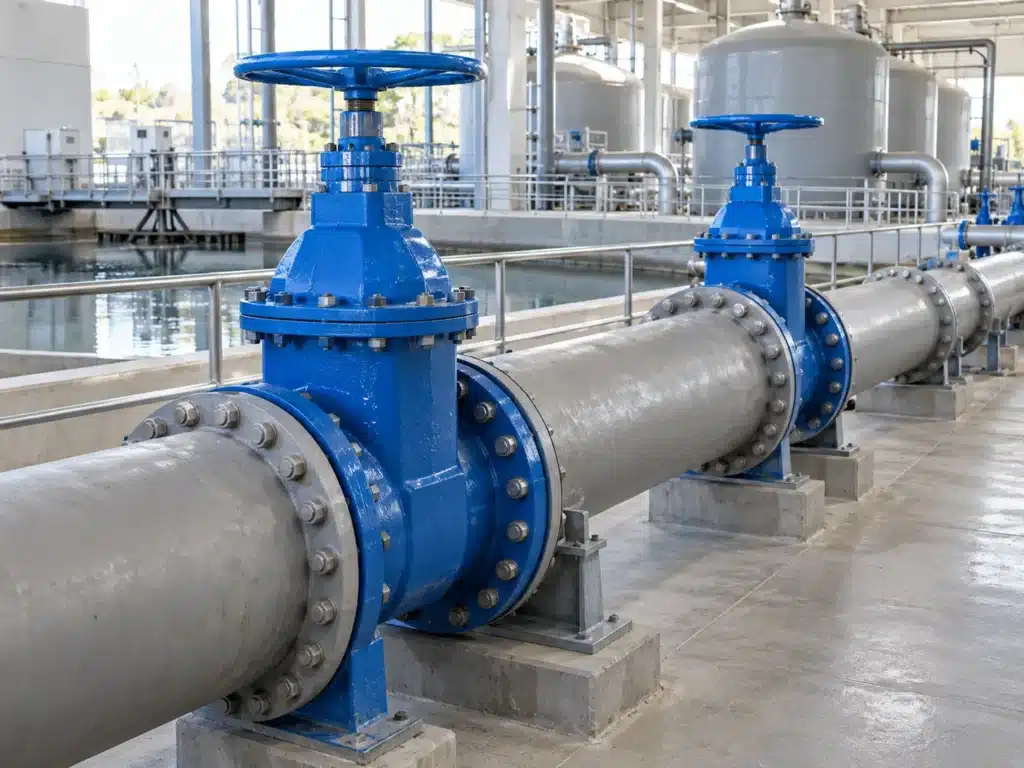
What Is a Gate Valve?
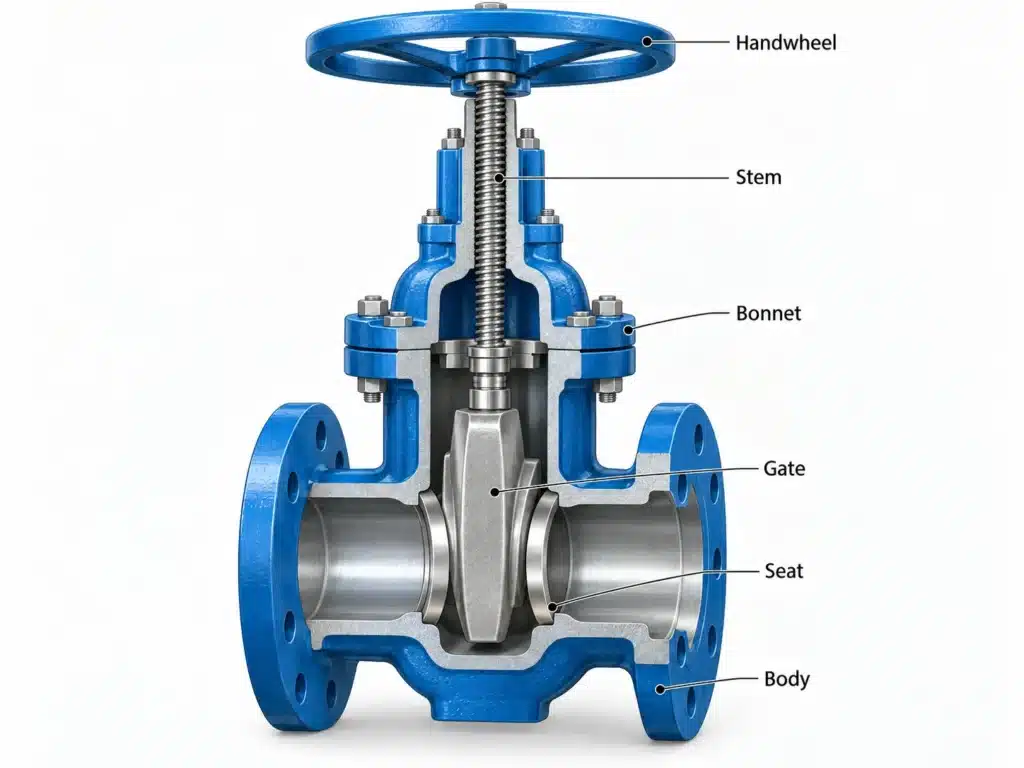
A gate valve is a linear-motion isolation valve that controls flow by raising or lowering a gate inside the valve body. The gate moves perpendicular to the direction of the pipeline flow.
When the valve is fully open, the gate is withdrawn from the main flow passage. This provides a relatively unobstructed flow path and makes the valve suitable for applications where low pressure loss is desirable.
When the valve is closed, the gate moves into the seating area and creates a seal between the upstream and downstream sides of the pipeline.
Gate valves are commonly used on water pipelines because they are suitable for isolation and can be manufactured in a wide range of nominal diameters and pressure ratings.
Depending on the project, the valve may be manually operated through a handwheel or gearbox, or automated using an electric or pneumatic actuator.
Why Are Gate Valves Used in Water Treatment?
Water treatment facilities contain many sections of piping that need to be isolated for operation, inspection, maintenance and emergency response. Gate valves provide a straightforward way to separate tanks, pumps, filters, pipelines and treatment equipment.
One important advantage is the relatively clear flow path available when a gate valve is fully open. Because the closure element is moved largely out of the water stream, the valve can provide low flow resistance compared with some other valve designs.
Gate valves are also available in large sizes, which makes them suitable for municipal water mains, treatment-plant headers, pump stations and transmission pipelines.
Water treatment operators may also prefer gate valves where valves remain in one position for long periods and are operated mainly during maintenance or process changes.
The actual valve design must still match the application. Clean treated water, raw river water, wastewater and sludge do not create the same service conditions.
How Does a Gate Valve Work?
A gate valve uses a threaded stem or actuator mechanism to move the gate vertically through the valve body.
During opening, the stem lifts the gate away from the seats. As the gate moves upward, the flow area increases until the gate is completely removed from the main flow passage.
During closing, the stem drives the gate toward the bottom of the valve body. The gate contacts the seating surfaces and separates the upstream and downstream water pressure.
Because the gate travels through the flowing water during opening and closing, partially open operation can expose the gate and seats to high local velocity and turbulence.
For this reason, conventional gate valves are usually better suited to isolation service than continuous flow regulation.
Resilient Seated Gate Valve
Resilient seated gate valves are widely used in drinking-water systems, municipal water networks, treatment plants and general water-distribution applications.
Instead of relying on metal-to-metal seating surfaces, the gate is covered or combined with an elastomeric material that creates the sealing interface.
The resilient surface can provide tight shutoff while also accommodating small surface irregularities that could prevent reliable sealing in a metal-seated design.
Ductile iron bodies combined with corrosion-resistant internal and external coatings are common in water-service resilient gate valves.
The selected elastomer should be compatible with the water chemistry, temperature and applicable potable-water requirements when the valve is installed in drinking-water service.
Metal Seated Gate Valve
Metal seated gate valves use metallic seating surfaces rather than a resilient elastomer as the primary seating interface.
These valves have a long history in water infrastructure and may still be specified for particular existing systems, higher-temperature conditions or projects where the design requirements favor metal seating.
Compared with resilient seated valves, metal seated designs can be more sensitive to deposits or debris on the seating surfaces when tight shutoff is required.
Water-treatment engineers should therefore consider water cleanliness, solids content, sealing expectations and maintenance practices when choosing between resilient and metal seated designs.
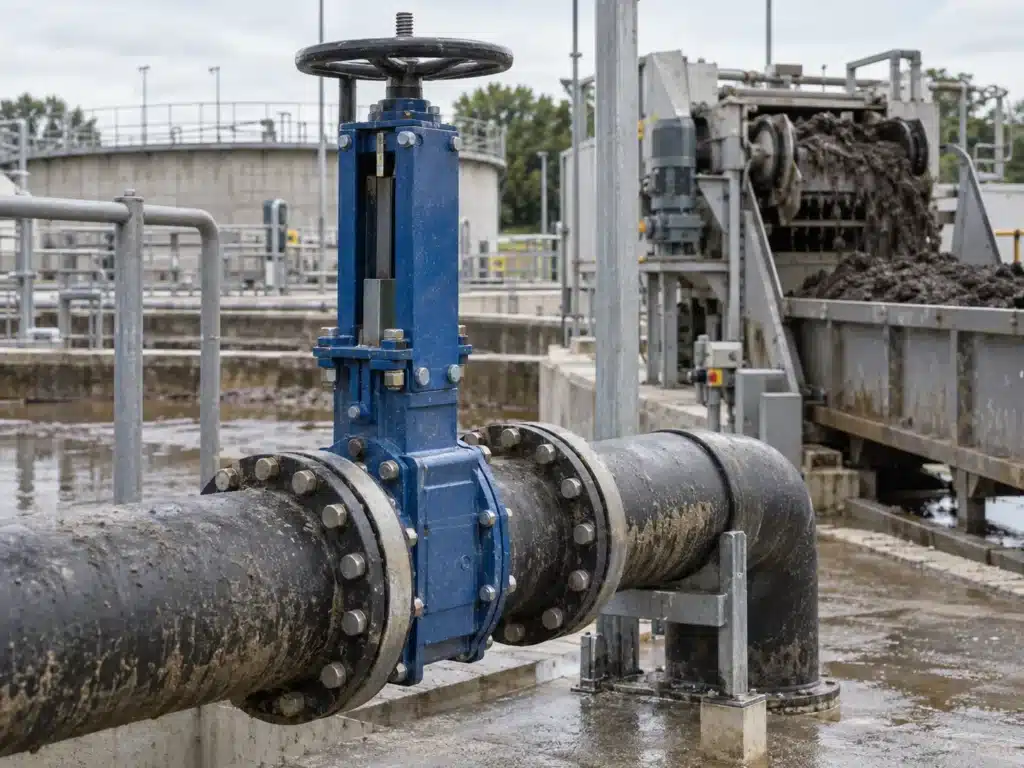
Knife Gate Valve for Wastewater and Sludge
Wastewater treatment introduces service conditions that can be very different from clean-water pipelines. Sludge, fibers, suspended solids and other contaminants can make conventional isolation more difficult.
A knife gate valve uses a relatively thin gate that travels through the flow path and can be suitable for selected slurry, sludge and solids-containing applications.
Knife gate valves are therefore commonly considered in sludge handling, wastewater treatment, dewatering systems and process streams containing suspended solids.
They should not automatically be treated as a direct replacement for every conventional gate valve. Pressure capability, sealing direction, leakage requirements and solids characteristics vary significantly between knife gate valve designs.
For wastewater service, the supplier should be given clear information about the medium rather than receiving only a general description such as “water.”
Rising Stem vs Non-Rising Stem Gate Valve
Gate valves can use either rising stem or non-rising stem construction. The difference affects valve height, position indication and installation requirements.
Rising Stem Gate Valve
In a rising stem gate valve, the stem moves upward as the valve opens. The exposed stem position provides a direct visual indication of valve travel.
The design requires sufficient vertical clearance above the valve to accommodate the rising stem.
Non-Rising Stem Gate Valve
In a non-rising stem design, the stem does not travel significantly upward during operation. Instead, the gate moves along the threaded stem inside the valve.
This makes non-rising stem valves useful where installation height is limited, such as underground water pipelines and compact valve chambers.
| Особенность | Rising Stem | Non-Rising Stem |
|---|---|---|
| Stem Movement | Stem rises during opening | Stem remains at approximately the same height |
| Position Visibility | Easy to identify from stem position | May require a separate indicator |
| Vertical Space | Requires more clearance | More compact |
| Typical Water Application | Accessible plant piping and selected industrial installations | Buried pipelines, valve chambers and compact installations |
Gate Valve Materials for Water Treatment
Gate valve material selection should reflect water chemistry, corrosion conditions, pressure, temperature and expected service life.
Ductile iron is widely used in municipal water and treatment systems because it can provide a practical combination of mechanical strength, cost and corrosion protection when used with a suitable coating system.
Carbon steel may be used in industrial water treatment plants, process-water systems and higher-pressure installations where project specifications require steel valve construction.
Stainless steel can be appropriate where water chemistry is more corrosive, where chemical treatment creates more aggressive conditions or where higher corrosion resistance is required.
Internal wetted components such as stems, seats, fasteners and trim should also be considered. A corrosion-resistant body alone does not guarantee reliable long-term operation if critical internal components are unsuitable for the process water.
| Материал | Typical Water Treatment Use | Main Consideration |
|---|---|---|
| Ductile Iron | Municipal water, treatment plants and distribution systems | Requires suitable corrosion-resistant coating |
| Углеродистая сталь | Industrial water and higher-pressure process systems | Corrosion protection should match the service |
| Нержавеющая сталь | Corrosive water, chemical treatment and demanding industrial service | Higher material cost but improved corrosion resistance |
Seat and Seal Material Selection
Seat and seal materials directly affect shutoff performance, chemical compatibility and service life.
EPDM is commonly associated with water service because of its compatibility with many clean-water applications. Other elastomers may be selected when process chemistry, oil contamination or different temperature conditions require alternative properties.
The phrase “water treatment” can cover many different fluids. Raw water containing suspended solids, chemically treated water, seawater, brine and wastewater may require different material combinations.
Buyers should therefore provide the actual medium composition whenever possible instead of selecting seals only from a general water-service description.
Gate Valve Applications in Water Treatment
Gate valves can be installed throughout a water treatment facility wherever sections of pipeline or equipment need reliable isolation.
Raw-water intake systems may use gate valves to isolate incoming lines before water reaches the main treatment process. Valves may also be installed around screening, sedimentation, filtration and disinfection equipment so individual process units can be taken out of service.
Treated-water systems use gate valves on storage tanks, distribution headers and transmission pipelines. Their low restriction when fully open can be useful where maintaining pipeline capacity is important.
Gate valves may also be used on utility-water lines, chemical-support systems and other plant services where the fluid is compatible with the selected valve materials.
Gate Valves in Wastewater Treatment
Wastewater treatment applications require additional attention because the fluid can contain suspended solids, fibers, organic matter, grit and sludge.
Conventional resilient seated gate valves may still be suitable for many wastewater isolation duties, especially where the liquid contains only moderate levels of solids.
More difficult sludge or slurry services may favor knife gate valves or other valve designs specifically developed to handle solids.
The possibility of material collecting in the valve body, seat pocket or stem area should be considered when evaluating long-term operation.
Infrequently operated valves should also be cycled according to the maintenance program because deposits can make a valve increasingly difficult to operate after long periods in one position.
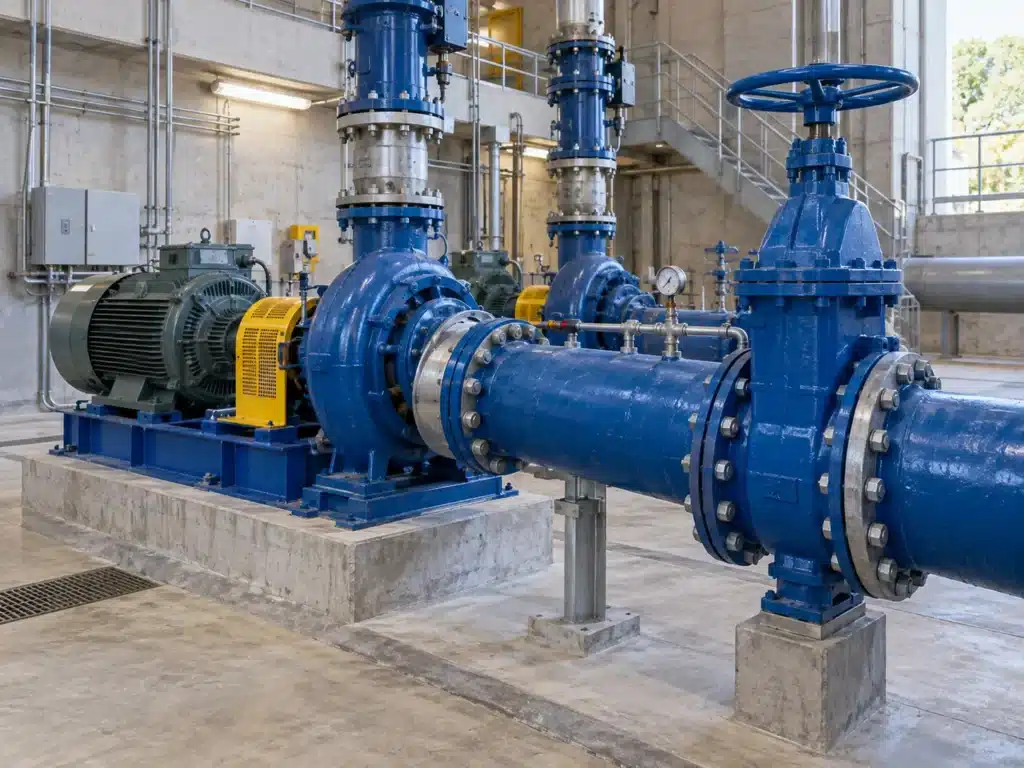
Gate Valves for Pump Stations
Pump stations require isolation valves so individual pumps and associated equipment can be removed from service without shutting down the entire water system.
Gate valves can be installed on pump suction or discharge piping where the system design requires full-bore isolation.
The valve should be selected for the maximum expected system pressure and the actual differential pressure that may exist during operation.
Valve operation should also be coordinated with pump startup and shutdown procedures. Closing a large water valve too rapidly can produce significant transient pressure changes.
When motorized gate valves are installed in pump stations, actuator speed and control logic should therefore be selected together with the hydraulic operating sequence.
A gate valve can isolate a pump, but it should not automatically be treated as the primary solution for preventing reverse flow. Pump discharge systems normally require a correctly selected check valve when reverse-flow prevention is needed.
Manual vs Actuated Gate Valve
Gate valves in water treatment systems can be operated manually or automatically depending on accessibility, valve size, operating frequency and control requirements.
A handwheel-operated gate valve is often suitable for smaller valves that are operated infrequently and located in accessible areas.
Larger valves may use a gearbox to reduce the torque required from the operator.
Automated gate valves become more attractive when valves are large, difficult to access or part of an automatic treatment sequence.
Electric actuators are especially common where water treatment plants have centralized control systems and require remote open, close and position feedback.
Electric Actuated Gate Valve for Water Treatment
An electric actuated gate valve uses an electric motor and gearbox to produce the stem movement required to open or close the gate.
These assemblies can be integrated with PLC systems, plant control rooms and pump-control sequences.
Limit switches can provide fully open and fully closed feedback, while torque switches can help protect the actuator and valve from excessive mechanical loading.
Large water treatment valves may require substantial stem thrust, so actuator sizing should be based on actual valve operating requirements rather than nominal valve diameter alone.
Power supply, actuator enclosure protection, duty cycle, opening and closing time, manual override and control interface should all be specified during valve selection.
Gate Valve vs Butterfly Valve for Water Treatment
Both gate valves and butterfly valves are widely used in water treatment, but they have different structural and operating characteristics.
A gate valve moves its closure element out of the main flow path when fully open. This can provide a very clear passage through the valve.
A butterfly valve retains its disc inside the pipeline even when open, but its compact body and quarter-turn operation can make it attractive for large-diameter water systems.
Butterfly valves can also require less installation space and may operate faster than large multi-turn gate valves.
Gate valves may be preferred where a full opening and minimal obstruction are important, while butterfly valves may be preferred where compact size, lower weight and quarter-turn automation are significant project priorities.
| Особенность | Задвижка | Дроссельная заслонка |
|---|---|---|
| Motion | Linear, multi-turn | Quarter-turn rotary |
| Open Flow Path | Gate largely removed from flow | Disc remains in pipeline |
| Installation Space | Can require more vertical space | Generally compact |
| Рабочая скорость | Usually slower | Typically faster |
| Large Diameter Use | Widely available | Very common |
| Typical Function | Изоляция | Isolation and selected throttling service |
How to Select a Gate Valve for Water Treatment
Selecting a gate valve for water treatment should begin with the actual process conditions rather than a valve catalog size alone.
First identify the service medium. Clean treated water, raw water, seawater, wastewater and sludge can require very different body, seat and stem materials.
Next determine the nominal pipe size, operating pressure, design pressure and process temperature.
The required valve function should also be confirmed. If the valve is mainly used for isolation, a conventional resilient or metal seated gate valve may be appropriate. If the medium contains heavy solids or sludge, another gate design such as a knife gate valve may need to be evaluated.
Installation location affects stem design and actuator selection. Buried valves, valve chambers, indoor treatment buildings and outdoor exposed pipelines can have different space and environmental requirements.
Finally, determine how frequently the valve will operate and whether manual, gearbox or electric actuation is required.
| Selection Item | Что необходимо подтвердить |
|---|---|
| Water Type | Raw water, treated water, wastewater, sludge or chemical solution |
| Valve Size | Nominal pipeline diameter |
| Давление | Operating and design pressure |
| Температура | Minimum and maximum process temperature |
| Материал корпуса | Ductile iron, carbon steel, stainless steel or project-specific material |
| Seat Design | Resilient or metal seated |
| Stem Type | Rising or non-rising stem |
| Подключение | Flanged or other required piping connection |
| Operation | Handwheel, gearbox or actuator |
| Environment | Indoor, outdoor, buried, submerged or corrosive area |
| Water Quality | Clean water, suspended solids, chlorides, chemicals or other contaminants |
| Required Standard | Project, municipal or water-industry specification |
Gate Valve Installation in Water Treatment Systems
Correct installation is important for maintaining sealing performance and reducing unnecessary operating loads.
The pipeline should be aligned before the valve is installed. A valve should not be used to pull misaligned pipe flanges into position because this can introduce mechanical stress into the valve body.
Valve internals should be protected from construction debris, welding residue and foreign material before commissioning.
Sufficient clearance should be provided for the stem, handwheel, gearbox or actuator. Rising stem gate valves require additional vertical space.
Heavy actuators and large valves may require independent support so the piping system does not carry unnecessary mechanical loads.
Before commissioning, the valve should be cycled through its expected operating range to verify smooth movement and correct position indication.
Gate Valve Maintenance for Water Treatment
Gate valves that remain in one position for long periods can become difficult to operate if corrosion, deposits or sediment accumulate around moving parts.
Periodic cycling can help confirm that the gate and stem remain operable. The appropriate cycling interval depends on the treatment facility and valve service.
Operators should inspect the stem, packing area, bonnet, flange connections and actuator for signs of leakage, corrosion or mechanical damage.
For resilient seated valves, sealing performance should be monitored because damage to the elastomer or foreign material trapped around the seat can reduce shutoff quality.
Motorized gate valves should also have actuator limit and torque settings checked as part of the preventive maintenance program.
Common Gate Valve Problems in Water Treatment
One common problem is a valve that becomes increasingly difficult to open or close. This may be caused by corrosion, deposits, stem damage, seat contamination or long periods without operation.
Leakage through a closed valve may indicate seat damage, foreign material on the sealing surfaces or insufficient gate travel.
Leakage around the stem can be related to packing condition, stem surface damage or incorrect packing adjustment.
An electrically actuated gate valve may fail to complete its stroke if actuator torque or thrust is insufficient, the limit settings are incorrect or mechanical resistance inside the valve has increased.
Repeatedly using a conventional gate valve for throttling can also accelerate wear because the partially open gate and seat are exposed to concentrated flow velocity and turbulence.
If a gate valve requires substantially more operating torque than before, investigate the reason rather than simply increasing actuator torque. Excessive force can damage the stem, gate, seats or actuator components.
What to Include in a Gate Valve RFQ
A complete gate valve RFQ allows the supplier to evaluate the actual water treatment service rather than selecting a valve from nominal size alone.
The request should include valve size, pressure rating, process medium, maximum temperature, required body material and pipeline connection.
Buyers should also identify whether a resilient seated, metal seated or other gate design is required.
Rising or non-rising stem construction should be specified when installation space, valve chambers or underground operation affect the design.
For automated valves, include power supply, actuator control type, opening and closing time, required feedback signals, manual override and environmental protection requirements.
Water quality should be described clearly when the medium contains chlorides, treatment chemicals, suspended solids, sludge or other substances that may influence valve materials.
“Water” is often not enough information for valve selection. Raw water, potable water, chemically treated water, wastewater and sludge can require very different gate valve configurations.
Frequently Asked Questions About Gate Valves for Water Treatment
What is a gate valve used for in water treatment?
Gate valves are mainly used to isolate pipelines, pumps, tanks, filters and other treatment equipment. They are normally operated fully open or fully closed.
Are gate valves suitable for drinking water?
Yes. Gate valves are widely used in potable-water systems when their body, coating, seat and other wetted materials comply with the applicable drinking-water requirements.
Which gate valve is commonly used for clean water?
Resilient seated gate valves are widely used for clean-water and municipal water applications because they can provide tight shutoff and good corrosion protection when correctly specified.
Can gate valves be used for wastewater?
Yes, but the valve design should match the solids content and wastewater characteristics. Heavy sludge or slurry service may require a knife gate valve or another valve specifically designed for solids-containing media.
Can a gate valve regulate water flow?
Conventional gate valves are primarily isolation valves and are generally not preferred for continuous throttling. Long-term partially open operation can increase turbulence and wear.
What is the difference between resilient seated and metal seated gate valves?
A resilient seated valve uses an elastomeric sealing surface, while a metal seated valve relies mainly on metallic seating surfaces. The correct choice depends on water quality, temperature, sealing expectations and project requirements.
What is the difference between rising stem and non-rising stem gate valves?
A rising stem moves upward as the valve opens and provides visible position indication. A non-rising stem remains at approximately the same height and is useful where installation space is limited.
Can a gate valve be electrically actuated?
Yes. Electric actuators are widely used on larger gate valves and automated water-treatment systems where remote operation and valve-position feedback are required.
Are gate valves suitable for pump stations?
Yes. Gate valves can provide pump isolation and pipeline isolation. Hydraulic sequencing and valve operating speed should be considered when large water flows are involved.
What material is best for a water treatment gate valve?
There is no single best material for every system. Ductile iron is common in municipal water service, while carbon steel and stainless steel may be selected for industrial, higher-pressure or more corrosive conditions.
What information should I provide when ordering a gate valve?
Provide valve size, pressure, temperature, water type, body and seat material requirements, stem design, connection type, operation method, installation environment and applicable project standards.
Заключение
A gate valve remains an important isolation valve for water treatment systems because it can provide a clear flow passage, reliable pipeline isolation and compatibility with a wide range of pipe sizes.
Resilient seated gate valves are widely used in municipal and clean-water applications, while metal seated designs may remain appropriate for selected project requirements. Wastewater and sludge services may require different gate constructions such as knife gate valves when suspended solids become a major operating concern.
Material selection should consider more than the word “water.” Raw water, treated water, chemically conditioned water, wastewater and sludge can create very different corrosion, sealing and solids-handling requirements.
Stem design, installation space, actuator type and operating frequency should also be considered. Large or remotely located water-treatment valves can benefit from electric actuation, while manually operated valves may remain practical for smaller and infrequently operated isolation points.
The most reliable gate valve selection comes from matching the valve body, seat, stem, materials and actuator to the actual water treatment process rather than choosing the valve from nominal diameter alone.