


HYGIENIC FLOW CONTROL
Sanitary Control Valves: Types, Applications & Selection Guide
Sanitary control valves play an important role in food and beverage processing, dairy production, pharmaceutical manufacturing and other hygienic fluid-handling systems. They help control product flow while supporting the cleanliness, sealing integrity and process consistency required in sanitary production lines.
Unlike conventional industrial valves, sanitary valves must be selected with particular attention to wetted-surface design, product residue, cleanability, sealing materials and hygienic connections. When automatic operation is required, the actuator and control system must also match the process duty.
This guide explains the main types of sanitary control valves, how electric and pneumatic actuation work, how CIP and SIP requirements affect valve selection, and what engineers should check before specifying a valve for a hygienic application.
What Are Sanitary Control Valves?
Sanitary control valves are used in hygienic production systems to manage the movement of liquids and compatible process media through pipelines, tanks, filling equipment and processing machinery. Depending on their design, they may provide simple open-close operation, flow diversion or continuous modulation.
The term covers more than one valve construction. Sanitary ball valves and butterfly valves are commonly used for isolation and routing, while purpose-designed diaphragm valves and single-seat control valves can be appropriate where specific hygienic or modulating performance is required.
A key distinction is that not every sanitary valve is a precision control valve. A standard sanitary ball valve may provide reliable shutoff, but its suitability for continuous throttling must be evaluated separately. If the process requires stable flow regulation, the valve’s flow characteristics, actuator and control accessories should be specified as a complete assembly.
What Makes a Sanitary Valve Different from a Standard Industrial Valve?
Conventional industrial valves are often selected primarily around pressure rating, flow capacity, shutoff performance and mechanical durability. In hygienic processing, these requirements remain important, but the internal geometry and cleanability of product-contacting surfaces are also critical.
| Fator de seleção | Sanitary Valve Requirement | Por que isso é importante |
|---|---|---|
| Wetted surfaces | Smooth, cleanable surfaces appropriate for the application | Reduces locations where product residue can accumulate. |
| Internal geometry | Minimized crevices and product-retention areas | Supports effective cleaning and hygienic process design. |
| Materials | Compatible stainless steel, seats, seals and gaskets | Helps prevent corrosion, degradation and contamination. |
| Connections | Suitable sanitary clamp, welded or other hygienic connections | Supports assembly, inspection and maintenance. |
| Capacidade de drenagem | Installation and design suited to the required drainage conditions | Helps prevent unwanted liquid retention. |
| Cleaning | Verified compatibility with the intended cleaning process | Helps maintain repeatable sanitation procedures. |
Sanitary design is a property of the complete valve and installation, not simply the use of stainless steel. Surface finish, seal geometry, connection alignment, orientation and the cleaning procedure all influence hygienic performance.
Main Types of Sanitary Control Valves
The most appropriate valve depends on whether the application requires isolation, flow diversion, backflow prevention or continuous flow regulation.
1. Sanitary Ball Valves
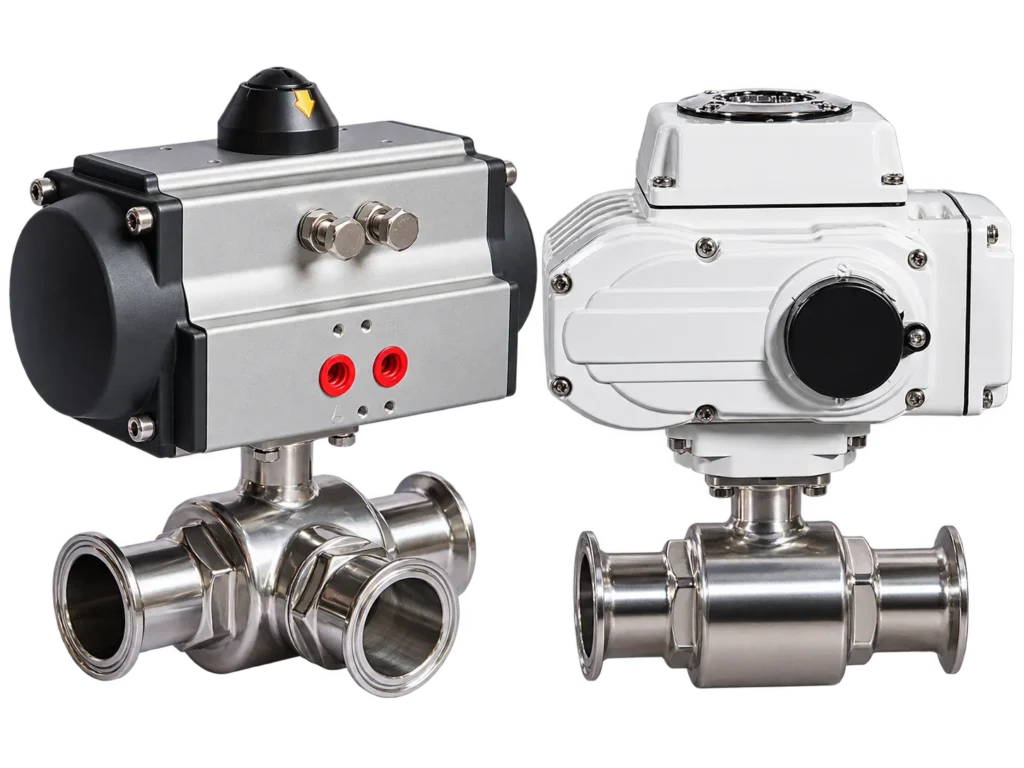
Sanitary ball valves use a rotating ball with an internal passage to open or close the flow path. Two-way designs are commonly used for hygienic isolation, while three-way designs can divert or select flow between connected pipelines.
Sanitary Tri-Clamp ball valves are useful where quick assembly and disassembly are required. Stainless steel body options and compatible sealing materials should be selected according to the product, cleaning chemicals, temperature and operating pressure.
For applications requiring modulating control, verify the valve’s installed flow characteristics and actuator configuration rather than assuming that every ball valve is suitable for precision regulation.
2. Sanitary Butterfly Valves
Sanitary butterfly valves use a rotating disc inside the pipeline. Their compact construction makes them useful in hygienic piping systems where installation space, weight and flow capacity are important.
They are commonly used for isolation and can provide limited flow adjustment in suitable applications. However, the disc remains in the flow path, and control performance depends on disc design, seat construction, operating angle and differential pressure.
For frequent cleaning cycles, the seat material and its compatibility with the process and cleaning temperatures must be verified.
3. Sanitary Diaphragm Valves
Sanitary diaphragm valves use a flexible diaphragm to control flow and separate the operating mechanism from the process medium. They are often considered for applications that prioritize cleanability and controlled contact between the fluid and valve components.
The diaphragm material must be compatible with the product, cleaning agents, operating temperature and pressure. Replacement intervals and the consequences of diaphragm failure should also be considered in critical applications.
4. Sanitary Single-Seat Control Valves
Purpose-designed single-seat control valves can provide continuous modulation in hygienic systems where a process variable must be maintained within a target range. They may be used to regulate flow or other process conditions, depending on the valve and control-system design.
Selection should include the required flow coefficient, operating range, differential pressure, valve characteristic, actuator thrust and cleaning requirements. These factors distinguish a genuine modulating control application from simple sanitary on-off isolation.
5. Sanitary Three-Way Valves
Three-way sanitary valves are used to divert product between lines, select a supply path or connect alternative process routes. They can be useful in filling systems, tank transfer, beverage production and automated process skids.
Port configuration is particularly important. The supplier should confirm which ports connect in each operating position and whether the arrangement is appropriate for preventing unwanted cross-flow between products or cleaning media.
| Tipo de válvula | Typical Function | Important Consideration |
|---|---|---|
| Válvula de esfera sanitária | Isolation and selected flow routing | Seat compatibility and suitability for throttling. |
| Válvula borboleta sanitária | Compact isolation and selected flow adjustment | Disc geometry, seat design and operating range. |
| Válvula de diafragma sanitária | Hygienic isolation and selected regulating duties | Diaphragm integrity and chemical compatibility. |
| Single-Seat Control Valve | Continuous process regulation | Flow coefficient, control range and actuator sizing. |
| Sanitary Three-Way Valve | Diverting or selecting flow paths | Port arrangement and prevention of unintended cross-flow. |
Electric vs. Pneumatic Sanitary Control Valves
Actuation determines how a sanitary valve receives operating commands and moves between positions. Electric and pneumatic actuators can both be used in hygienic automation, provided the complete assembly is suitable for the installation and process duty.
Electric Sanitary Valves
Electric actuators use a motor and gearbox to operate the valve. Depending on the model, they may support ON/OFF operation, position feedback or modulating signals such as 4–20 mA and 0–10 V.
Electric actuation can be useful when electrical power and control wiring are readily available. For modulating duties, verify that the selected valve and actuator can deliver the required positioning performance rather than relying on the control signal alone.
Pneumatic Sanitary Valves
Pneumatic actuators use compressed air to operate the valve. They are common in automated production lines where instrument air is available and repeatable switching is required.
Double-acting actuators use air pressure to move in both directions. Spring-return configurations can provide a defined movement following loss of air, depending on the actuator and valve arrangement. The required failure position should be specified explicitly.
| Factor | Electric Actuation | Pneumatic Actuation |
|---|---|---|
| Energy source | Electrical power | Compressed air |
| Control integration | Electrical commands and supported feedback | Air control and optional electrical accessories |
| Modulation | Available on compatible configurations | Requires suitable positioning equipment where modulation is needed |
| Failure behavior | Depends on actuator and backup-energy design | Spring-return options may provide fail-open or fail-close action |
| Selection priority | Power, signal, duty cycle and washdown suitability | Air quality, supply pressure, cycle frequency and failure position |
In both cases, the actuator housing and accessories should be appropriate for washdown, humidity, temperature and the surrounding environment. Product-contacting hygienic requirements and external actuator protection are related but separate selection issues.
CIP and SIP Compatibility: What Should You Check?
Clean-in-Place (CIP) uses a defined cleaning procedure to clean process equipment without routine disassembly. Steam-in-Place (SIP) uses steam under specified conditions where the equipment and process require it.
A sanitary control valve should only be considered compatible with a particular CIP or SIP procedure when the complete configuration has been verified for the required cleaning conditions. A valve that can handle normal product temperatures may not automatically be suitable for repeated high-temperature steam exposure.
Key CIP/SIP Selection Factors
- Temperature limits: Check the permitted temperature of the valve body, seats, gaskets, diaphragm and actuator accessories.
- Chemical compatibility: Confirm compatibility with the actual cleaning agents and their concentrations.
- Internal coverage: Verify that the specified cleaning process can reach the required product-contacting areas.
- Drainability: Consider valve orientation, pipeline slope and locations where residual liquid could remain.
- Seal condition: Ensure elastomers and other sealing components are appropriate for repeated cleaning cycles.
- Documentation: Request the manufacturer’s cleaning limits, material details and applicable hygienic documentation.
CIP and SIP are process-specific. Neither term should be used as a blanket guarantee that every valve model is suitable for every cleaning temperature, sterilization procedure or hygienic standard.
Materials and Hygienic Standards
Stainless steel is widely used in sanitary valve construction because it can provide corrosion resistance, mechanical strength and cleanable surfaces. Grades such as 304 and 316L are used in different hygienic applications, but the correct choice depends on the medium, cleaning chemicals, temperature and exposure conditions.
Seat and seal materials are equally important. PTFE and compatible elastomers may be suitable for particular applications, but chemical resistance, compression behavior, temperature limits and repeated cleaning cycles must be evaluated for the selected grade.
Depending on the application and destination market, the project may require documentation related to FDA food-contact requirements, 3-A Sanitary Standards, EHEDG hygienic design guidance or ASME BPE. These are not interchangeable: material compliance, equipment certification and hygienic design assessment address different requirements.
Always verify the exact product model, configuration and available documentation. Do not assume that a stainless steel valve automatically meets every sanitary standard.
Where Are Sanitary Control Valves Used?
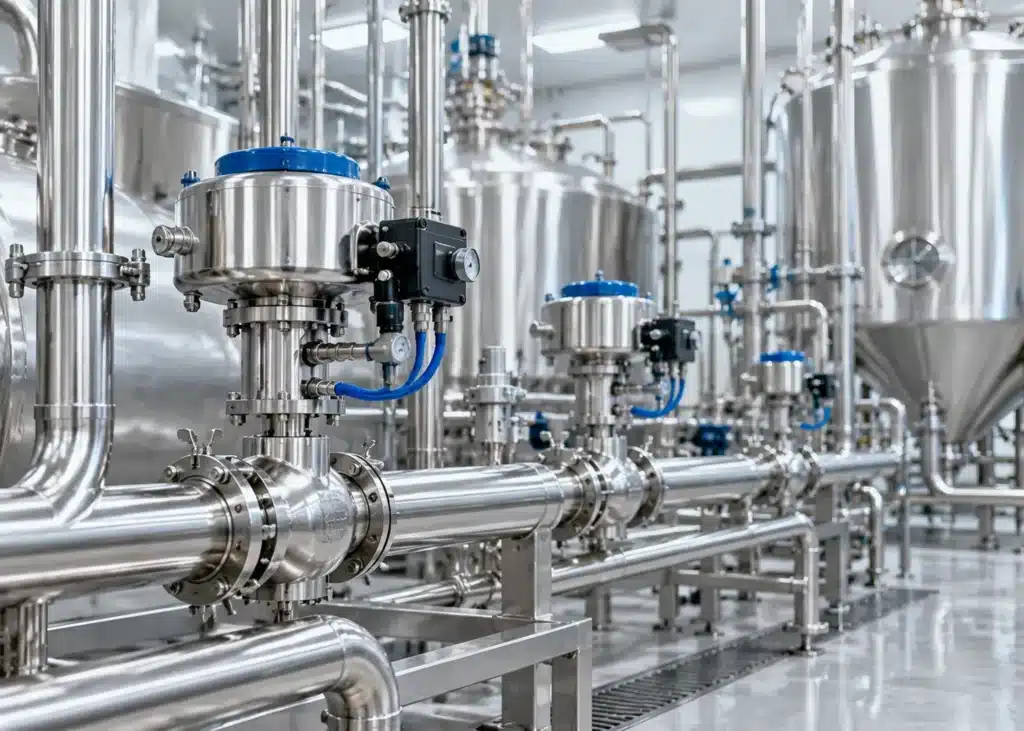
Sanitary control valves support automated fluid handling in production environments where product integrity, repeatable operation and cleaning are important.
Food and Beverage Processing
Valves can control product transfer, tank filling, beverage blending, ingredient dosing and cleaning circuits. The appropriate design depends on the product, cleaning regime and whether the valve performs isolation, diversion or continuous regulation.
Dairy Processing
Dairy systems require careful attention to residue removal, seal condition, drainability and cleaning-cycle repeatability. Valve selection should reflect milk or dairy-product characteristics and the plant’s validated cleaning procedures.
Pharmaceutical and Bioprocess Applications
Pharmaceutical and bioprocess systems may require stricter material traceability, surface-finish documentation, cleanability assessment and validation. The valve specification should be aligned with the process risk and the applicable project standards.
Cosmetics and Personal Care
Cosmetic production may involve viscous liquids, emulsions, fragrances and cleaning agents. The selected valve should account for product viscosity, residue behavior, seal compatibility and cleaning access.
How to Choose the Right Sanitary Control Valve
Use a structured selection process to match the valve design with the process function and hygiene requirements.
01
Define the Process Function
Identify whether the valve must isolate, divert, prevent backflow or continuously regulate flow.
02
Specify the Medium
Provide the product name, viscosity, solids content, chemical properties and any sensitivity to contamination.
03
Confirm Pressure and Temperature
Include normal and maximum operating conditions as well as CIP/SIP temperatures where applicable.
04
Select Wetted Materials
Verify body grade, seat, seal, gasket and diaphragm compatibility with both product and cleaning agents.
05
Choose the Connection
Specify Tri-Clamp, welded or other suitable connections and confirm the required tubing dimensions.
06
Define Automation Requirements
Choose electric or pneumatic actuation, ON/OFF or modulating control, feedback and failure behavior.
07
Verify Hygienic Documentation
Request material certificates, cleaning limits, surface-finish information and any required conformity documents.
Common Sanitary Valve Selection Mistakes
- Choosing only by body material: The seats, seals and other wetted components must also be compatible with the product and cleaning process.
- Assuming every valve supports CIP/SIP: Verify the actual temperature, chemical exposure and cleaning configuration.
- Using an isolation valve for precision regulation: Confirm the valve’s flow characteristics and actuator capabilities for modulating service.
- Ignoring drainability: Installation orientation and pipeline geometry can affect residual liquid and cleaning effectiveness.
- Overlooking connection alignment: Poorly aligned sanitary connections or damaged gaskets can create leakage and hygiene problems.
- Assuming certification from appearance: Stainless steel construction alone does not establish compliance with 3-A, EHEDG, FDA or ASME BPE requirements.
FLEYENDA SANITARY VALVE SOLUTIONS
Sanitary Valve Options from Fleyenda
Fleyenda offers sanitary valve configurations for selected hygienic fluid-handling applications, including two-way and three-way Tri-Clamp electric ball valves. The suitable configuration depends on the process medium, operating conditions, connection requirements and automation objective.
FLE-Q-S 2-Way Tri-Clamp Sanitary Electric Ball Valve
Designed for hygienic pipeline applications requiring automated two-way isolation. The listed configuration includes stainless steel options, sanitary Tri-Clamp connections and electric actuator choices. Verify seal compatibility, cleaning limits and whether the required control duty is ON/OFF or modulating.
Three-Way Sanitary Ball Valve Options
For applications requiring flow diversion or selection between process lines, review the available sanitary three-way ball valve configurations. Confirm the L-port or T-port arrangement, connection dimensions and required operating positions before ordering.
For broader industry context, visit Fleyenda’s Food & Beverage Valve Solutions page.
When requesting a quotation, provide the medium, valve size, operating pressure and temperature, connection type, cleaning procedure, required control mode and any applicable hygienic standards.
Frequently Asked Questions About Sanitary Control Valves
What are sanitary control valves used for?
They are used to isolate, divert or regulate compatible process media in hygienic production systems, including food, beverage, dairy, pharmaceutical and personal-care applications.
What is the difference between a sanitary valve and a sanitary control valve?
A sanitary valve is designed for hygienic service and may provide simple isolation or backflow prevention. A sanitary control valve is configured for a specific flow-control duty, which may include continuous modulation where the valve design supports it.
Are sanitary ball valves suitable for modulating control?
Some configurations can support modulating operation, but not every sanitary ball valve is suitable for stable precision control. The valve characteristic, operating range, actuator and control system should be evaluated together.
Can sanitary control valves be used with CIP and SIP?
They can be used in CIP or SIP systems when the specific valve configuration, wetted materials, seals and accessories are rated for the required cleaning conditions. Confirm the manufacturer’s limits before use.
Which materials are commonly used for sanitary valves?
Stainless steel grades such as 304 and 316L are common, along with application-specific seats, elastomers and gaskets. The final combination depends on the product, cleaning chemicals and operating temperature.
What is a Tri-Clamp sanitary valve?
A Tri-Clamp valve uses a clamp-style connection designed for compatible hygienic tubing systems. The tubing dimensions, ferrules, gasket and clamp must match the intended installation.
Should I choose an electric or pneumatic sanitary valve?
Electric actuation may suit installations with available power and electrical control requirements. Pneumatic actuation may be suitable where instrument air is available. The decision depends on operating frequency, control mode, failure behavior and the installation environment.
What information is needed to select a sanitary control valve?
Provide the process medium, flow requirement, valve size, pressure, temperature, connection type, cleaning procedure, wetted materials, control mode and applicable hygienic documentation requirements.
Select Sanitary Control Valves Around Your Process Requirements
Reliable sanitary flow control depends on matching valve construction, materials, connections, actuator performance and cleaning requirements to the actual production process. A hygienic-looking valve is not sufficient on its own; the complete assembly must meet the operating and sanitation requirements of the application.
Fleyenda provides sanitary valve options for selected automated food, beverage and hygienic fluid-handling systems. Share your process details with the team to identify an appropriate configuration.