


Are Globe Valves Suitable for Steam and High-Pressure Applications?
Globe valves are widely used in industrial pipelines where reliable shut-off and controlled fluid flow are required. Their internal flow path and movable disc design make them particularly suitable for throttling applications, including steam distribution, boiler systems, power generation and high-pressure process pipelines.
However, selecting globe valves for steam and high-pressure service requires more than checking the nominal pressure rating. Operating temperature, pressure fluctuations, valve body material, trim construction, seat sealing and connection standards all affect long-term performance.
This guide explains when industrial globe valves are suitable for steam and high-pressure applications, what technical factors engineers should evaluate, and how to select an appropriate configuration for demanding pipeline conditions.
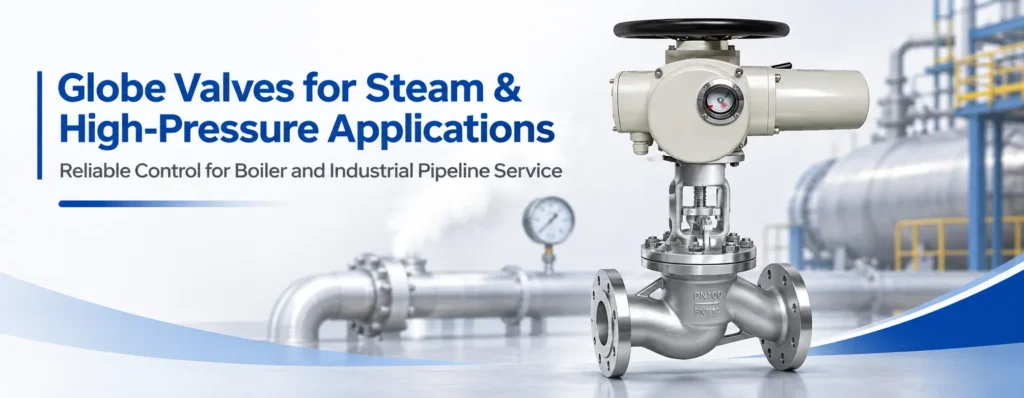
FLEYENDA / INDUSTRIAL VALVE SOLUTIONS
Electric Actuated Globe Valve for Industrial Applications
Explore Fleyenda’s multi-turn electric globe valve solution for selected boiler, steam and industrial pipeline applications.
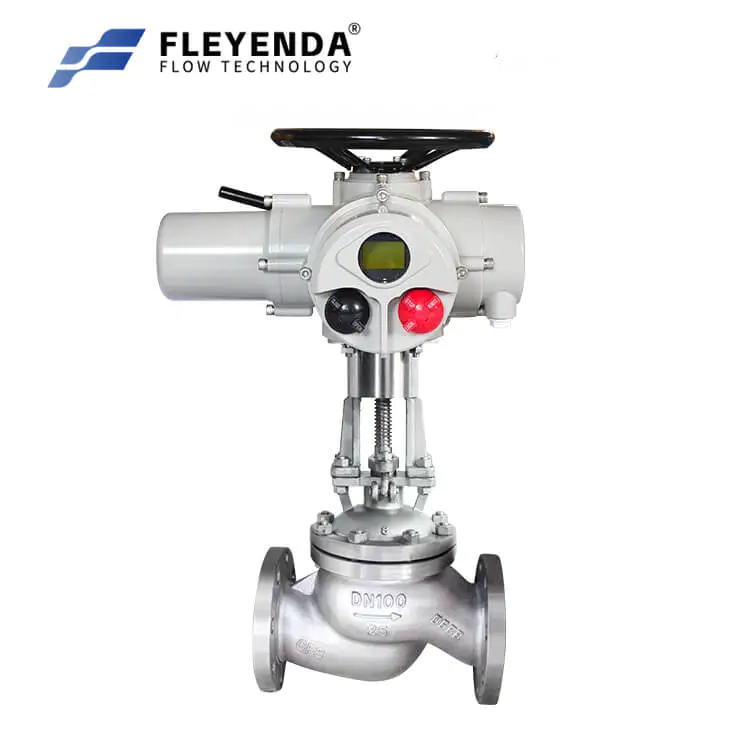
FLE-Z30-SKG SERIES
Multi-Turn Electric Actuator Globe Valve
A motorized globe valve assembly designed for automated pipeline operation. Its multi-turn actuator provides controlled stem movement for compatible globe valve applications.
DN50–DN1000
PN1.0–PN6.0 MPa
Ferro fundido
Wafer / Flanged
LIGADO/DESLIGADO / Regulável / Inteligente
Steam / Boiler / Industrial Pipelines
Final operating limits depend on the selected valve configuration, sealing materials, pressure-temperature conditions and project requirements.
1. Are Globe Valves Suitable for Steam Applications?
Yes. Globe valves can be suitable for industrial steam applications, particularly where flow regulation, controlled isolation and reliable shut-off are required.
Unlike gate valves, which are primarily designed for full-open or full-closed service, globe valves use a movable disc or plug that travels toward or away from a stationary seat. This arrangement allows the flow passage to be adjusted, making globe valves useful in steam distribution and process control systems.
Common industrial steam applications include:
- Boiler steam outlets: Controlling steam flow from boilers to downstream distribution systems.
- Steam distribution pipelines: Isolating and regulating steam supply to different production areas.
- Power generation: Managing steam flow in auxiliary systems and selected power plant pipelines.
- Industrial heating: Controlling steam supplied to heat exchangers, dryers and process equipment.
- Steam bypass systems: Regulating flow through designated bypass lines when the valve is properly sized for the operating conditions.
For steam service, the valve must be selected according to the actual steam pressure and temperature. Saturated steam and superheated steam can impose substantially different thermal requirements on the valve body, trim, packing and gasket materials.
2. Why Are Globe Valves Used in High-Pressure Systems?
High-pressure globe valves are used in industrial systems where flow adjustment and controlled shut-off are important. Their construction allows the disc to move in a controlled direction against the seat, providing a suitable arrangement for many throttling and isolation duties.
Controlled Flow Regulation
One of the main advantages of globe valves is their ability to regulate flow through changes in disc position. This is useful when process conditions require adjustments to the flow rate rather than simple pipeline isolation.
With a suitable valve trim and actuator, the valve opening can be adjusted according to the required flow characteristics and control strategy.
Pressure-Containing Construction
Industrial globe valves can be manufactured with different body designs, pressure classes and connection configurations. The selected body, bonnet, bolting and pressure-containing components must be suitable for the design pressure and temperature.
For demanding services, engineers should evaluate the applicable pressure-temperature rating, material specification, body construction and relevant manufacturing standards rather than relying on nominal pressure alone.
Suitable for Repeated Operating Adjustments
In process systems where flow needs to be adjusted regularly, globe valves offer a practical operating arrangement. The stem and disc move progressively, allowing the valve to be positioned according to the required operating condition.
However, frequent throttling under high differential pressure can cause erosion, cavitation or flashing depending on the fluid and operating conditions. Appropriate trim design and valve sizing are therefore essential.
3. Globe Valves for High-Temperature Applications
High-temperature globe valves must be designed around the thermal conditions of the process. Steam pipelines, boiler systems and power generation facilities can expose valve components to continuous heating, temperature fluctuations and thermal cycling.
Valve Body Material
The valve body must maintain adequate mechanical strength at the intended operating temperature and pressure.
Common industrial material options include:
- Carbon steel: Commonly used in industrial steam and utility pipelines when its pressure-temperature rating is suitable.
- Alloy steel: Selected for certain elevated-temperature applications where improved high-temperature strength is required.
- Stainless steel: Considered where corrosion resistance and process-medium compatibility are important.
- Cast iron: Used in selected industrial services, subject to the material’s pressure and temperature limitations.
The correct material depends on operating pressure, temperature, steam quality, corrosion conditions and the applicable engineering standard. Material selection should never be based on temperature alone.
Seat and Sealing Materials
Seat materials, packing and gaskets must withstand the operating temperature and pressure while maintaining the required sealing performance.
PTFE and elastomeric sealing materials have specific temperature limitations. For elevated-temperature steam service, engineers may need to consider metallic seating, graphite-based packing or other temperature-compatible sealing arrangements, depending on the valve design.
Thermal Expansion and Cycling
Repeated heating and cooling can cause dimensional changes in the valve body, stem and internal components. These changes may influence sealing performance, stem movement and operating torque.
For systems with frequent startup and shutdown cycles, the valve design should account for thermal expansion, temperature gradients and the expected operating frequency.
4. Pressure Ratings and Temperature Limits: What Should You Check?
Pressure rating is one of the most important factors when selecting globe valves for high-pressure applications. However, a valve’s allowable working pressure generally depends on both the material and operating temperature.
A valve marked PN16 or PN40 should not automatically be assumed to maintain that nominal pressure rating at every temperature.
Understand the Pressure Rating
Common industrial pressure designation systems include:
- PN ratings: Metric nominal pressure designations used in relevant pipeline and valve standards.
- ASME Class ratings: Pressure class designations such as Class 150, 300, 600 and higher, with allowable pressure determined by the applicable material group and temperature.
PN and ASME Class ratings are not directly interchangeable. The corresponding pressure-temperature tables and applicable standards must be checked before specifying the valve.
Consider the Actual Operating Conditions
Engineers should distinguish between normal operating pressure, maximum operating pressure, design pressure and possible transient conditions.
Steam systems may experience pressure fluctuations, startup loads, water hammer and temperature changes. These conditions should be considered during valve selection and pipeline design.
| Selection Parameter | What to Verify |
|---|---|
| Operating pressure | Normal and maximum working pressure |
| Design pressure | Required design conditions and safety margin |
| Operating temperature | Saturated or superheated steam conditions |
| Pressure rating | Allowable pressure at the actual temperature |
| Body material | Material strength and compatibility |
| Sealing materials | Temperature resistance and leakage requirements |
| Conexão | Flange or other connection standard and rating |
5. Where Are Industrial Steam and High-Pressure Globe Valves Used?
Globe valves are found in many industrial applications where controlled fluid movement and dependable isolation are required.
Boiler and Steam Distribution Systems
Industrial boilers supply steam to manufacturing processes, heating equipment and utility systems. Globe valves can be used on selected steam lines for isolation and flow adjustment.
Typical locations include boiler auxiliary pipelines, steam distribution branches, equipment supply lines and designated bypass circuits.
Power Generation Plants
Power generation facilities use steam and other process fluids across a wide range of operating conditions. Globe valves may be specified for auxiliary steam systems, heating services and selected flow regulation duties.
For main steam and other critical high-energy services, valve material, pressure class, trim design, applicable power plant standards and project qualification requirements must be carefully evaluated.
Petrochemical and Chemical Processing
Chemical and petrochemical facilities use globe valves in process lines where flow adjustment, isolation and equipment protection are required.
Material compatibility is particularly important when the process medium contains corrosive substances, contaminants or high-temperature chemicals.
Industrial Heating and Heat Exchangers
Steam is widely used as a heat-transfer medium in industrial production. Globe valves can help regulate steam supply to heat exchangers, dryers, heating coils and other process equipment.
For automatic temperature control, a properly sized globe valve combined with a compatible control actuator can respond to signals from the plant’s control system.
6. Globe Valve vs. Gate Valve vs. Ball Valve for Steam and High Pressure
Not every industrial pipeline requires a globe valve. The appropriate valve depends on whether the main requirement is isolation, flow regulation, low pressure loss or frequent operation.
| Comparação | Válvula de esfera | Válvula de gaveta | Válvula de esfera |
|---|---|---|---|
| Função principal | Flow regulation and isolation | Pipeline isolation | Fast shut-off and isolation |
| Flow control | Suitable for throttling with correct trim | Generally not recommended for throttling | Standard designs mainly for on/off service |
| Pressure loss | Generally higher | Generally lower when fully open | Low for suitable full-bore designs |
| Operation | Linear stem movement | Linear stem movement | Quarter-turn rotation |
| Aplicações típicas | Steam regulation and process control | High-capacity isolation | Pipeline shut-off and automation |
For steam and high-pressure services, a globe valve is often a strong option when controlled flow adjustment is required. A gate valve may be more appropriate for full-open isolation with low pressure loss, while a ball valve is frequently selected for rapid and reliable shut-off.
7. How to Select the Right Globe Valve for Steam and High-Pressure Service
Before purchasing industrial globe valves, engineers and procurement teams should evaluate the complete operating conditions rather than selecting a valve based on size or pressure designation alone.
1. Identify the Process Medium
Confirm whether the pipeline carries saturated steam, superheated steam, hot water, gas, oil or another process fluid. Steam quality and the presence of condensate can influence material and internal component selection.
2. Confirme a pressão e a temperatura
Provide normal operating conditions, maximum design pressure and temperature, and any expected transient conditions. Check the allowable pressure-temperature rating of the selected valve material.
3. Determine the Required Flow Function
Clarify whether the valve is intended for isolation, throttling or continuous flow regulation. If automatic regulation is required, the required flow range, differential pressure and Cv/Kv value should be established.
4. Select the Valve Body and Trim Materials
Match the body, disc, seat, stem, packing and gasket materials to the process conditions. High-temperature steam applications may require specialized metal trim and sealing configurations.
5. Choose the Correct Connection
Flanged, threaded and welded connections are available across different industrial valve designs. The connection must match the pipeline standard, pressure rating, installation requirements and maintenance strategy.
6. Consider Manual or Actuated Operation
Manual operation may be sufficient for infrequently adjusted valves. Electric or pneumatic actuation can be considered where remote operation, automated control or frequent positioning is required.
7. Check Applicable Standards and Documentation
Depending on the project, review the relevant design, material, flange, pressure-temperature and testing standards. Request material certificates, pressure test documentation, inspection records and product drawings where required.
8. Frequently Asked Questions About Globe Valves
Are globe valves suitable for high-pressure steam?
Yes, suitably designed globe valves can be used in high-pressure steam systems. The valve material, pressure-temperature rating, trim, packing and connection design must all be appropriate for the actual operating conditions.
Why are globe valves used in steam pipelines?
Globe valves provide controlled disc movement and are suitable for applications requiring flow regulation and isolation. They are commonly considered for steam distribution branches, boiler auxiliary lines and industrial heating systems.
What is the difference between a high-pressure globe valve and a standard globe valve?
The difference generally involves pressure class, pressure-containing body construction, material selection, bolting, sealing design and testing requirements. The correct configuration must be selected according to the applicable pressure-temperature rating.
Which material is best for high-temperature globe valves?
Carbon steel, alloy steel and stainless steel are all used in different temperature and process conditions. The correct choice depends on design pressure, operating temperature, corrosion conditions and the relevant material standard.
Can globe valves regulate steam flow?
Yes. Globe valves are commonly used for steam flow regulation when the trim and valve sizing are suitable. Automated versions can be combined with compatible electric or pneumatic actuators for remote positioning.
Do globe valves cause pressure loss?
Yes. Their internal flow path generally creates more pressure loss than a comparable full-bore gate valve when fully open. This should be considered when sizing the pipeline and selecting the valve.
Can electric globe valves be used in boiler systems?
Yes, electric globe valves can be used in selected boiler auxiliary and steam control applications. The actuator, valve body, trim and sealing materials must be matched to the boiler system’s pressure, temperature and control requirements.
What information is needed to select an industrial globe valve?
Important information includes medium, nominal size, operating and design pressure, temperature, required flow rate, connection standard, material requirements, control method and applicable project specifications.
Select Globe Valves for Reliable Industrial Steam and Pressure Control
Globe valves can provide an effective solution for industrial steam and high-pressure applications when flow regulation, controlled isolation and reliable operation are required. Their performance depends on selecting the correct body construction, trim, sealing materials and pressure-temperature configuration.
For boiler systems, power generation and industrial process pipelines, the most reliable selection process starts with actual operating data rather than nominal pressure or valve size alone.
Fleyenda supports industrial valve projects with electric globe valve configurations and application-based technical selection.
Have a steam or high-pressure pipeline project? Share your operating conditions and valve requirements with our team.