


7 Types of Electric Valve: Which One Should You Choose?
An electric valve combines an industrial valve body with an electric actuator so the valve can open, close or move to an intermediate position automatically. Electric valves are widely used in water treatment, pump systems, oil and gas, metallurgy and process piping where manual operation is impractical or where the valve must be integrated with a PLC, DCS or other automation system.
However, the term electric valve describes the actuation method rather than one specific valve design. An electric ball valve, butterfly valve, gate valve and globe control valve can all use electric actuators, but their flow characteristics, pressure loss, torque requirements and suitable applications are very different.
Selecting the right type therefore starts with valve function. Some electric valves are designed mainly for isolation, while others are intended for throttling, flow diversion, pressure control or difficult media such as slurry.
This guide compares seven common types of electric valve and explains where each one is most useful.
Choose the valve body according to the process duty first. Then size the electric actuator according to the valve torque or thrust, operating speed, voltage, control mode and environmental conditions.
7 Types of Electric Valve at a Glance
The seven valve types below cover most common industrial electric-valve duties, from simple isolation to precise flow control.
| Electric Valve Type | Função principal | Aplicações típicas |
|---|---|---|
| Válvula de esfera elétrica | Isolation and switching | Pump systems, water treatment, oil and gas |
| Válvula borboleta elétrica | Large-diameter isolation and selected control | Water pipelines, pump stations, industrial water |
| Válvula de porta elétrica | Full-open isolation | Water treatment, pipelines, large process lines |
| Electric Globe Control Valve | Accurate throttling | Flow, pressure and temperature control |
| Electric V-Port Ball Valve | Modulating flow control | Pump bypass, process flow and pressure control |
| Electric Three-Way Ball Valve | Diverting and mixing | Tank transfer, process routing and pump systems |
| Válvula de guilhotina elétrica | Isolation of slurry or solids-containing media | Wastewater, mining, pulp and slurry handling |
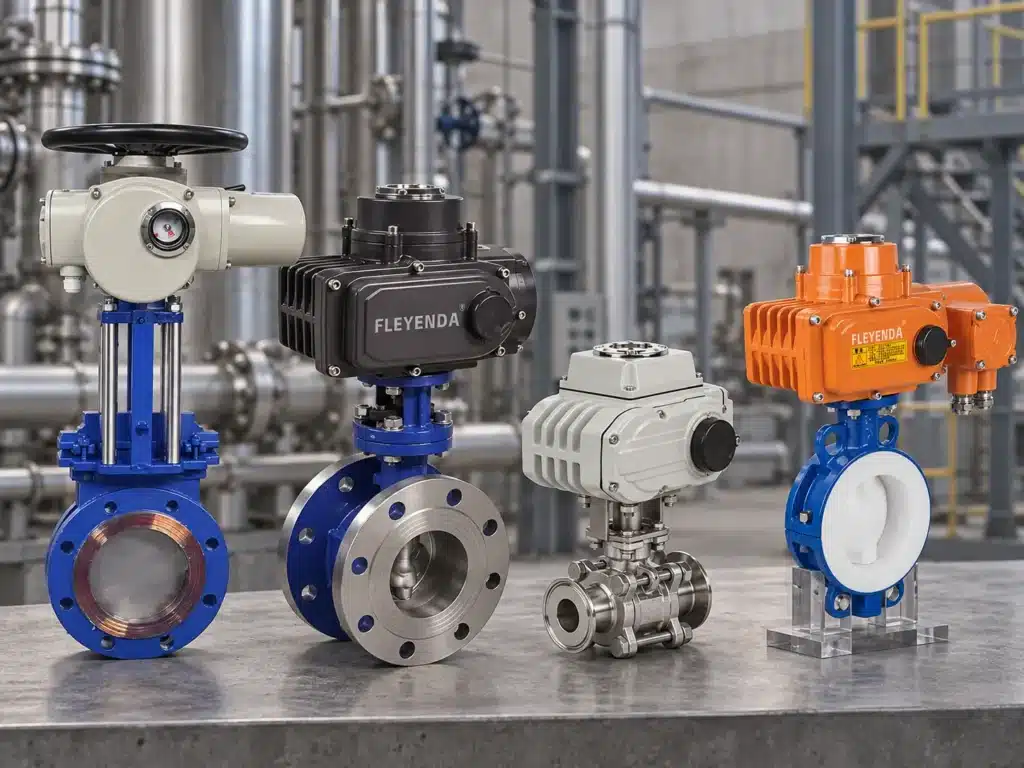
1. Electric Ball Valve
An electric ball valve combines a quarter-turn ball valve with an electric actuator. When the actuator rotates the stem approximately 90 degrees, the bore through the ball either aligns with the pipeline or rotates across the flow path.
This simple operating principle makes the electric ball valve one of the most widely used choices for automatic industrial isolation.
A full-port ball valve can provide a relatively unrestricted flow path when fully open, making it useful where pressure loss needs to be minimized.
Electric ball valves are commonly used on pump discharge lines, process skids, water treatment equipment, tank transfer systems and oil and gas pipelines.
Best suited for: automatic on-off isolation, low-pressure-loss flow paths and frequent quarter-turn operation.
A standard round-port ball valve should not automatically be selected for continuous throttling. If proportional control is required, a V-port design is generally more suitable.
2. Electric Butterfly Valve
An electric butterfly valve uses an electric actuator to rotate a disc inside the valve body. Like a ball valve, it normally requires approximately 90 degrees of movement between the fully open and fully closed positions.
Butterfly valves are especially attractive for larger pipe diameters because their bodies are relatively compact compared with many alternative valve designs.
In water treatment plants and pump stations, electric butterfly valves are frequently used for automated isolation of large pipelines.
Depending on the seat design and valve geometry, butterfly valves can also be used for selected throttling duties.
Concentric, Double-Offset and Triple-Offset Designs
Concentric butterfly valves are widely used in general water service. Double-offset and triple-offset designs are intended for more demanding pressure, temperature or sealing requirements.
The required actuator torque can vary significantly between these designs, particularly at breakaway and final seating positions.
Best suited for: larger pipelines where compact size, lower weight and electric automation are important.
3. Electric Gate Valve
An electric gate valve uses a multi-turn electric actuator to raise or lower a gate through the flow path.
When fully open, the gate is withdrawn from the main flow stream, allowing a relatively straight passage through the valve.
This makes electric gate valves suitable for isolation in water treatment plants, pump stations and large industrial pipelines.
Unlike quarter-turn ball and butterfly valves, gate valves usually require multiple stem rotations, so their actuators are designed for multi-turn output rather than 90-degree movement.
Gate valves are normally intended to operate either fully open or fully closed. Leaving a conventional gate valve partially open for continuous throttling can create vibration, erosion and damage to the gate and seats.
Best suited for: full-open isolation where low restriction and large pipeline sizes are important.
4. Electric Globe Control Valve
An electric globe control valve is designed for throttling rather than simple isolation.
The actuator moves the plug relative to the seat, changing the effective flow area in a controlled manner. This geometry allows much more predictable modulation than a conventional isolation valve.
Electric globe valves are commonly used where a process requires accurate control of flow, pressure, temperature or another operating variable.
The electric actuator may receive a 4–20 mA, 0–10 V or another compatible control signal and position the valve according to the process controller output.
The main trade-off is pressure loss. The internal flow path of a globe valve creates more resistance than a fully open ball or gate valve.
Best suited for: applications where precise throttling is more important than minimum fully open pressure loss.
5. Electric V-Port Ball Valve
An electric V-port ball valve combines the compact quarter-turn construction of a ball valve with a V-shaped control opening designed for proportional flow regulation.
As the actuator rotates the valve, the V-shaped opening produces a more progressive change in effective flow area than a standard round-port ball valve.
This makes the V-port electric valve useful for pump discharge regulation, minimum-flow recirculation, bypass control, tank filling and other modulating duties.
V-port geometry can also help provide a useful control range across intermediate valve positions.
The valve should still be sized according to required Cv or Kv, differential pressure and actual flow range. Using the same DN as the pipeline without a control-valve calculation can result in an oversized valve.
Best suited for: modulating flow control where a compact quarter-turn valve is preferred.
6. Electric Three-Way Ball Valve
An electric three-way ball valve has three pipe connections and can route flow between different paths.
The two most common internal configurations are T-port and L-port.
An L-port ball normally connects one inlet to one of two outlets, making it useful for diverting service.
A T-port design can provide additional flow-path combinations, depending on actuator position and valve configuration.
Electric three-way valves are frequently used in tank-transfer systems, pump skids, process routing and automated distribution systems where a single actuator must switch flow between pipelines.
Always confirm the required T-port or L-port flow diagram before ordering. Two three-way valves with the same size and actuator can provide completely different flow paths.
Best suited for: automatic flow diversion, line switching and selected mixing applications.
7. Electric Knife Gate Valve
An electric knife gate valve is designed for media that may contain suspended solids, sludge, pulp or slurry.
The thin gate moves through the flow path and can cut through or move past soft solids that could cause problems in conventional isolation valves.
Electric knife gate valves are therefore used in wastewater treatment, mining, metallurgy, pulp processing and other industrial systems where the medium is not a clean liquid.
Like a conventional gate valve, the knife gate valve normally uses a linear or multi-turn actuator arrangement rather than a quarter-turn actuator.
Media characteristics are especially important. Solids concentration, particle size, abrasiveness and settling tendency should all be considered before valve selection.
Best suited for: wastewater, slurry and solids-containing media where ordinary isolation valves may experience clogging or seat damage.
On-Off or Modulating Electric Valve?
After choosing the valve type, the next major decision is the control mode.
An on-off electric valve travels between fully open and fully closed positions. It is commonly used for isolation, line switching and automated process sequencing.
A modulating electric valve can stop at intermediate positions. It normally receives a proportional control command such as 4–20 mA and adjusts valve position according to the process requirement.
Modulating actuators should be paired with a valve design intended for throttling. Simply installing a modulating actuator on an unsuitable isolation valve does not create an effective control valve.
How to Choose the Right Electric Valve
The correct electric valve should be selected from the complete process duty rather than from pipeline size alone.
Start by defining whether the valve needs to isolate, regulate, divert or handle solids. This immediately narrows the available valve types.
Next, confirm pressure, temperature, medium, flow rate and required connection standard.
The actuator should then be matched to the valve torque or thrust requirement and the electrical control system.
| Fator de seleção | What to Confirm | Por que isso é importante |
|---|---|---|
| Valve Function | Isolation, modulation, diversion or slurry service | Determines the basic valve type |
| Pipe Size | DN or NPS | Defines valve connection size |
| Pressão | Operating pressure and maximum differential pressure | Affects body rating and actuator load |
| Temperatura | Minimum and maximum process temperature | Affects seat, seal and material selection |
| Medium | Water, oil, gas, chemical, steam or slurry | Determines material compatibility |
| Actuator Output | Torque or thrust requirement | Ensures reliable valve movement |
| Tensão | 24V DC, 110V AC, 220V AC or project supply | Must match the electrical system |
| Control Mode | Ligar/desligar ou modulação | Determines actuator electronics |
| Operating Time | Required opening and closing speed | Affects process response and water hammer |
| Proteção | Indoor, outdoor, wet or hazardous environment | Determines IP and explosion-proof requirements |
Electric Valve Actuator Torque and Thrust
Electric actuator sizing depends on the valve mechanism.
Ball and butterfly valves normally require rotary torque, while gate and globe valves may require multi-turn torque or linear thrust.
Differential pressure, seat friction, temperature and deposits can significantly change the force required to operate the valve.
Actuator output should therefore be based on the valve manufacturer’s operating torque or thrust data rather than DN alone.
Do not select an electric actuator only because it physically fits the valve mounting flange. Output torque, travel, speed, duty cycle and control mode must all be compatible.
24V, 110V or 220V Electric Valve?
Electric valves can be supplied with different power configurations depending on actuator design.
24V DC is commonly used in compact automation systems and control panels, while 110V AC and 220V AC can be practical in industrial installations with longer cable runs or existing AC power infrastructure.
Voltage should not be confused with actuator torque. A 220V actuator is not automatically stronger than a 24V actuator.
The required torque is determined by the valve load, while the voltage is selected according to the electrical system and actuator model.
How Fast Should an Electric Valve Operate?
Electric valve operating speed should be selected according to the process rather than choosing the fastest actuator available.
Fast operation may be useful for emergency isolation or short machine cycles, but rapid valve closure in liquid pipelines can contribute to water hammer.
Slow operation may reduce the rate of pressure change but can delay process sequencing.
Pump systems deserve particular attention because pump startup, shutdown and valve movement can directly affect pressure transients.
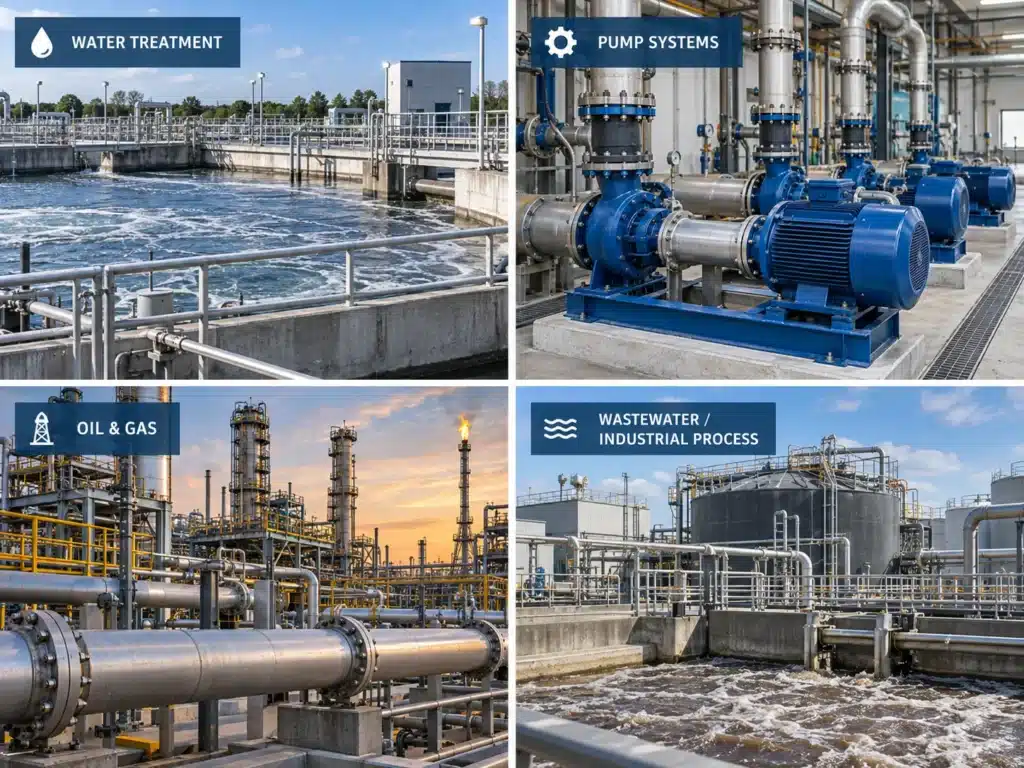
Where Are Electric Valves Used?
Tratamento de Água
Electric ball, butterfly and gate valves are commonly used for automated isolation, filtration systems, pump stations, tank control and distribution pipelines.
Pump Systems
Electric valves can isolate pumps, control discharge flow, regulate bypass lines and operate as part of an automated pump startup or shutdown sequence.
Petróleo e Gás
Electric actuated valves are used where remote operation, pipeline automation and process isolation are required. Pressure class, hazardous-area requirements and fail-safe philosophy are important selection factors.
Metalurgia
Metallurgical plants use electric valves for cooling water, process media, slurry and automated utility systems. Media temperature, solids and abrasion should be evaluated carefully.
Common Electric Valve Selection Mistakes
A common mistake is selecting the valve from DN alone without defining what the valve actually needs to do.
Another is choosing a standard isolation valve for continuous throttling. The actuator may be capable of stopping at intermediate positions, but the valve body may still have poor control characteristics.
Actuator undersizing is another frequent problem. Valve torque should be checked under maximum realistic differential pressure rather than workshop conditions with no process load.
Selecting an unnecessarily fast actuator can also create problems in liquid pipelines because rapid closure may increase pressure surge.
Finally, electrical requirements should be confirmed separately. Supply voltage, control signal and position-feedback signal are different specifications and should not be assumed from one another.
What to Include in an Electric Valve RFQ
A useful RFQ should include more than valve size and voltage.
Specify the medium, DN or NPS, pressure class, working pressure, temperature and required connection standard.
State whether the valve is for isolation, throttling, diversion or slurry service.
For the actuator, provide supply voltage, control mode, required operating time, position-feedback requirements and environmental protection.
If the valve is intended for modulation, provide minimum, normal and maximum flow together with upstream and downstream pressure so the required Cv or Kv can be checked.
“DN100 electric valve, 220V” is not enough information for reliable selection. Valve type, function, medium, pressure, torque and control requirements should also be defined.
Perguntas frequentes
O que é uma válvula elétrica?
An electric valve is a valve operated by an electric actuator rather than manual force or compressed air. It can be configured for on-off operation or proportional control depending on the valve and actuator design.
What are the main types of electric valve?
Common industrial types include electric ball valves, butterfly valves, gate valves, globe control valves, V-port ball valves, three-way ball valves and knife gate valves.
Which electric valve is best for isolation?
Electric ball valves are widely used for compact quarter-turn isolation, while butterfly and gate valves can be more appropriate for larger pipeline sizes depending on process conditions.
Which electric valve is best for flow control?
Electric globe control valves and V-port ball valves are commonly used when proportional flow regulation is required.
Can an electric ball valve be used for throttling?
A conventional round-port ball valve can restrict flow, but a V-port ball valve is generally more suitable for continuous modulating control.
What voltage does an electric valve use?
Common industrial actuator options include 24V DC, 110V AC and 220V AC, although other voltages are available depending on the actuator and project.
How do I size an electric valve actuator?
Size the actuator according to the valve’s required torque or thrust under the maximum realistic operating conditions, then check travel, operating time, duty cycle, voltage and control mode.
Can an electric valve fail closed during a power outage?
A standard electric actuator may remain in its current position after power loss. A fail-close function requires a suitable fail-safe actuator or power-failure reset configuration.
Conclusão
The term electric valve covers many different valve designs, and the best choice depends first on what the valve must do in the process.
Electric ball valves are strong choices for compact automatic isolation, while butterfly valves are practical for many larger pipelines. Gate valves suit full-open isolation, globe control valves provide accurate throttling, and V-port ball valves combine quarter-turn operation with modulating control.
Three-way electric valves are useful for flow routing, while electric knife gate valves are designed for wastewater, slurry and solids-containing media.
After choosing the valve type, actuator torque or thrust, voltage, operating speed, control mode, position feedback and environmental protection must be matched to the application.
The most reliable electric valve selection starts with process function and operating conditions rather than valve size alone.