


Forged Steel Gate Valve
A forged steel gate valve provides dependable isolation in high-pressure, high-temperature and demanding industrial piping systems. Its compact body, strong material structure and reliable sealing performance make it a common choice for oil and gas, petrochemical, power generation and process applications.
What Is a Forged Steel Gate Valve?
A forged steel gate valve is an isolation valve manufactured from steel that has been shaped under compressive force. During forging, the metal structure is refined and aligned, producing a dense valve body with excellent strength, impact resistance and pressure-retaining capability.
The valve controls flow by raising or lowering an internal gate. When the gate is fully raised, the flow passage is open and fluid can move through the valve with relatively low resistance. When the gate is lowered onto the seats, the passage is closed.
Forged gate valves are commonly used in small-bore and high-pressure pipelines. They are frequently supplied with socket-weld, threaded, butt-weld or flanged ends. Depending on the design, they may have bolted bonnets, welded bonnets or pressure-seal bonnets.
Many forged steel gate valves are designed according to recognized industrial standards such as API 602 and ASME B16.34. However, the applicable standard, material grade and pressure-temperature rating should always be confirmed for each project.
Why Use Forged Steel?
Forged steel offers a compact grain structure, high mechanical strength and good resistance to pressure, thermal stress and impact. These properties make forged valves suitable for critical services where leakage or body failure could cause serious operational problems.
How Does a Forged Steel Gate Valve Work?
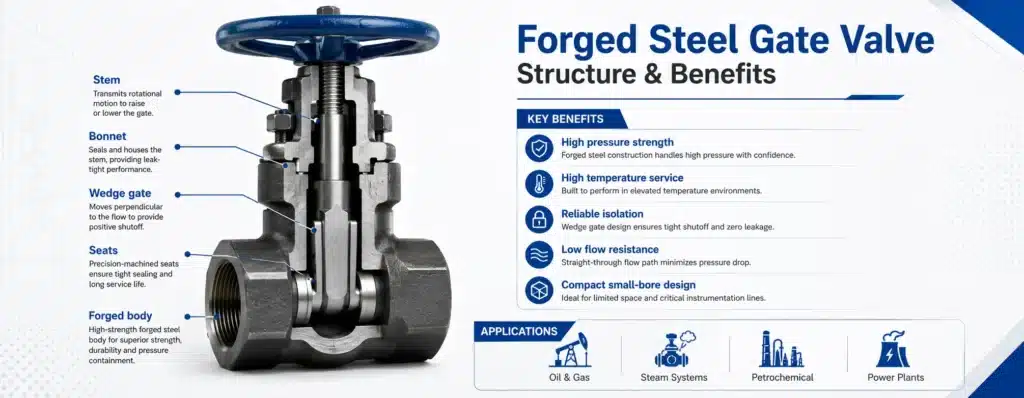
A forged steel gate valve is operated by turning a handwheel, gearbox or actuator. The operating mechanism converts rotary movement into linear stem movement. As the stem rises, the gate moves away from the valve seats and opens the flow path. As the stem moves downward, the gate presses against the seats and shuts off the pipeline.
Gate valves are designed primarily for fully open or fully closed service. They should not normally be used for continuous throttling. When a gate remains partially open, high fluid velocity can produce vibration, erosion and uneven wear on the gate and seat surfaces.
Rising Stem Design
In a rising stem forged steel gate valve, the stem moves upward as the valve opens. The visible stem position provides a clear indication of whether the valve is open or closed. Rising stem designs are widely used in industrial facilities where operators need immediate visual confirmation.
Outside Screw and Yoke Design
An outside screw and yoke design keeps the stem threads outside the pressure-containing area. This arrangement separates the threads from the process fluid, simplifies lubrication and makes maintenance easier. It is common in oil, gas, steam and chemical process applications.
Wedge Gate Design
Many forged steel gate valves use a solid or flexible wedge. A solid wedge provides a simple and durable shutoff element. A flexible wedge can compensate for minor seat misalignment and thermal expansion, reducing the risk of binding in high-temperature service.
Forged Steel Gate Valve Construction
The performance of a forged steel gate valve depends on the design and compatibility of its internal and external components. Each part must be selected according to system pressure, temperature, fluid composition and operating conditions.
Corps de vanne
The forged body contains the process pressure and supports the internal components. Common materials include carbon steel, low-alloy steel and stainless steel.
Gate
The gate moves vertically to open or close the flow passage. It may use a solid wedge, flexible wedge or parallel configuration depending on the valve design.
Seats
The seats provide sealing surfaces for the gate. They may be renewable, welded or integral, with hard-facing materials added for severe service.
Tige
The stem transfers operating force from the handwheel or actuator to the gate. Stem material must resist tension, corrosion and repeated operation.
Capot
The bonnet closes the top of the body and supports the stem assembly. Bolted, welded and pressure-seal bonnet designs are available.
Packing and Gasket
Stem packing and body-bonnet gaskets prevent external leakage. Graphite, PTFE and other engineered materials may be selected according to service conditions.
Advantages of Forged Steel Gate Valves
High Strength in a Compact Body
The forging process produces a strong and dense pressure-containing structure. This allows a forged steel gate valve to handle demanding pressure and temperature conditions while maintaining a relatively compact body size.
Low Flow Resistance
When fully open, the gate is removed from the main flow passage. This creates a relatively straight internal path and helps reduce pressure loss. Low flow resistance is important in pipelines where energy efficiency and flow capacity must be maintained.
Reliable Pipeline Isolation
A correctly selected and maintained forged steel gate valve can provide dependable shutoff. Metal seating surfaces are suitable for high temperatures and industrial fluids that may damage soft-seated valves.
Bidirectional Flow Capability
Many gate valve designs can control flow in either direction. This provides installation flexibility, although the manufacturer’s recommended flow direction should still be checked.
Suitability for Severe Service
Forged steel valves can be manufactured with special trims, hard-facing alloys, low-emission packing and corrosion-resistant internal parts. These options support steam, hydrocarbon, chemical and high-cycle services.
Multiple End Connections
Threaded ends simplify installation in smaller utility lines. Socket-weld and butt-weld ends provide strong, permanent pipeline connections, while flanged ends allow easier removal for inspection and maintenance.
Forged Steel Gate Valve vs Other Gate Valve Types
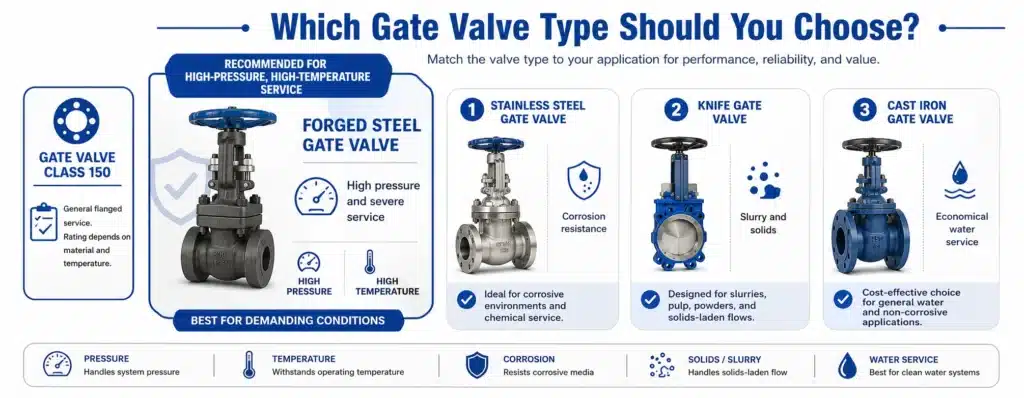
Gate valves are available in different materials and structural designs. A forged steel gate valve is not automatically the best option for every system. The correct selection depends on pressure, temperature, corrosion, pipe size, media and operating frequency.
Stainless Steel Gate Valve
A stainless steel gate valve is selected when corrosion resistance is more important than the additional cost of stainless material. Common applications include chemical processing, water treatment, food production, pharmaceuticals and marine systems.
It is important to understand that stainless steel describes the material, while forged describes the manufacturing method. A stainless steel gate valve may be forged or cast. For critical small-bore service, a forged stainless steel body can combine corrosion resistance with high mechanical strength.
Different stainless steel grades provide different levels of resistance to chlorides, acids and elevated temperatures. Material selection should be based on the actual fluid concentration, temperature and expected corrosion mechanism.
Knife Gate Valve
A knife gate valve uses a thin, sharp-edged gate that moves through thick media or suspended solids. It is commonly installed in wastewater, mining, pulp and paper, biomass and slurry-handling systems.
Unlike a conventional forged steel gate valve, a knife gate valve is designed for media that may clog a standard wedge gate. Its narrow blade can cut through soft solids and accumulated material. However, many knife gate valves are intended for lower-pressure service and may not provide the same pressure capability as a forged steel design.
A knife gate valve should be chosen according to slurry concentration, particle size, pressure, seat design and required leakage class. It should not be selected only because the pipeline contains dirty fluid.
Cast Iron Gate Valve
A cast iron gate valve is widely used in municipal water, irrigation, fire protection, HVAC and general utility systems. Cast iron is economical and performs well in many low- and moderate-pressure water applications.
Compared with forged steel, cast iron is more brittle and normally has lower impact and high-temperature capability. It is not usually selected for severe hydrocarbon, high-pressure steam or rapid thermal cycling services.
For clean water pipelines, a cast iron gate valve may offer the best balance of price and performance. For high-pressure process systems, forged steel is usually the more appropriate material.
What Is a Gate Valve Class 150?
The keyword gate valve class 150 refers to a valve designed for an ASME pressure class, not a valve with a universal maximum pressure of 150 psi. The actual allowable working pressure depends on valve material and operating temperature.
At lower temperatures, some Class 150 steel valves may have pressure ratings above 150 psi. As the operating temperature rises, the permitted pressure normally decreases. The pressure-temperature table for the specified material group should always be reviewed.
A gate valve Class 150 is commonly supplied with flanged ends for water, oil, gas and general industrial service. These valves are often manufactured with cast bodies in larger pipe sizes, although forged flanged versions may also be available for specific sizes and project requirements.
Important Pressure Rating Note
Do not select a gate valve by class designation alone. Confirm body material, design standard, operating temperature, end connection, test pressure and the manufacturer’s published pressure-temperature rating.
Class 150 vs Class 300 and Higher Ratings
Class 150 valves are commonly used for lower-pressure general service. Class 300, Class 600 and higher ratings are selected as pressure and temperature requirements increase. Higher-class valves normally have thicker pressure-containing walls, stronger flanges and heavier bolting.
Many small forged steel gate valves are also supplied in Class 800, Class 1500 or Class 2500 threaded and socket-weld configurations. These class designations should not be directly compared with flanged ratings without reviewing the applicable standard and pressure-temperature data.
How to Select a Forged Steel Gate Valve
1. Identifier le fluide de procédé
Determine whether the valve will control steam, oil, natural gas, water, chemicals or another medium. Check material and trim compatibility.
2. Vérifier la pression et la température
Use the maximum design pressure and temperature, not only normal operating conditions. Include startup, shutdown and upset conditions.
3. Select the Body Material
Carbon steel is common for general industrial service. Stainless and alloy steels may be needed for corrosion, low temperature or high-temperature strength.
4. Choose the End Connection
Threaded connections are convenient, while socket-weld and butt-weld ends reduce potential leakage paths. Flanges simplify removal and replacement.
5. Review the Bonnet Design
Bolted bonnets support maintenance access. Welded bonnets reduce external leak paths, while pressure-seal designs suit high-pressure service.
6. Check Seat and Trim Materials
Seat surfaces, stem material and hard-facing must resist corrosion, erosion, galling and repeated operation under the expected service conditions.
7. Define Leakage Requirements
Confirm the required seat leakage performance and any fugitive-emission requirements for hydrocarbon, toxic or environmentally controlled service.
8. Select Manual or Automated Operation
Handwheels suit local operation. Gearboxes, electric actuators and pneumatic actuators may be used for larger valves or remote control.
Forged Steel Gate Valve Applications
Oil and Gas Processing
Forged steel gate valves are used for isolation in upstream, midstream and downstream systems. Typical services include hydrocarbon processing, compressor stations, fuel gas, drainage, venting and refinery utility lines.
Power Generation
Power plants use forged valves in steam, condensate, feedwater and auxiliary piping. High-temperature materials and pressure-seal construction may be required for demanding steam conditions.
Petrochemical and Chemical Plants
Chemical facilities require reliable isolation and careful material selection. Carbon steel, stainless steel and alloy steel gate valves may be used depending on chemical compatibility and operating temperature.
Industrial Steam Systems
Metal-seated forged steel gate valves can handle elevated steam temperatures that would damage many soft-seated valve designs. Correct packing, gasket and trim materials are essential for long-term performance.
Pipeline Drain and Vent Service
Compact forged valves are often installed in drain, bypass, vent and sampling lines. Welded-end designs help reduce the risk of leakage in critical hydrocarbon systems.
Installation and Maintenance Guidelines
Before installation, confirm the valve identification, material, size, pressure class, flow direction and end connection. Inspect the valve bore and pipeline for dirt, welding residue and foreign material.
The valve should normally be installed in the fully closed position unless the manufacturer specifies otherwise. Welding procedures must protect the seats, packing and internal components from excessive heat.
Gate valves should be operated fully open or fully closed. Do not apply excessive handwheel force after the gate reaches the end of its travel. Over-tightening can damage the stem, gate or seating surfaces.
Routine inspection should include packing leakage, body-bonnet leakage, stem condition, operating torque and seat performance. Stem threads and bearings should be lubricated according to the manufacturer’s maintenance instructions.
Valves that remain in one position for extended periods should be exercised when the process and safety procedures allow. Periodic operation helps identify corrosion, deposits and increasing operating resistance before the valve becomes inoperable.
Foire aux questions
What is a forged steel gate valve used for?
It is mainly used for high-pressure or high-temperature pipeline isolation in oil, gas, petrochemical, steam, power and industrial process systems.
Is forged steel stronger than cast steel?
Forged steel generally has a refined grain structure and strong mechanical properties. However, the correct choice also depends on valve size, material grade, manufacturing quality and service conditions.
Is a stainless steel gate valve always forged?
No. A stainless steel gate valve may have a forged or cast body. Stainless steel identifies the material family, while forging and casting identify the manufacturing process.
Can a knife gate valve replace a forged steel gate valve?
Usually not in high-pressure service. Knife gate valves are designed mainly for slurry and solids, while forged steel gate valves are commonly selected for pressure and temperature capability.
Does gate valve Class 150 mean 150 psi?
No. Class 150 is an ASME pressure class. The actual allowable pressure depends on the valve material and operating temperature.
Can a forged steel gate valve regulate flow?
It is not recommended for continuous throttling. A forged steel gate valve should normally operate fully open or fully closed.
When should a cast iron gate valve be selected?
A cast iron gate valve is commonly selected for economical water, irrigation, HVAC and municipal applications where pressure and temperature conditions are moderate.
Select the Right Gate Valve for Reliable Isolation
A forged steel gate valve is a dependable choice for compact, high-strength pipeline isolation in demanding industrial service. Its suitability depends on more than valve size or pressure class. Body material, trim, bonnet design, end connection, temperature and fluid compatibility must all be evaluated.
Understanding the differences between a forged steel gate valve, stainless steel gate valve, knife gate valve, cast iron gate valve and gate valve Class 150 helps engineers and buyers choose a valve that delivers reliable performance, safe operation and a longer service life.