


¿Cómo funciona una válvula de bola?
Una válvula de bola controla el flujo de fluido al mover un disco o un obturador hacia o lejos de un asiento fijo. A diferencia de una válvula de compuerta, que está diseñada principalmente para funcionar en posición totalmente abierta o totalmente cerrada, una válvula de bola puede proporcionar un cierre confiable y, al mismo tiempo, permitir a los operadores regular el flujo con mayor precisión.
Es importante comprender el principio de funcionamiento de la válvula de bola a la hora de seleccionar válvulas para sistemas de vapor, agua, aceite, gas, procesamiento químico, sistemas de enfriamiento y líneas de servicios industriales. La trayectoria interna del flujo, el diseño del disco, la disposición del asiento y el movimiento del vástago influyen en la caída de presión, el rendimiento de control, el par de operación y la vida útil.
Esta guía explica cómo funciona una válvula de globo, identifica las principales piezas y funciones de la válvula de globo, compara los diseños más comunes del cuerpo y del disco, explica la dirección correcta del flujo en la válvula de globo y ofrece consejos prácticos sobre instalación, selección y mantenimiento.
Resumen del principio de funcionamiento de la válvula de bola
- Apertura de la válvula: El vástago levanta el disco alejándolo del asiento, creando una abertura por la que puede pasar el fluido.
- Cierre de la válvula: El vástago empuja el disco hacia el asiento hasta que las superficies de sellado entran en contacto y detienen el flujo.
- Regulación del flujo: Las posiciones intermedias del disco modifican el área de paso disponible y permiten que la válvula regule el flujo del fluido de proceso.
- Característica principal: Una válvula de bola ofrece una mejor capacidad de regulación que muchas válvulas de aislamiento, pero normalmente genera una mayor caída de presión.
¿Qué es una válvula de bola?
Una válvula de bola es una válvula de movimiento lineal que se utiliza para iniciar, detener o regular el flujo de un líquido, gas o vapor. Su nombre proviene originalmente de la forma redondeada de los primeros cuerpos de válvula, aunque las válvulas de bola modernas pueden tener varias formas externas diferentes.
En el interior de la válvula, un disco móvil se cierra contra un asiento fijo. El disco está conectado a un vástago, que puede accionarse mediante un volante, una caja de engranajes, un actuador neumático, un actuador eléctrico o un actuador hidráulico. A medida que el vástago se mueve en línea recta, cambia la distancia entre el disco y el asiento.
Cuando se eleva el disco, el fluido pasa a través de la abertura del asiento y cambia de dirección a medida que atraviesa el cuerpo de la válvula. Cuando se baja el disco, el área de flujo disponible se reduce. Cuando el disco entra en contacto con el asiento, la válvula detiene el flujo.
Esta relación controlable entre la posición del disco y el área de flujo es la razón principal por la que las válvulas de globo se utilizan ampliamente para la regulación y el control del flujo.
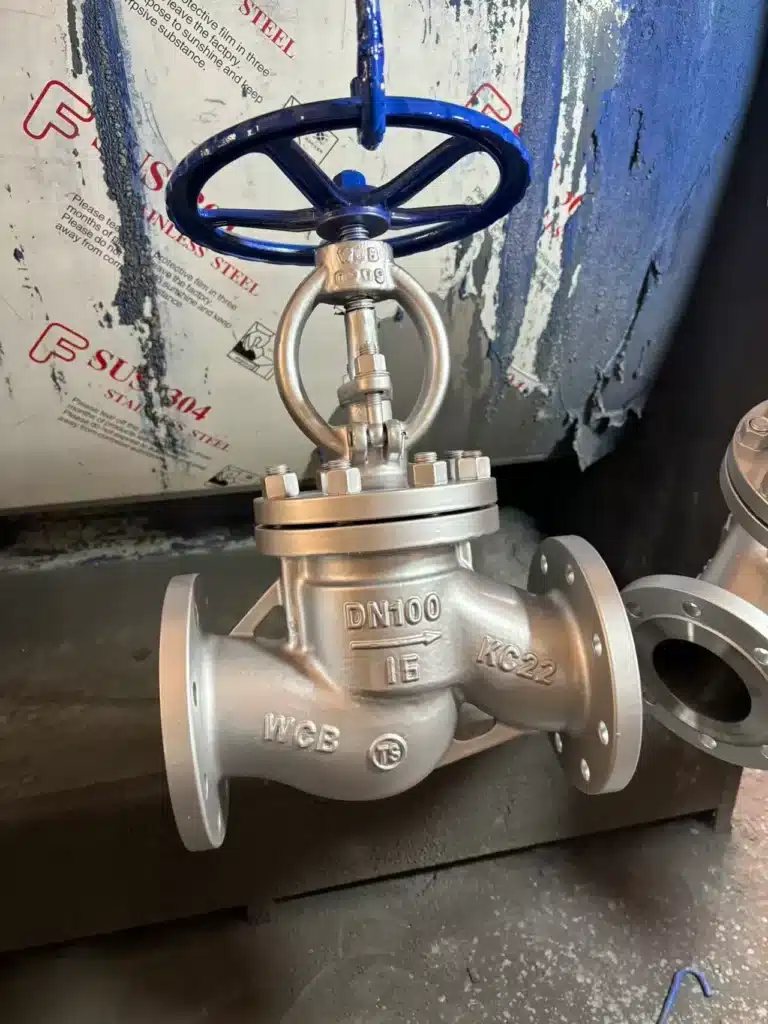
¿Cómo funciona una válvula de bola paso a paso?
El funcionamiento de una válvula de bola se puede dividir en cinco etapas básicas.
- El operador gira el volante o activa el actuador. El movimiento giratorio del volante se convierte en movimiento lineal a través del vástago roscado y el mecanismo de yugo.
- El vástago se mueve hacia arriba o hacia abajo. En muchos diseños, al girar el volante en sentido antihorario, el vástago se eleva y la válvula se abre, mientras que al girarlo en sentido horario, el vástago desciende y la válvula se cierra.
- El disco cambia su posición con respecto al asiento. Al elevar el disco se aumenta el área de flujo, mientras que al bajarlo se reduce el área de flujo.
- El fluido de proceso pasa por el recorrido interno. El fluido cambia de dirección al ingresar al cuerpo de la válvula, pasa por la abertura del asiento y sale por la conexión opuesta.
- El disco entra en contacto con el asiento para detener el flujo. Durante el cierre total, el volante o el actuador aplica fuerza a través del vástago para que el disco presione contra el asiento y forme un sello.
Cómo se abre una válvula de bola
Cuando se gira el volante para abrir la válvula, el vástago roscado se desplaza hacia arriba. El disco conectado al vástago se separa del asiento de la válvula. Esto crea una abertura anular entre el disco y el asiento, a través de la cual puede fluir el fluido.
Al inicio del movimiento de apertura, un pequeño cambio en la posición del vástago crea un paso de flujo relativamente pequeño. A medida que el disco sigue elevándose, aumenta el área de flujo disponible. La relación exacta entre el recorrido del vástago y la tasa de flujo depende del perfil del disco, la geometría del asiento y las condiciones de presión.
Cómo se cierra una válvula de bola
Para cerrar la válvula, el volante o el actuador mueve el vástago hacia abajo. El disco se acerca al asiento, reduciendo el área de flujo disponible. A medida que la abertura se hace más pequeña, la velocidad del fluido a través del área restringida puede aumentar, mientras que la presión aguas abajo disminuye.
Cuando el disco llega al asiento, una fuerza adicional ejercida por el vástago presiona las superficies de sellado entre sí. Una válvula de globo correctamente seleccionada y mantenida puede, entonces, proporcionar un cierre confiable.
Cómo regula el flujo una válvula de bola
Durante el servicio de regulación, el disco permanece parcialmente abierto. Al mover el disco se modifica la restricción dentro de la válvula, lo que a su vez cambia la caída de presión y el caudal a través del sistema.
En comparación con una válvula de compuerta, la disposición del disco y el asiento de una válvula de globo ofrece un control más estable en posiciones intermedias. Esto hace que las válvulas de globo sean adecuadas para aplicaciones en las que el operador debe ajustar con frecuencia el flujo de vapor, agua de enfriamiento, combustible, condensado o de proceso.
Importante: Una válvula de globo manual estándar puede regular el flujo, pero en aplicaciones de control automático exigentes se debe utilizar una válvula de control de globo del tamaño adecuado, con una característica de trim, un actuador y un posicionador apropiados.
Piezas principales de la válvula de bola y sus funciones
Comprender los componentes internos ayuda a explicar cómo funciona una válvula de bola y por qué se producen ciertas fallas.
| Pieza de válvula de bola | Función | Consideraciones para la selección |
|---|---|---|
| Cuerpo de válvula | Contiene la presión y dirige el fluido a través del recorrido interno. | Debe cumplir con los requisitos de presión, temperatura, fluido y material de las tuberías. |
| Capó | Cierra la parte superior del cuerpo de la válvula y sostiene el vástago y el sistema de empaque. | Puede tener una construcción atornillada, soldada, con sellado a presión o con uniones. |
| Disco o tapón | Se mueve hacia el asiento o se aleja de él para controlar o detener el flujo. | La forma del disco influye en el cierre, la precisión de la regulación y la resistencia a la erosión. |
| Asiento o anillo de asiento | Proporciona la superficie de sellado fija contra la cual se cierra el disco. | El material debe ser resistente a la corrosión, a la temperatura, al desgaste y a la velocidad del fluido. |
| Tallo | Transmite el movimiento y la fuerza desde el volante o el actuador al disco. | Debe resistir las cargas mecánicas, la corrosión y el agarrotamiento. |
| Empaque | Crea un sello alrededor del vástago móvil para evitar fugas externas. | La elección depende de la temperatura, el fluido, los requisitos de emisiones y el movimiento del vástago. |
| Glándula y seguidor de la glándula | Aplica presión a la empaquetadura del vástago. | Un ajuste incorrecto puede provocar fugas o una fricción excesiva durante el funcionamiento. |
| Yugo | Sostiene el mecanismo de funcionamiento y mantiene la alineación del vástago. | Debe proporcionar la resistencia suficiente para la fuerza de cierre requerida. |
| Volante o actuador | Provides the force needed to position the disc. | Must be sized for maximum differential pressure and required operating speed. |
¿Por qué una válvula de bola presenta una gran caída de presión?
A globe valve normally creates a greater pressure drop than a gate valve or full-port ball valve because the fluid does not travel through a straight, unrestricted passage.
In a conventional T-pattern globe valve, the fluid enters the body, changes direction, passes through the restricted seat opening and changes direction again before leaving the valve. These changes in direction and flow area create turbulence and energy loss.
Globe valve pressure drop increases when:
- The valve is partially closed.
- The seat opening is small relative to the pipe size.
- Fluid velocity is high.
- The internal flow path contains sharp directional changes.
- The valve is undersized for the required flow rate.
- The disc, seat or valve body contains deposits or damage.
This pressure loss is not always undesirable. In a control application, the globe valve intentionally creates a variable pressure drop to regulate flow. However, in a system where low energy loss is the main priority, a globe valve may not be the most efficient isolation valve.
Dirección del flujo en una válvula de bola
Correct globe valve flow direction is important because it can affect operating torque, shutoff behavior, stem packing load, noise, erosion and valve stability.
Many conventional globe valves are installed with flow entering below the disc and leaving above the seat. This arrangement is often called flow to open because process pressure tends to help lift the disc away from the seat.
Other globe valve designs may require flow from above the disc toward the seat. This is sometimes called flow to close because process pressure helps push the disc toward the closed position.
Flujo bajo el disco
With flow entering below the disc, process pressure acts upward on the disc. This arrangement can reduce the force needed to begin opening in some services. It may also reduce the tendency of certain contaminants to collect above the disc.
However, the pressure may work against the closing force, especially at high differential pressure. The operator or actuator must provide enough force to push the disc onto the seat.
Flujo sobre el disco
With flow entering above the disc, process pressure can assist the closing action. This can be useful in selected high-pressure or control applications. However, pressure acting on the top of the disc may increase the force required to open the valve.
Important: Always follow the flow arrow marked on the valve body and the manufacturer’s installation instructions. The correct direction depends on the valve design, disc arrangement, actuator sizing and intended service.
Tipos comunes de válvulas de bola
Válvula de bola tipo T
The T-pattern globe valve is the most traditional design. The inlet and outlet connections are arranged in a straight line, while the seat is positioned between them. The fluid changes direction as it passes through the valve body.
This design provides effective throttling and shutoff but generally has the highest pressure drop among common globe valve body patterns.
Válvula de bola con diseño en Y
A Y-pattern globe valve positions the stem and seat at an angle to the main pipeline. This creates a smoother internal flow path than a conventional T-pattern body.
The design can reduce pressure loss and may be preferred in high-pressure, high-temperature or continuous-flow applications where the valve remains open for long periods.
Válvula de globo angular
An angle globe valve changes the direction of the pipeline, usually by 90 degrees, while also controlling the flow. It combines the function of a valve and an elbow, which can reduce the number of separate piping components.
Angle globe valves are commonly considered for boiler systems, drains, condensate lines and installations where the piping direction must change near the valve.
Válvula de bola de aguja
A needle-type globe valve uses a long, tapered disc or needle that fits into a small seat opening. The gradual change in flow area allows more precise adjustment of low flow rates.
Needle valves are generally used in small-bore instrumentation, sampling and pressure-control lines rather than large process pipelines.
Válvula de bola con sellado de fuelle
A bellows-sealed globe valve includes a flexible metal bellows around the stem. The bellows creates an additional pressure boundary that reduces the possibility of process fluid escaping through the stem packing area.
This design is often considered for hazardous, toxic, high-purity or high-temperature media where external leakage must be minimized.
Válvula de globo con sellado a presión
A pressure-seal globe valve uses internal system pressure to improve the seal between the body and bonnet. Pressure-seal construction is commonly used in high-pressure, high-temperature power plant and steam applications.
Tipos de discos de válvulas de bola
The globe valve disc profile influences throttling performance, leakage, erosion resistance and sensitivity to contamination.
| Disc Type | Main Characteristic | Typical Use |
|---|---|---|
| Plug disc | Provides a defined contact area and can offer reliable shutoff. | General industrial isolation and moderate throttling. |
| Conventional disc | Uses a relatively simple disc profile for opening and closing. | General utility applications. |
| Needle disc | Provides gradual flow-area changes for fine adjustment. | Low-flow and instrumentation service. |
| Contoured plug | Produces a more predictable relationship between valve travel and flow. | Automatic globe control valves. |
| Soft-seated disc | Uses a polymer or resilient sealing element for tight shutoff. | Compatible low- or moderate-temperature fluids. |
| Metal-seated disc | Provides improved resistance to temperature and severe operating conditions. | Steam, high-temperature and erosive services. |
Ventajas y desventajas de las válvulas de bola
Ventajas de una válvula de bola
- Good throttling and flow-regulation capability
- Predictable control at intermediate stem positions
- Reliable shutoff when the disc and seat are in good condition
- Apto para uso frecuente
- Available with different body, trim and actuator configurations
- The seat and disc can often be repaired or replaced
- Compatible with automatic process-control systems
- Available for high-pressure and high-temperature applications
Desventajas de una válvula de bola
- Higher pressure drop than gate valves and full-port ball valves
- Greater energy loss in continuously open service
- Higher operating force at large sizes or high differential pressure
- More complex internal flow path
- Potential for noise, cavitation, flashing or erosion during severe throttling
- Generally unsuitable for pipeline pigging
- May be heavier and more expensive than simple isolation valves
Válvula de bola vs. válvula de compuerta
The difference between a globe valve and gate valve is one of the most common questions in industrial valve selection.
| Comparación | Válvula de bola | Válvula de compuerta |
|---|---|---|
| Primary purpose | Flow regulation and isolation | Fully open or fully closed isolation |
| Closure movement | Disc moves toward a horizontal or angled seat | Gate moves into or out of the flow path |
| Throttling performance | Bien | Generally poor |
| Pressure drop when open | Relativamente alto | Relatively low |
| Operating travel | Moderado | Usually longer |
| Partial opening | Suitable for controlled throttling | Can damage the gate and seats |
| Aplicaciones típicas | Steam control, cooling water, fuel regulation and process control | Main pipeline isolation and low-resistance flow service |
Choose a globe valve when flow adjustment is required. Choose a gate valve when the main requirement is low-pressure-loss isolation and the valve will normally remain fully open or fully closed.
Válvula de globo vs. válvula de bola
A ball valve uses a rotating ball with a central bore, while a globe valve uses a linearly moving disc and seat.
A full-port ball valve generally produces less pressure loss and can open or close with a quarter turn. A globe valve requires multiple turns or linear actuator travel, but it usually provides more stable throttling performance.
Ball valves are often selected for fast isolation. Globe valves are often selected for flow control, steam regulation and applications requiring frequent adjustment.
¿Cómo funciona una válvula de control de bola?
A globe control valve uses the same basic disc-and-seat principle as a manual globe valve, but an actuator automatically positions the plug in response to a control signal.
A typical globe control valve loop works as follows:
- A sensor measures pressure, temperature, level or flow.
- A controller compares the measured value with the required setpoint.
- The controller sends a signal to the valve positioner.
- The positioner adjusts the pneumatic or electric actuator.
- The actuator moves the valve stem and plug.
- The changed flow rate moves the process closer to the setpoint.
The control valve trim may be designed to provide linear, equal-percentage or quick-opening flow characteristics. Correct valve sizing is essential because an oversized control valve may operate too close to the seat, while an undersized valve may not deliver the required maximum flow.
¿Por qué se usan válvulas de bola para el vapor?
A globe valve for steam is widely used because its disc and seat arrangement can provide controlled opening, reliable shutoff and resistance to frequent operation.
Steam systems often require gradual flow adjustment during startup, warm-up, pressure reduction or equipment isolation. A globe valve allows the operator to increase flow progressively rather than releasing the full steam flow immediately.
When selecting a steam globe valve, consider:
- Steam pressure and temperature
- Superheated or saturated steam conditions
- Body and trim material ratings
- Metal seat hardness and erosion resistance
- Pressure-seal or bolted-bonnet construction
- Stem packing suitability
- Condensate and water-hammer risk
- Required opening and closing force
Steam system safety: A globe valve should not be opened rapidly into a cold steam line. Proper warm-up, condensate drainage and operating procedures are necessary to reduce thermal shock and water-hammer risk.
Cómo elegir una válvula de bola
Selecting the correct globe valve requires more than matching the nominal pipe size. The valve must be evaluated as part of the complete piping and process system.
1. Identificar el fluido de proceso
Determine whether the valve will handle water, steam, oil, gas, chemicals, condensate or another medium. Confirm concentration, solids content, corrosiveness, toxicity and contamination limits.
2. Verificar la presión y la temperatura
Record normal, minimum, maximum and design conditions. The body, bonnet, seat, packing and gasket materials must remain suitable throughout the entire operating range.
3. Definir la función de la válvula
Determine whether the globe valve is intended for isolation, manual throttling, automatic control, pressure reduction, bypass service or emergency shutdown. The required function affects the body pattern, disc profile and actuator selection.
4. Calcular la capacidad de flujo requerida
For control applications, use actual flow, pressure and fluid-property data to calculate the required valve flow coefficient. Do not select a globe control valve only by matching it to the pipe diameter.
5. Selecciona el patrón del cuerpo
- Use a T-pattern globe valve for general throttling and shutoff.
- Consider a Y-pattern globe valve when reduced pressure loss is important.
- Use an angle globe valve when the piping must change direction.
- Consider bellows-sealed construction for low-emission service.
- Consider pressure-seal construction for high-pressure steam systems.
6. Selecciona los materiales del cuerpo y los adornos
Common globe valve body materials include cast iron, ductile iron, carbon steel, stainless steel, alloy steel and special corrosion-resistant alloys. Trim materials must resist wear, corrosion, galling and erosion at the seat and stem.
7. Determinar la conexión final
Globe valves are available with threaded, socket-weld, butt-weld and flanged ends. The connection must match the pipe class, pressure rating, maintenance requirements and applicable project standards.
8. Selecciona el modo de funcionamiento manual o automático
Manual globe valves may use a handwheel or gearbox. Automated globe valves may use pneumatic, electric or hydraulic actuators. The actuator must produce enough thrust to move and seat the disc under the maximum expected differential pressure.
Lista de verificación para la selección de válvulas de bola
- Fluido de proceso y concentración
- Caudal normal y máximo
- Presión de entrada y de salida
- Temperatura mínima y máxima
- Pipe size and connection standard
- Required pressure class
- Materiales de la carrocería y los acabados
- Shutoff leakage requirement
- Funcionamiento manual o automático
- Posición de apertura en caso de falla, cierre en caso de falla o mantenimiento de la posición en caso de falla
- Noise, cavitation and erosion risk
- Required inspection and certification documents
Guía de instalación de válvulas de bola
Correct installation protects the seat, stem, packing, valve body and connected piping. Poor alignment or incorrect flow direction can shorten valve life even when the valve itself is correctly selected.
Antes de la instalación
- Confirm the valve size, pressure class, material and identification tag.
- Check the body flow arrow and required installation direction.
- Inspect the valve for shipping damage or contamination.
- Flush weld slag, rust, sand and debris from the pipeline.
- Confirm that the mating connections are correctly aligned.
- Provide adequate pipe support.
- Verify that there is sufficient space for handwheel or actuator movement.
Durante la instalación
- Position the valve according to the marked flow direction.
- Prevent excessive pipe loads from acting on the valve body.
- Use compatible gaskets, bolts and joint materials.
- Tighten flange bolts gradually in a cross pattern.
- Protect the valve from welding heat and debris when applicable.
- Do not use the handwheel or actuator as a lifting point.
Después de la instalación
- Operate the valve through its full travel.
- Confirm smooth stem movement.
- Check the body, bonnet, flanges and packing for leakage.
- Verify actuator travel and limit settings.
- Perform the required pressure and functional tests.
- Record the installation and test results.
Mantenimiento de válvulas de bola
A globe valve should be inspected according to service severity, operating frequency and the consequences of failure. Valves in high-temperature, corrosive or frequently cycled service normally require more attention than valves in clean, stable utility systems.
Puntos de inspección de rutina
- Stem packing leakage
- Bonnet and body-joint leakage
- Flange or threaded connection leakage
- Changes in handwheel torque
- Apertura o cierre incompleto
- Internal seat leakage
- Stem corrosion or damage
- Actuator air, hydraulic or electrical condition
- Abnormal vibration, noise or temperature
Ajuste del empaque del vástago
If leakage appears around the stem, the packing gland may require adjustment. Packing compression should be increased gradually and evenly. Excessive tightening can increase stem friction, damage the packing and prevent smooth valve operation.
If adjustment does not stop the leakage, the packing may need replacement. The line must be safely isolated, depressurized, drained and cooled before packing maintenance.
Inspección de discos y asientos
Internal leakage may result from erosion, corrosion, foreign material, misalignment or damaged sealing surfaces. After safe disassembly, inspect the disc and seat for scratches, wire drawing, pitting, deformation or deposits.
Depending on the valve design and damage level, the sealing surfaces may be cleaned, lapped, machined or replaced.
Problemas comunes de las válvulas de bola y sus soluciones
| Problema | Possible Cause | Recommended Action |
|---|---|---|
| Valve is difficult to operate | Packing is too tight, the stem is damaged, deposits are present or differential pressure is too high. | Inspect packing adjustment, stem condition, internal deposits and actuator sizing. |
| Fuga a través de la válvula cerrada | Damaged seat, eroded disc, trapped debris or insufficient closing force. | Confirm full closure, safely flush if permitted and inspect the disc and seat. |
| Fuga alrededor del vástago | Worn packing, thermal cycling, loose gland or damaged stem surface. | Adjust or replace the packing and inspect the stem. |
| Leakage at the bonnet | Damaged gasket, loose bolting, thermal movement or sealing-surface damage. | Isolate the valve and inspect the gasket, bolts and joint surfaces. |
| Noise or vibration during throttling | High velocity, cavitation, flashing, excessive pressure drop or an oversized valve. | Review valve sizing, trim design, pressure conditions and operating position. |
| Rapid seat erosion | Severe throttling, abrasive particles, incorrect trim material or excessive velocity. | Use suitable hardened trim, improve valve sizing or select a severe-service control valve. |
| Actuator cannot close the valve | Insufficient thrust, high differential pressure, incorrect flow direction or mechanical obstruction. | Verify actuator sizing, process conditions, installation direction and internal valve condition. |
¿Cuándo se debe usar una válvula de bola?
A globe valve is a strong choice when the application requires controlled flow adjustment, frequent operation or reliable shutoff with a linear-motion design.
Typical globe valve applications include:
- Steam supply and distribution
- Boiler feedwater systems
- Cooling water regulation
- Condensate and drain lines
- Sistemas de combustible líquido
- Sistemas de aire comprimido
- Líneas de proceso químico
- Bypass and recirculation lines
- Pressure-reducing stations
- Automatic flow-control loops
- Power generation facilities
- Oil and gas processing plants
¿Cuándo no es una válvula de bola la mejor opción?
A globe valve may not be the best option when the system requires minimum pressure loss, unrestricted flow, pipeline pigging or very fast quarter-turn isolation.
Alternative valve types may be more appropriate when:
- A full-bore flow path is required.
- The valve will remain fully open for most of its service life.
- The system is highly sensitive to pressure loss.
- The medium contains large solids or fibrous material.
- Very rapid opening or closing is required.
- Compact dimensions and low weight are primary requirements.
In these conditions, a gate valve, ball valve, butterfly valve or another specialized valve may provide better overall performance.
Preguntas frecuentes sobre las válvulas de bola
How does a globe valve work?
A globe valve works by moving a disc or plug toward or away from a fixed seat. Raising the disc opens the flow passage, lowering it restricts the flow and pressing it against the seat stops the flow.
What is the main purpose of a globe valve?
The main purpose of a globe valve is to regulate, start or stop fluid flow. It is particularly useful when stable throttling and frequent flow adjustment are required.
Can a globe valve be used for isolation?
Yes. A correctly selected globe valve can provide reliable isolation. However, it normally creates more pressure drop in the open position than a gate valve or full-port ball valve.
Which way should a globe valve be installed?
Install the globe valve according to the flow arrow on the body and the manufacturer’s instructions. Some designs use flow under the disc, while others require flow over the disc.
Why is a globe valve suitable for throttling?
The linear movement of the disc creates a controlled change in the flow area. This provides more stable regulation at partially open positions than valves designed mainly for isolation.
Why does a globe valve have a high pressure drop?
The fluid changes direction and passes through a restricted seat opening inside the valve. These directional and area changes create turbulence and energy loss.
Can a globe valve be installed vertically?
Many globe valves can be installed in vertical piping, but actuator orientation, flow direction, drainage, maintenance access and manufacturer limitations must be checked.
What is the difference between a globe valve and a globe control valve?
A manual globe valve is positioned by a handwheel or manual gearbox. A globe control valve normally uses an actuator, positioner and specially designed trim to regulate flow automatically in response to a control signal.
Is a globe valve normally open or normally closed?
A manual globe valve does not have a fixed normal position. An actuated globe valve can be configured to fail open, fail closed or remain in its last position, depending on the actuator and process-safety requirement.
How often should a globe valve be maintained?
Maintenance frequency depends on fluid condition, temperature, operating cycles, pressure drop and service criticality. Critical valves should be included in a documented inspection and functional-testing program.
Conclusión
A globe valve works by using linear stem movement to position a disc relative to a fixed seat. This operating principle allows the valve to start, stop and regulate fluid flow with greater control than many valves designed only for isolation.
The best globe valve performance depends on correct sizing, body pattern, flow direction, disc design, material selection and actuator capacity. Engineers should review the complete process conditions rather than selecting a valve only by pipe size or pressure class.
When properly selected and maintained, a globe valve can provide dependable throttling, frequent operation and effective shutoff in steam, water, oil, gas and industrial process systems.