


Industrial Valve Guide
Actuator Valve vs Manual Valve
An actuator valve and a manual valve can use the same basic valve body, but they differ significantly in how they are operated, controlled, monitored, and integrated into a piping system. An actuator valve uses pneumatic, electric, or hydraulic power to move the valve, while a manual valve depends on direct human operation. Understanding these differences helps engineers, plant operators, contractors, and purchasing teams choose the right operating method for safety, reliability, process efficiency, and lifecycle cost.
What Is an Actuator Valve?
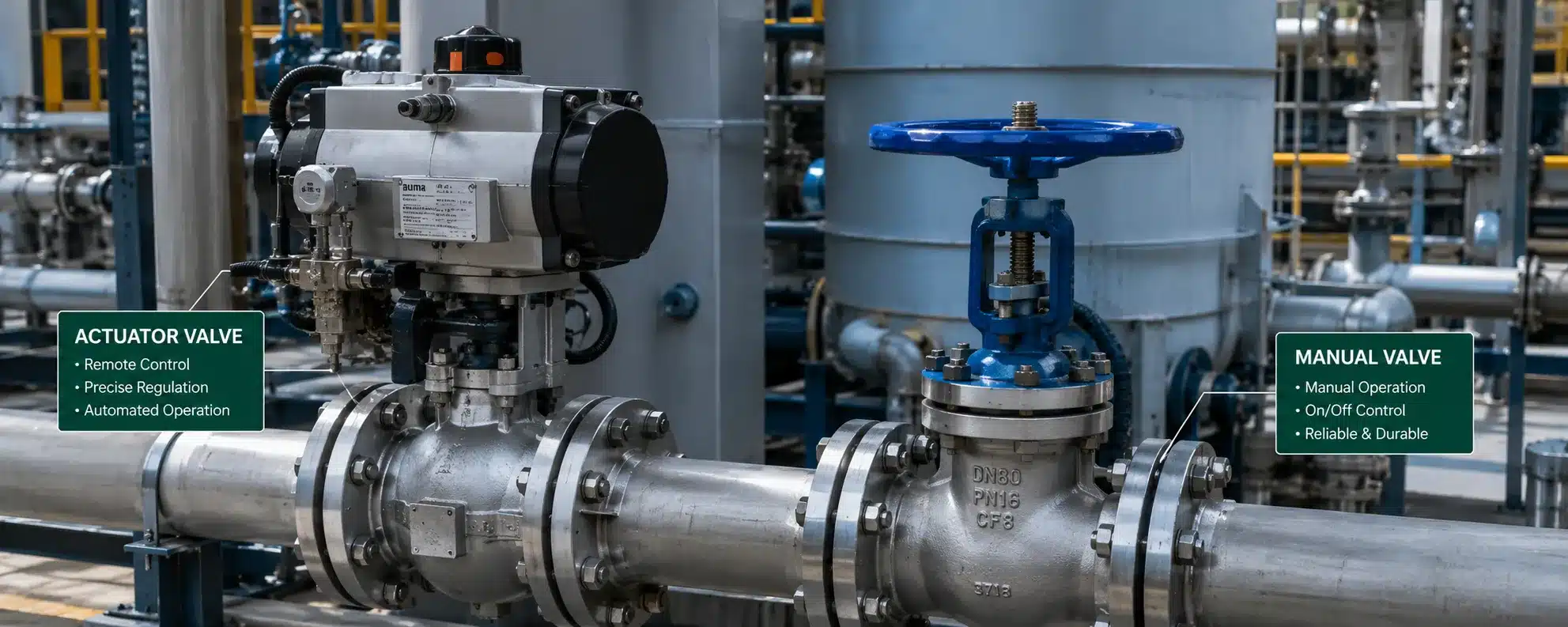
An actuator valve is a valve assembly that uses a powered actuator to open, close, or position the valve. The actuator converts electrical energy, compressed air, or hydraulic pressure into mechanical movement.
The phrase actuator valve is widely used in industrial applications, although the more precise technical term is often actuated valve. The complete assembly may include the valve body, closure element, valve stem or shaft, actuator, mounting bracket, coupling, position indicator, switches, solenoid valve, positioner, and control accessories.
An actuator valve can perform simple on-off operation or modulating control. In on-off service, the valve normally moves between fully open and fully closed positions. In modulating service, the actuator positions the valve at different opening percentages to regulate flow, pressure, temperature, level, or another process variable.
Ball valves, butterfly valves, plug valves, gate valves, globe valves, and diaphragm valves can all be fitted with actuators. However, the actuator type and motion must match the operating characteristics of the valve.
Quarter-turn actuators are commonly used with ball, butterfly, and plug valves. Multi-turn actuators are typically used with gate valves and some globe valves. Linear actuators are frequently used with globe control valves and diaphragm valves.
What Is a Manual Valve?
A manual valve is operated directly by a person using a lever, handwheel, chainwheel, wrench, or manual gearbox. It does not normally require electric power, compressed air, hydraulic pressure, control wiring, or a programmable control system.
Small quarter-turn valves often use a lever. Gate valves and globe valves commonly use a handwheel. Larger ball and butterfly valves may use a gearbox because the operating torque is too high for direct lever operation.
Manual valves are widely used for isolation, drainage, venting, sampling, equipment bypasses, maintenance connections, and piping systems where valve operation is infrequent.
The main advantage of a manual valve is simplicity. It contains fewer control components, requires less infrastructure, and can often be installed at a lower initial cost.
However, every operation requires a person to reach the valve. This can become a limitation when the valve is located at height, underground, inside a hazardous area, behind equipment, or far from the control room.
How Does an Actuator Valve Work?
An actuator valve works by receiving a command and converting available energy into valve movement. The command may come from a local push button, control panel, programmable logic controller, distributed control system, safety system, remote terminal unit, or building automation system.
For an on-off actuator valve, the control signal instructs the actuator to move the valve to an open or closed position. Limit switches or internal sensors can confirm when the required position has been reached.
For a modulating actuator valve, a positioner or internal control module compares the requested position with the actual valve position. The actuator then adjusts its movement until the valve reaches the target opening.
The actuator must generate enough torque or thrust to overcome valve friction, seat load, pressure forces, packing friction, fluid forces, and possible deposits inside the valve.
Actuator sizing should not be based only on the valve size. Two valves with the same nominal diameter may require different operating torque because of differences in pressure, seat material, valve design, service conditions, and operating history.
Main Types of Valve Actuators
The most common industrial actuator types are pneumatic, electric, and hydraulic. Each type has different requirements, advantages, and limitations.
Válvula con actuador neumático
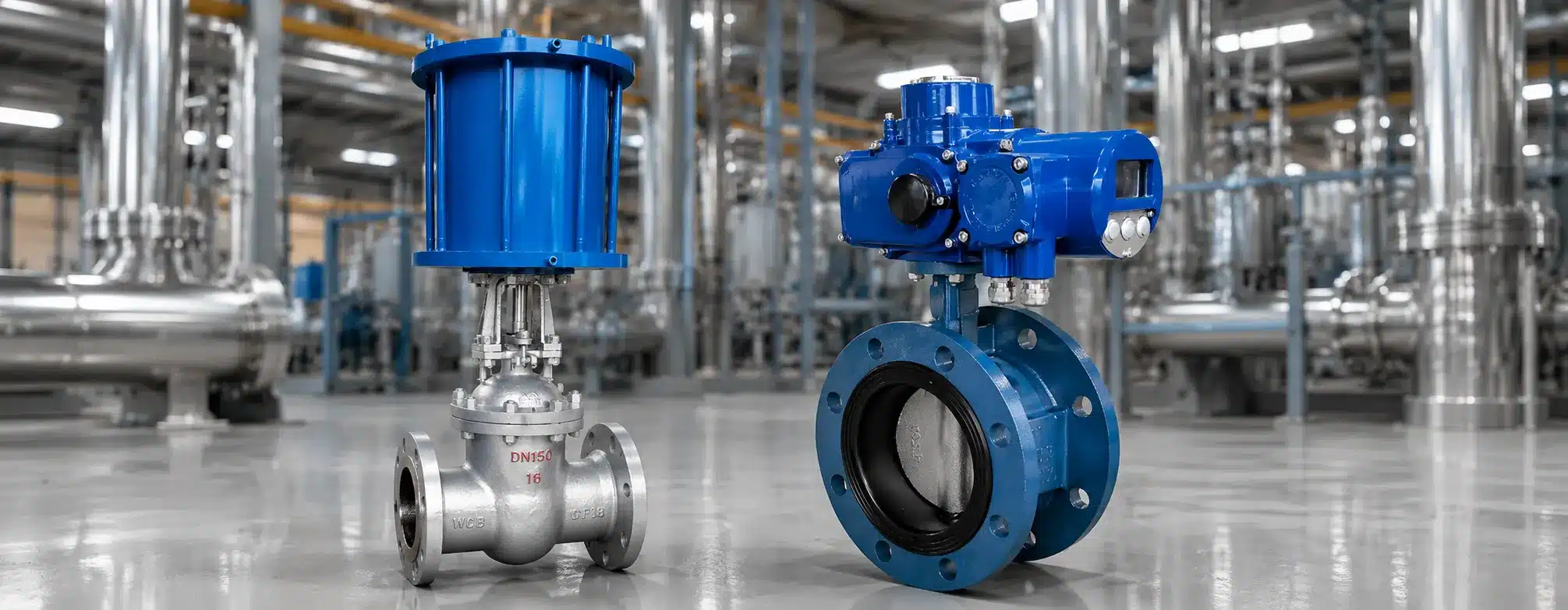
A pneumatic actuator valve uses compressed air to generate motion. Pneumatic actuators are widely used in chemical processing, water treatment, food production, oil and gas systems, power generation, and general manufacturing.
Quarter-turn pneumatic actuators commonly use rack-and-pinion or scotch-yoke mechanisms. Linear pneumatic actuators may use a diaphragm or piston to move the valve stem.
Pneumatic operation can provide fast response, simple construction, and practical fail-safe configurations. A spring-return actuator can move the valve to a predetermined position when air pressure is lost.
The main disadvantage is the need for a reliable compressed-air system. Air quality, pressure stability, tubing condition, solenoid performance, and leakage can all influence operation.
Válvula con actuador eléctrico
An electric actuator valve uses an electric motor and gear mechanism to operate the valve. Electric actuators are commonly used where compressed air is unavailable or where integration with electrical control systems is preferred.
Electric actuators can support on-off, inching, or modulating operation. Many designs include position indication, torque protection, local controls, manual override, diagnostics, and communication functions.
Electric actuation requires appropriate power supply, enclosure protection, duty rating, motor capacity, and electrical classification. The actuator must also be selected for the required operating speed and frequency.
A standard electric actuator may remain in its last position during power loss unless it includes a battery, spring mechanism, stored-energy system, or other emergency positioning arrangement.
Hydraulic Actuator Valve
A hydraulic actuator valve uses pressurized hydraulic fluid to generate high torque or linear thrust. Hydraulic actuators are often selected for large valves, high-pressure pipelines, emergency shutdown systems, and applications requiring powerful or controlled movement.
Hydraulic systems can provide high force in a compact package, but they require pumps, reservoirs, hydraulic lines, filtration, seals, and fluid maintenance.
Leak prevention, fluid cleanliness, temperature control, and maintenance capability are important considerations when hydraulic actuation is used.
Actuator Valve vs Manual Valve: Key Differences
The most obvious difference is the source of operating force, but the practical differences extend into process control, safety, maintenance, cost, and system design.
| Comparison Factor | Actuator Valve | Manual Valve |
|---|---|---|
| Operating method | Powered by air, electricity, or hydraulic pressure | Operated directly by a person |
| Remote operation | Normally possible | Normally not possible |
| Automatic control | Suitable for control-system integration | Not suitable without additional automation |
| Operating speed | Can provide repeatable and controlled speed | Depends on operator and valve accessibility |
| Position feedback | Can provide electrical or digital feedback | Usually based on visual indication |
| Costo inicial | Generally higher | Generally lower |
| System complexity | Requires power and control components | Relatively simple |
| Fail-safe capability | Can be engineered for fail-open, fail-closed, or fail-in-place | Usually remains in its current position |
| Frequent operation | Well suited when correctly sized | May increase labor requirements |
| Maintenance scope | Includes valve, actuator, controls, and utilities | Mainly mechanical valve components |
Control and Automation Capability
An actuator valve can be integrated into an automated process. This allows valves to respond to operating conditions without waiting for an operator to reach the valve.
For example, an actuator valve may close when a tank reaches a high level, open when a pump starts, adjust according to flow demand, or isolate a pipeline after a safety signal.
Automation also allows several valves to operate in a defined sequence. This is useful in batch processing, filtration systems, water treatment, loading systems, clean-in-place processes, and production lines.
A manual valve cannot provide this function by itself. The operator must receive an instruction, travel to the valve, confirm its identity, and move it to the required position.
Manual operation may still be appropriate where timing is not critical and valve movement is rare. Automation should not be added only because it is technically possible. It should solve a real operational, safety, or control requirement.
On-Off Actuator Valve vs Modulating Actuator Valve
Not every actuator valve is a control valve. This distinction is important when specifying equipment.
An on-off actuator valve normally moves between two end positions. Its purpose may be isolation, diversion, equipment protection, batch routing, or emergency shutdown.
A modulating actuator valve can move to intermediate positions. It receives a variable command and adjusts the valve opening to influence the process.
A control valve is a complete final control element designed to regulate a process variable. It usually includes a valve selected for throttling, a correctly sized actuator, and a positioner or integrated control system.
Installing a modulating actuator on an unsuitable valve does not automatically produce stable or accurate control. Valve flow characteristic, rangeability, pressure drop, mechanical backlash, seat design, process conditions, and actuator response must all be evaluated.
Advantages of an Actuator Valve
Remote Operation
An actuator valve can be operated from a control room, local panel, remote station, or automated control system. This reduces the need for personnel to travel to each valve.
Consistent Operation
A correctly selected actuator can provide repeatable torque, speed, and travel. This reduces variation caused by differences in operator strength or technique.
Faster Process Response
Automated operation can respond quickly to alarms, process changes, equipment status, and shutdown commands.
Improved Accessibility
Actuation is useful for valves located at height, below ground, inside enclosed equipment, or in areas that are difficult to access during operation.
Position Monitoring
Switches, sensors, and communication modules can provide valve-position feedback to the control system. This can help operators verify whether a valve is open, closed, moving, or in an alarm condition.
Fail-Safe Function
Some actuator systems can move the valve to a defined safe position after loss of power or control signal. The required failure position must be determined through process and safety analysis.
Limitations of an Actuator Valve
An actuator valve costs more initially than a comparable manually operated valve because it requires an actuator, mounting components, controls, wiring or tubing, commissioning, and testing.
The assembly is also more complex. A valve that is mechanically functional may still fail to operate because of a damaged solenoid, low air pressure, electrical fault, incorrect limit setting, communication problem, or actuator failure.
Actuator systems require skilled selection. An undersized actuator may stall or fail to achieve shutoff. An excessively oversized actuator may damage the valve stem, shaft, seat, or mounting components if torque limits are not controlled.
The available power source must also be reliable. Pneumatic systems depend on clean and stable compressed air. Electric systems depend on suitable electrical supply and protection. Hydraulic systems depend on fluid pressure and cleanliness.
Maintenance personnel must understand both the valve and its automation components. Troubleshooting may involve mechanical, electrical, pneumatic, hydraulic, and control-system checks.
Advantages of a Manual Valve
A manual valve is usually less expensive to purchase and install. It does not require control cables, air tubing, solenoid valves, electrical panels, or automation programming.
Its mechanical design is relatively easy to understand. Routine maintenance can often be performed using standard valve maintenance procedures.
Manual valves are also independent of utility failure. Loss of plant air or electrical power does not prevent a person from operating the valve, provided the valve remains accessible and mechanically functional.
For valves that are used only during annual maintenance, equipment isolation, draining, or occasional process changes, manual operation may be the most practical solution.
Manual valves can also serve as permanent isolation valves around automated equipment, although their position and locking requirements should be considered in the operating procedure.
Limitations of a Manual Valve
Manual operation depends on human availability and physical access. A valve cannot respond automatically to a process alarm unless an operator is present and able to reach it.
Operating time may be significant in large facilities, particularly when valves are distributed across several floors, remote stations, or outdoor areas.
Manual valves can also be left in the wrong position after operation. Clear identification, position indicators, operating procedures, locking devices, and verification practices may be required.
Large valves can require substantial operating force. A gearbox can reduce handwheel effort, but it also increases the number of turns and the time needed to operate the valve.
Manual operation may expose personnel to heat, pressure, chemicals, moving equipment, traffic, poor weather, confined spaces, or other site hazards.
Safety and Fail-Safe Considerations
Safety is one of the most important factors when comparing an actuator valve with a manual valve.
An actuator valve can be included in an emergency shutdown or process protection system. Depending on the design, the valve may move to a fail-closed, fail-open, or fail-in-place condition after loss of power.
Fail-closed operation is often considered when continued flow could create a hazard. Fail-open operation may be appropriate where cooling, ventilation, or pressure relief flow must continue. Fail-in-place may be selected when either full opening or full closure could create additional risk.
The correct failure position cannot be selected from a general rule. It must be based on process behavior, hazard analysis, operating philosophy, and applicable safety requirements.
A manual valve normally remains in its last position during a power failure. This can be beneficial in simple systems but may be unacceptable where immediate automatic isolation is required.
How to Choose Between an Actuator Valve and a Manual Valve
Operating Frequency
Frequently operated valves are strong candidates for actuation. A valve that moves several times per hour creates a very different labor requirement from a valve operated once per year.
Required Response Time
Use an actuator valve when the process requires rapid or predictable response. Manual operation may be sufficient when operating time is not critical.
Valve Location
Valves in remote, elevated, underground, hazardous, or restricted locations may benefit from remote actuation.
Valve Size and Torque
Large valves and high-pressure services may require more torque than an operator can safely provide. The required actuator output should be based on verified valve torque or thrust data.
Control Requirement
Choose an actuator valve when the valve must respond to a process signal, follow a sequence, or provide modulating control.
Available Utilities
Confirm whether the site has reliable electrical power, instrument air, or hydraulic pressure. The preferred actuator technology often depends on the utilities already available.
Environmental Conditions
Consider temperature, moisture, dust, corrosion, vibration, washdown, flooding, hazardous-area classification, and outdoor exposure.
Failure Position
Determine what the valve should do after loss of power, air, signal, or communication. The actuator design must support the required safe position.
Maintenance Capability
Review whether the site has personnel, spare parts, diagnostic equipment, and procedures to maintain the selected actuator system.
Lifecycle Cost
Compare more than the purchase price. Include installation, utilities, inspection, maintenance, labor, downtime, replacement parts, and the operational value of automation.
Actuator Valve Sizing Considerations
The actuator must provide enough torque or thrust under the most demanding expected operating condition.
For rotary valves, important values may include break-to-open torque, running torque, end-to-close torque, maximum differential pressure, seat friction, and safety factor.
For linear valves, the actuator may need to overcome pressure imbalance, seat load, packing friction, stem friction, and dynamic fluid forces.
Supply pressure should be evaluated at the minimum available condition, not only at the normal operating value. For pneumatic actuators, pressure loss in tubing and accessories should also be considered.
The actuator output must remain compatible with the maximum allowable stem or shaft torque of the valve. More actuator force is not always better.
Operating speed, cycle frequency, temperature, mounting orientation, and required failure mode should be included in the sizing review.
Maintenance Requirements
Both actuator valves and manual valves require periodic inspection. The difference is the number and type of components that must be maintained.
Manual valve maintenance typically focuses on packing leakage, stem condition, gearbox lubrication, seat performance, body corrosion, fasteners, and ease of operation.
Actuator valve maintenance may also include air filters, tubing, solenoid valves, electrical connections, limit switches, positioners, seals, springs, gear mechanisms, control modules, and communication devices.
Routine functional testing is especially important for actuator valves that remain in one position for long periods. A valve may appear healthy externally while internal deposits, corrosion, or seat adhesion prevent movement.
Maintenance should confirm that the valve reaches the required position within the expected time and that feedback signals accurately represent the physical valve position.
Typical Applications
Tratamiento de agua y aguas residuales
Actuator valves are used for filter sequencing, pump isolation, tank control, chemical dosing, and flow routing. Manual valves remain common for maintenance isolation, drainage, and bypass lines.
Petróleo y gas
Actuator valves may be used for pipeline isolation, loading systems, emergency shutdown, process control, and remote facilities. Manual valves are used where local operation is acceptable and rapid response is not required.
Chemical Processing
Automated valves can reduce operator exposure and support repeatable batch processes. Material compatibility and safe failure position are especially important.
Generación de energía
Actuator valves are used in cooling water, steam, fuel, condensate, and auxiliary systems. Manual valves are often retained for equipment isolation and maintenance activities.
General Manufacturing
Production lines use actuator valves for machine cycles, utility control, compressed air, water, gas, and process media. Manual valves may be selected for infrequently used branches and service connections.
Preguntas frecuentes
What Is the Main Difference Between an Actuator Valve and a Manual Valve?
An actuator valve uses pneumatic, electric, or hydraulic power to operate the valve. A manual valve requires a person to move a lever, handwheel, gearbox, or other operating device.
Is Every Actuator Valve a Control Valve?
No. Many actuator valves provide only on-off isolation. A control valve is specifically designed and configured to regulate a process variable through modulating movement.
Which Actuator Valve Is Better: Pneumatic or Electric?
Neither type is universally better. Pneumatic actuators are often selected for fast response and practical spring-return operation. Electric actuators are useful where electrical power is readily available and compressed air is not.
The decision should consider torque, speed, duty cycle, failure position, utilities, environment, controls, and maintenance resources.
Can a Manual Valve Be Converted into an Actuator Valve?
Some manual valves can be automated when the valve includes a suitable stem or shaft interface and the manufacturer permits actuator mounting.
The valve torque, mounting dimensions, operating direction, travel stops, stem strength, and actuator compatibility must be verified before conversion.
Can an Actuator Valve Be Operated Manually?
Many electric, pneumatic, and hydraulic actuator systems include a manual override. The override design varies and may require isolation of the power source before use.
Operators should follow the actuator instructions and site safety procedures before attempting manual operation.
What Happens to an Actuator Valve During Power Failure?
The result depends on the actuator design. The valve may fail closed, fail open, remain in its last position, or move using stored energy.
The required behavior should be specified during system design rather than assumed after installation.
Are Actuator Valves More Expensive Than Manual Valves?
Actuator valves normally have a higher initial purchase and installation cost. However, automation may reduce operating labor, improve process consistency, shorten response time, and reduce exposure to hazardous locations.
The correct comparison should consider total lifecycle cost rather than purchase price alone.
How Do I Size an Actuator for a Valve?
Actuator sizing requires verified valve torque or thrust, differential pressure, seat and packing friction, minimum supply pressure, operating speed, duty cycle, environmental conditions, and an appropriate design margin.
The actuator output must also remain within the valve stem or shaft limits.
Conclusión
The choice between an actuator valve and a manual valve should be based on how the valve must function within the complete piping and control system.
An actuator valve is generally the better option when remote operation, frequent cycling, rapid response, automatic sequencing, process control, position feedback, or fail-safe movement is required.
A manual valve is often more practical for simple isolation, maintenance duties, low-frequency operation, and installations where automation would add cost without meaningful operational value.
Successful valve automation requires more than attaching an actuator to a valve. Engineers must evaluate valve torque or thrust, actuator power source, control method, operating speed, failure position, environmental conditions, maintenance capability, and lifecycle cost.
When these factors are evaluated correctly, both actuator valves and manual valves can provide safe and reliable service in water treatment, oil and gas, chemical processing, power generation, manufacturing, and general industrial piping systems.