


Comprehensive Guide: Understanding the Globe Valves
From basic operation to actuator selection, this guide explains how globe valves work and what to consider before specifying one for an industrial pipeline.
Quick answer
Globe valves are linear-motion valves used to start, stop and regulate flow. A disc moves toward or away from a stationary seat, changing the flow opening. They are often chosen for throttling, but their internal flow path generally produces more pressure loss than a fully open gate or ball valve.
How Do Globe Valves Work?
A globe valve controls flow by moving a disc, sometimes called a plug, perpendicular to a seat. A handwheel or actuator moves the stem and disc. As the disc rises, the opening increases; as it approaches the seat, the opening becomes smaller. When the disc contacts the seat, the valve closes.
Because travel changes the opening gradually, a suitable globe valve can regulate flow at intermediate positions. However, the shape of the disc, the available pressure drop and the rest of the system determine how much flow changes at each position. A manual isolation valve should not automatically be treated as a precision control valve.
In many conventional designs, fluid changes direction as it passes through the body and seat. This restriction creates pressure loss even when the valve is open. It also means sizing must consider the whole system, rather than pipe diameter alone. The U.S. Department of Energy valve handbook describes the operating principle and the associated head loss.
What Are the Main Parts of a Globe Valve?
Each component contributes to pressure containment, movement or sealing. The exact arrangement varies by manufacturer and service.
- Body: The pressure-containing shell and flow passage, with connections to the pipeline.
- Bonnet: The cover that provides access to internal parts and supports the stem sealing arrangement.
- Disc or plug: The moving element that changes the opening and contacts the seat.
- Seat: The surface against which the disc closes. Seat and disc materials must suit the fluid and duty. For throttling, the plug profile and seat opening also determine how quickly capacity changes as the valve opens.
- Stem and packing: The stem transfers motion to the disc; packing helps contain fluid around the moving stem.
- Operator: A handwheel, gearbox or actuator supplies the force and travel needed to operate the valve.
Body material and trim material are separate decisions. For example, a project may specify a carbon steel body and a different seating material to address wear or corrosion. Confirm the complete wetted-material list and pressure–temperature limits for the specific model.
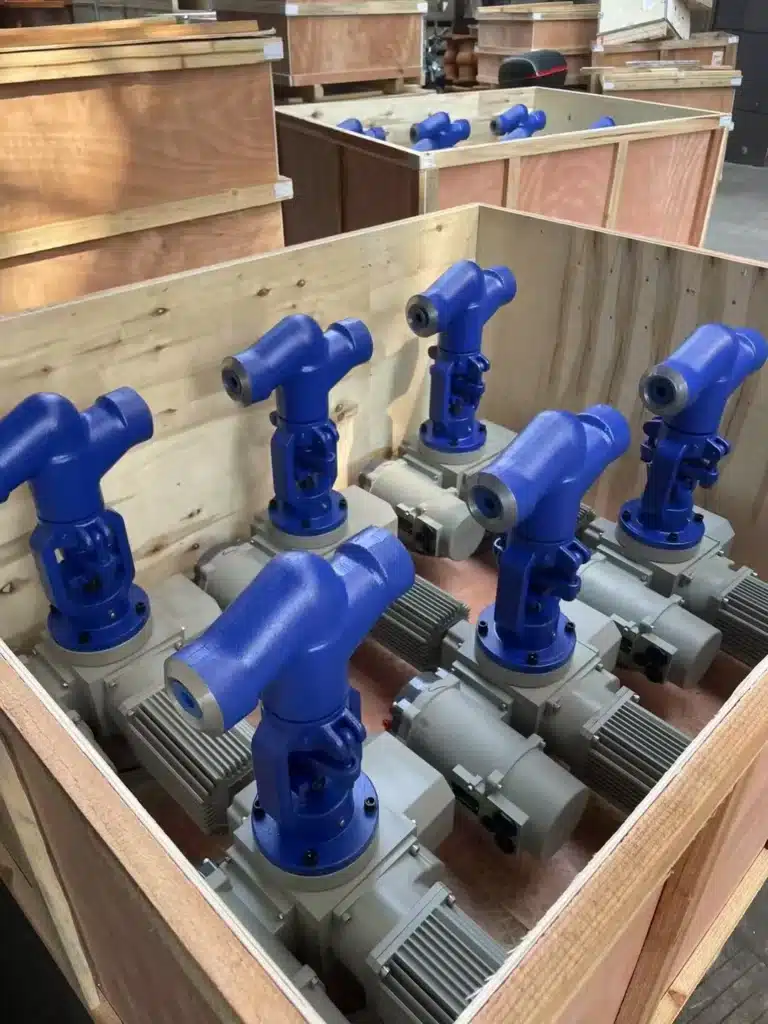
Types of Globe Valves and Where They Fit
T-pattern globe valve
The conventional tee or Z-pattern has inlet and outlet connections in line. It is a common choice for general isolation and manual regulation, provided the available pressure drop is acceptable. Its flow path is relatively restrictive, so check capacity at the required operating conditions.
Y-pattern globe valve
In a Y-pattern design, the stem and seat are inclined relative to the pipeline. The resulting flow path can reduce resistance compared with a conventional pattern. The benefit depends on the actual valve design and operating position; compare published capacity data when evaluating alternatives.
Angle-pattern globe valve
An angle valve changes the flow direction by approximately 90 degrees. It can suit a layout that already requires a change in direction, potentially combining valve and elbow functions. Confirm pipe support, orientation and the manufacturer’s flow-direction requirements.
Manual, electric and pneumatic operation
Manual valves suit accessible locations with infrequent adjustment. Electric actuators support remote operation where power is available. Pneumatic actuators use compressed air and can be configured with spring-return action where a defined response to air failure is required. Modulating duty requires a compatible actuator, controls and, where appropriate, a positioner.
For a broader look at body, bonnet and sealing variations, see Fleyenda’s guide to globe valve types.
Globe Valve vs. Gate Valve vs. Ball Valve
The best valve depends on the required duty. These are general tendencies; actual performance depends on design and sizing.
| Consideration | Globe | Gate | Ball |
|---|---|---|---|
| Typical duty | Throttling or isolation | Primarily isolation | Primarily isolation |
| Operation | Linear / multi-turn | Linear / multi-turn | Quarter-turn |
| Open-valve pressure loss | Generally higher | Generally lower | Generally lower |
| Control service | Suitable when selected and sized for duty | Generally not preferred for throttling | Characterized designs can be used for control |
Choose a globe valve when controlled adjustment or a suitable control trim matters more than minimum pressure loss. Choose between gate and ball designs when isolation is the main requirement, subject to fluid, operating conditions and project specifications.
Where Are Globe Valves Used?
Globe valves appear in systems that require flow adjustment as well as shutoff. Typical applications include steam distribution, boiler feedwater, cooling-water circuits, fuel oil lines, chemical processing and bypass lines. In a heat exchanger circuit, for example, an appropriately sized control valve can adjust cooling-water flow in response to a temperature signal.
These applications do not imply that one model suits every service. Steam temperature, chemical concentration, pressure differential, fluid cleanliness and required shutoff must all be checked against the proposed valve. Solids can damage conventional trim or obstruct the flow path; review abrasive or slurry service with the manufacturer.
How to Select a Globe Valve
Start with the process duty, then use the valve and actuator data to verify the selection. This sequence helps avoid choosing an oversized valve that spends most of its time near the seat.
- Define the function. Is the valve for manual isolation, occasional adjustment or continuous automatic control? State the required leakage performance and operating frequency.
- Describe the fluid. Include composition, concentration, density, viscosity and any solids. Identify corrosive, hazardous or contaminating substances.
- Provide operating cases. Record minimum, normal and maximum flow, inlet and outlet pressures and temperatures, including startup and shutdown.
- Check flow capacity. Use the manufacturer’s Cv or Kv data and a suitable sizing method. Review maximum and minimum flow, pressure recovery, cavitation or flashing in liquids, and noise or choked flow in gases.
- Specify construction. Confirm body and trim materials, pressure class, end connections, bonnet, packing and applicable design and inspection requirements. A pressure class is not a single allowable pressure at every temperature.
- Choose the operator. Check required stem thrust and stroke under the maximum differential pressure. For automation, state power or air supply, control signal, duty cycle and required failure position.
Procurement tip
Send a valve datasheet with minimum, normal and maximum cases. A nominal pipe size and pressure class alone are not enough to verify a control valve or its actuator.
Example: Cooling Water to a Heat Exchanger
Suppose a heat exchanger needs more cooling water in summer than in winter. At peak demand, the valve must pass the maximum flow with the differential pressure available on the hottest day. At low demand, the plug must travel far enough above the seat to make small adjustments repeatable. A replacement valve with the same flange size can still perform differently because its trim and capacity may have changed.
Give the supplier the flow and pressure conditions at both ends of the operating range. Ask for the estimated travel at minimum, normal and maximum flow, plus the pressure loss when the valve is fully open. Those values help you decide whether to keep the same valve body size, change trim or allow for a different body size and pipe reducers.
When Does a Manual Globe Valve Need a Control Valve Instead?
A handwheel is practical when operators set a position occasionally and conditions stay fairly stable. If flow must adjust as a load or process temperature changes, specify a globe control valve with suitable trim and a modulating actuator. For remote shutoff, prioritize the required closing time, seat leakage and response to loss of power or instrument air. State the duty explicitly on the purchase specification.
What standards should be specified?
Projects may refer to ASME B16.34 for valve pressure–temperature requirements, API 623 for certain steel globe valves, and API 598 or another agreed standard for inspection and testing. Applicability depends on the product and project. Name the required edition, test scope and documentation in the purchase specification; do not assume every product carries every approval.
Fleyenda Electric Globe Valves
Compare these three electric globe valves by pressure designation, flange requirements and actuator duty. Request the datasheet and dimensional drawing for the configuration you plan to order.

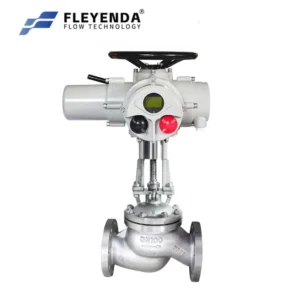
FLE-Z30-SKG
PN20 Multi-Turn Electric Globe Valve
For a project that specifies a PN20 globe valve with electric operation, start by confirming the pressure–temperature rating and actuator sizing for the selected valve size.
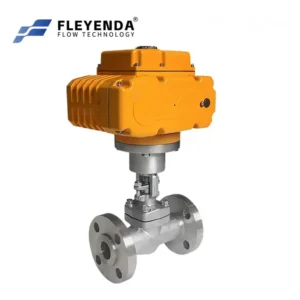
FLE-QH-GV
10K Flanged Stainless Steel Electric Globe Valve
Review this model when the piping specification calls for 10K flanges and stainless steel. For hazardous locations, request the approvals and markings for the exact actuator configuration.
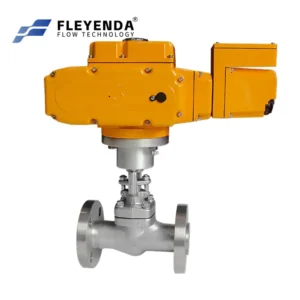
FLE-QH-FGV
Intelligent Multi-Turn Electric Globe Valve
For remote automation, specify the supply voltage, command and feedback signals, operating duty, and what the valve needs to do on loss of power.
For pneumatic operation, see the Fleyenda pneumatic actuated valve range.
Installation and Maintenance Considerations
Before installation, verify the nameplate, end connections, materials and pressure–temperature suitability. Clean the piping, support the valve and actuator, and provide clearance for operation and maintenance. Follow the flow arrow and the specific manufacturer’s instructions: flow direction is design- and service-dependent.
For welded valves, follow the manufacturer’s procedure for disc position, heat protection and post-weld cleaning. Do not apply a generic open-or-closed rule to every construction. Commission actuators using the approved wiring or air supply and check travel, control action and the specified response to loss of power or air.
During service, inspect for stem leakage, unusual noise, vibration and changes in operating force or control response. Cavitation, flashing, erosion and poor sizing can damage trim. Investigate the cause before replacing parts. Isolate, depressurize, drain and cool equipment in accordance with site procedures before maintenance; use the manufacturer’s instructions and qualified personnel.
Frequently Asked Questions
Can a globe valve be used for isolation?
Yes. Many globe valves are designed for shutoff as well as regulation. The achievable leakage rate depends on seat design, condition and the specified test standard. Confirm the required shutoff class for the application.
Are all globe valves suitable for automatic control?
No. Automatic control requires an appropriately sized valve, suitable trim and an actuator and control system designed for the required positioning duty. Simply adding an actuator to an isolation valve does not establish control performance.
What direction should flow enter a globe valve?
Follow the arrow and manufacturer’s instructions for the specific valve. Flow-under-seat is common in some designs, but other arrangements are used for particular pressures, temperatures, actuation requirements or services.
Does 50% open mean 50% flow?
Valve travel describes the position of the plug. Flow depends on both the trim geometry and the pressure across the valve at that position. Ask for the capacity curve if the relationship between travel and flow matters for your control loop.
Why is pressure drop important?
Pressure drop affects available flow, energy use and the potential for noise, cavitation or flashing. The system must provide enough pressure differential for the required duty without exceeding the limits of the valve and downstream equipment.
Can a globe valve handle steam?
Globe valves are used in steam systems when their materials, pressure–temperature rating, trim, packing and actuator are suitable. Provide startup and operating conditions as well as the required shutoff and control duty when requesting a recommendation.