


7 Common Types of Valve End Connections Explained
Valve end connections play a critical role in how a valve is installed, sealed, maintained, and operated within a piping system. Whether a valve is used in water treatment, oil and gas, chemical processing, power generation, HVAC, or food and beverage production, the end connection determines how the valve joins the pipeline and how reliable the system will be under pressure, temperature, vibration, and corrosive conditions.
Among all valve end connection types, the flange connection is one of the most widely used in industrial applications because it allows easy installation, removal, inspection, and replacement. However, a flange connection is not always the best option for every system. Threaded, welded, wafer, lug, and sanitary connections may be more suitable depending on the pipe size, pressure rating, fluid media, hygiene requirements, and maintenance needs.
This guide explains seven common types of valve end connections, their advantages, limitations, and typical applications. It also provides a practical comparison table to help engineers, buyers, contractors, and maintenance teams select the right valve connection for their piping systems.
What Are Valve End Connections?
Valve end connections are the connection interfaces located at both ends of a valve body. They allow the valve to be connected to pipes, fittings, equipment, or other pipeline components. The connection method must create a secure mechanical joint and, in most cases, a reliable seal to prevent leakage.
A valve may have different end connection designs depending on its intended service. For example, a large gate valve in a water pipeline may use a flanged end connection, while a small ball valve for low-pressure service may use threaded ends. A high-pressure steam valve may require butt weld ends, while a sanitary butterfly valve in a dairy plant may use clamp-type sanitary connections.
The main factors that influence valve end connection selection include pipe size, pressure class, temperature, fluid type, installation space, maintenance frequency, industry standards, and total project cost. Understanding these factors helps avoid mismatched components, unnecessary downtime, and premature valve failure.
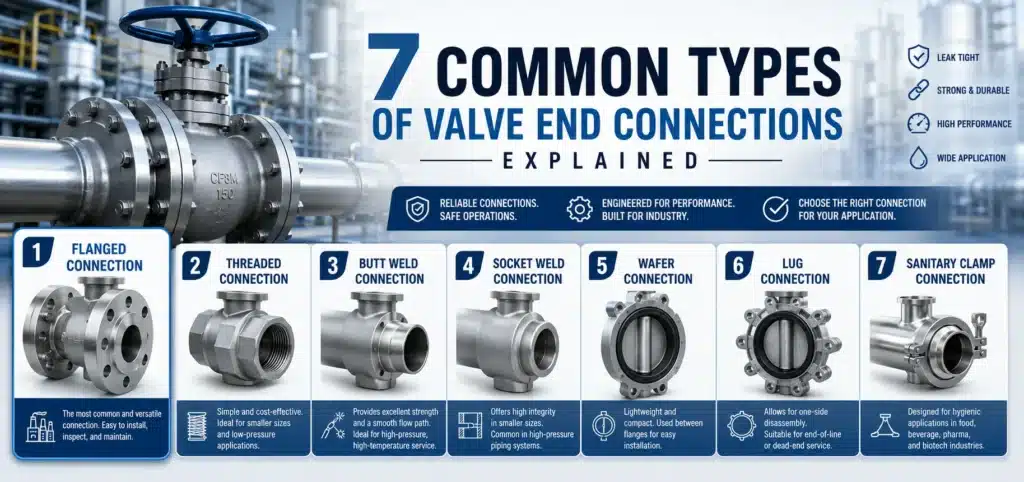
Comparison Table of Common Valve End Connections
| Connection Type | Common Valve Types | Main Advantages | Typical Applications |
|---|---|---|---|
| Flanged Connection | Gate valves, globe valves, check valves, ball valves, butterfly valves | Easy installation, easy removal, strong sealing, suitable for large sizes | Water treatment, oil and gas, chemical plants, power plants |
| Threaded Connection | Ball valves, check valves, needle valves, small gate valves | Simple structure, low cost, compact design | Small-diameter pipelines, low to medium pressure systems |
| Butt Weld Connection | Gate valves, globe valves, check valves, high-pressure ball valves | Permanent joint, high strength, excellent leakage resistance | High-pressure steam, oil, gas, and chemical pipelines |
| Socket Weld Connection | Forged steel valves, ball valves, globe valves, check valves | Strong connection, suitable for small high-pressure pipes | Refineries, petrochemical plants, high-pressure small-bore piping |
| Wafer Connection | Butterfly valves, check valves | Lightweight, compact, cost-effective | HVAC, water systems, general industrial pipelines |
| Lug Connection | Butterfly valves | Allows downstream pipe removal, easier maintenance than wafer type | Water, wastewater, industrial process systems |
| Sanitary Clamp Connection | Sanitary butterfly valves, ball valves, diaphragm valves | Easy cleaning, hygienic design, quick disassembly | Food, beverage, pharmaceutical, biotechnology industries |
1. Flanged Valve End Connection
A flanged valve end connection uses flanges on the valve body and matching pipe flanges to create a bolted connection. A gasket is placed between the valve flange and the pipe flange to provide sealing. Bolts and nuts are then tightened to compress the gasket and secure the joint.
The flange connection is one of the most common valve end connection types in industrial piping systems. It is widely used for medium and large-diameter valves because it provides high mechanical strength and allows the valve to be removed without cutting the pipe. This makes flanged valves especially useful in systems where inspection, maintenance, or replacement may be required during the service life of the pipeline.
Flanged valve connections are available in different standards and pressure classes, such as ANSI, ASME, DIN, EN, JIS, and GB standards. Common flange face types include raised face, flat face, and ring-type joint. The correct flange standard, pressure rating, gasket material, and bolt specification must be selected according to the pipeline design.
Advantages of Flanged Connections
- Suitable for large valve sizes and high-flow systems.
- Easy to install, inspect, remove, and replace.
- Provides reliable sealing when properly assembled.
- Compatible with many industrial standards and pressure classes.
- Ideal for systems requiring regular maintenance access.
Limitations of Flanged Connections
- Heavier and bulkier than threaded or wafer connections.
- Requires more installation space.
- Higher cost due to flanges, bolts, nuts, and gaskets.
- Improper bolt tightening may cause gasket leakage.
In many industrial applications, the flanged valve connection is preferred because it offers a strong balance between reliability and serviceability. For example, flanged gate valves and flanged butterfly valves are commonly used in water supply systems, cooling water lines, fire protection systems, and chemical processing plants.
2. Threaded Valve End Connection
Threaded valve end connections use internal or external threads to connect the valve directly to threaded pipe ends or fittings. They are commonly found in small-diameter valves, especially in low-pressure and medium-pressure systems. Threaded connections may follow standards such as NPT, BSP, BSPT, or other regional thread specifications.
Threaded valves are popular because they are compact, economical, and relatively easy to install. They do not require welding or flange bolting, which can reduce installation time and cost. Small ball valves, check valves, needle valves, and pressure instrument valves often use threaded end connections.
However, threaded connections are generally not preferred for large pipe sizes or severe service conditions. Threads can be damaged during installation, and improper sealing can lead to leakage. Thread sealant, PTFE tape, or pipe dope is often required to achieve a tight seal.
Best Uses for Threaded Connections
- Small-diameter pipelines.
- Utility services such as air, water, and non-critical fluids.
- Low to medium pressure systems.
- Compact installations with limited space.
3. Butt Weld Valve End Connection
Butt weld valve end connections are designed to be welded directly to the pipe. The valve ends and pipe ends are beveled, aligned, and welded together to form a permanent joint. This type of connection is widely used in high-pressure, high-temperature, and critical service applications.
Compared with a flange connection, a butt weld connection provides a more permanent and leak-resistant joint. Since there are no flange gaskets or bolted joints, the risk of gasket failure is eliminated. This makes butt weld valves suitable for steam systems, oil and gas pipelines, chemical processing units, and power plant applications.
The main disadvantage is that butt weld valves are more difficult to remove. If the valve needs to be replaced, the pipeline usually must be cut. Welding also requires qualified welders, proper inspection, and post-weld treatment when required by the project specification.
Advantages of Butt Weld Connections
- Excellent strength and sealing performance.
- Suitable for high pressure and high temperature.
- Reduces potential leak paths.
- Ideal for critical and hazardous media.
4. Socket Weld Valve End Connection
Socket weld valve connections are commonly used for small-bore high-pressure piping. In this design, the pipe is inserted into a recessed socket in the valve end and then welded around the outside. Socket weld valves are often found in forged steel gate valves, globe valves, check valves, and ball valves.
Socket weld connections provide a strong and reliable joint while being easier to align than butt weld connections for small pipe sizes. They are frequently used in refineries, petrochemical plants, power stations, and other industrial facilities where small-diameter high-pressure lines are common.
One limitation is that the small gap between the pipe and socket may create a crevice where corrosion or contamination can occur. For this reason, socket weld connections may not be suitable for all corrosive or sanitary services.
5. Wafer Valve End Connection
Wafer connections are most commonly associated with butterfly valves and some check valves. A wafer valve is installed between two pipe flanges and held in place by long bolts that pass through the flanges. Unlike a standard flanged valve, the wafer valve body usually does not have full flanges of its own.
The wafer design is compact, lightweight, and cost-effective. It is widely used in HVAC systems, water distribution, cooling water systems, and general industrial applications. Because the valve is sandwiched between two flanges, accurate alignment is important to ensure proper sealing.
Although wafer valves are economical, they may not be suitable when one side of the pipeline must be removed while the other side remains pressurized. In such cases, a lug-style butterfly valve may be a better option.
6. Lug Valve End Connection
Lug valve connections are commonly used for butterfly valves. A lug-style valve has threaded inserts or lugs around the valve body. Bolts are inserted from each side of the pipe flange into the valve body, allowing each side of the pipeline to be connected independently.
The biggest advantage of a lug connection is that it can support dead-end service in some applications. This means one side of the pipeline may be disconnected while the valve remains attached to the other side. This feature makes lug butterfly valves more convenient for maintenance than wafer butterfly valves.
Lug connections are often used in water treatment plants, wastewater systems, industrial process pipelines, and building services. They provide a good balance between compact design and improved maintenance flexibility.
7. Sanitary Clamp Valve End Connection
Sanitary clamp connections are designed for hygienic applications where cleanliness and quick disassembly are essential. They are widely used in food, beverage, dairy, pharmaceutical, biotechnology, and cosmetic processing systems.
A sanitary clamp connection typically includes two ferrules, a gasket, and a clamp. The clamp compresses the gasket between the ferrules to create a hygienic seal. This design allows operators to quickly remove the valve for cleaning, sterilization, inspection, or replacement.
Sanitary valve connections are commonly found on sanitary butterfly valves, ball valves, diaphragm valves, and check valves. Materials are usually stainless steel, and internal surfaces are often polished to reduce contamination risk and support clean-in-place or sterilize-in-place processes.
How to Choose the Right Valve End Connection
Selecting the right valve end connection requires a careful review of both operating conditions and maintenance requirements. No single connection type is best for every application. A flange connection may be ideal for large industrial pipelines, while a threaded connection may be more practical for a small utility line. A welded connection may be required for high-pressure steam, while a sanitary clamp connection may be necessary for hygienic processing.
The first factor to consider is pipe size. For small pipe sizes, threaded and socket weld connections are common. For medium and large pipe sizes, flanged valve connections are often preferred because they are easier to assemble and remove. In large water or process pipelines, the flange remains one of the most practical and widely accepted connection methods.
The second factor is pressure and temperature. High-pressure or high-temperature systems may require butt weld or socket weld connections to reduce leakage risk. Flanged connections can also be used in high-pressure systems, but the correct flange class, gasket type, and bolting material must be selected.
The third factor is maintenance. If the valve must be removed regularly for inspection or replacement, a flanged connection is often better than a welded connection. The use of a flange allows technicians to unbolt the valve rather than cut the pipeline. For systems where downtime is expensive, this serviceability can be a major advantage.
The fourth factor is fluid media. Corrosive, toxic, flammable, or hazardous fluids require stronger sealing and higher reliability. For such services, engineers may prefer welded or properly rated flanged connections. For hygienic fluids, sanitary clamp connections are typically required.
Common Mistakes to Avoid
One common mistake is selecting a valve end connection based only on price. A threaded valve may be cheaper than a flanged valve, but it may not provide the same durability or maintenance convenience in a large industrial pipeline. Similarly, a welded valve may offer excellent sealing but may increase replacement difficulty.
Another mistake is mixing incompatible flange standards. A valve with an ANSI flange may not match a pipe flange made to a different standard. Even when the nominal size appears similar, bolt hole dimensions, flange thickness, pressure rating, and face type may differ. This can lead to installation delays, leakage, or unsafe operation.
Improper gasket selection is also a frequent issue in flanged valve connections. The gasket must be compatible with the fluid, pressure, temperature, and flange face. A poor gasket choice can cause leakage even when the flange and valve are correctly manufactured.
Conclusion
Valve end connections are essential to the performance, safety, and maintainability of any piping system. The seven common types include flanged, threaded, butt weld, socket weld, wafer, lug, and sanitary clamp connections. Each type has its own strengths and limitations.
Among these options, the flange connection remains one of the most important and widely used choices for industrial valves. A flanged valve end connection offers strong sealing performance, easy installation, and convenient maintenance, especially for medium and large-diameter pipelines. However, threaded, welded, wafer, lug, and sanitary connections also have important roles in specific applications.
To choose the right valve end connection, engineers and buyers should evaluate pipe size, pressure rating, temperature, fluid media, installation space, maintenance needs, and applicable industry standards. A well-selected connection improves system reliability, reduces leakage risk, and helps ensure long-term pipeline performance.