


Industrial Flow Control Guide
How Does a Three Way Valve Work?
Learn how a three way valve controls mixing, diverting, switching, and bypass flow in HVAC systems, water treatment, chemical processing, and industrial pipelines.
A three way valve is a type of industrial valve designed with three ports to control how fluid moves through a piping system. Instead of only opening or closing one straight flow path like a standard two way valve, a three way valve can connect different ports to mix two flows, divert one flow to another line, or switch the flow direction between different pipeline routes.
In practical engineering, the three way valve working principle is useful when a system needs more than simple on-off control. For example, a three way mixing valve can combine hot and cold water to achieve a target temperature, while a three way diverting valve can send one inlet flow to either a heat exchanger, bypass line, storage tank, or process equipment. This makes the valve widely used in HVAC systems, water treatment plants, chemical processing lines, boiler systems, cooling circuits, and industrial automation.
Three way valves are available in many forms, including three way ball valve, three way control valve, manual three way valve, electric three way valve, and pneumatic three way valve. The correct choice depends on the media, pressure, temperature, flow direction, port design, control accuracy, and operation method required by the system.
Quick answer: A three way valve works by changing the internal connection between three ports. Depending on the valve design, it can mix two inlet flows into one outlet, divert one inlet flow to two possible outlets, or switch the flow between different pipeline paths.
What Is a Three Way Valve?
A three way valve is a valve with three connection ports. These ports are often marked as port A, port B, and port C, although the exact marking depends on the manufacturer and valve structure. The internal passage of the valve determines which ports are connected and which port is closed during operation.
In many pipeline systems, a three way valve can replace two or more separate valves. This helps simplify the pipe layout, reduce installation space, lower the number of fittings, and make flow control easier. For example, a three way valve for HVAC system may be used to control hot water, chilled water, or bypass flow in a heating and cooling loop. A three way valve for chemical processing may be used to direct chemicals to different tanks, reactors, filters, or treatment stages.
| Valve Name | Three way valve, 3 way valve, three port valve, three way control valve. |
| Main Function | Mixing flow, diverting flow, switching flow direction, or creating a bypass route. |
| Common Structures | L port three way valve, T port three way valve, three way ball valve, three way control valve. |
| Common Applications | HVAC, water treatment, chemical processing, boiler systems, cooling systems, industrial pipelines. |
How Does a Three Way Valve Work?
A three way valve works by rotating or moving an internal closure element, such as a ball, plug, stem, or control trim. When the handle or actuator changes position, the internal flow passage aligns with different ports. This allows the valve to decide which port is open, which port is closed, and how the fluid moves through the valve body.
In a three way ball valve, the ball has an internal drilled passage. The passage may be L-shaped or T-shaped. As the ball rotates, the passage connects different ports. This design is common for quick flow switching, bypass service, route selection, and general industrial flow control.
In a three way control valve, the internal plug or trim moves gradually to regulate the amount of flow passing through each port. This design is used when the system requires more accurate flow control, temperature control, or proportional mixing. Three way control valves are especially common in HVAC systems, heat exchangers, boiler loops, and automated process control systems.
Step 1: Flow Enters
Fluid enters through one or two ports depending on whether the valve is used for mixing or diverting service.
Step 2: Internal Passage Aligns
The ball, plug, or control trim moves to connect the required ports and block or reduce other flow paths.
Step 3: Flow Leaves
The fluid exits through the selected outlet port, or two inlet flows combine and leave through one outlet.
Main Working Modes of a Three Way Valve
The main working modes of a three way valve are mixing, diverting, and switching. These functions are the reason three way valves are preferred in systems where one valve must manage multiple flow paths.
| Working Mode | How It Works | Typical Applications |
|---|---|---|
| Three Way Mixing Valve | Two inlet flows enter the valve and combine into one outlet flow. | Temperature control, hot and cold water mixing, chemical blending, HVAC loops. |
| Three Way Diverting Valve | One inlet flow enters the valve and is directed to one of two outlet ports. | Bypass lines, tank selection, heat exchanger control, process route switching. |
| Switching Service | The valve changes between different port combinations according to handle or actuator position. | Sampling lines, filter systems, cleaning circuits, equipment bypass control. |
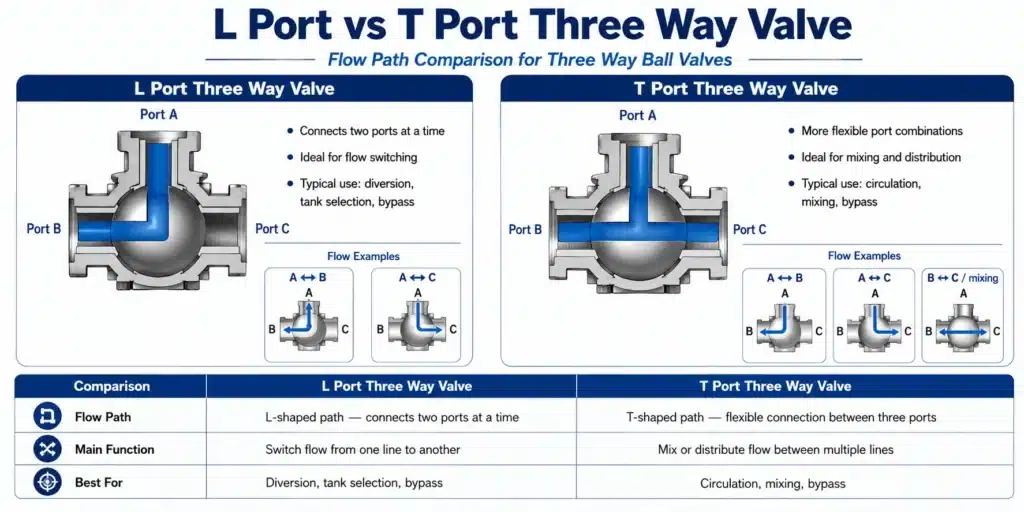
L Port Three Way Valve and T Port Three Way Valve
The internal port design is one of the most important factors when selecting a three way valve. The two common designs are the L port three way valve and the T port three way valve. Both designs are widely used in three way ball valves, but they are not interchangeable in every system.
L Port Three Way Valve
An L port three way valve has an L-shaped passage inside the ball or plug. It usually connects two ports at a time and is mainly used to switch flow from one line to another.
It is commonly selected for flow diversion, tank selection, alternate outlet control, and equipment bypass service.
T Port Three Way Valve
A T port three way valve has a T-shaped passage that allows more flow combinations. In some positions, it can connect all three ports or distribute flow between different directions.
It is commonly used for mixing, distribution, circulation, bypass systems, and multi-directional flow control.
| Comparison Item | L Port Three Way Valve | T Port Three Way Valve |
|---|---|---|
| Internal Passage | L-shaped passage. | T-shaped passage. |
| Main Function | Switches flow between two paths. | Allows mixing, distribution, and more flow combinations. |
| Best For | Diverting flow, tank selection, bypass operation. | Mixing flow, circulation, multi-line distribution. |
Professional selection tip: Choose an L port three way valve when the system needs to switch between two flow paths. Choose a T port three way valve when the system needs mixing, circulation, or more flexible port combinations.
Common Types of Three Way Valves
Three way valves are available in different structures and operating methods. The correct type depends on whether the application needs simple switching, accurate control, automation, corrosion resistance, or frequent operation.
Three Way Ball Valve
A three way ball valve uses a rotating ball with an internal passage. It is compact, easy to operate, and suitable for quick 90-degree switching. This valve is commonly used in water systems, oil lines, gas pipelines, chemical service, equipment bypass systems, and general industrial pipelines.
Three Way Control Valve
A three way control valve is designed for modulating operation. Instead of simply opening or closing, it can regulate flow proportion between ports. It is commonly used for temperature control in HVAC systems, boiler loops, heat exchangers, and process automation.
Manual Three Way Valve
A manual three way valve is operated by a handle or handwheel. It is suitable for applications where flow switching is not frequent, such as maintenance bypass lines, sampling systems, laboratory pipelines, small water systems, and simple industrial process lines.
Electric Three Way Valve
An electric three way valve uses an electric actuator for remote control or automatic operation. It is widely used in building automation, HVAC systems, water treatment equipment, and industrial control systems where electrical signals are used to control valve position.
Pneumatic Three Way Valve
A pneumatic three way valve uses compressed air to operate the actuator. It provides fast response and reliable performance in automated production lines, chemical plants, pneumatic control systems, and applications that require frequent switching.
Three Way Valve Flow Direction
Correct three way valve flow direction is essential for stable system performance. Some three way valves can handle bidirectional flow, while others have a recommended flow direction. This is especially important for three way control valves, mixing valves, and applications with pressure differences between ports.
In mixing service, two inlet ports usually combine into one outlet port. In diverting service, one inlet port is directed to one of two outlet ports. If the valve is installed incorrectly, the system may experience poor control accuracy, excessive pressure drop, unstable temperature, noise, vibration, or premature seat wear.
| Service Type | Typical Flow Direction | Installation Note |
|---|---|---|
| Mixing Service | Two inlets combine into one outlet. | Confirm the common outlet before installation. |
| Diverting Service | One inlet is directed to one of two outlets. | Confirm the inlet and both outlet ports. |
| Bypass Service | Flow can be directed through equipment or around it. | Check handle position and actuator fail position. |
Common Materials for Three Way Valves
Material selection affects corrosion resistance, pressure rating, hygiene, temperature resistance, and service life. A stainless steel three way valve is often selected for chemical processing, food and beverage systems, pharmaceutical pipelines, and corrosive service. Brass three way valves are common in HVAC, water, and air systems. Carbon steel three way valves are suitable for industrial oil, gas, steam, and higher-pressure systems. Plastic three way valves such as PVC, CPVC, PP, and PVDF are often used for chemical dosing, water treatment, and low-pressure corrosive service.
| Material | Main Features | Suitable Applications |
|---|---|---|
| Stainless Steel | Good corrosion resistance, hygienic surface, strong mechanical performance. | Chemical processing, food and beverage, pharmaceutical systems, water treatment. |
| Brass | Economical, easy to machine, suitable for clean water and air. | HVAC, water supply, compressed air, small equipment pipelines. |
| Carbon Steel | High strength and good pressure resistance. | Oil, gas, steam, power plants, industrial process lines. |
| Plastic | Lightweight and resistant to many corrosive chemicals. | Chemical dosing, water treatment, laboratory systems, low-pressure corrosive pipelines. |
Three Way Valve Applications
Three way valve applications are found in many industries because the valve can perform several flow control tasks within one compact body. It can reduce the need for multiple two way valves and simplify system operation.
HVAC Systems
A three way valve for HVAC system controls hot water, chilled water, bypass flow, and temperature mixing in heating and cooling loops.
Water Treatment
A three way valve for water treatment can switch flow between filters, tanks, dosing lines, bypass pipelines, and cleaning circuits.
Chemical Processing
A three way valve for chemical processing directs compatible media to reactors, tanks, filters, or process lines.
Boiler and Heating Systems
Three way mixing valves are used for temperature balancing, return water protection, and heating loop control.
Industrial Pipelines
Three way valves for industrial pipelines provide bypass, route selection, sampling, cleaning, and circulation control.
Food and Beverage
Stainless steel three way valves can be used for ingredient transfer, cleaning lines, and hygienic fluid routing.
Advantages of Using a Three Way Valve
A three way valve offers several advantages in piping systems where flexible flow control is required. It can reduce system complexity while improving control efficiency.
- Flexible flow control: A three way valve can mix, divert, switch, or bypass flow within one valve body.
- Simplified pipeline design: One valve may replace multiple two way valves in some systems.
- Space saving: The compact design helps reduce installation space, fittings, and pipe connections.
- Automation compatibility: Electric three way valves and pneumatic three way valves support remote or automatic operation.
- Good process control: Three way control valves can regulate temperature, flow ratio, and bypass flow.
- Wide material options: Stainless steel, brass, carbon steel, and plastic materials are available for different media.
Three Way Valve vs Two Way Valve
The main difference between a three way valve and a two way valve is the number of ports and the flow control function. A two way valve has one inlet and one outlet. It mainly opens, closes, or regulates one flow path. A three way valve has three ports and can control multiple flow paths.
| Comparison Item | Three Way Valve | Two Way Valve |
|---|---|---|
| Number of Ports | Three ports. | Two ports. |
| Main Function | Mixing, diverting, switching, or bypass control. | Open, close, or regulate one flow path. |
| Pipeline Design | Can reduce extra valves and fittings. | Additional valves may be needed for multiple routes. |
| Typical Use | HVAC bypass, mixing systems, route selection, process control. | General shutoff, isolation, and simple throttling. |
How to Select the Right Three Way Valve
Selecting the right three way valve requires a clear understanding of the process conditions. The first step is to define the valve function. The valve may be used for mixing, diverting, switching, bypass control, or modulating flow control. After that, the port configuration, valve material, pressure rating, temperature range, media compatibility, connection type, and actuator method should be confirmed.
For simple on-off route switching, a manual three way ball valve may be sufficient. For remote control or automatic operation, an electric three way valve is often selected. For fast operation in automated production lines, a pneumatic three way valve may be more suitable. For accurate temperature or flow regulation, a three way control valve with a proper actuator and control signal should be used.
| Valve Function | Mixing, diverting, switching, bypass, or modulating control. |
| Port Design | L port for switching; T port for mixing, distribution, and circulation. |
| Media Type | Water, steam, oil, gas, chemicals, slurry, compressed air, or food-grade fluids. |
| Material | Stainless steel, brass, carbon steel, PVC, CPVC, PP, PVDF, or other compatible materials. |
| Pressure and Temperature | Valve rating must match the working pressure and operating temperature range. |
| Operation Method | Manual handle, electric actuator, pneumatic actuator, or modulating actuator. |
Practical recommendation: Before purchasing a three way valve, provide the supplier with the media name, working pressure, temperature, pipe size, connection standard, flow direction diagram, port position, and whether the valve is used for mixing or diverting service.
Installation and Maintenance Tips
Proper installation is important for reliable three way valve operation. Before installation, the installer should check the port markings, flow diagram, handle position, actuator rotation direction, gasket material, and pipe alignment. For automated valves, the actuator signal and fail-safe position should also be verified.
- Confirm port A, port B, and port C before installation.
- Check whether the valve is designed for mixing, diverting, switching, or bypass service.
- Avoid applying excessive pipe stress to the valve body.
- Use seals, gaskets, and thread materials compatible with the process media.
- For electric three way valves, test opening and closing signals before operation.
- For pneumatic three way valves, confirm air pressure, actuator response, and fail-safe position.
- Inspect the valve seat, ball, stem seal, actuator, and connection points regularly for leakage or wear.
Frequently Asked Questions About Three Way Valves
What does a three way valve do?
A three way valve controls fluid flow between three ports. It can mix two flows into one outlet, divert one inlet flow to two outlets, or switch flow between different pipeline routes.
What is the difference between a three way mixing valve and a three way diverting valve?
A three way mixing valve combines two inlet flows into one outlet flow. A three way diverting valve takes one inlet flow and sends it to one of two outlet paths. The correct choice depends on the required flow direction.
What is an L port three way valve used for?
An L port three way valve is mainly used for switching flow between two different paths. It is commonly used for tank selection, equipment bypass, alternate outlet control, and process route switching.
What is a T port three way valve used for?
A T port three way valve is used when more flow combinations are required. It can be used for mixing, distribution, bypass, circulation, and multi-directional flow control.
Can a three way valve be automated?
Yes. A three way valve can be equipped with an electric actuator, pneumatic actuator, or modulating control actuator. Automated three way valves are commonly used in HVAC systems, water treatment, chemical processing, and industrial process control.
How do I choose a reliable three way valve manufacturer?
When choosing a three way valve manufacturer or industrial three way valve supplier, consider product range, material options, pressure ratings, actuator availability, testing capability, technical documentation, customization support, and after-sales service. A professional supplier should help confirm the correct port design, flow direction, valve material, connection standard, and actuator configuration.
Conclusion
A three way valve is a versatile flow control solution for systems that require mixing, diverting, switching, or bypass operation. By using three ports in one valve body, it can simplify pipeline design, reduce the number of separate valves, and improve system control flexibility.
The working principle of a three way valve depends on its internal design. An L port three way valve is commonly used for flow switching, while a T port three way valve provides more flow combinations for mixing, distribution, and circulation. A three way ball valve is suitable for quick switching, while a three way control valve is better for modulating flow and temperature control.
For reliable long-term performance, users should select the correct three way valve according to media compatibility, pressure rating, temperature range, port design, flow direction, connection type, and operation method. Whether used as a manual three way valve, electric three way valve, pneumatic three way valve, stainless steel three way valve, three way mixing valve, or three way diverting valve, the right product selection can improve efficiency, safety, and service life in industrial fluid control systems.