


Industrial Valve Automation Guide
What Is a Motorized Valve?
A motorized valve is an automated valve assembly that uses an electric actuator to open, close, or modulate the flow of liquid, gas, steam, or other media in a pipeline. It is widely used in HVAC systems, water treatment, chemical processing, irrigation, power plants, marine systems, and general industrial automation where remote control, repeatable positioning, and reliable shutoff are required.
What Is a Motorized Valve?
A motorized valve is a valve equipped with an electric actuator. The valve body performs the flow-control function, while the actuator provides the mechanical force needed to move the valve element. Depending on the valve design, the moving element may be a ball, disc, gate, plug, or stem. When the actuator receives an electrical command from a controller, thermostat, PLC, building management system, or remote switch, it drives the valve to the required position.
In simple on-off service, a motorized valve moves between fully open and fully closed positions. In more advanced control systems, a modulating motorized valve can stop at intermediate positions to regulate flow rate, pressure, temperature, or mixing ratio. This makes the motorized valve an important component in modern fluid automation, especially where manual operation is inefficient, unsafe, or technically insufficient.
The key value of a motorized valve is not only that it eliminates manual labor. Its real value lies in repeatable control, system integration, and operational reliability. In a large HVAC plant, for example, hundreds of valves may need to respond to temperature demand, pump status, or energy-saving logic. In a water treatment plant, valves may need to switch automatically between filtration, backwash, dosing, and discharge processes. In these cases, motorized valves allow the whole system to operate with higher consistency and less human intervention.
Quick Definition
A motorized valve is an electrically actuated valve used to automatically control pipeline flow. It can be designed for simple shutoff, flow diversion, proportional control, or process automation.
How Does a Motorized Valve Work?
A motorized valve works by converting electrical energy into mechanical motion. The actuator contains an electric motor, gear mechanism, limit switches, torque protection components, and sometimes a control board or position feedback module. When power or a control signal is supplied, the motor rotates. This rotation is reduced and strengthened through gears, then transferred to the valve stem or shaft.
For quarter-turn valves such as ball valves and butterfly valves, the actuator normally rotates the valve shaft by 90 degrees. When the valve is fully open, the flow path is aligned with the pipeline. When it is fully closed, the flow path is blocked. For multi-turn valves such as gate valves, the actuator rotates the stem through multiple turns to raise or lower the gate. For linear control valves, the actuator moves the stem upward or downward to change the opening between the plug and seat.
Most motorized valves include limit switches that stop the motor when the valve reaches the fully open or fully closed position. Higher-grade actuators may include torque switches to prevent damage when the valve is jammed or when excessive resistance is detected. Modulating actuators use control signals such as 0–10 VDC, 2–10 VDC, or 4–20 mA to position the valve at different opening percentages. Some intelligent actuators also support communication protocols such as Modbus, BACnet, or other industrial control networks.
On-Off Control
The valve moves fully open or fully closed. This is suitable for isolation, zone control, equipment protection, and simple automatic switching.
Modulating Control
The valve can stop at different opening positions. This is suitable for flow regulation, temperature control, pressure control, and process automation.
Feedback Control
The actuator sends position or status feedback to the controller, helping operators confirm valve operation and detect failures quickly.
Main Types of Motorized Valves
The phrase motorized valve describes the actuation method, not a single valve structure. In practical engineering, different valve bodies can be combined with electric actuators to meet different working conditions. The most common types include motorized ball valves, motorized butterfly valves, motorized gate valves, motorized globe valves, motorized control valves, and motorized zone valves. Each type has its own strengths, limitations, and ideal applications.
Motorized Ball Valve
A motorized ball valve uses a hollow ball as the shutoff element. When the hole in the ball aligns with the pipeline, fluid passes through with low pressure loss. When the actuator rotates the ball by 90 degrees, the passage is blocked. This design provides fast operation, compact structure, and reliable sealing. Motorized ball valves are widely used for water, air, oil, HVAC systems, irrigation, water treatment equipment, and general industrial pipelines.
One major advantage of a motorized ball valve is its excellent shutoff performance. It is commonly selected when leakage control is important and when the system requires frequent automatic opening and closing. Stainless steel motorized ball valves are often used in corrosive or hygienic environments, while brass motorized ball valves are popular in plumbing, HVAC, and irrigation systems. Flanged motorized ball valves are suitable for larger industrial pipelines where stable connection strength and easy maintenance are needed.
Motorized Butterfly Valve
A motorized butterfly valve uses a disc mounted on a central shaft. The actuator rotates the disc to control the flow. Butterfly valves are especially useful for medium and large pipe diameters because they are lighter, more compact, and usually more cost-effective than large ball valves or gate valves. They are frequently used in HVAC chilled water systems, cooling towers, wastewater treatment, fire protection, seawater systems, and industrial water distribution.
Motorized butterfly valves are suitable for both on-off and throttling service, depending on the seat design and actuator control type. For many building and industrial water systems, they provide a practical balance between cost, performance, and installation space. However, because the disc remains in the flow path even when fully open, the pressure drop is usually higher than that of a full-bore ball valve or gate valve.
Motorized Gate Valve
A motorized gate valve uses a gate or wedge that moves vertically to open or close the pipeline. Gate valves are usually designed for isolation service rather than flow regulation. When fully open, the gate is lifted out of the flow path, resulting in very low pressure drop. This makes motorized gate valves suitable for water supply networks, oil and gas pipelines, power plants, and large industrial systems.
Because gate valves require multiple stem rotations to move from closed to open, they are normally equipped with multi-turn electric actuators. The actuator must be carefully selected according to valve size, pressure, stem torque, operating frequency, and safety margin. A motorized gate valve is not usually recommended for frequent throttling because partial opening can cause vibration, seat wear, and poor control accuracy.
Motorized Globe Valve
A motorized globe valve is designed for more precise flow regulation. Its internal structure forces the media to pass through a controlled opening between the plug and seat. Compared with ball valves and gate valves, globe valves usually have a higher pressure drop, but they offer better throttling performance and more stable control characteristics.
Motorized globe valves are often used in steam systems, hot water systems, cooling systems, chemical dosing lines, and process control loops. When combined with a modulating electric actuator, a globe valve can adjust its opening continuously according to controller demand. This makes it valuable in systems where temperature, pressure, or flow rate must be accurately maintained.
Motorized Control Valve
A motorized control valve is designed specifically for regulating process variables. It may use a globe valve, characterized ball valve, butterfly valve, or other valve structure, but its main feature is accurate actuator positioning. In a closed-loop control system, sensors measure the process condition, the controller calculates the required adjustment, and the motorized control valve changes its opening to maintain the target value.
Motorized control valves are widely used in process industries, central air-conditioning systems, district heating, water treatment, pharmaceutical production, food processing, and chemical manufacturing. For these applications, flow coefficient, control rangeability, actuator resolution, response time, and feedback accuracy are all important engineering factors.
Motorized Zone Valve
A motorized zone valve is commonly used in HVAC and plumbing systems to divide a building or system into separate control zones. In a hydronic heating system, for example, each floor or room may have its own thermostat. When heating is required, the thermostat sends a signal to open the corresponding motorized zone valve. When the set temperature is reached, the valve closes.
Motorized zone valves improve comfort and energy efficiency because they allow heating or cooling to be delivered only where needed. They are often compact, low-voltage, and designed for relatively small pipe sizes. Although they may look simpler than industrial motorized valves, reliable operation is still important because a failed zone valve can lead to poor comfort, energy waste, or system imbalance.
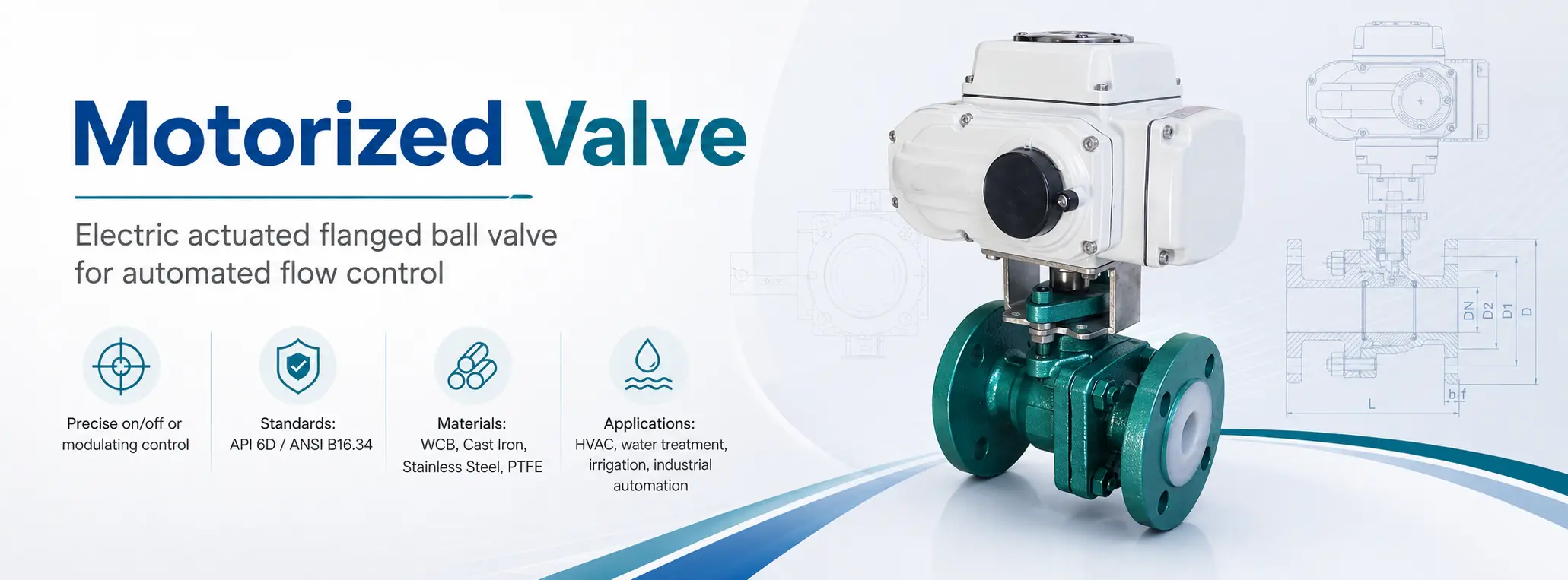
Technical Parameters and Materials of a Motorized Flanged Ball Valve
The following technical information is based on a typical motorized flanged ball valve structure. This type of valve is widely used in industrial water systems, HVAC pipelines, chemical service, and automated fluid control systems. The design standards, connection standards, inspection standards, and material configuration are important because they directly influence installation compatibility, pressure-bearing performance, sealing reliability, and service life.
| Item | Technical Parameter | Standard / Specification |
|---|---|---|
| Design Basis | API, ANS | Engineering design reference |
| Design Standard | API 6D, ANSI B16.34 | Valve design and pressure-temperature rating |
| Face-to-Face Dimension | API 6D, ANSI B16.10 | Structural length and installation dimension |
| Connecting Flange Size | ANSI B16.5 | Flanged pipeline connection standard |
| Test and Inspection | API 6D, API 598 | Pressure test, sealing test, and valve inspection |
Note: The structural length and connection flange size of ball valve series can be designed and manufactured according to user requirements.
| No. | Part Name | Material |
|---|---|---|
| 1 | Body | Cast Iron, WCB, Stainless Steel |
| 2 | Ball | Cast Iron, WCB, Stainless Steel |
| 3 | Lining Material / Seat | PTFE |
| 4 | Packing | PTFE |
| 5 | Cap | Cast Iron, WCB, Stainless Steel |
| 6 | Stem | Stainless Steel 304, 316 |
| 7 | Connecting Set | Stainless Steel 304, 316 |
| 8 | Screw | Stainless Steel 304, 316 |
| 9 | Hand Gear | Plastic |
| 10 | Electric Actuator | On/Off Type, Intelligent Type, Multi-Turn Type, Explosion-Proof Type |
These parameters show that a professional motorized valve is not just an actuator mounted on a common valve body. The design standard determines how the valve is engineered. The face-to-face dimension affects whether the valve can be installed into an existing pipeline. The flange standard ensures that the valve can match the pipe flange, gasket, and bolt arrangement. The test and inspection standards help verify pressure resistance and sealing performance before the valve is delivered to the project site.
Material selection is equally important. Cast iron and WCB are often selected for general industrial service where cost and mechanical strength are important. Stainless steel is preferred for corrosive media, clean water systems, food-related pipelines, chemical service, and marine environments. PTFE seats and packing provide strong chemical resistance and low friction, making them suitable for many water, air, oil, and chemical applications. Stainless steel 304 and 316 stems improve corrosion resistance and mechanical durability, especially in humid or aggressive environments.
Where Are Motorized Valves Used?
Motorized valves are used in almost every industry where fluid control needs to be automated. In HVAC systems, they control chilled water, hot water, condenser water, steam, and glycol solutions. A building automation system can open or close valves according to temperature demand, pump operation, pressure differential, or occupancy schedule. This helps improve energy efficiency and comfort while reducing manual balancing work.
In water treatment plants, motorized valves control filtration, backwash, chemical dosing, sludge discharge, raw water intake, and treated water distribution. Automated valve operation allows the plant to run stable cycles and reduces operator workload. In wastewater treatment, motorized valves are especially valuable because many pipelines are large, dirty, difficult to access, or located in harsh environments.
In irrigation systems, motorized valves divide large areas into watering zones. They can work with irrigation controllers, moisture sensors, weather-based controllers, and remote management platforms. This is important because irrigation efficiency is directly related to water conservation. In commercial landscapes, farms, greenhouses, golf courses, and municipal projects, automatic valve control can reduce overwatering and help maintain more consistent water distribution.
In chemical processing, motorized valves are used for dosing, mixing, batching, transfer, and isolation. The valve material must be compatible with the chemical media, and the actuator must be protected from corrosive vapor or hazardous atmosphere. In food and beverage production, sanitary motorized valves help control water, steam, cleaning solutions, syrups, milk, beverages, and other process fluids. Hygienic design, stainless steel materials, and cleanability are essential in these applications.
In power plants, oil and gas facilities, marine systems, and heavy industry, motorized valves are often selected for large pipelines, high pressure, high temperature, or remote operation. They may be used in cooling water, fuel systems, boiler auxiliary systems, seawater pipelines, fire protection systems, and process isolation. In these demanding environments, actuator torque, enclosure rating, manual override, explosion-proof design, and long-term reliability are critical.
Typical Application Areas
- HVAC chilled water, hot water, condenser water, and steam systems
- Water treatment, wastewater treatment, filtration, and backwash systems
- Smart irrigation, agricultural watering, greenhouse control, and landscape systems
- Chemical dosing, mixing, batching, and industrial process pipelines
- Food and beverage processing, cleaning-in-place systems, and sanitary pipelines
- Power plants, marine engineering, oil and gas, and general industrial automation
How to Select the Right Motorized Valve
Selecting the right motorized valve requires more than confirming the pipe size. A reliable selection should begin with the medium. Water, steam, compressed air, seawater, oil, acid, alkali, glycol, chlorine solution, and food-grade liquid all require different body materials and sealing materials. For example, PTFE seats are suitable for many chemical applications, while EPDM is commonly used for water and HVAC systems. Stainless steel is recommended for corrosion resistance, clean service, and many industrial environments.
The second factor is pressure and temperature. The valve must be rated for the maximum working pressure and temperature of the system, including possible pressure surges. Flange standards, pressure class, wall thickness, seat design, and body material all influence pressure-bearing capability. For steam and high-temperature service, the buyer should pay special attention to seat material, packing design, actuator heat protection, and installation position.
The third factor is control requirement. If the application only needs automatic shutoff, an on-off motorized valve is usually enough. If the process requires accurate flow regulation, a modulating motorized valve should be selected. For building automation and PLC systems, the actuator control signal must match the controller output. Common options include AC/DC power supply, 0–10 VDC, 4–20 mA, relay control, floating control, and digital communication.
Actuator torque is one of the most important technical considerations. The actuator must provide enough torque to operate the valve under real working conditions, not only under no-load factory conditions. Pressure differential, media viscosity, seat friction, temperature, long-term scaling, and valve aging can all increase the required operating torque. Professional valve suppliers usually apply a safety margin when matching the actuator to the valve body.
The installation environment should also be considered. Indoor equipment rooms may only require a standard actuator enclosure, while outdoor irrigation systems, wastewater plants, marine projects, and chemical factories may require waterproof, dustproof, corrosion-resistant, or explosion-proof actuators. If the valve is installed in a location that is difficult to access, position feedback, manual override, and fault alarm functions can significantly improve maintenance efficiency.
Professional Selection Checklist
- Confirm the medium, concentration, viscosity, and corrosion characteristics.
- Confirm pipe size, connection type, pressure rating, and flange standard.
- Confirm working temperature and possible temperature fluctuation.
- Choose the correct valve type: ball, butterfly, gate, globe, control, or zone valve.
- Choose on-off, modulating, intelligent, multi-turn, or explosion-proof actuator type.
- Confirm power supply, wiring method, control signal, and feedback requirement.
- Check actuator torque, duty cycle, operating speed, and manual override function.
- Confirm enclosure protection level for indoor, outdoor, wet, dusty, or hazardous areas.
- Request drawings, test standards, material specifications, and installation instructions.
Advantages of Using a Motorized Valve
The biggest advantage of a motorized valve is automatic control. Once the valve is connected to a control system, it can operate according to real-time signals without manual intervention. This improves system efficiency, reduces labor costs, and allows the pipeline to respond quickly to changing operating conditions. In large facilities, this advantage becomes significant because manual operation of dozens or hundreds of valves is slow, expensive, and prone to error.
Another advantage is repeatability. A motorized valve moves according to defined electrical commands and mechanical limits, which helps ensure consistent operation. In process applications, repeatable valve movement helps maintain stable flow, pressure, and temperature. In building systems, repeatable valve control improves comfort and energy management. In water treatment, repeatable valve cycling improves process reliability.
Motorized valves also improve safety. They can be integrated with leak detectors, level sensors, pressure switches, fire alarm systems, emergency shutdown systems, and remote monitoring platforms. When abnormal conditions occur, the valve can automatically close or open to protect equipment, prevent overflow, isolate dangerous media, or reduce the risk of system damage.
Compared with pneumatic valves, motorized valves do not require compressed air infrastructure. This can reduce installation complexity in buildings, irrigation projects, small factories, and remote sites. Although pneumatic actuators remain valuable in many heavy-duty process applications, electric motorized valves are often easier to install where electrical control is already available.
Common Problems and Maintenance Tips
Like all mechanical and electrical equipment, motorized valves require correct installation and maintenance. One common problem is actuator overload caused by insufficient torque selection, pipeline debris, valve scaling, or excessive pressure differential. If the actuator is forced to operate beyond its rated torque, the motor, gears, or control board may be damaged.
Another common problem is leakage. Leakage may occur because of seat wear, wrong sealing material, poor installation, pipeline stress, or particles trapped between the ball and seat. For ball valves and butterfly valves, correct alignment and clean pipelines are important. Before commissioning, the pipeline should be flushed to remove welding slag, sand, rust, and other contaminants.
Electrical failure can also occur if the actuator is exposed to water, dust, corrosive vapor, unstable voltage, or incorrect wiring. Outdoor or humid installations should use properly rated actuator enclosures. Cable glands should be tightened, unused cable entries should be sealed, and wiring should follow the manufacturer’s diagram. For modulating actuators, signal grounding and interference protection should be checked carefully.
Regular maintenance should include visual inspection, wiring inspection, actuator operation testing, leakage checking, and verification of open-close position. In critical systems, operators should record valve cycles, actuator alarms, abnormal noise, and operating time. These records help identify early signs of wear before a complete failure occurs.
Frequently Asked Questions About Motorized Valves
What is the main function of a motorized valve?
The main function of a motorized valve is to automatically control the flow of media in a pipeline. It can open, close, divert, or modulate flow according to electrical signals from a controller or automation system.
Is a motorized valve suitable for flow control?
Yes, but the valve and actuator must be selected correctly. For accurate flow control, a modulating actuator and a suitable valve body, such as a globe valve or characterized control valve, are recommended. A simple on-off valve is mainly used for isolation.
What is the difference between an on-off motorized valve and a modulating motorized valve?
An on-off motorized valve only moves to fully open or fully closed positions. A modulating motorized valve can stop at intermediate positions, allowing more precise control of flow, pressure, or temperature.
Which motorized valve is best for large pipelines?
For large pipelines, motorized butterfly valves are often selected because they are compact, lighter in weight, and cost-effective. However, motorized gate valves may be preferred when full-bore flow and low pressure drop are required.
Can a motorized valve be used outdoors?
Yes. Outdoor applications require an actuator with suitable enclosure protection, weather resistance, and cable sealing. For corrosive, humid, or hazardous environments, additional protection such as stainless steel housing or explosion-proof design may be required.
Conclusion
A motorized valve is an essential component in modern pipeline automation. By combining a valve body with an electric actuator, it provides automatic, remote, and repeatable control of liquids, gases, steam, and other media. Different types of motorized valves serve different engineering purposes. Motorized ball valves are valued for reliable shutoff, motorized butterfly valves are practical for larger pipelines, motorized gate valves are suitable for heavy-duty isolation, motorized globe valves offer better throttling, and motorized control valves provide accurate process regulation.
For engineers, contractors, equipment manufacturers, and industrial buyers, the right motorized valve should be selected according to media compatibility, pressure, temperature, valve type, actuator torque, control signal, duty cycle, installation environment, and required standards. A well-selected motorized valve can improve automation efficiency, reduce manual operation, enhance safety, save resources, and support long-term stable operation in demanding industrial and commercial systems.