


Industrial valve selection guide
Electric Actuated Butterfly Valves: Sizing & Selection Guide
Choosing an electric butterfly valve takes more than matching a pipe diameter and a power supply. The right assembly must handle the fluid, close against the actual pressure difference, deliver the required control, and respond correctly when power or the control signal is lost.
This guide explains how electric actuated butterfly valves work, which materials and body styles suit different services, how to specify the actuator, and what to include in a quotation request. It also introduces a stainless steel hard-seated option for projects that need a closer review of elevated-temperature service.
What are electric actuated butterfly valves? They combine a butterfly valve with an electric actuator that rotates the disc through approximately 90 degrees to open, close, or regulate flow. Selection depends on media compatibility, pressure and temperature, shutoff requirements, valve torque, electrical supply, control duty, and the required failure position.
Start here: define the process conditions first, select the valve and seat second, then match the actuator and controls to the confirmed valve requirements.
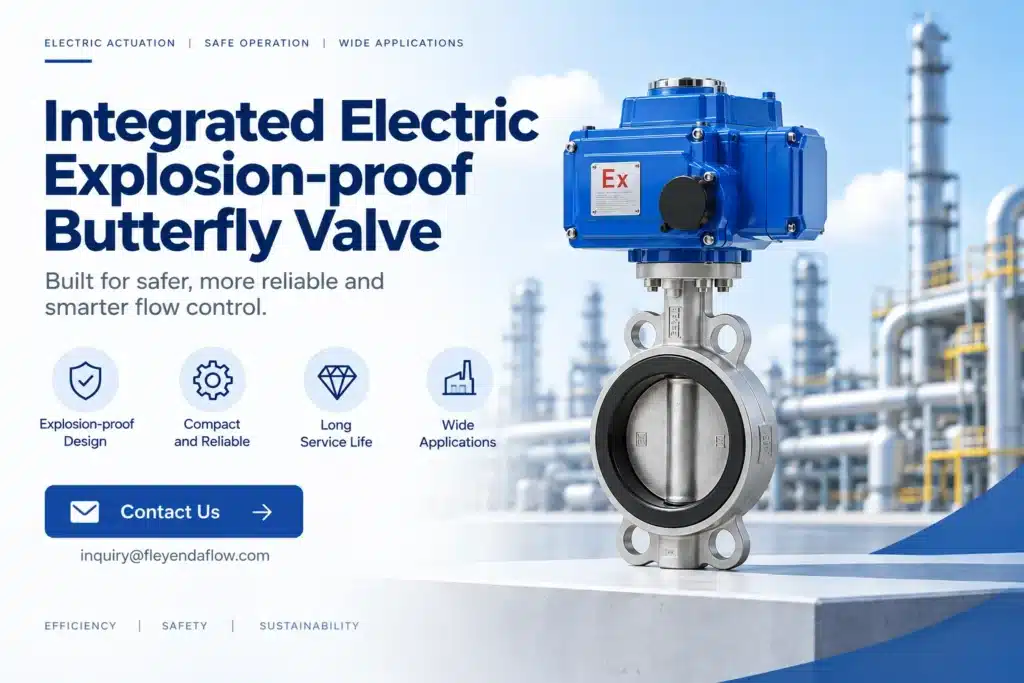
How does an electric actuated butterfly valve work?
The valve body sits in the pipeline, while a disc turns on a shaft inside the flow passage. An electric motor and gear mechanism drive that shaft through a coupling or mounting assembly. As the disc approaches the closed position, its sealing surface meets the seat. As it opens, the available flow area increases.
A complete package also needs a way to stop travel and communicate its position. Depending on the actuator, this can include limit switches, torque protection, a position sensor, a local indicator, and remote feedback. The control system sends a command; the actuator moves the valve; feedback tells the control system what position the assembly has reached.
On/off operation
The valve normally travels between open and closed positions. This suits isolation, tank filling sequences, equipment changeover, and other duties where intermediate positioning is unnecessary. Specify separate open and closed confirmation signals if the operating sequence depends on them.
Modulating operation
The actuator positions the disc between its end stops in response to a command. This can support flow or temperature control when the valve has suitable flow characteristics and the actuator is rated for the required positioning frequency.
Position control is different from flow measurement. A valve at 50% travel does not necessarily pass 50% of the maximum flow. The installed pipe system, pressure difference, and valve characteristic determine the result. A process loop that must maintain a measured flow generally also needs an appropriate flow signal and controller.
Where are electric butterfly valves a good fit?
Electric actuation is attractive where power and control wiring are available and bringing instrument air to each valve would add complexity. Butterfly valves also offer a compact arrangement for many larger pipe sizes. Suitability still depends on the selected valve construction and operating conditions.
- Water treatment and distribution: remote isolation, filter sequencing, and process-water routing. Check solids, treatment chemicals, and any drinking-water approvals required for the installation.
- HVAC and building services: chilled-water and heating-water control or isolation. Include glycol concentration, system pressure, and the building controller’s signal requirements.
- Industrial utilities: cooling water, compatible air, and auxiliary services. Consider outdoor exposure, operating frequency, and maintenance access.
- Chemical processing: compatible media where the disc, seat, shaft, seals, and other wetted parts can withstand the actual mixture and temperature.
- Thermal processes: selected metal-seated designs for hot fluids or steam after checking temperature-dependent pressure ratings, sealing performance, and actuator heat exposure.
A different valve arrangement may be more suitable for severe slurry service, a very small controllable flow range, or a duty demanding specialized noise or cavitation control. For liquid throttling, excessive pressure recovery can create cavitation, with noise, vibration, and damage. Evaluate those conditions during selection rather than treating them as a commissioning adjustment. Emerson’s cavitation guidance explains the underlying mechanism.
Choose the seat, wetted materials, and connection together
The seat is central to shutoff performance, but it is only one part of the material selection. A stainless steel body does not establish chemical compatibility for the complete valve. Review the disc, shaft, seat, packing, and any coatings or liners exposed to the fluid, including cleaning solutions and occasional process upsets.
Soft-seated versus hard-seated butterfly valves
| Seat type | Potential fit | Selection check |
|---|---|---|
| EPDM | Many water and compatible aqueous services. | Confirm compound and temperature limits; generally unsuitable for petroleum oils. |
| NBR / Buna-N | Many compatible petroleum oil and fuel services. | Check the specific fluid, additives, temperature, and aging conditions. |
| PTFE or other fluoropolymer lining | Selected chemically demanding applications. | Verify liner construction, pressure, temperature, and vacuum suitability. |
| Metal / hard seat | Selected elevated-temperature or demanding process duties. | Confirm seal design, materials, leakage acceptance, and required seating torque. |
These are screening guidelines. Compatibility changes with chemical concentration, temperature, and material formulation; use condition-specific data such as Bray’s materials selection reference and obtain approval for the actual assembly.
A soft seat can provide effective shutoff in a compatible service at an economical cost. A hard seat can be a stronger candidate where the service exceeds the practical limits of a selected elastomer. Neither description establishes a universal leakage class, service life, or pressure rating.
For hard-seated valves, specify the required leakage acceptance and test conditions in the purchase documents. Terms such as “tight shutoff” need an agreed test medium, differential pressure, test direction, duration, and acceptance criterion to become a verifiable requirement.
Wafer, lug, or flanged body?
- Wafer: fits between pipeline flanges and offers a compact installation. Check centering, bolt clearance, and the exact flange compatibility.
- Lug: uses threaded body lugs for attachment. Some designs support downstream pipe removal, but dead-end suitability and its pressure limit must be confirmed for that model.
- Double-flanged: provides integral flange connections on both ends. Verify face-to-face length, flange drilling, weight, and space for installation.
Do not assume that matching nominal sizes means the valve will fit. Flange standard, pressure class, face type, pipe bore, adjacent fittings, and disc clearance all matter. Likewise, “hard-seated” does not by itself establish whether a valve is double-offset or triple-offset; obtain the construction drawing when that detail is required.
How to size electric actuated butterfly valves
Valve sizing has two linked tasks: choose a flow passage and pressure boundary that suit the process, then choose an actuator that can operate the valve throughout its required duty. Starting with the actuator’s advertised torque skips the information needed to make either choice.
1. Record the full operating envelope
List the minimum, normal, and maximum flow rates; upstream and downstream pressures; fluid temperature; and fluid properties. Include startup, shutdown, blocked-line, and cleaning conditions where relevant. State whether pressures are gauge or absolute and keep units consistent.
The pressure difference across the closed valve deserves separate attention. A valve in a normally balanced line may need to open or close while one side is depressurized. That situation can be more demanding than normal running conditions.
2. Check flow capacity and the useful control range
For isolation, evaluate full-open pressure loss and the required shutoff condition. For modulation, ask for Cv or Kv data across the relevant travel range and a sizing check at minimum, normal, and maximum flow. Oversizing can concentrate useful control into a narrow portion of travel, making small position changes disproportionately important.
As a simplified illustration for turbulent, non-choked liquid flow without significant piping corrections, Cv = Q × √(SG / ΔP), where Q is in US gallons per minute, SG is specific gravity relative to water, and ΔP is in psi. At 100 gpm, SG = 1, and ΔP = 4 psi, the preliminary required Cv is 50. This does not select a valve size by itself; verify opening position, installed conditions, and cavitation limits. Gas, steam, viscous, and choked-flow duties need the appropriate sizing method. See Emerson’s control-valve sizing guidance.
3. Obtain valve torque data for the actual duty
Request the manufacturer’s required torque throughout travel, including breakaway, running, and seating requirements. The relevant values depend on the valve design, seat, pressure difference, temperature, and service. Long idle periods, deposits, and changing friction can also affect the application review.
Ask the supplier to document the selection allowance used and any derating applied to the actuator. An allowance already included in the valve torque data should not be unknowingly added again. The coupling, mounting bracket, and valve shaft must also withstand the transmitted torque.
Illustrative torque check: suppose the valve supplier confirms a maximum required torque of 180 N·m for the stated duty and specifies a 1.3 selection factor that is not already included. The preliminary requirement becomes 234 N·m. The chosen actuator must provide at least that usable output under the stated conditions, with suitable duty and travel time. This example is a calculation method, not a sizing rule or a recommendation for a particular valve.
4. Verify temperature limits for the whole assembly
A high process-temperature rating does not mean the actuator can operate at that temperature. Check the pressure-temperature curve for the valve materials and the actuator’s separate ambient limit. Heat conducted through the shaft and bracket, radiant heat, insulation, and ventilation all influence the final arrangement.
For a hot line, request a drawing showing the actuator position and any thermal separation. Avoid covering the actuator with pipeline insulation unless its manufacturer explicitly approves the arrangement.
Specify voltage, controls, duty cycle, and failure response
Power supply and control signal are separate requirements
An actuator’s supply voltage powers its motor and electronics. A control signal tells it what to do. A 4–20 mA positioning input, for example, does not mean the actuator is powered by that signal. Confirm the available voltage, AC or DC supply, frequency and phase where applicable, starting demand, and the approved wiring arrangement.
For a US installation, state the actual site supply. Do not treat 110 V and 120 V, or 220 V and 230 V, as interchangeable unless the actuator’s documented operating range covers the supply. Check the project’s electrical approval requirements before purchase.
- On/off: define the command logic, supply arrangement, and open/closed feedback required.
- Modulating: specify the input signal, feedback signal, operating direction, accuracy needs, and behavior on signal loss.
- Networked control: identify the exact protocol, interface, required data, and controller compatibility.
- Local operation: identify any selector switch, local display, manual override, or access restriction needed.
Match the actuator duty to the process
Count how often the valve starts and how long the motor runs, rather than describing the duty only as “automatic.” A few full strokes per day and frequent corrective movements in a control loop place different demands on an actuator. Confirm starts per hour, duty rating, ambient conditions, and rated torque for the proposed operating mode.
Also specify the required stroke time. The shortest available closing time may not suit a liquid pipeline because rapid changes in flow can create pressure surges. Select the movement profile as part of the system design.
Define what happens when power or the signal fails
Ordinary power-to-open, power-to-close actuators do not automatically provide a fail-closed function. A required movement after power loss needs an engineered energy source or mechanism, such as a spring, battery, or capacitor system. Available designs differ; for example, Rotork documents a configurable supercapacitor fail-to-position option for its CVQ range.
Specify power-loss and signal-loss behavior separately. Ask how long the stored-energy system needs to recover, how its condition is monitored, and what operating conditions limit the return stroke. A manual override provides local intervention; it is not an automatic failure response.
Choose environmental protection for the installation
Identify outdoor exposure, washdown, flooding risk, condensation, dust, corrosion, and hazardous-area requirements. An ingress-protection rating does not establish explosion protection. Where submersion is possible, obtain the specified depth and duration as well as the enclosure rating, cable-entry requirements, and mounting instructions.
Electric versus pneumatic butterfly valves
The better actuation method depends on the utilities and operating requirements at the valve location. Both technologies can support on/off and modulating applications with suitable equipment.
| Decision factor | Electric actuation | Pneumatic actuation |
|---|---|---|
| Site utilities | Requires suitable electrical power and controls. | Requires an adequately sized, conditioned air supply and controls. |
| Failure movement | Requires a specified fail-safe mechanism or backup energy. | Spring-return arrangements are available; size for the required failure stroke. |
| Operating speed | Depends on the motor, gearing, and selected movement profile. | Can suit rapid cycling; speed depends on the complete air circuit and load. |
| Positioning duty | Needs a suitable positioning controller and motor duty rating. | Typically uses a positioner for controlled intermediate positioning. |
| Installed cost | Include wiring, controls, protection, and any fail-safe option. | Include air infrastructure, tubing, conditioning, and accessories. |
For an isolated location with available electrical power, electric actuation can simplify utility provision. In a plant with reliable instrument air and demanding cycling requirements, pneumatic actuation may merit closer comparison. Evaluate the complete installed package and its maintenance needs.
Product option for your shortlist
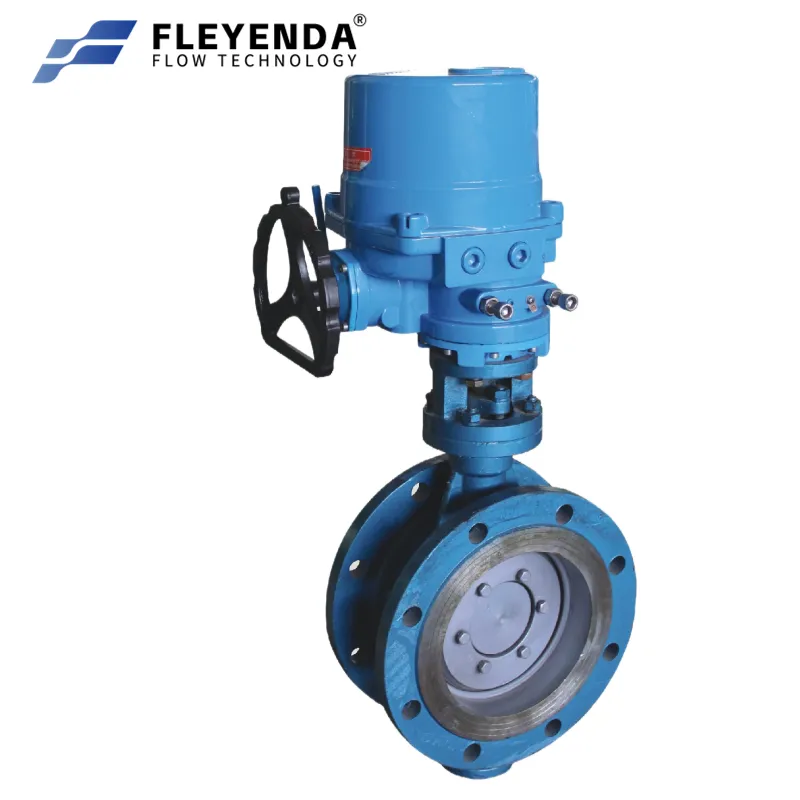
Fleyenda motorized stainless steel hard-seated butterfly valve
The Fleyenda QT-D-SH motorized stainless steel hard-seated butterfly valve combines electric actuation, a flanged stainless steel body, and a metal sealing arrangement. Its published product-family data provides a starting point for reviewing a hard-seated assembly.
| Пункт | Published range or option |
|---|---|
| Nominal size | DN50–DN1200 / 2–48 inches |
| Body and connection | CF8 or CF8M stainless steel; flanged |
| Pressure designations | PN10–PN40 / Class 150–300 |
| Process temperature range | −20°C to +450°C / −4°F to +842°F |
| Listed supply options | AC220V, AC380V, DC24V |
| Design / testing references | API 609 / EN 593; API 598 / ISO 5208 |
| Actuator protection and ambient | IP67; IP68 optional. Ambient: −20°C to +60°C. |
Confirm the exact configuration: these ranges do not establish that every size supports every pressure and temperature combination. Request the selected model’s pressure-temperature curve, seat construction, leakage criterion, torque calculation, and electrical specification. PN and ASME Class designations also require confirmation of the actual flange standard; they are not interchangeable labels.
For a hot-fluid project, use the product discussion to resolve the assembly details: the required sealing performance at operating temperature, actuator thermal separation, controller interface, and failure response. Where the project requires specific electrical, fire-test, or functional-safety evidence, request documents that identify the quoted model and configuration.
Two examples of a better selection brief
The examples below illustrate how to frame a supplier discussion. They are hypothetical requirements, not completed selections or customer case studies.
Example 1: automated cooling-water isolation
A plant needs a DN150 valve for treated cooling water at 35°C. The normal line pressure is 6 bar, but one side may be drained during maintenance. The valve makes four full cycles per day, receives open/close commands, and needs independent end-position feedback.
The first review should establish the maximum shutoff differential and compatibility with the treatment chemicals. Then confirm the flange details, disc clearance, required closing time, actuator supply, and behavior on power loss. A compatible resilient seat may be appropriate; the presence of an electric actuator alone does not create a reason to specify a hard seat.
Example 2: remotely operated hot-process isolation
A process line carries a hot medium beyond the approved temperature limit of the site’s existing soft seat. The team wants remote operation and needs a documented shutoff requirement.
A stainless steel hard-seated assembly can enter the shortlist, but “high temperature” is not a complete specification. The supplier still needs the medium, normal and maximum temperatures, pressures on both sides, thermal cycling pattern, corrosion conditions, and leakage acceptance. Review the valve and actuator temperature limits separately before deciding whether the quoted assembly suits the line.
In both examples, a useful quotation identifies the proposed construction and explains its operating limits. A price attached only to pipe size and voltage leaves too many purchasing decisions unresolved.
Installation, commissioning, and maintenance checks
Use the selected valve and actuator manuals for the installation procedure. The following points help a project team prepare for that work; exact gasket arrangements, bolt loads, travel settings, and wiring must follow the approved assembly documentation.
Before installation
Confirm the delivered nameplates against the purchase specification. Verify flange alignment and bore clearance for the disc, inspect the sealing surfaces, and remove pipeline debris. Use the specified lifting points and supports. Gasket requirements differ by design: a resilient or lined valve may seal differently from a flanged metal-seated valve. Manufacturer installation guidance, such as Bray’s resilient-seated butterfly valve manual, illustrates why disc clearance and the correct flange arrangement matter.
During commissioning
Qualified personnel should verify the wiring, protective grounding, supply, movement direction, end positions, and remote feedback. Establish that the indicated valve position corresponds to the actual disc position. For modulating duty, check representative command points and the returned position signal.
Test the agreed power-loss and signal-loss responses under controlled conditions. Record the final settings, operating time, and any abnormal load or noise. This baseline makes later changes easier to diagnose.
During service
Set inspection intervals according to the duty, fluid, environment, and manufacturer recommendations. Look for external leakage, damaged cable entries, loose mounting hardware, unusual stroke time, corrosion, and deterioration in position response. Where provided, use torque or fault history to identify changes before they become a loss of function.
If a valve fails to seat, investigate deposits, mechanical interference, alignment, travel adjustment, and sealing damage. Increasing actuator torque without understanding the cause can overload the shaft or mounting components. Isolate electrical energy and relieve process pressure before intrusive work.
What affects the price of an electric butterfly valve?
There is no meaningful universal price for an electric actuated butterfly valve. A small water-service valve with basic on/off operation differs substantially from a large hard-seated assembly with specialized controls and documented failure performance.
The main cost drivers are valve size, pressure rating, body and trim materials, seat construction, actuator torque, operating duty, control features, enclosure requirements, and testing or documentation. Packaging, freight, spare parts, and project-specific inspection can also change the delivered cost.
Compare quotations against the same requirements. Ask each supplier to identify included accessories, assumptions, exclusions, delivery terms, and required commissioning work. A lower initial price can lose its advantage if it omits the feedback, mounting hardware, or control function the project needs.
For repeat purchases, keep the approved configuration and drawings with the equipment record. Reordering from a short description such as “6-inch electric butterfly valve” can introduce a different seat compound, face-to-face dimension, or electrical arrangement.
What to include in your quotation request
A clear enquiry helps the supplier propose a usable assembly and reduces repeated questions. Copy the following fields into your request. If a value is unknown, identify it as a point for engineering review instead of guessing.
- Process and medium
- Fluid or gas name; composition or concentration; solids; normal and maximum temperature; cleaning conditions.
- Pressure and flow
- Upstream and downstream pressures; maximum shutoff differential; minimum, normal, and maximum flow; units and gauge/absolute pressure basis.
- Mechanical connection
- DN or NPS size; flange standard and rating; wafer, lug, or flanged body; required face-to-face length; pipe bore; available space.
- Materials and shutoff
- Required body, disc, shaft, seat, and packing materials; leakage acceptance; test standard; test direction and conditions.
- Actuation and controls
- Power supply; on/off or modulating duty; control and feedback signals; operating frequency; travel time; local operation requirements.
- Failure response and environment
- Required action on power loss and signal loss; ambient temperature; enclosure requirements; hazardous-area classification if applicable.
- Commercial and documentation needs
- Quantity; delivery destination and timing; drawings; material records; test reports; required approvals; spare parts.
Ask the proposal to include a completed datasheet, valve-and-actuator drawing, wiring diagram, torque selection basis, and a clear list of options. These documents make technical comparison easier and create a useful reference for installation and future maintenance.
Frequently asked questions about electric actuated butterfly valves
Are motorized butterfly valves and electric actuated butterfly valves the same?
The terms usually describe a butterfly valve operated by an electric actuator. Neither term specifies the seat, voltage, control mode, or failure response. Check the complete assembly specification rather than relying on the product name.
Can an electric butterfly valve regulate flow?
Yes, when both the valve and actuator are selected for that duty. The actuator needs suitable positioning capability and operating frequency, while the valve needs an acceptable controllable flow range. Verify pressure loss, minimum flow, cavitation risk, and the process feedback needed by the control loop.
Will the valve close automatically during a power failure?
Only if the assembly includes a suitable fail-closed function and the energy or mechanism to complete that movement. A standard electrically driven assembly may remain where it stopped. State the required failure action explicitly and verify it during commissioning.
How much actuator torque do I need?
Obtain the valve supplier’s torque requirements for the actual pressure difference, temperature, seat, and service. Apply the supplier’s documented selection method and confirm the actuator’s usable output, duty rating, and shaft limits. Pipe size alone is insufficient for torque selection.
Is a hard seat always better than a soft seat?
No. A compatible soft seat can be the appropriate choice for many water and utility applications. A hard seat becomes a candidate when temperature or other service requirements justify it. Compare the required leakage performance, materials, maintenance, and operating conditions.
Can I use an electric butterfly valve for steam?
Some specifically rated assemblies can be considered for steam. Confirm steam pressure and temperature, the valve’s pressure-temperature rating, seat and packing materials, shutoff performance, and the actuator’s thermal protection. For throttling, also require an appropriate steam sizing and noise review.
What is the difference between IP67 and IP68 for an actuator?
They describe different water-ingress test conditions. For IP68, obtain the manufacturer’s stated immersion depth and duration rather than assuming unlimited underwater operation. Correct cable glands, enclosure assembly, and installation remain necessary. Neither rating by itself establishes hazardous-area suitability.
Can an existing manual butterfly valve be converted to electric operation?
Possibly, if its mounting interface, shaft, mechanical condition, and torque requirements are suitable. A compatible mounting pattern alone is not enough. Review the coupling, bracket, alignment, travel stops, and actuator load with the suppliers before ordering a retrofit package.
Build your valve enquiry around the operating conditions
The best electric actuated butterfly valve is the assembly that fits the process and arrives with clearly defined operating limits. Start with the medium, pressure, temperature, and shutoff requirement; then confirm the connection, torque, controls, and failure response.
Considering a stainless steel hard-seated assembly? Send your line size, media, pressure, temperature, and control requirements with your enquiry. Ask Fleyenda to confirm the proposed valve configuration, actuator selection, and supporting documents before ordering.