


What Is API 6D Ball Valve
An API 6D ball valve is a pipeline isolation valve designed and manufactured in accordance with the applicable requirements of API Specification 6D. These valves are widely used in oil, natural gas, petrochemical, transmission pipeline and industrial piping systems where reliable shutoff, pressure containment and documented manufacturing quality are essential.
What Is an API 6D Ball Valve?
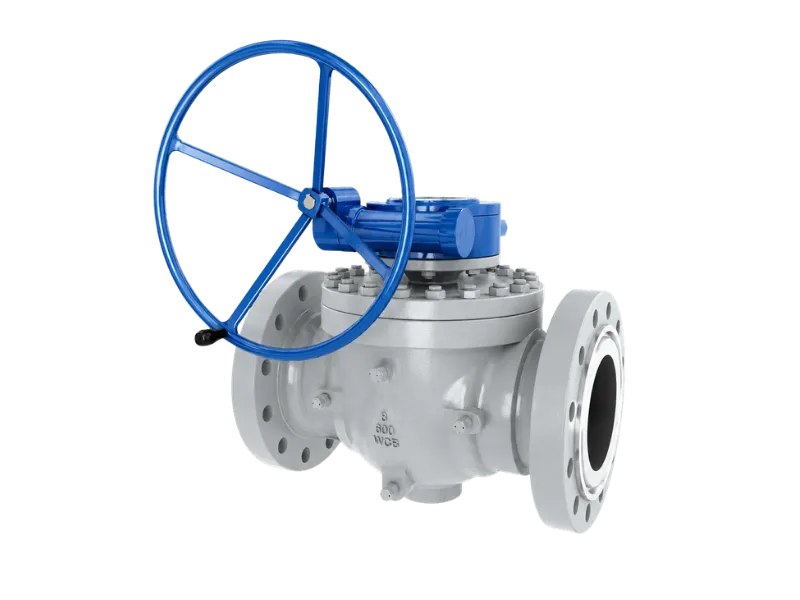
An API 6D ball valve is a quarter-turn valve manufactured for pipeline and piping isolation service according to API Specification 6D. It controls flow through a rotating ball with a circular bore. When the bore aligns with the pipeline, the valve is open. When the ball turns 90 degrees, the solid surface blocks the flow passage.
The term API 6D does not describe one body material, pressure class or seat design. API 6D ball valves can be supplied in different sizes, pressure ratings, body materials, bore configurations, seat arrangements and operating methods.
Depending on the application, an API 6D pipeline ball valve may use floating-ball or trunnion-mounted construction. It may also be supplied with full-bore or reduced-bore flow passages, soft or metal seats, flanged or welded ends and manual, pneumatic, hydraulic or electric operation.
Simple Definition
An API 6D ball valve is a pipeline-grade isolation valve designed, manufactured, tested, marked and documented to meet the applicable requirements of API Specification 6D and the purchaser’s project specification.
What Does API 6D Mean?
API stands for the American Petroleum Institute. API Specification 6D is an internationally used specification for pipeline and piping valves. Its scope includes ball valves as well as other valve categories used in energy transportation and process systems.
For a ball valve manufacturer, API 6D provides a structured technical framework covering areas such as design, manufacturing, materials, assembly, inspection, testing, marking and documentation. The purchaser may add further requirements according to the process fluid, pressure, temperature, installation location and safety classification.
API 6D is especially important for oil and gas pipelines because an isolation valve may remain open for long periods and then be required to close reliably during maintenance, commissioning or an emergency. Valve performance must therefore be considered throughout the complete service life, not only during initial factory testing.
API 6D Compliance and API Monogram
An API 6D compliant ball valve and an API Monogrammed valve are not automatically the same thing. A manufacturer may state that a product is designed to meet API 6D, but the API Monogram is connected to a voluntary licensing program administered by API.
When a project specifically requires the API Monogram, the purchaser should verify that the manufacturing facility holds an active and appropriate license for the relevant product scope. A general company certificate or an unrelated API license should not be treated as proof that a particular valve is authorized to carry the API Monogram.
Important Purchasing Note
Always specify whether the order requires API 6D design conformity, an API Monogrammed product or both. The purchase specification should also identify the required edition, addenda, valve configuration and supplementary project requirements.
How Does an API 6D Ball Valve Work?
An API 6D ball valve operates by rotating its closure element through approximately 90 degrees. The ball contains a cylindrical opening that forms the flow passage. A stem connects the ball to a lever, gearbox or actuator.
When the stem rotates the ball into the open position, the bore aligns with the connected pipeline. When the stem rotates the ball into the closed position, the ball surface contacts the valve seats and isolates the upstream and downstream piping.
Unlike a gate valve, which requires multiple turns and linear gate movement, a ball valve provides fast quarter-turn operation. This makes it suitable for emergency shutdown, remote isolation and automated pipeline stations.
Valve Seats and Sealing
The seats form the sealing interface around the ball. Soft-seated valves may use engineered polymer materials for low operating torque and tight shutoff. Metal-seated designs are selected for abrasive fluids, high temperatures, solids or other severe-service conditions.
The correct seat material must be compatible with the operating temperature, pressure, fluid composition and expected number of cycles. A valve that performs well in clean natural gas service may require a different seat design for slurry, high-temperature hydrocarbon or contaminated pipeline service.
Body Cavity Pressure
When a ball valve is closed, fluid may become trapped inside the body cavity. Changes in temperature can increase the pressure of trapped liquid or gas. The valve design and project specification must therefore address safe cavity-pressure management.
The appropriate solution depends on seat direction, service medium, pipeline arrangement and purchaser requirements. Buyers should not assume that every ball valve provides the same cavity-relief behavior.
Common API 6D Ball Valve Types
API 6D Floating Ball Valve
An API 6D floating ball valve uses a ball that is supported mainly by the valve seats rather than by fixed trunnions. Pipeline pressure pushes the ball toward the downstream seat, helping create shutoff.
Floating ball valves are compact and are commonly used in smaller sizes and moderate pressure classes. They generally have fewer major internal components than trunnion-mounted designs.
As valve size and pressure increase, the force acting on the ball and downstream seat also increases. This can increase operating torque and influence seat wear, which is why large pipeline ball valves commonly use trunnion-mounted construction.
API 6D Trunnion Mounted Ball Valve
An API 6D trunnion mounted ball valve supports the ball with upper and lower bearings or trunnions. The ball rotates in a fixed position while the seats move toward the ball to provide sealing.
Trunnion-mounted valves are widely used in large-diameter, high-pressure and critical pipeline applications. Supporting the ball reduces the load transferred to the seats and can help control operating torque.
These valves may be supplied with bolted, welded or fully welded body construction. Fully welded ball valves are commonly considered for buried pipelines because they reduce body-joint leak paths, although maintenance and replacement planning must be considered.
API 6D Full Bore Ball Valve
An API 6D full bore ball valve has a bore intended to provide a flow passage closely matched to the connected pipeline. This reduces flow restriction and supports pipeline operations such as pigging when the complete valve and piping arrangement is designed for pig passage.
Full-bore valves are commonly selected for transmission pipelines, compressor stations and applications where pressure loss must be minimized. They are usually larger, heavier and more expensive than reduced-bore valves of the same nominal size and pressure class.
Шаровой кран с уменьшенным проходом
A reduced-bore valve has an internal flow passage smaller than the nominal connected pipe. It can provide a more compact and economical solution where the additional pressure drop is acceptable and pipeline pigging is not required.
The purchaser should review the actual bore diameter rather than relying only on the terms full bore or reduced bore. Flow capacity, cleaning requirements and pressure-drop calculations should be included in the selection process.
Key Features of an API 6D Pipeline Ball Valve
Quarter-Turn Shutoff
The ball rotates through approximately 90 degrees, allowing fast manual or automated pipeline isolation.
Low Flow Resistance
A full-bore design provides a relatively straight flow path and helps limit pressure loss when fully open.
Bidirectional Service
Many configurations can isolate pressure from either direction, but the exact seat function must be confirmed.
Pressure-Containing Body
The body, closure and body joints are designed according to the specified pressure, temperature and material conditions.
Manual or Automated Operation
Valves may use levers, gearboxes, electric actuators, pneumatic actuators or hydraulic actuators.
Documented Inspection
Manufacturing records, test documentation and material traceability may be supplied according to the order requirements.
Double Block and Bleed Ball Valve
An API 6D double block and bleed ball valve is used where operators need to isolate pressure and access or vent the valve body cavity. The term is frequently used in pipeline projects, but its exact functional meaning must be defined in the purchase specification.
Seat direction and sealing arrangement affect whether the valve provides double block and bleed, double isolation and bleed or another isolation function. These terms should not be used interchangeably without reviewing the valve design and applicable project definitions.
Soft-Seated and Metal-Seated Designs
Soft-seated API 6D ball valves are commonly used for clean oil, gas and water service where low leakage and moderate operating torque are important. Typical seat materials are selected according to temperature and chemical compatibility.
Metal-seated API 6D ball valves are used for higher temperatures, abrasive particles, dirty fluids and severe operating conditions. Their ball and seat surfaces may use hard coatings or overlays to improve resistance to erosion and wear.
Fire-Safe Design
Pipeline projects may require a fire-tested or fire-safe ball valve. This is a separate performance consideration that should be clearly identified in the purchase specification with the applicable fire-test standard.
Using the phrase API 6D ball valve alone does not communicate every fire, fugitive-emission, low-temperature or severe-service requirement. Supplementary project requirements should be listed separately.
API 6D Ball Valve Testing and Inspection
API 6D ball valve testing is an important part of manufacturing conformity. Testing is used to evaluate the pressure-containing structure, seat sealing and functional operation of the completed valve.
The exact inspection and testing plan depends on the applicable API 6D edition, valve type, product configuration and purchaser requirements. Project specifications may also request additional examination, witness points, material verification or third-party inspection.
Pressure Testing
Pressure testing is used to verify the integrity of the valve body and the performance of the seats. Test pressure, test medium, duration and acceptance criteria must follow the applicable specification and purchase order.
Testing with water and testing with gas do not provide identical information. A purchaser may therefore request supplementary low-pressure gas seat testing or other tests when very low leakage is important.
Operational Testing
The valve should operate through its required travel without abnormal binding or interference. For actuated valves, the complete valve-actuator package should be evaluated according to the specified operating conditions.
Material and Dimensional Inspection
Inspection may include verification of body material, trim materials, dimensions, flange details, bore size, marking and manufacturing documentation. Critical-service projects may add nondestructive examination or positive material identification.
Documentation
Required records may include pressure-test reports, material certificates, inspection reports, drawings, operating instructions and coating documentation. Documentation requirements should be agreed before manufacturing begins.
API 6D vs API 608 Ball Valve
The search phrase API 6D vs API 608 ball valve is common because both standards can apply to metal ball valves, but they are not identical in scope or purchasing intent.
API 6D is associated with pipeline and piping valves used in pipeline transportation and related facilities. API 608 addresses metal ball valves with flanged, threaded and welding ends and is widely specified for refinery, petrochemical and general process piping.
A project may reference API 6D, API 608 or multiple standards together. When more than one document is listed, the purchase specification should explain which requirements control if differences arise.
Do Not Select by Standard Number Alone
The standard reference does not replace a complete valve data sheet. Size, class, material, bore, seat design, end connection, operator, testing and documentation must still be specified.
Typical API 6D Ball Valve Applications
Oil and Gas Transmission Pipelines
API 6D ball valves are widely used as mainline block valves, station isolation valves and sectionalizing valves in oil and natural gas transmission systems.
Compressor and Pump Stations
Pipeline stations use ball valves to isolate compressors, pumps, filters, meters and other equipment for operation and maintenance.
Gas Metering and Regulating Stations
Tight shutoff and automated operation make ball valves suitable for metering skids, pressure-regulating stations and gas-distribution facilities.
Tank Farms and Terminals
Ball valves are installed in loading, unloading, transfer and storage systems handling crude oil, refined fuels and other liquid products.
Petrochemical Facilities
API 6D valves may also be selected for process piping where the owner requires pipeline-style valve construction, testing or documentation.
Hydrogen Pipeline Service
Hydrogen service requires careful attention to materials, leakage control, sealing systems and current specification requirements. A standard natural-gas valve should not automatically be assumed suitable for hydrogen.
How to Select an API 6D Ball Valve
1. Define the Process Medium
Identify whether the valve will handle natural gas, crude oil, refined products, water, hydrogen, sour gas or another fluid.
2. Confirm Pressure and Temperature
Use maximum design conditions, including startup, shutdown, pressure surges and emergency scenarios.
3. Choose Floating or Trunnion Design
Floating valves suit many smaller sizes, while trunnion-mounted valves are common in large or high-pressure pipelines.
4. Specify Full or Reduced Bore
Select full bore when low pressure loss or pig passage is required. Use reduced bore where a smaller passage is acceptable.
5. Select Seat Materials
Match soft or metal seats to temperature, pressure, chemicals, solids, leakage requirements and operating frequency.
6. Select Body Material
Carbon steel, low-temperature steel, stainless steel and alloy materials may be used according to service conditions.
7. Define the End Connection
Common options include raised-face flanges, ring-type-joint flanges, butt-weld ends and project-specific connections.
8. Choose the Operator
Select a lever, gearbox, pneumatic actuator, hydraulic actuator or electric actuator based on size and automation needs.
9. Define Isolation Functions
Specify the required seat direction, cavity relief, double block and bleed or double isolation arrangement.
10. List Supplementary Requirements
Include fire testing, fugitive emissions, sour service, low-temperature testing, coating and documentation requirements.
How to Evaluate an API 6D Ball Valve Manufacturer
Choosing an API 6D ball valve manufacturer should involve more than comparing valve prices. The supplier must demonstrate the ability to control design, materials, machining, assembly, testing and documentation.
Buyers should review the manufacturer’s product range, manufacturing facility, quality-management system, applicable API licenses, engineering capability and experience with similar pipeline conditions.
Material traceability and approved sub-suppliers are especially important for critical pressure-containing parts. The manufacturer should also be able to provide clear drawings, data sheets, test procedures and installation instructions.
For actuated pipeline valves, review both the valve and actuator sizing. The actuator should provide sufficient torque under maximum differential pressure and the most demanding operating condition, including suitable safety margins.
Часто задаваемые вопросы
What is an API 6D ball valve used for?
It is mainly used for reliable isolation in oil, gas, petroleum-product and other pipeline or pipeline-facility applications.
Is every API 6D ball valve trunnion mounted?
No. API 6D ball valves may use floating or trunnion-mounted construction depending on size, pressure and application.
What is an API 6D full bore ball valve?
It is a valve with a flow passage designed to closely match the pipeline bore, helping reduce pressure loss and support pigging when properly specified.
Is API 6D the same as API 608?
No. API 6D focuses on pipeline and piping valves, while API 608 applies to metal ball valves with flanged, threaded and welding ends for process and industrial service.
Does API 6D automatically mean fire safe?
Fire-tested performance should be separately identified with the required fire-test standard and project acceptance criteria.
Can an API 6D ball valve regulate flow?
Standard pipeline ball valves are primarily designed for isolation. Continuous throttling can damage the seats unless the valve is specifically engineered for control service.
What information is needed when ordering?
Specify size, pressure class, material, temperature, medium, bore, seats, end connections, operator, isolation function, tests and documentation.
Does API 6D compliance mean the valve has an API Monogram?
No. API Monogram licensing is a separate program. The purchase order should clearly state whether a Monogrammed product is required.
Choose the Right API 6D Ball Valve
An API 6D ball valve provides fast quarter-turn isolation, low flow resistance and dependable pipeline shutoff. However, the API 6D designation alone does not define the complete valve.
To select the right valve, buyers must specify the operating medium, pressure, temperature, ball support, bore, seat arrangement, body material, end connection, actuator, testing and documentation requirements.
A complete technical data sheet and a qualified API 6D ball valve manufacturer are essential for achieving safe operation, reliable sealing and long service life.