


Pneumatically Actuated Ball Valves: Types & Applications
Pneumatically actuated ball valves combine the shut-off capability of a quarter-turn ball valve with the speed and automation capability of a pneumatic actuator. Compressed air generates the torque required to operate the valve, allowing pipelines and process equipment to be opened, closed, diverted or controlled without manual operation.
These valves are widely used in automated water treatment systems, chemical process lines, pump skids, oil and gas facilities, power generation systems, packaged process equipment and general industrial automation.
However, different pneumatically actuated ball valves are designed for different duties. A conventional 2-way valve is mainly used for isolation, a 3-way valve provides flow routing, and a V-port ball valve is more suitable for proportional regulation. Valve body material, sealing material, connection type and pneumatic actuator configuration must also match the actual process conditions.
This guide explains the main types of pneumatically actuated ball valves, where they are commonly used, how double-acting and spring-return actuators differ, and what engineers, OEMs and industrial buyers should consider before selecting a valve.
A pneumatically actuated ball valve should be treated as a complete valve-and-actuator assembly. Process medium, pressure, temperature, valve torque, available air pressure, required fail position and control accessories all influence reliable operation.
What Are Pneumatically Actuated Ball Valves?
Pneumatically actuated ball valves are automated quarter-turn valves operated by compressed air. A pneumatic actuator is installed above the ball valve and connected to the valve stem, allowing pneumatic energy to replace manual handle operation.
When compressed air enters the actuator, its internal piston or rotary mechanism generates torque. This torque rotates the valve stem and internal ball, changing the flow path between open and closed positions.
Most ball valves require approximately 90 degrees of rotation between fully open and fully closed positions. Because the required movement is relatively short, pneumatic actuation can provide fast, repeatable operation in applications involving frequent valve cycling.
A complete pneumatic valve package may also include a solenoid valve, filter regulator lubricator, limit switch box, pneumatic positioner and manual override. These accessories allow pneumatically actuated ball valves to communicate with PLC, DCS and other industrial automation systems.
This combination of reliable shut-off, quarter-turn movement and pneumatic automation makes pneumatically actuated ball valves suitable for both industrial pipelines and OEM equipment.
Main Types of Pneumatically Actuated Ball Valves
Pneumatically actuated ball valves can be classified according to flow path, body construction, connection type, material and control function. The correct valve design should be determined by what the valve needs to do in the process rather than by pipe size alone.
| Tipo de válvula | Função principal | Aplicação típica | Ponto-chave de seleção |
|---|---|---|---|
| 2-Way Ball Valve | Open / close isolation | Water, air, oil and process liquids | Pressure and operating torque |
| 3-Way Ball Valve | Diverting and routing | Tank switching and process skids | L-port or T-port configuration |
| V-Port Ball Valve | Proportional flow control | Process-control loops | Flow coefficient and positioner |
| Trunnion Ball Valve | Heavy-duty isolation | Large-diameter and high-pressure pipelines | Differential pressure and actuator torque |
| Plastic Ball Valve | Corrosion-resistant isolation | Water treatment and compatible chemicals | Compatibilidade de materiais |
| Válvula de esfera sanitária | Hygienic isolation and routing | Food and beverage process systems | Connection and cleanability |
2-Way Pneumatically Actuated Ball Valves
A 2-way design is one of the most common forms of pneumatically actuated ball valves. The valve contains one inlet and one outlet and is primarily used to start or stop flow through a pipeline.
When the bore through the ball aligns with the pipeline, the valve is open. When the pneumatic actuator rotates the ball approximately 90 degrees, the solid side of the ball moves across the flow path and isolates the pipeline.
Full-port ball valves provide a relatively unrestricted flow passage when fully open and are commonly selected where pressure loss must be minimized. Reduced-port designs can provide a more compact alternative when the smaller internal flow area is acceptable.
2-way pneumatically actuated ball valves are frequently used in water systems, industrial utilities, pump packages, chemical transfer lines, compressed-air systems and automated production equipment.
Flanged versions are particularly useful for industrial piping systems because the bolted connection provides secure installation and allows the complete valve assembly to be removed for inspection or maintenance.
3-Way Pneumatically Actuated Ball Valves
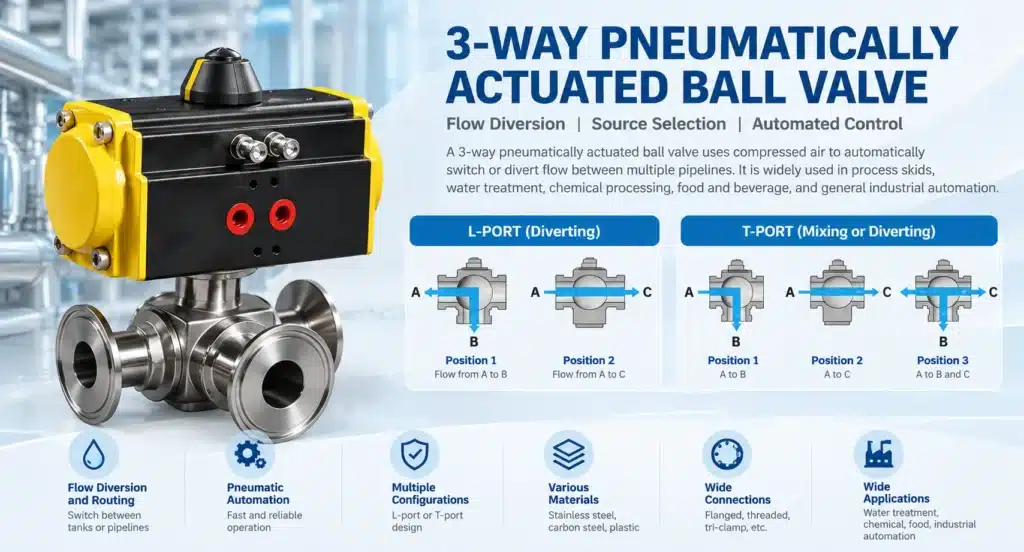
3-way pneumatically actuated ball valves are used when a process requires flow diversion, source selection or routing between multiple pipelines rather than simple isolation.
The valve contains three ports, and the internal ball normally uses either an L-shaped or T-shaped flow passage.
L-Port Ball Valve
An L-port ball normally connects one common port to one of two alternative ports. This makes the design useful for switching flow between tanks, process equipment or parallel pipelines.
T-Port Ball Valve
A T-port ball provides additional flow combinations and may allow multiple ports to communicate depending on the selected actuator position.
When ordering 3-way pneumatically actuated ball valves, the required flow-position diagram should be clearly specified. Selecting only the valve size and connection type does not define how the three ports should communicate in each operating position.
V-Port Pneumatically Actuated Ball Valves
Conventional round-port ball valves are primarily designed for open-close isolation. Although a standard valve can physically stop at intermediate positions, this does not automatically provide stable or predictable proportional flow control.
V-port pneumatically actuated ball valves use a shaped opening that progressively changes the available flow area as the ball rotates. This gives the valve a more useful control characteristic for throttling and process regulation.
A pneumatic or electro-pneumatic positioner is normally installed when the valve must respond to a continuous control signal and move to controlled intermediate positions.
When specifying this type of valve, engineers should consider minimum, normal and maximum flow rates, upstream pressure, downstream pressure, differential pressure and fluid characteristics rather than simply selecting a nominal valve diameter.
Materials and Connection Types
Material selection is a critical part of specifying pneumatically actuated ball valves because the process fluid can contact the body, ball, seats, stem seals and gaskets.
Stainless Steel Ball Valves
Stainless-steel ball valves are commonly used in industrial applications requiring corrosion resistance, clean wetted surfaces or compatibility with a broad range of process fluids. Material grade should still be selected according to the actual chemical composition, concentration and temperature.
Carbon Steel and Cast Materials
Carbon steel and cast valve bodies can be suitable for water, utilities and general process applications where the medium and operating conditions are compatible with the selected construction.
Plastic Ball Valves
UPVC, CPVC, PP and PVDF pneumatically actuated ball valves can be selected for suitable corrosive chemicals and water-treatment applications. Because thermoplastic pressure capability changes with temperature, both process pressure and maximum temperature should be checked carefully.
PTFE Seats
PTFE is widely used for soft-seated ball valves because it provides low operating friction, good sealing performance and useful resistance to many industrial fluids. More demanding temperatures or abrasive media may require alternative seat materials.
Flanged Connections
Flanged pneumatically actuated ball valves are widely used in process pipelines and industrial equipment. The flange standard must match the piping system, including requirements such as ANSI, DIN, JIS or GB.
Threaded and Union Connections
Threaded ball valves are commonly used on smaller pipelines, while union connections are useful in compatible plastic piping systems where convenient valve removal and maintenance are required.
Double-Acting vs Spring-Return Pneumatically Actuated Ball Valves
The pneumatic actuator determines how the valve moves and what happens when compressed-air supply is lost. Double-acting and spring-return actuators therefore serve different process requirements.
Double-Acting Pneumatic Actuator
A double-acting actuator uses compressed air to move the ball valve in both directions. Air pressure drives the valve toward one position and a second pneumatic signal drives it back toward the opposite position.
This configuration is widely used for general industrial automation where reliable compressed air is continuously available and a mechanical return spring is not required.
Spring-Return Pneumatic Actuator
A spring-return actuator uses compressed air for movement in one direction and stored spring force for movement in the opposite direction.
Depending on valve and actuator orientation, spring-return pneumatically actuated ball valves can be configured for fail-open or fail-closed operation when the required pneumatic supply is removed.
| Factor | Double Acting | Spring Return |
|---|---|---|
| Operating Method | Compressed air in both directions | Compressed air plus spring force |
| Fail Position | Depends on pneumatic and control circuit | Defined spring-return position |
| Typical Duty | General automated isolation | Fail-safe applications |
| Actuator Sizing | Usually more compact for equivalent valve torque | Spring force must also be considered |
Industrial Applications of Pneumatically Actuated Ball Valves
Pneumatically actuated ball valves are used in many process industries, but valve construction, materials and actuator configuration should always be matched to the specific operating conditions.
Pneumatically actuated ball valves are used for filtration sequencing, process-water isolation, chemical dosing, tank switching, backwash systems and packaged water-treatment equipment.
Material selection should consider both the water chemistry and any treatment chemicals introduced into the system.
Chemical process systems use pneumatic valves for transfer, isolation and automated routing. The actual chemical name, concentration, operating temperature and pressure should be confirmed before body and sealing materials are selected.
Pneumatic actuation is useful where pipelines and process systems require rapid and remote valve operation. Higher pressure, larger valve size and hazardous operating environments make actuator sizing and accessory selection particularly important.
Pneumatically actuated ball valves can automate pump isolation, bypass switching, tank selection and equipment sequencing. Valve closing speed should be evaluated in liquid systems where rapid shut-off could contribute to pressure surge.
OEMs and system integrators use pneumatically actuated ball valves in process skids, filtration machines, dosing systems and automated production equipment. Solenoid valves and position feedback allow the valve to operate as part of an automatic machine sequence.
Suitable sanitary ball valve configurations can provide automated isolation and routing in food and beverage processing systems where hygienic connections and suitable wetted surfaces are required.
Featured Pneumatically Actuated Ball Valve
For general industrial isolation, a 2-way flanged design is one of the most practical configurations of pneumatically actuated ball valves. The Fleyenda FLE-AT-FQ combines a flanged ball valve with an AT Series pneumatic actuator for automated open-close operation.

2-Way
Com flange
Série AT
The FLE-AT-FQ is a 2-way flanged pneumatically actuated ball valve designed for automatic isolation in industrial piping systems.
Its flanged body supports GB, ANSI, JIS and DIN connection standards, allowing the valve to be specified for different international piping requirements.
The valve is paired with an AT Series pneumatic actuator. Depending on the required process function, the actuator can be configured for double-acting operation or single-acting fail-open / fail-closed operation.
Optional pneumatic control accessories include solenoid valves, filter regulator lubricators, positioners, limit switches and manual operating accessories for integration into industrial automation systems.
DN15–DN200 / 1/2″–8″
10 / 16 bar
GB / ANSI / JIS / DIN
PTFE
Typical applications: water treatment systems, power-generation auxiliary systems, industrial process equipment, automated pipeline isolation and packaged process skids.
DN15–DN200
10 / 16 bar
-30°C to 180°C
3–8 bar
Double Acting / FO / FC
How to Select Pneumatically Actuated Ball Valves
Reliable selection of pneumatically actuated ball valves should begin with the process conditions and required valve function rather than choosing a valve based only on nominal pipe diameter.
1. Define the Flow Function
Determine whether the valve is required for simple isolation, flow diversion, source selection or proportional regulation. This establishes whether a 2-way, 3-way or V-port design is the correct starting point.
2. Identify the Process Medium
Provide the actual fluid name, chemical concentration, solids content, viscosity and any corrosive or abrasive characteristics. These conditions influence the required body, ball, seat and sealing materials.
3. Confirm Pressure and Temperature
Specify normal operating pressure, maximum pressure, maximum differential pressure and minimum and maximum process temperatures. Differential pressure is particularly important because it directly affects the torque required to move the ball.
4. Confirm the Connection Standard
Flanged valves must match the mating pipeline standard. ANSI, DIN, JIS and GB flanges should not be treated as interchangeable simply because the nominal pipe diameter is the same.
5. Size the Pneumatic Actuator
Pneumatic actuator sizing should use valve-specific torque data under the most demanding expected process conditions. The actuator should also be evaluated using the minimum reliable compressed-air pressure available at the installation point.
6. Define the Required Failure Position
Determine whether the process requires fail-open, fail-closed or another operating strategy if compressed air or control power is lost. This decision influences whether a double-acting or spring-return actuator is appropriate.
7. Select the Required Accessories
Specify solenoid valve voltage, limit-switch feedback, filter regulator lubricator, positioner requirements and any environmental or hazardous-area requirements.
Pneumatically Actuated Ball Valve RFQ Checklist
- Valve size / DN / NPS
- Process medium and concentration
- Operating pressure
- Maximum pressure
- Maximum differential pressure
- Temperatura mínima e máxima
- 2-way, 3-way or V-port configuration
- Body and ball material
- Seat and sealing material
- Connection type and flange standard
- Available compressed-air pressure
- Double acting or spring return
- Fail-open or fail-closed requirement
- On/off or modulating operation
- Solenoid valve and control voltage
- Limit-switch or position-feedback requirement
- Required quantity
Common Pneumatically Actuated Ball Valve Selection Mistakes
| Selection Mistake | Possible Result | Recommended Approach |
|---|---|---|
| Selecting only by pipe size | Valve or actuator may be unsuitable for the actual process load | Evaluate complete operating conditions |
| Ignoring differential pressure | Actuator torque may be insufficient | Use maximum expected differential pressure for sizing |
| Ignoring minimum air pressure | Valve may not complete its stroke | Size the actuator using minimum reliable air pressure |
| Wrong seat material | Leakage or premature sealing failure | Verify chemical and temperature compatibility |
| Wrong flange standard | Valve cannot connect correctly to the pipeline | Confirm ANSI, DIN, JIS or GB before ordering |
| Wrong fail position | Unexpected process condition after air loss | Define FO / FC requirements before actuator selection |
| Using a standard ball valve for precise regulation | Poor process-control performance | Evaluate a V-port ball valve |
Pneumatically Actuated Ball Valves FAQs
What are pneumatically actuated ball valves?
Pneumatically actuated ball valves are ball valves operated automatically by compressed air through a pneumatic actuator. They are commonly used for pipeline isolation, flow routing and selected process-control functions.
How do pneumatically actuated ball valves work?
Compressed air enters the pneumatic actuator and generates rotary torque. The actuator transfers this torque to the valve stem, rotating the internal ball to open, close or position the flow passage.
What types of pneumatically actuated ball valves are available?
Common types include 2-way ball valves, 3-way ball valves, V-port ball valves, trunnion-mounted ball valves, plastic ball valves, sanitary ball valves and different threaded or flanged configurations.
What is the difference between double acting and spring return?
A double-acting actuator uses compressed air in both operating directions. A spring-return actuator uses compressed air in one direction and internal spring force for the return movement.
Can pneumatically actuated ball valves fail closed?
Yes. A suitable spring-return actuator can be configured so the valve moves toward the closed position when the required compressed-air supply is removed.
Can pneumatically actuated ball valves regulate flow?
Yes, but a V-port ball valve combined with an appropriate pneumatic positioner is generally more suitable for proportional flow regulation than a conventional round-port isolation valve.
What air pressure does a pneumatic ball valve require?
The required air pressure depends on the actuator and valve torque. The FLE-AT-FQ featured above specifies an air-source pressure range of 3 to 8 bar.
Can a pneumatic ball valve connect to a PLC?
Yes. Solenoid valves can receive PLC commands, limit switches can provide valve-position feedback, and pneumatic or electro-pneumatic positioners can be used for proportional control.
Are pneumatically actuated ball valves suitable for water treatment?
Yes. They are widely used for water isolation, filtration sequences, chemical dosing, tank switching and automated treatment equipment. Valve materials should still be selected according to the actual water chemistry and dosing chemicals.
How should I specify a pneumatically actuated ball valve?
Provide the valve size, process medium, pressure, temperature, connection standard, materials, available air pressure, actuator function, required failure position, control accessories and quantity.
Need Pneumatically Actuated Ball Valves for Your Project?
The correct valve configuration depends on the process medium, pressure, temperature, connection standard, operating torque, available air pressure and required automation function.
Fleyenda provides pneumatic valve solutions for industrial pipelines, water treatment systems, chemical processing, pump systems, packaged process equipment and industrial automation.
For technical selection, send the valve size, medium, operating pressure, temperature, connection standard, air pressure, actuator function and required quantity.
Choosing the Right Pneumatically Actuated Ball Valve
Pneumatically actuated ball valves provide a practical solution for automating industrial pipeline isolation, flow routing and selected process-control duties. Their quarter-turn construction enables relatively fast operation, while pneumatic actuators allow remote control and integration with automated equipment.
A 2-way ball valve is suitable for many isolation duties, while 3-way valves provide process-routing capability and V-port valves are more appropriate for proportional regulation.
The valve itself must also match the process conditions. Pressure, temperature, medium compatibility, sealing materials and connection standards should all be confirmed before final actuator selection.
Actuator torque, minimum available air pressure, fail position and control accessories should then be evaluated as part of the complete assembly.
Specifying pneumatically actuated ball valves as complete engineered valve-and-actuator packages provides a stronger basis for reliable automation, easier system integration and long-term industrial operation.