


How to Choose the Right Electric Ball Valve
Choosing the right electric ball valve requires more than matching the valve size to the pipeline. The correct valve must also match the process medium, pressure, temperature, flow function, connection standard, actuator torque, power supply, and control requirements.
An electric ball valve combines a quarter-turn ball valve with an electric actuator, allowing the valve to open, close, or position automatically from a PLC, DCS, local controller, or remote control system.
Electric ball valves are widely used in water treatment, pump systems, chemical processing, oil and gas, industrial utilities, food processing, and automated equipment. However, different applications may require completely different valve bodies, seats, connection types, actuator speeds, and control modes.
This guide explains how to choose an electric ball valve step by step and highlights the specifications industrial buyers should confirm before ordering.
The correct selection sequence is usually: process conditions → valve construction → flow function → actuator torque → voltage and control → environmental protection. Choosing the actuator first can lead to an unsuitable electric ball valve assembly.
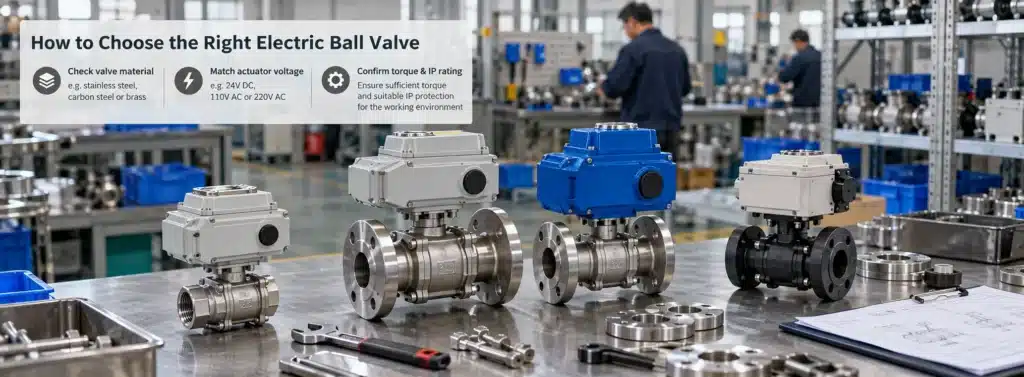
What Is an Electric Ball Valve?
An electric ball valve is a quarter-turn ball valve operated by an electric actuator instead of a manual lever. The electric actuator rotates the valve stem, which turns the internal ball between open, closed, or selected intermediate positions.
For standard on-off service, the ball normally rotates approximately 90 degrees. A position feedback system or internal limit switch stops the electric actuator when the required position is reached.
A motorized ball valve can also be configured for modulating service. In this case, the actuator responds to a control signal and positions the valve between fully open and fully closed.
However, not every electric ball valve is equally suitable for throttling. A standard round-port ball valve is primarily designed for isolation, while a V-port electric ball valve provides a more useful flow characteristic for proportional control.
1. Start With the Medium Before Choosing an Electric Ball Valve
The process medium should be the first selection factor because it determines the suitable valve body, ball, seats, seals, and sometimes the entire valve construction.
An electric ball valve used for clean water does not necessarily require the same materials as one used for sulfuric acid, steam, food products, oil, or abrasive process liquids.
Water and General Industrial Liquids
Stainless steel, carbon steel, or suitable plastic electric ball valves can be selected according to pressure, water chemistry, temperature, and installation requirements.
For industrial water systems, corrosion resistance and long-term seat reliability should be considered alongside purchase price.
Chemicals and Corrosive Media
Chemical compatibility becomes critical when an electric ball valve handles acids, alkalis, solvents, chlorine-related media, or other aggressive fluids.
Stainless steel alone may not provide sufficient corrosion resistance for every chemical process. Depending on the actual medium, a PTFE/PFA-lined ball valve, UPVC valve, PVDF valve, or another compatible construction may be more appropriate.
Always provide the chemical name, concentration, temperature, and pressure when requesting material selection.
Steam and High-Temperature Media
Temperature affects seat material, stem packing, valve body rating, and actuator installation.
A standard PTFE-seated electric ball valve should not automatically be selected for every steam application simply because its body material is stainless steel.
Confirm the actual seat and packing temperature limits with the supplier.
Slurry and Solids-Bearing Media
Suspended solids may increase wear or interfere with sealing. A suitable V-port, segmented ball design, special seat construction, or even another valve type may perform better than a conventional full-port ball valve.
2. Check Electric Ball Valve Pressure and Temperature
Nominal pipe size alone does not define the correct valve. Every electric ball valve should be selected according to its actual working pressure and process temperature.
Pressure ratings such as PN16, PN40, Class 150, Class 300, or 1000 PSI refer to different valve constructions and applicable standards.
The valve’s allowable pressure can also decrease as temperature increases, especially when polymer seats are used.
| Parameter | What to Specify | Por que isso é importante |
|---|---|---|
| Valve Size | DN / NPS | Determines flow area and connection dimensions |
| Operating Pressure | Pressão normal e máxima | Determines valve pressure rating |
| Differential Pressure | Maximum pressure across the closed valve | Affects valve torque |
| Temperatura | Minimum and maximum process temperature | Affects body, seat and seals |
| Flow Rate | Minimum / normal / maximum | Important for valve sizing and modulation |
For an electric ball valve, actuator torque should be evaluated at the maximum expected valve operating load—not simply according to DN size.
3. Choose the Right Electric Ball Valve Configuration
Electric ball valves are available in several flow configurations. The required process function should determine which type is selected.
2-Way Electric Ball Valve
A 2-way electric ball valve has one inlet and one outlet and is primarily used for automatic pipeline isolation.
This is the most common configuration for pump isolation, equipment switching, tank outlets, industrial utilities, and automated process lines.
3-Way Electric Ball Valve
A 3-way electric ball valve is used when the system needs to divert flow between alternative pipelines or connect several flow paths.
L-port and T-port ball designs provide different routing functions. The actual flow-position diagram should be confirmed before ordering.
V-Port Electric Ball Valve
A V-port electric ball valve is designed for proportional flow regulation rather than simple open-close isolation.
The V-shaped opening changes the available flow area progressively as the ball rotates, providing better controllability than a standard round-port valve.
For applications using a 4–20 mA control signal, flow rate and pressure-drop information should be supplied so the V-port valve can be selected around the actual control duty.
| Electric Ball Valve Type | Primary Duty | Aplicação típica |
|---|---|---|
| 2-Way | Open / Close | Pipeline isolation |
| 3-Way L-Port | Diverting | Tank or line switching |
| 3-Way T-Port | Routing / combining | Process distribution |
| V-Port | Modulating flow control | Process regulation |
4. Select the Correct Connection Type
The connection affects installation, maintenance, allowable pressure, system size, and compatibility with the existing piping.
Threaded Electric Ball Valve
Threaded valves are compact and commonly used for smaller pipelines. BSP and NPT are two common thread standards and should not be treated as interchangeable.
Flanged Electric Ball Valve
A flanged electric ball valve is widely used in industrial process piping because the bolted connection provides reliable installation and simplifies removal from larger pipelines.
Common flange standards include ANSI, DIN, and JIS. The correct standard and pressure class must match the pipeline.
Three-Piece Electric Ball Valve
A three-piece body allows the center valve section to be serviced more conveniently than many one-piece or two-piece constructions.
This can be useful in equipment skids and process systems where valve maintenance is expected during the service life.
Sanitary and Union Connections
Tri-Clamp electric ball valves are used in appropriate food, beverage, and sanitary process systems.
Plastic union valves are useful for selected water treatment and chemical applications where compatible thermoplastic construction is required.
5. Match the Electric Actuator to the Ball Valve
The actuator is one of the most important parts of an electric ball valve assembly. It must provide sufficient torque to overcome the valve’s breakaway, running, and seating requirements.
Ball valve torque varies with valve size, seat material, pressure differential, temperature, fluid deposits, and operating history.
Therefore, actuator sizing should use valve-specific torque data rather than selecting an actuator simply because another valve of the same DN uses that model.
Confirm Maximum Valve Torque
Obtain the required breakaway and seating torque under the maximum expected differential pressure and temperature.
Apply an Appropriate Engineering Margin
The actuator should provide sufficient output under the specified operating conditions while remaining within the valve stem and mounting limits.
Confirm Operating Time
Fast actuation may be useful for equipment automation, but excessive closing speed can cause pressure surges in liquid systems.
Check Manual Override
A manual override allows the electric ball valve to be operated during commissioning, maintenance, or selected power-loss situations.
6. Electric Ball Valve On/Off vs Modulating Control
Selecting the correct control type is essential because an on-off electric ball valve and a modulating electric ball valve perform different tasks.
On/Off Electric Ball Valve
An on-off actuator moves the valve between its fully open and fully closed positions.
This configuration is suitable for isolation, equipment sequencing, tank filling, automatic switching, and many pump-system applications.
Modulating Electric Ball Valve
A modulating electric ball valve accepts a proportional control command and moves to intermediate positions.
Common analog signals include 4–20 mA and 0–10 V, depending on the actuator configuration.
For true flow regulation, the valve design matters as much as the actuator. A V-port electric ball valve is normally a better starting point than a standard full-bore ball valve where stable proportional control is required.
Do not order a standard electric ball valve with a modulating actuator and automatically assume it will behave like a purpose-selected control valve. Provide the required flow range, pressure drop and control signal.
7. Choose the Correct Electric Ball Valve Voltage
Electric ball valve actuators are available with different AC and DC supply options. The voltage must match the power available at the installation.
Common industrial options include DC24V, AC24V, AC110V, AC220V, and AC380V, depending on the actuator model.
DC24V is widely used in control panels and equipment automation. AC110V or AC220V can be suitable for plant systems and stand-alone equipment, while larger actuators may use three-phase power depending on the design.
Buyers should specify voltage, frequency, control signal, feedback requirements, and wiring philosophy when requesting an electric ball valve quotation.
8. Check IP68 and Explosion-Proof Requirements
Environmental protection is especially important when an electric ball valve is installed outdoors, in wash-down areas, near water, or in a hazardous industrial location.
IP67 and IP68
IP67 and IP68 ratings describe enclosure protection against dust and water.
An IP68 electric actuator can provide enhanced water-ingress protection, but the specified immersion depth and duration should be confirmed with the manufacturer.
Correct cable glands, sealing, wiring, and enclosure installation are also necessary to maintain the intended protection level.
Explosion-Proof Electric Ball Valve
Chemical plants, oil and gas facilities, fuel systems, and other hazardous locations may require an explosion-protected electric actuator.
Selected actuator configurations can be supplied with ratings such as Ex d II BT4, CT4, or CT6 depending on the exact product and certification.
The explosion-protection rating must match the hazardous-area classification rather than simply choosing an actuator labeled “explosion-proof.”
Fleyenda Electric Ball Valve Options
Fleyenda provides electric ball valve configurations for general industrial isolation, high-pressure or corrosive applications, and proportional flow control.
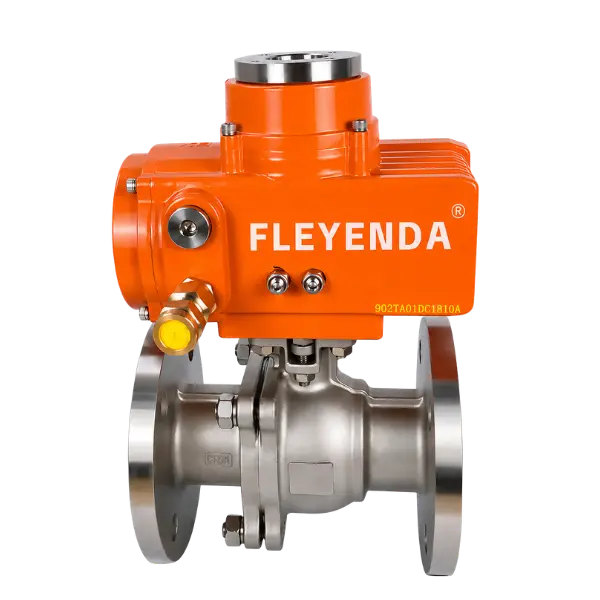
A general-purpose industrial electric ball valve for automated isolation in water, oil, gas, chemical and compatible process systems.
The series covers flanged pipeline applications and supports different electric actuator voltages and control configurations.
Typical selection: industrial pipeline isolation where a robust flanged connection and remote electric operation are required.
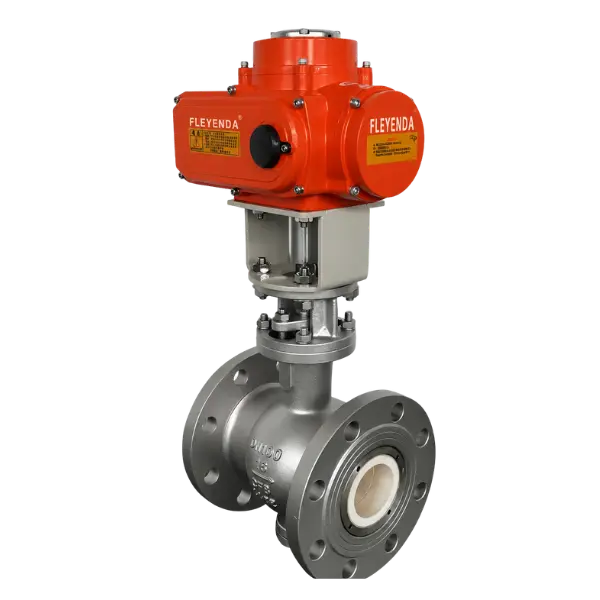
A V-port electric ball valve developed for applications requiring proportional flow regulation rather than basic on-off isolation.
Different V-notch configurations can be selected according to required flow capacity and controllability.
Typical selection: water regulation, process liquids, chemical control, dosing and automated flow-control loops.
A three-piece stainless steel electric ball valve designed for industrial applications where maintainability and multiple connection options are important.
The removable center-body construction can make inspection and servicing more convenient in appropriate process systems.
Where Are Electric Ball Valves Commonly Used?
Water & Wastewater Treatment
An electric ball valve can automate treatment skids, filtration systems, chemical dosing lines, water distribution and pump isolation.
Remote operation is particularly useful at equipment locations where compressed air is unavailable.
Pump Systems
Electric ball valves can be integrated with pump control systems for automatic isolation, line switching, bypass and equipment sequencing.
Actuation time should be selected carefully to reduce the risk of hydraulic pressure surges.
Processamento Químico
Electric ball valve selection for chemical service should focus on body, ball, seat and lining compatibility before actuator options are considered.
Corrosive media may require PTFE/PFA-lined or compatible thermoplastic constructions.
Oil & Gas
Electric ball valves can provide automated pipeline isolation and remote control in suitable oil and gas applications.
Pressure rating, fire-safe design, actuator torque, hazardous-area certification and failure strategy should all be evaluated.
Electric Ball Valve Selection Checklist
Before requesting a quotation, provide enough information for both the valve and actuator to be selected as one assembly.
- Process medium and chemical concentration
- Valve size: DN / NPS
- Normal and maximum working pressure
- Maximum differential pressure
- Temperatura mínima e máxima
- 2-way, 3-way or V-port function
- Threaded, flanged, welded, union or sanitary connection
- Preferred body and seat materials
- On/off or modulating control
- Power supply: DC24V / AC110V / AC220V / other
- Required control signal and feedback
- Opening and closing time
- IP67 / IP68 requirement
- Explosion-proof requirement
- Quantity and project delivery requirements
If the application involves proportional flow regulation, also provide minimum, normal and maximum flow rates together with upstream and downstream pressure. This information is more useful than simply requesting a “DN50 modulating electric ball valve.”
Common Electric Ball Valve Selection Mistakes
| Mistake | Possible Result | Better Approach |
|---|---|---|
| Selecting by pipe size only | Wrong pressure, material or torque | Provide full process conditions |
| Using a standard ball valve for precise modulation | Poor control performance | Evaluate a V-port design |
| Ignoring chemical concentration | Corrosion or seal failure | Check complete material compatibility |
| Oversizing actuator without checking stem limits | Mechanical overload | Verify valve torque and maximum stem torque |
| Choosing the wrong voltage | Installation or control problems | Confirm site power before ordering |
| Ignoring actuation speed | Water hammer or slow sequence | Match travel time to the process |
| Assuming all IP68 ratings are identical | Water-ingress risk | Check manufacturer’s immersion conditions |
Need Help Choosing an Electric Ball Valve?
The best electric ball valve is the one configured around the actual process rather than selected from valve size alone.
Fleyenda supports industrial buyers, equipment manufacturers and engineering projects with electric actuated ball valve configurations for isolation, flow routing and proportional control.
Share your process data, piping requirements and automation conditions so the valve body and electric actuator can be evaluated as one complete assembly.
Send your electric ball valve requirements for technical selection and quotation.
Electric Ball Valve Frequently Asked Questions
How do I choose the right electric ball valve?
Start with the process medium, pressure, temperature and flow function. Then select the valve body, seat material, connection type, actuator torque, voltage, control signal and environmental protection.
What voltage does an electric ball valve use?
Common actuator options include DC24V, AC24V, AC110V, AC220V and AC380V depending on actuator model and torque requirements.
Can an electric ball valve control flow?
Yes, but a V-port electric ball valve is normally more suitable for proportional flow regulation than a conventional round-port ball valve.
What is the difference between an on/off and modulating electric ball valve?
An on/off valve moves between fully open and fully closed positions. A modulating electric ball valve can move to intermediate positions according to a proportional control command.
How do I size an electric actuator for a ball valve?
Use the valve manufacturer’s required operating torque under the maximum expected process conditions and apply the appropriate engineering margin without exceeding allowable valve stem torque.
Can an electric ball valve be used outdoors?
Yes, if the actuator enclosure, cable glands and electrical installation provide appropriate protection for the environment. Check IP rating, temperature range and corrosion exposure.
What is an IP68 electric ball valve?
It uses an electric actuator enclosure rated for dust-tight protection and specified immersion conditions. The exact immersion depth and duration should be confirmed with the manufacturer.
Can electric ball valves be explosion-proof?
Selected electric actuator configurations are available with explosion-protection certifications. The exact rating must match the site’s hazardous-area requirements.
Should I choose a threaded or flanged electric ball valve?
Threaded valves are compact and common on smaller lines, while flanged electric ball valves are widely used in larger industrial process piping and applications requiring bolted connections.
What information should I send when requesting an electric ball valve quote?
Provide medium, valve size, pressure, temperature, connection, flow function, material requirements, voltage, control mode, control signal, environmental requirements and quantity.
Conclusion: Choosing the Right Electric Ball Valve
Choosing an electric ball valve should begin with the process conditions rather than the actuator specification.
First confirm the medium, pressure, temperature, valve size and required flow function. Then select a suitable valve body, seat material and connection.
After the valve is defined, the electric actuator can be selected according to required torque, operating speed, voltage, control mode, feedback, IP rating and hazardous-area requirements.
A 2-way electric ball valve is suitable for many isolation applications, while a 3-way valve supports flow routing and a V-port electric ball valve is better suited to proportional control.
Treating the valve and actuator as one engineered assembly is the most reliable way to achieve long-term performance in water treatment, pump systems, chemical processing, oil and gas, and other industrial automation applications.