


Actuator Valve Selection: Electric vs Pneumatic for Industrial Use
Selecting the right actuator valve is an important decision in industrial flow control. An actuator valve combines a valve body with an automated operating mechanism, allowing industrial systems to open, close, or regulate fluid flow without continuous manual intervention.
Electric and pneumatic actuator valves are widely used in water treatment, pump systems, oil and gas processing, chemical plants, and industrial production lines. Both can automate ball valves, butterfly valves, and suitable control valves, but their operating characteristics and infrastructure requirements differ.
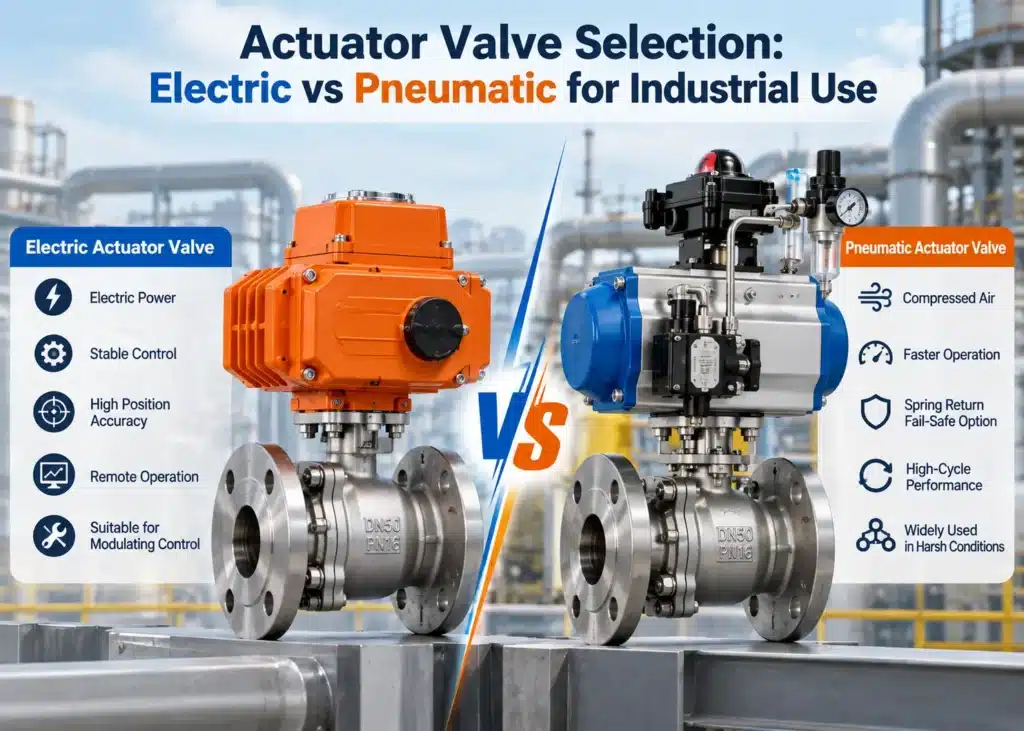
An electric actuator valve uses an electric motor and mechanical transmission to operate the valve. A pneumatic actuator valve uses compressed air to generate motion. The choice affects valve speed, control accuracy, fail-safe response, installation cost, maintenance, and operating reliability.
This guide compares electric and pneumatic actuator valve systems from an engineering and purchasing perspective. It explains where each technology performs best, which specifications matter, and how to select a complete valve-and-actuator assembly for industrial applications.
The best actuator valve is the assembly that delivers the required valve movement, control function, failure response, and service life under the actual process conditions.
What Is an Actuator Valve?
An actuator valve is a valve assembly equipped with a device that moves the internal closure element. Instead of relying on an operator to turn a handwheel or lever, the actuator responds to a control command and changes the valve position.
In industrial automation, the most common functions are on-off isolation, flow diversion, and proportional regulation. The actuator may rotate a ball or butterfly disc, move a gate, or position the stem of a globe control valve.
The term actuator valve is often used interchangeably with actuated valve. However, a valve actuator refers specifically to the operating device, while an actuator valve usually refers to the complete valve and actuator assembly.
Main Components of an Industrial Actuator Valve
A complete actuator valve generally includes a valve body, internal closure element, stem, actuator, mounting interface, and the control accessories required by the application.
The valve body and internal components determine pressure capability, medium compatibility, leakage performance, and flow characteristics. The actuator determines available operating torque or thrust, movement speed, and response to control signals.
Accessories such as position switches, feedback transmitters, pilot solenoid valves, positioners, and manual overrides may also be required.
Since these components operate together, actuator valve selection should start with the process duty and valve mechanics rather than actuator technology alone.
How Does an Electric Actuator Valve Work?
An electric actuator valve uses an electric motor to generate movement. A gearbox or mechanical transmission converts motor rotation into the torque or thrust required to operate the valve.
For quarter-turn ball and butterfly valves, the actuator typically rotates the shaft through approximately 90 degrees. Gate and certain globe valve applications may require multi-turn or linear actuator arrangements.
Depending on the actuator, control may use simple open-close commands, 4–20 mA analog signals, 0–10 V signals, or supported digital communications.
Limit switches, position sensors, and control electronics stop the movement at the appropriate position and can report valve status to a PLC, DCS, or SCADA system.
Advantages of Electric Actuator Valves
Electric actuator valves are useful where reliable electrical power is available but compressed air is not. They can provide convenient remote operation and, with appropriate modulating control, repeatable positioning for flow regulation.
Electric actuators can also integrate with automated monitoring systems that require position feedback, local indication, and diagnostics.
Since electric actuation does not require a dedicated compressed-air network, installation can be simpler in remote pump stations, water treatment equipment, and isolated process skids.
Limitations to Consider
Electric actuators may have longer operating times than comparable fast-acting pneumatic configurations. Actual speed depends on actuator size, gearing, torque rating, and motor design.
Another important consideration is power-failure behavior. A conventional electric actuator does not automatically return the valve to a safe position when electrical power disappears.
Applications requiring automatic fail-open or fail-close movement need an appropriate stored-energy or verified fail-safe mechanism.
Motor duty cycle, environmental protection, electrical heat management, and hazardous-area certification must also be evaluated.
¿Cómo funciona una válvula de accionamiento neumático?
A pneumatic actuator valve uses compressed air to produce mechanical movement. Air pressure acts on a piston, diaphragm, or another operating mechanism, generating the torque or thrust required to move the valve.
Rotary pneumatic actuators commonly operate ball and butterfly valves. Suitable linear pneumatic actuators can operate globe and other linear-stroke valves.
In on-off applications, a pilot solenoid valve commonly directs compressed air according to a command from the control system.
For proportional control, a pneumatic positioner adjusts actuator pressure according to the commanded valve position. A suitably designed control valve can then operate at intermediate openings.
Double-Acting Pneumatic Actuators
A double-acting actuator uses compressed air to move the valve in both directions. It is commonly selected for industrial switching where a dependable instrument-air supply is available.
Double-acting configurations can be compact and suitable for applications involving rapid movement or frequent operation.
Spring-Return Pneumatic Actuators
A spring-return actuator uses compressed air in one direction and stored spring force in the other.
It can provide a predetermined position when the required air supply is removed, making it useful for selected process safety and shutdown functions.
The exact response to electrical signal loss depends on the pilot valve and pneumatic control circuit. The complete system must be configured for the required failure behavior.
Limitations to Consider
Pneumatic systems require suitable compressed-air infrastructure. Compressors, dryers, filters, regulators, distribution tubing, and air-control accessories all contribute to installation and operating costs.
Moisture, contamination, insufficient air pressure, and leakage can affect actuator performance. High-cycle systems require regular inspection of seals, pilot valves, and air preparation equipment.
Electric vs Pneumatic Actuator Valve: Key Differences
Both electric and pneumatic actuator valves can perform industrial isolation and regulating functions. The most important differences involve the available utilities, operating speed, control requirements, safety response, and total cost of ownership.
| Factor de selección | Válvula con actuador eléctrico | Válvula con actuador neumático |
|---|---|---|
| Power Source | Energía eléctrica | Aire comprimido |
| Principio de funcionamiento | Motor and transmission | Air-driven piston or diaphragm |
| Operating Speed | Depends on motor and gearing | Often capable of faster switching |
| Control de encendido y apagado | Suitable | Suitable |
| Control de modulación | With modulating electric actuator | With suitable positioner and actuator |
| Failure Response | Automatic return requires a suitable fail-safe system | Spring-return options available |
| Infrastructure | Power and electrical controls | Instrument air and pneumatic controls |
| High-Cycle Switching | Subject to actuator duty rating | Often suitable, subject to sizing |
| Retroalimentación de posición | Switches, transmitters, and intelligent controls | Limit switches and positioners |
| Maintenance Focus | Motor, gearing, electrical connections | Air supply, seals, pilot valves, positioners |
| Typical Advantage | Remote operation without compressed air | Fast switching and spring-return options |
These comparisons describe common engineering tendencies rather than absolute limits. The correct configuration depends on the exact valve, actuator, and operating requirements.
What Matters Most When Selecting an Actuator Valve?
Operating Speed and Cycle Frequency
Pneumatic actuator valves are often preferred for rapid switching and frequent cycling. Actual stroke time depends on actuator size, air pressure, pilot valve flow capacity, tubing, and speed controls.
Electric actuators may be appropriate when controlled movement and remote positioning matter more than minimum switching time.
In water pipelines, rapid closure can create pressure surges and water hammer. The required opening and closing times should be determined from the process rather than choosing the fastest actuator.
Control Accuracy and Modulation
Electric modulating actuators can provide repeatable positioning with suitable feedback electronics. Pneumatic actuators can also provide proportional control when paired with a correctly selected positioner.
However, actuator position accuracy does not automatically produce accurate flow regulation. Valve Cv/Kv, flow characteristic, pressure differential, and controllable range also matter.
A V-port ball valve is generally more suitable for proportional flow control than a standard round-port ball valve intended primarily for isolation.
Torque and Thrust Requirements
Actuator sizing should be based on the maximum required valve torque or thrust throughout the complete stroke.
Ball valve breakaway torque changes with differential pressure, seat loading, temperature, deposits, and operating history. Butterfly valves and globe valves have different torque or thrust characteristics.
Pneumatic actuators must be checked at minimum guaranteed air pressure. Electric actuators must provide adequate rated output under the specified power and duty conditions.
Fail-Safe Operation
Engineers should define the required valve position when electrical power, instrument air, or control signals are lost.
Spring-return pneumatic actuators can move toward a predetermined position when air is removed. Electric actuators require a suitable fail-safe or stored-energy system for automatic movement after power loss.
Protección del medio ambiente
Outdoor installations may require protection from rain, dust, humidity, corrosion, and extreme temperatures. Electric actuator protection ratings such as IP67 or IP68 should be matched to the installation.
In hazardous industrial locations, suitable explosion-protected electrical equipment must be selected according to the applicable area classification and certification requirements.
Total Cost of Ownership
Electric actuator valves may reduce infrastructure requirements where compressed air is unavailable. Pneumatic actuators may be economical where a reliable instrument-air network already exists.
Purchase price alone does not determine overall cost. Installation, air generation, power consumption, accessories, maintenance, cycle frequency, and downtime should all be considered.
Which Industrial Valve Types Can Use Electric or Pneumatic Actuators?
Válvulas de bola
Actuated ball valves are widely used for on-off isolation and pipeline switching. Their quarter-turn construction is compatible with electric and pneumatic rotary actuators.
V-port or characterized ball designs provide more suitable flow characteristics for modulating applications.
Válvulas de mariposa
Actuated butterfly valves are commonly selected for medium- and large-diameter pipelines because of their compact construction.
They are used in industrial water distribution, treatment plants, process pipelines, and suitable isolation or regulating applications.
Válvulas de compuerta
Actuated gate valves are primarily used for full-open or full-closed isolation. Suitable electric multi-turn or pneumatic linear actuators may be selected according to the valve construction.
Globe and Control Valves
Globe control valves use regulating trim to control fluid flow over a defined operating range.
Electric or pneumatic actuators are selected according to the required thrust, positioning accuracy, response speed, and available utilities.
Knife Gate Valves
Knife gate valves can be used for appropriate slurry, pulp, and solids-bearing services. Actuator selection should consider operating thrust, deposits, shut-off requirements, and process pressure.
Electric vs Pneumatic Actuator Valve Applications
Tratamiento de agua y aguas residuales
Electric actuator valves are often suitable for remote water treatment facilities, distribution lines, and installations without compressed air.
Pneumatic actuator valves can be used for filter sequencing, repeated switching, and suitable chemical-handling duties where instrument air is available.
Pump Systems and Equipment Skids
Electric ball and butterfly valves support automated pump isolation, distribution, and selected bypass duties with PLC integration.
Pneumatic actuators are useful where rapid or frequent switching is required. In both cases, valve operating time should be evaluated against hydraulic pressure transients.
Oil and Gas Processing
Pneumatic actuator valves are widely used where reliable instrument air is available and defined spring-return behavior may be required.
Electric actuator valves are also used in suitable pipeline and process applications when electrical supply, environmental protection, and hazardous-area requirements are addressed.
Procesamiento químico
Electric and pneumatic actuator valves can support chemical transfer, dosing, diversion, and isolation.
Body and seat compatibility, corrosion resistance, hazardous-area classification, and emergency operating requirements are important selection factors.
Metallurgy and Heavy Industry
Metallurgical facilities use automated valves for cooling water, process gas, compressed air, steam, and utility systems.
Heat, dust, vibration, cycle frequency, and equipment accessibility should be evaluated when selecting electric or pneumatic actuation.
Fleyenda Actuator Valve Solutions for Industrial Automation
Fleyenda supplies electric and pneumatic actuator valve assemblies for industrial isolation, high-pressure pipeline control, and proportional flow regulation. The following four products represent different actuation and valve-design requirements.
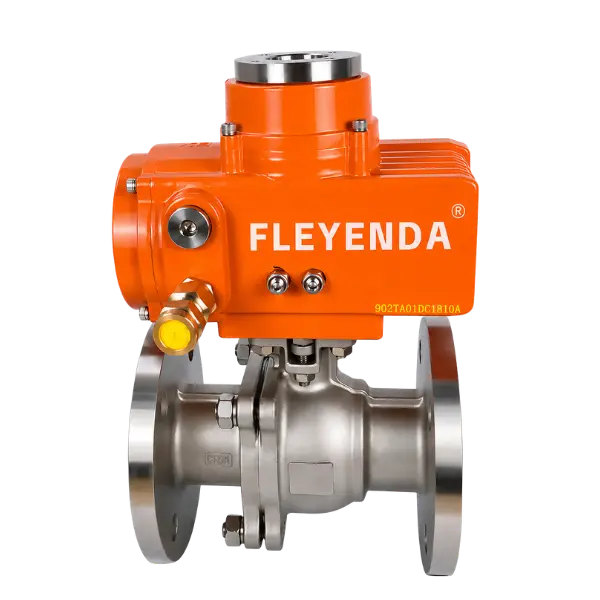
The FLE-Q-F combines an industrial flanged ball valve with an electric quarter-turn actuator for automated isolation and remote pipeline switching.
Its electric operation is useful where compressed air is unavailable and reliable PLC-controlled valve movement is required.
Body and actuator configurations can be selected to match the required pressure, medium, voltage, and control function.
Recommended for: water treatment, pump systems, chemical processing, industrial utilities, and remotely operated pipelines.
| Model | FLE-Q-F | Gama de tallas | DN15–DN300 |
| Presión | PN16–PN40 | Connection | Con brida |
| Actuador | Electric Quarter-Turn | Control | On/Off; Selected Modulating Options |
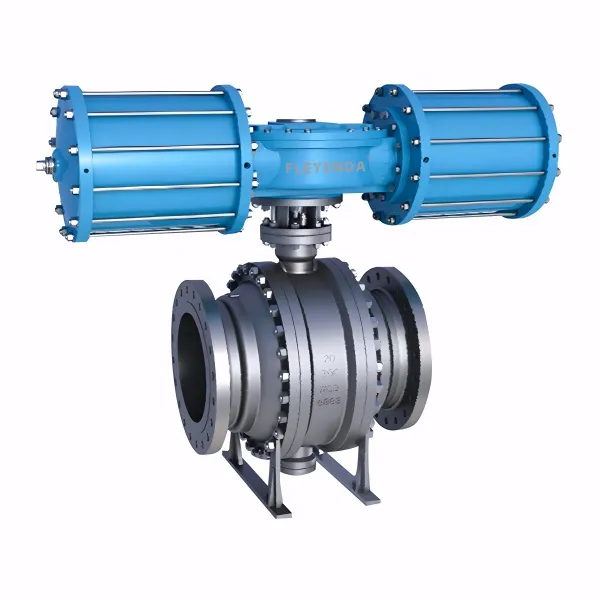
The FAW-Q combines a trunnion-supported industrial ball valve with an AW pneumatic actuator for large-diameter and demanding pipeline isolation.
The supported ball construction helps manage pressure-induced loading on the valve seats. It is suited to selected high-pressure isolation applications where valve torque and actuator sizing are critical.
Double-acting and spring-return configurations can be evaluated according to the required instrument-air conditions and failure response.
Recommended for: oil and gas pipelines, high-pressure utilities, pump stations, and large-diameter industrial isolation.
| Model | FAW-Q | Gama de tallas | DN50–DN600 |
| Presión | Class 150–2500 / PN16–PN420 | Connection | Con brida |
| Actuador | Pneumatic AW Series | Función | Double Acting / Spring Return |
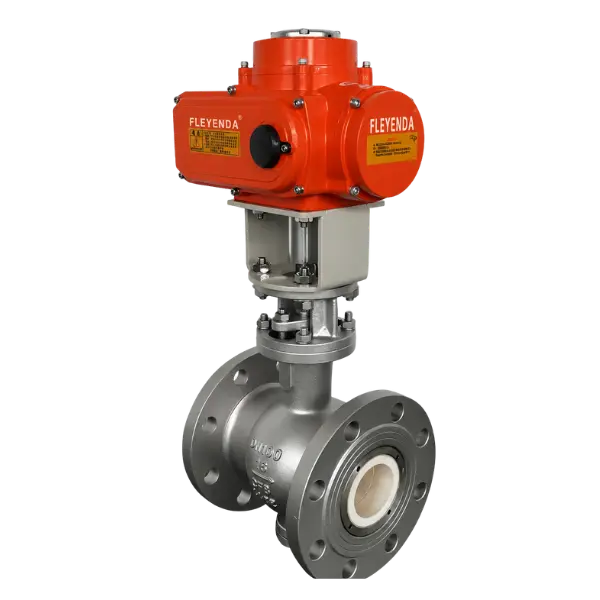
The FLE-VQ-F combines a V-port segmented ball valve with an electric actuator for proportional flow regulation.
Its characterized V-shaped opening provides more usable regulating travel than a conventional round-port ball valve.
Selected modulating actuator configurations support 4–20 mA commands and valve-position feedback for automated process control.
Recommended for: water flow regulation, chemical processing, industrial process-liquid control, and compatible pulp or slurry applications.
| Model | FLE-VQ-F | Gama de tallas | DN25–DN300 |
| Valve Design | V-Port Segmented Ball | Connection | Con brida |
| Actuador | Electric Modulating | Control | Selected 4–20 mA / Feedback Options |

The FAT-VQ-F combines a V-port ball valve with a pneumatic actuator for flow regulation in industrial process systems.
The V-shaped ball makes it more suitable for throttling than a conventional round-port isolation valve. A compatible pneumatic positioner can control intermediate valve positions.
Double-acting or spring-return actuator arrangements can be selected according to process control and failure-response requirements.
Recommended for: chemical flow regulation, industrial water treatment, process automation, and compatible pulp or slurry applications.
| Model | FAT-VQ-F | Gama de tallas | DN15–DN200 |
| Presión | PN16–PN40 | Connection | Con brida |
| Actuador | Double Acting / Spring Return | Control | Positioner for Modulating Service |
Actuator Valve Selection Checklist for Industrial Buyers
Choosing an actuator valve requires more than identifying nominal diameter and actuator power source.
The valve body, seats, actuator, control accessories, and available utilities should be specified as one complete assembly.
Step 1: Define the Valve Function
Identify whether the valve is intended for isolation, flow diversion, emergency shutdown, or proportional control.
For regulating service, determine minimum, normal, and maximum flow rates along with the available pressure differential.
Step 2: Confirm Process Conditions
Specify the medium, operating pressure, maximum differential pressure, temperature, pipe size, connection, and required leakage performance.
Corrosive, abrasive, viscous, or solids-bearing media may require special body and seat materials.
Step 3: Select Electric or Pneumatic Actuation
Confirm available power and instrument-air infrastructure. Consider movement speed, operating frequency, positioning requirements, maintenance capability, and failure response.
Step 4: Calculate Torque or Thrust
Use manufacturer-specific valve torque or thrust requirements under actual process conditions.
Pneumatic actuator sizing should use minimum guaranteed air pressure. Electric sizing should consider supply voltage, duty rating, and available output torque or thrust.
Step 5: Define the Control Interface
Specify open-close commands, 4–20 mA proportional control, feedback signals, or supported digital communication where required.
For pneumatic configurations, confirm pilot solenoid and positioner requirements. For electric configurations, verify the actual supported command and feedback functions.
Step 6: Confirm Protection and Failure Behavior
Define the required valve state during loss of electrical power, loss of instrument air, or emergency shutdown.
Also specify environmental protection, hazardous-area certification, ambient temperature, and manual operating requirements.
A useful actuator valve purchase specification should include:
- Valve type, nominal size, and connection standard
- Process medium, pressure, differential pressure, and temperature
- On-off or modulating control function
- Required Cv/Kv or flow range for regulating duty
- Electrical voltage or minimum pneumatic air pressure
- Required actuator torque, thrust, and stroke time
- Failure position and control-system interface
- Environmental protection and certification requirements
- Quantity and project delivery requirements
Request an Industrial Actuator Valve Configuration & Quote
Fleyenda supports industrial equipment manufacturers, engineering contractors, and plant operators with actuator valve configurations for water treatment, pump systems, oil and gas, chemical processing, and industrial automation.
Share your process requirements to identify a suitable valve body, actuator type, control arrangement, and accessories.
Ball, butterfly, gate, globe, V-port, or other suitable type
Medium, pressure, temperature, differential pressure, and flow
Available voltage or minimum instrument-air pressure
On-off, 4–20 mA, PLC/DCS, or position feedback
Fail-open, fail-closed, fail-in-place, IP rating, or hazardous-area protection
Quantity, project location, drawings, and delivery schedule
Send your actuator valve requirements or technical drawings to Fleyenda for technical selection and quotation.
Preguntas frecuentes
What is an actuator valve?
An actuator valve is a valve combined with a device that opens, closes, or regulates the valve automatically. The actuator may use electric power, compressed air, or another power source.
Which is better, an electric or pneumatic actuator valve?
Neither is universally better. Electric actuators are often practical when compressed air is unavailable. Pneumatic actuators are often suitable for fast switching and applications requiring spring-return operation.
Are pneumatic actuator valves faster than electric valves?
Pneumatic configurations can often move faster, but actual stroke time depends on actuator sizing, air supply, pilot valve capacity, and speed control. Electric actuators are available in different speed configurations.
Can an electric actuator valve regulate flow?
Yes. A suitable modulating electric actuator combined with a V-port, globe, or other regulating valve can provide proportional flow control.
Can pneumatic actuator valves provide proportional control?
Yes. A pneumatic control valve equipped with a suitable positioner can regulate intermediate valve positions according to a command signal.
What happens when an actuator valve loses power?
The result depends on the design. Conventional electric actuators may remain near their last position unless a fail-safe mechanism is provided. Spring-return pneumatic actuators can move toward a predetermined position when air supply is removed.
Can actuator valves connect to a PLC?
Yes. Electric and pneumatic actuator valve assemblies can be integrated with PLC and DCS systems using suitable command, feedback, and positioning accessories.
What is the difference between an actuator valve and a valve actuator?
A valve actuator is the device that produces valve movement. An actuator valve normally refers to the complete assembly of the valve and actuator.
What information is needed to order an actuator valve?
Provide valve type, size, connection, medium, pressure, temperature, operating function, power or air supply, failure position, control interface, and purchasing quantity.
Conclusion: Electric or Pneumatic Actuator Valve?
Electric and pneumatic actuator valves both provide effective solutions for industrial automation, but their suitability depends on the process requirements.
Electric actuator valves are often attractive where compressed air is unavailable or convenient electrical control and position feedback are important.
Pneumatic actuator valves are frequently selected for rapid switching, repetitive operation, high-force actuation, and suitable spring-return safety functions where reliable compressed air is available.
The final selection should consider valve type, required torque or thrust, operating speed, process medium, positioning accuracy, failure response, and lifetime operating cost.
For water treatment, pump systems, oil and gas, chemical processing, and other industrial applications, selecting the valve and actuator as one engineered assembly provides the most reliable approach to automated flow control.