


Butterfly Valve Guide
Butterfly valves are compact quarter-turn valves used to isolate, start, stop, and regulate fluid flow in industrial piping systems. Their simple construction, short installation length, relatively low weight, and suitability for medium and large pipe diameters make them widely used in water treatment, HVAC, chemical processing, power generation, marine systems, industrial automation, and many other applications.
This butterfly valve guide explains the operating principle, construction, common valve types, materials, electric actuation, applications, selection criteria, relevant standards, installation considerations, and the differences between butterfly valves and other common industrial valves.
Butterfly Valve Guide Contents
- What Is a Butterfly Valve?
- How Does a Butterfly Valve Work?
- Types of Butterfly Valves
- Electric Actuated Butterfly Valves
- Materials and Seat Selection
- Electric Butterfly Valve Selection
- Butterfly Valve Applications
- Advantages and Valve Comparison
- How to Select a Butterfly Valve
- Standards
- Installation and Maintenance
- Butterfly Valve FAQ
What Is a Butterfly Valve?
A válvula de mariposa is a rotary valve that uses a circular or near-circular disc to control fluid passing through a pipeline. The disc is connected to a shaft and rotates approximately one quarter turn between the closed and open positions.
When the valve is closed, the disc is positioned across the flow passage and engages the valve seat or sealing system. As the disc rotates toward the open position, the available flow area increases. In the fully open position, the disc is substantially aligned with the direction of flow, although it normally remains inside the flow path.
Compared with many gate and globe valve designs, butterfly valves typically require less installation space and have lower weight. These advantages become particularly important as pipeline diameter increases, which is one reason butterfly valves are widely used in large water, HVAC, utility, and industrial process systems.
| Característica | Typical Butterfly Valve Characteristics |
|---|---|
| Operating movement | Quarter-turn rotary operation |
| Main functions | Isolation, ON/OFF service and suitable throttling applications |
| Main components | Body, disc, shaft, seat, seals and operator or actuator |
| Common connections | Wafer, lug and flanged |
| Common sealing geometries | Concentric, double offset and triple offset |
| Operation methods | Lever, gearbox, pneumatic, electric or hydraulic actuator |
| Aplicaciones típicas | Water, HVAC, chemical, industrial automation, power and marine systems |
How Does a Butterfly Valve Work?
The operating principle of a butterfly valve is straightforward. Torque from a hand lever, gearbox, pneumatic actuator, electric actuator, or hydraulic actuator is transmitted through the valve shaft to the disc. When the shaft rotates, the disc changes its angle relative to the flow direction.
In the closed position, the disc engages the seat and blocks the pipeline. During opening, the disc gradually moves away from the sealing position and increases the available flow area. At approximately 90 degrees of rotation, the valve reaches its fully open position.
A butterfly valve can also be used for flow regulation when the valve design and sizing are suitable for throttling service. In these applications, engineers should consider pressure drop, fluid velocity, cavitation, noise, operating torque, and the required control range instead of simply selecting the valve according to pipe diameter.
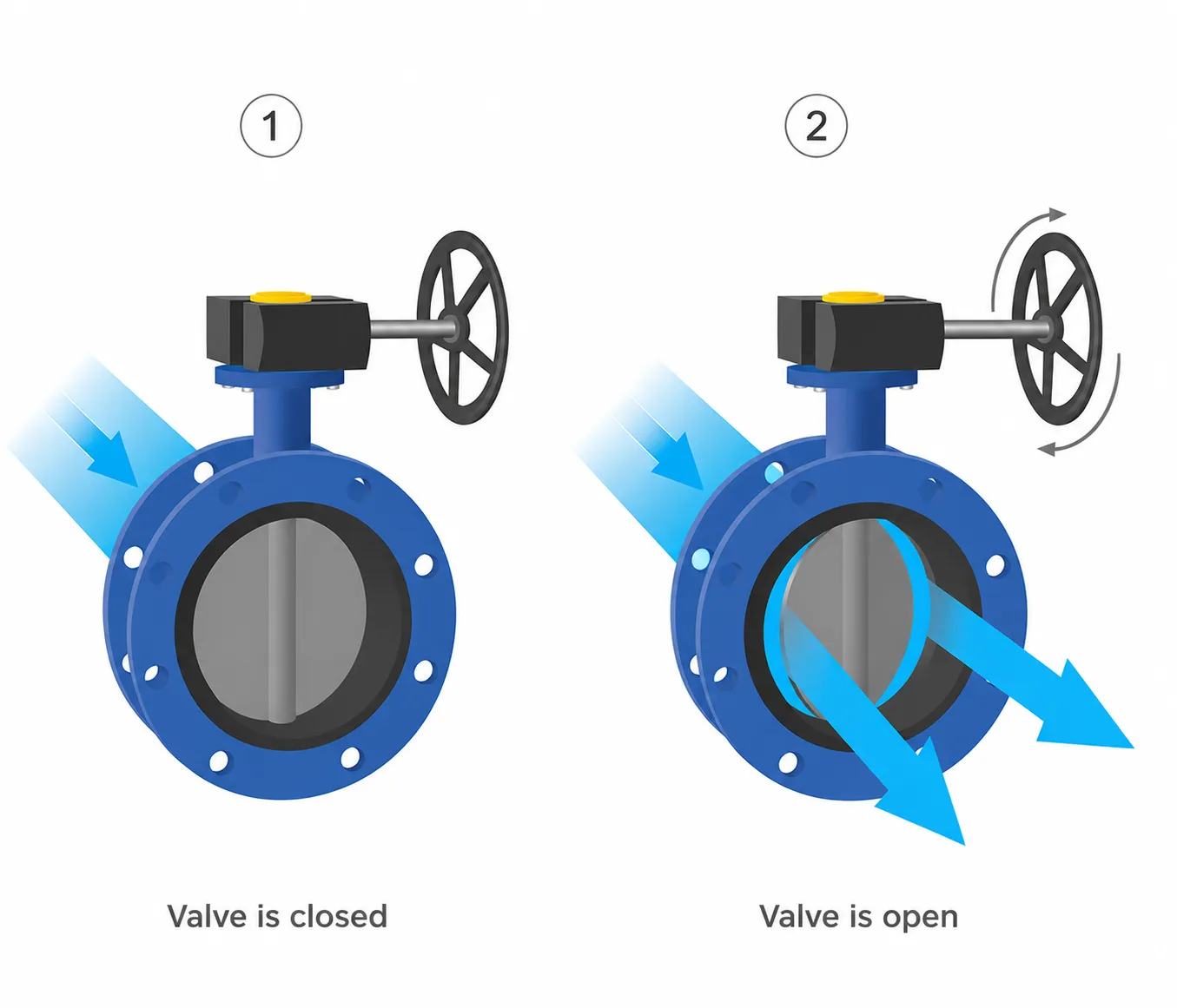
Main Butterfly Valve Parts
The valve body contains the process pressure and connects the valve to the pipeline. Inside the body, the disc controls the flow while the stem or shaft transmits torque from the operator. The seat creates the sealing interface, while bearings, bushings, and stem seals support the rotating components and help prevent external leakage.
| Componente | Función | Typical Selection Consideration |
|---|---|---|
| Cuerpo | Contains pressure and connects to the pipeline | Pressure, corrosion, connection type |
| Disco | Controls and isolates flow | Media compatibility, corrosion, flow conditions |
| Stem / Shaft | Transfers actuator torque to the disc | Strength and corrosion resistance |
| Asiento | Creates the shutoff seal | Media, temperature and leakage requirement |
| Bearings / Bushings | Support shaft movement and alignment | Load and service conditions |
| Actuador | Opens, closes or positions the valve | Torque, speed, control and power supply |
Types of Butterfly Valves
Butterfly valves are commonly classified in two ways: by pipeline connection and by disc or sealing geometry. The connection determines how the valve is installed, while the sealing geometry strongly influences seat wear, pressure-temperature capability, and the type of service for which the valve is suitable.
| Tipo | Construcción | Uso típico | Main Advantage |
|---|---|---|---|
| Wafer Butterfly Valve | Installed between pipeline flanges | Water, HVAC and general industry | Compact and economical |
| Lug Butterfly Valve | Body includes threaded or through lugs | Industrial piping and maintenance-sensitive systems | More installation flexibility |
| Flanged Butterfly Valve | Integral flange connection | Large pipelines and infrastructure | Robust pipeline connection |
| Concentric Butterfly Valve | Centerline shaft and resilient seat | Water, HVAC and utility service | Simple and economical design |
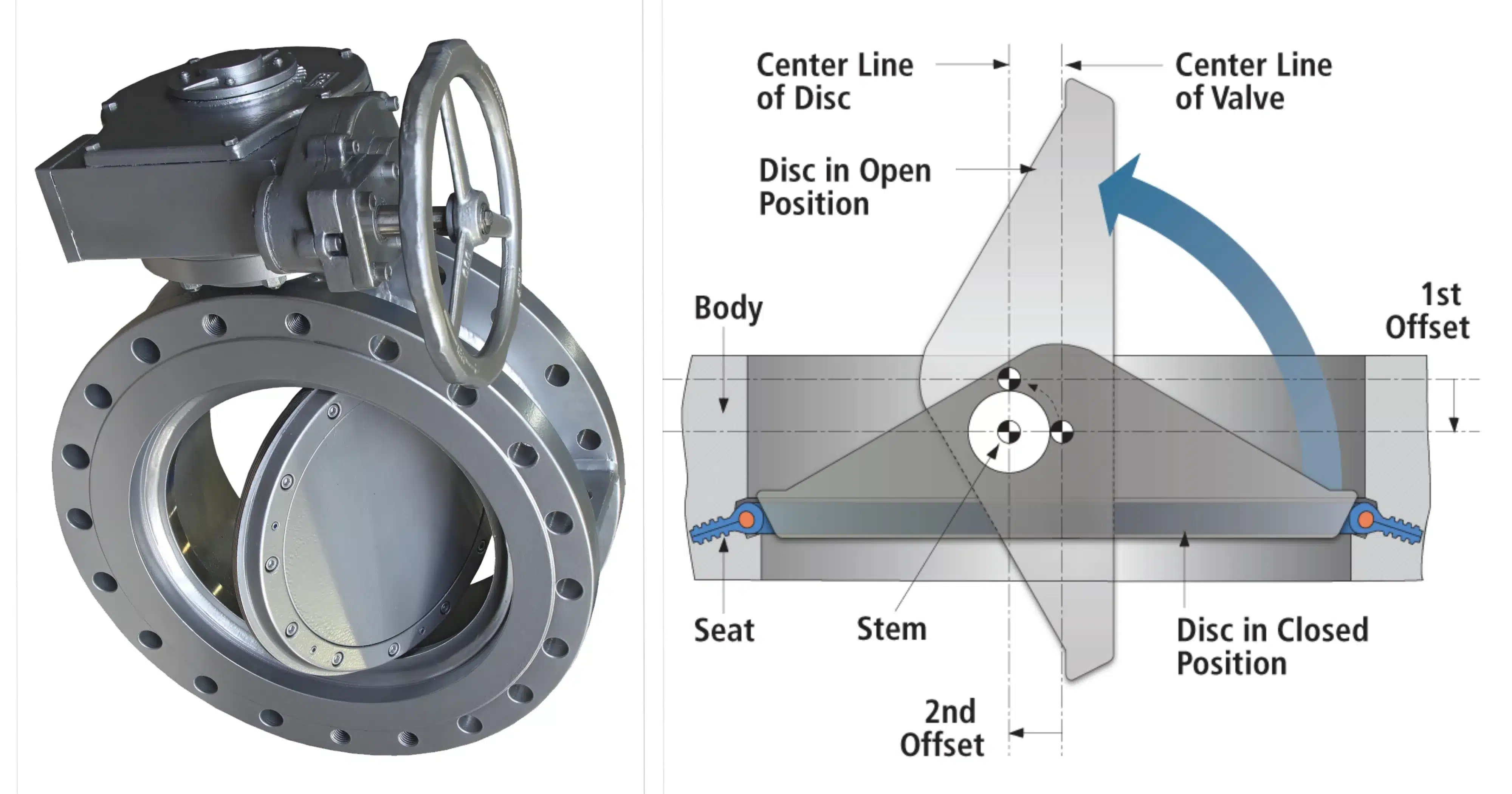
| Double Offset Butterfly Valve | Offset shaft and disc geometry | More demanding industrial service | Reduced seat rubbing |
| Triple Offset Butterfly Valve | Three geometric offsets | High-temperature and severe service | Minimal sliding seal contact |
A wafer butterfly valve is generally the most compact body style. A lug valve can provide additional maintenance flexibility, while a flanged butterfly valve is often preferred for larger or more mechanically demanding piping systems. Dead-end capability should never be assumed from the body style alone and must be verified from the valve manufacturer’s technical data.
From a sealing perspective, concentric valves are widely used with resilient seats for water and general utility applications. Double-offset designs reduce seat rubbing and are commonly used for more demanding process conditions. Triple-offset designs further change the sealing geometry and are frequently used with engineered metal sealing in severe-service applications.
Electric Actuated Butterfly Valves
Electric actuated butterfly valves combine a butterfly valve with a rotary electric actuator to provide automated opening, closing, or positioning. They are useful where remote operation, PLC or DCS integration, position feedback, modulating control, or automatic operating sequences are required.
The following Fleyenda configurations cover common industrial requirements including explosion-proof environments, wafer and flanged connections, resilient sealing, hard sealing, triple-offset construction, and PTFE-lined chemical service.
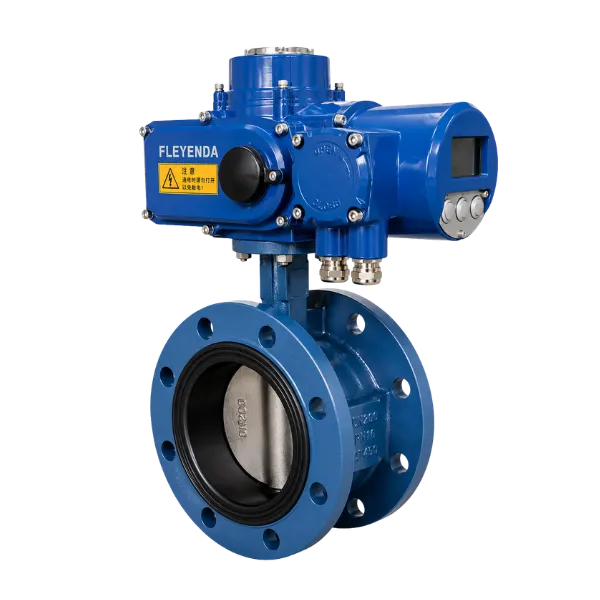
Flanged EPDM
Electric Cast Iron Flanged EPDM Butterfly Valve
Electric actuated cast iron flanged butterfly valve with EPDM seat for water treatment, HVAC systems, and industrial pipeline applications.
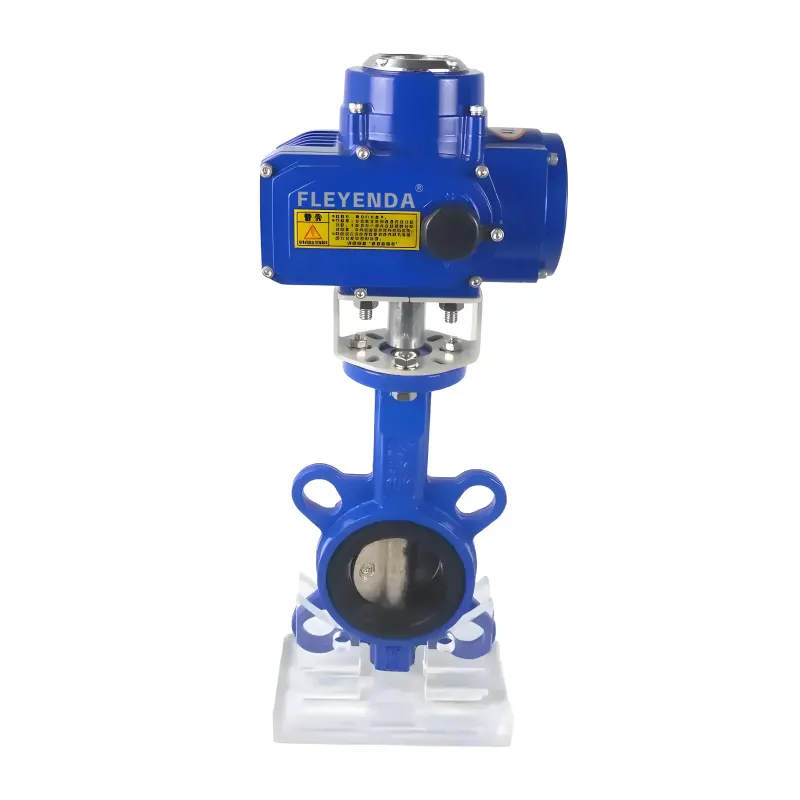
Wafer EPDM
Electric Cast Iron Wafer EPDM Butterfly Valve
Compact electric actuated wafer butterfly valve with cast iron body and EPDM sealing for industrial and water applications.
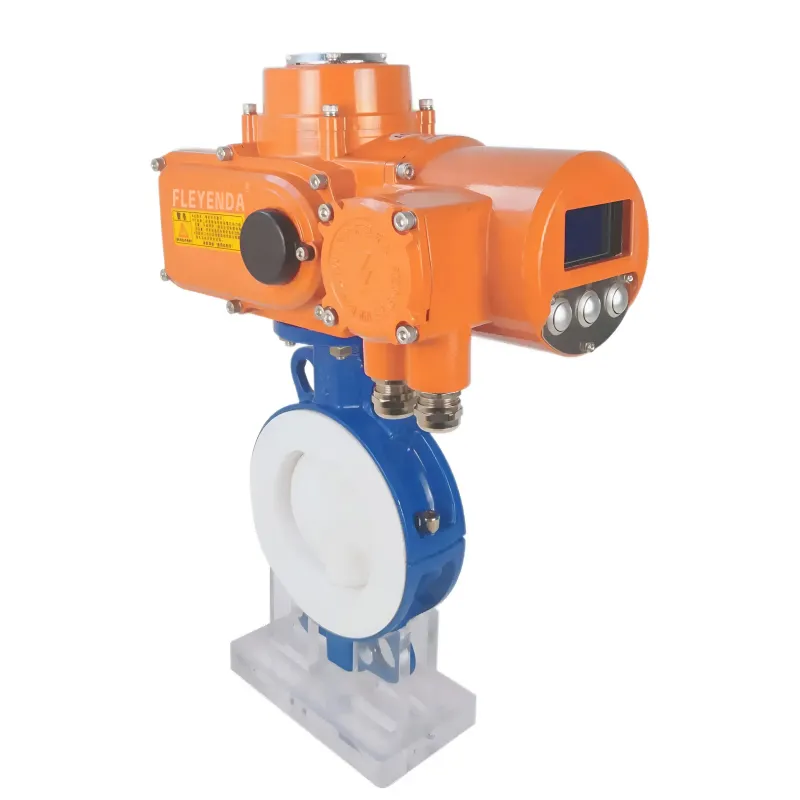
Fluorine Lined
Electric Cast Iron Flanged Fluorine Lining Butterfly Valve
Electric actuated fluorine lined butterfly valve designed for corrosive media applications requiring chemical resistance.

Hard Seated
Electric Stainless Steel Hard Seated Valve
Stainless steel electric actuated butterfly valve with hard seated design for demanding industrial and high temperature applications.
Need a Different Butterfly Valve Configuration?Valve size, body material, disc material, seat material, connection standard, actuator voltage, control function, environmental protection, and accessories can be selected according to project requirements.
Butterfly Valve Materials and Seat Selection
Material selection has a direct impact on corrosion resistance, temperature capability, sealing performance, and service life. The body, disc, shaft, seat, and seals should therefore be considered as a complete material system rather than selecting only the valve body.
Ductile iron is widely used in water, HVAC, and utility butterfly valves. Carbon steel is common in industrial process systems, while stainless steel is selected when improved corrosion resistance is required. Duplex stainless steels and special alloys may be considered for seawater, chloride-rich fluids, or more aggressive chemical environments.
The valve seat is particularly important because it directly contacts both the disc and process fluid. EPDM is commonly used for water and HVAC service, NBR is often considered for oil-related applications, FKM can provide improved resistance to many hydrocarbons and chemicals, PTFE is widely used for corrosive chemical media, and metal sealing is generally associated with higher-temperature or severe industrial service.
| Material | Common Application | Main Selection Consideration |
|---|---|---|
| Ductile Iron Body | Water, HVAC, utilities | Coating and corrosion environment |
| Carbon Steel Body | Industrial process systems | Pressure-temperature and corrosion conditions |
| Acero inoxidable | Chemical, clean and corrosive service | Correct stainless grade and media compatibility |
| EPDM Seat | Water and HVAC | Generally unsuitable for petroleum oils |
| NBR Seat | Oil-related utility service | Temperature and exact fluid compatibility |
| FKM Seat | Chemical and hydrocarbon service | Verify actual media and temperature |
| PTFE Seat / Lining | Corrosive chemicals | Pressure, temperature and valve construction |
| Metal Seat | High-temperature or severe service | Leakage requirement and sealing design |
How to Select an Electric Actuated Butterfly Valve
For an electric actuated butterfly valve, the valve body and electric actuator must be selected as one complete operating package. The actuator must provide sufficient torque under the maximum expected differential pressure, while its electrical and control characteristics must match the automation system.
The first decision is whether the valve requires simple ON/OFF control or modulating operation. ON/OFF actuators move between defined open and closed positions, while modulating actuators allow intermediate positioning. Where modulating control is required, the control and feedback interface may include signals such as 4–20 mA or 0–10 V, depending on the actuator specification.
Power supply, actuator torque, operating time, manual override, position feedback, waterproof protection, explosion-proof requirements, and fail-safe strategy should all be confirmed before ordering. Outdoor, corrosive, wet, dusty, or hazardous-area applications may require additional actuator protection.
| Elemento de selección | Information to Confirm |
|---|---|
| Valve | Size, pressure rating, wafer/lug/flanged connection and flange standard |
| Process | Media, operating pressure, design pressure and operating temperature |
| Materials | Body, disc, shaft and seat material |
| Actuador eléctrico | Required torque, power supply voltage and operating time |
| Control | ON/OFF or modulating operation, input signal and position feedback |
| Medio ambiente | Indoor/outdoor installation, waterproof or explosion-proof requirement |
| Additional Functions | Manual override, fail-safe strategy, communication and accessories |
Butterfly Valve Applications
Butterfly valves are used in a broad range of piping systems because their construction can be adapted through different body styles, sealing materials, disc materials, coatings, and actuators.
Agua y aguas residualesResilient-seated wafer, lug, and flanged butterfly valves are widely used in raw water, potable water, pumping stations, wastewater treatment, and distribution systems.
HVAC SystemsCompact butterfly valves are commonly used in chilled-water, cooling-water, and heating-water circuits, particularly where installation space is limited.
Procesamiento químicoPTFE-lined or corrosion-resistant valve configurations may be selected according to the chemical, concentration, pressure, and operating temperature.
Oil, Gas and PetrochemicalDouble-offset, triple-offset, hard-seated, and explosion-proof automated valve configurations may be required for more demanding process conditions.
Power and High-Temperature ServiceEngineered high-performance or triple-offset butterfly valves may be used where elevated temperatures and severe operating conditions exceed resilient-seat capability.
Automatización industrialElectric actuated butterfly valves are suitable for remotely controlled pipelines requiring PLC integration, valve position feedback, automatic sequencing, or modulating control.
Butterfly Valve Advantages, Limitations and Comparison
Butterfly valves are popular because they combine compact construction with relatively low weight and fast quarter-turn operation. In larger pipe sizes, this can reduce installation space, support requirements, actuator size, and overall project cost. Their rotary design also makes them easy to automate using electric or pneumatic actuators.
The main limitation is that the disc remains inside the fluid passage even when the valve is fully open. Seat materials also have specific temperature and chemical limitations, while abrasive fluids can accelerate disc and seat wear. For throttling applications, improper sizing may result in excessive velocity, noise, cavitation, or unstable control.
| Característica | Válvula de mariposa | Válvula de compuerta | Válvula de bola |
|---|---|---|---|
| Operating movement | Quarter turn | Linear / multi-turn | Quarter turn |
| Installation size | Compact | Generally larger | Depends on construction |
| Weight in large sizes | Relatively low | Más alto | Can be substantial |
| Open flow path | Disc remains in flow | Gate retracts | Full-port versions can provide open bore |
| Operating speed | Fast | Slower | Fast |
| Throttling capability | Good when correctly selected | Generally not preferred | Depends on ball and seat design |
| Large-diameter economics | Often favorable | Generally less favorable | Often higher cost |
How to Select the Right Butterfly Valve
A reliable butterfly valve selection begins with the operating conditions rather than the valve price or nominal pipe size. The process media, pressure, temperature, pipe diameter, required flow conditions, and pipeline connection should be confirmed first. Chemical media should be identified by actual chemical name and concentration whenever possible.
The next step is choosing the appropriate valve construction. Wafer valves provide compact installation, lug valves can provide additional maintenance flexibility, and flanged valves are commonly used in large or mechanically demanding piping systems. Concentric resilient-seated valves are frequently suitable for water and general utilities, while double-offset and triple-offset designs are better suited to certain higher-performance applications.
Material compatibility should then be reviewed for all wetted components, particularly the disc, shaft, seat, and liner. The required leakage performance, sealing direction, operating frequency, and whether the valve will be used only for isolation or also for throttling should also be defined.
Finally, the operator or actuator must be matched to the valve torque and control requirements. Automated systems should specify the available power supply, required control mode, position feedback, fail position, environmental protection, and communication requirements.
| Selection Stage | Questions to Answer |
|---|---|
| Operating Conditions | What is the media, pressure, temperature, flow rate and pipe size? |
| Valve Construction | Wafer, lug or flanged? Concentric, double offset or triple offset? |
| Materials | Which body, disc, shaft and seat materials are compatible? |
| Sealing | What leakage performance and pressure direction are required? |
| Operation | Isolation, throttling, frequent cycling or emergency shutdown? |
| Actuation | Manual, pneumatic, electric or hydraulic? |
| Automatización | What voltage, signal, feedback, fail-safe and protection are required? |
| Compliance | Which standards, tests, certificates and project documents are required? |
Need Help Selecting a Butterfly Valve?Send your valve size, quantity, media, pressure, temperature, materials, connection standard, actuator voltage, and control requirements. These details allow a more accurate valve and actuator configuration to be selected.
Common Butterfly Valve Standards
Butterfly valve standards depend on the industry, market, valve construction, and project specification. They may define design requirements, dimensions, inspection, testing, pressure-temperature ratings, and compatibility with pipeline flanges.
| Standard | Typical Relevance |
|---|---|
| API 609 | Industrial butterfly valve requirements |
| EN 593 | Metallic butterfly valves for industrial applications |
| AWWA C504 | Rubber-seated butterfly valves for waterworks applications |
| ISO 5752 | Face-to-face and centre-to-face dimensions for flanged metal valves |
| API 598 | Valve inspection and testing where specified |
| ASME / EN Flange Standards | Mating flange dimensions and drilling requirements |
Butterfly Valve Installation and Maintenance
Before installation, confirm that the valve size, pressure rating, flange standard, materials, and actuator configuration match the piping system. The pipeline should be cleaned of welding slag, scale, and foreign material, while the mating flanges should be properly aligned.
Disc clearance is particularly important because the disc rotates beyond the valve body into the adjoining pipe area. The valve should never be used to force misaligned pipework into position. Bolts should be tightened according to the manufacturer’s installation procedure, and the valve should be operated through its full travel before commissioning where permitted.
Maintenance intervals depend on media, operating frequency, actuator type, and service severity. Routine checks generally include external leakage, unusual increases in operating torque, actuator mounting, electrical enclosure seals, position feedback, and valve travel. Seat and disc condition should be inspected during planned shutdowns when service conditions justify internal inspection.
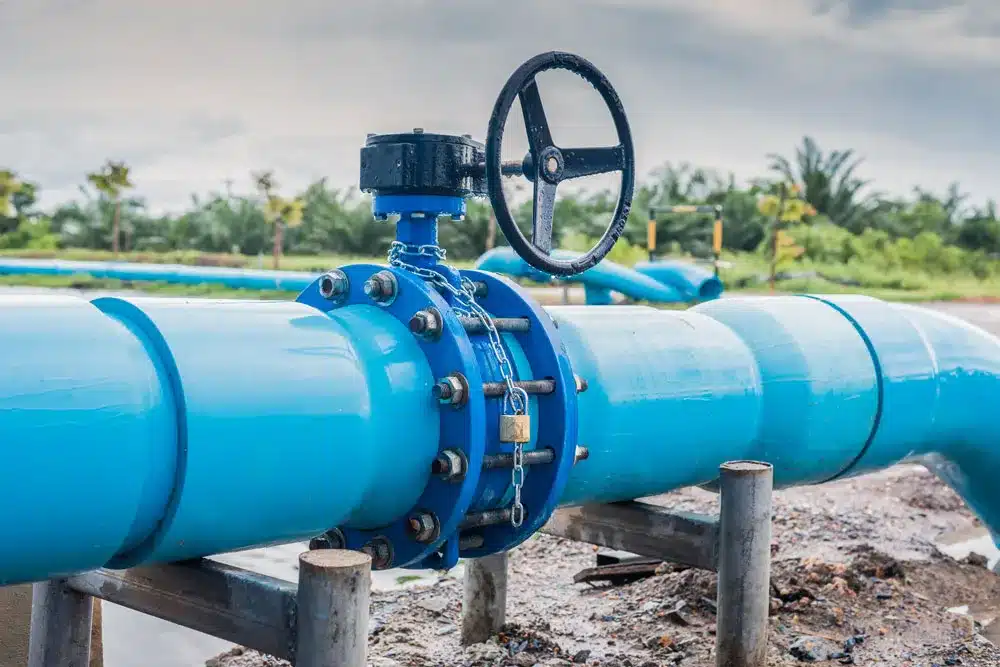
Butterfly Valve FAQ
What is a butterfly valve used for?
A butterfly valve is used to isolate, start, stop, or regulate fluid flow in a pipeline. Common applications include water treatment, HVAC, chemical processing, industrial automation, power generation, and marine systems.
How does a butterfly valve work?
A butterfly valve works by rotating a disc mounted on a shaft. Approximately 90 degrees of rotation moves the valve between the fully closed and fully open positions.
What are the main types of butterfly valves?
Common butterfly valves include wafer, lug, and flanged body styles. According to sealing geometry, they are commonly classified as concentric, double-offset, and triple-offset butterfly valves.
What is the difference between wafer and lug butterfly valves?
A wafer valve is installed between pipeline flanges, while a lug valve incorporates lugs around the body. Lug construction can provide greater flexibility for certain maintenance and piping arrangements.
What is a triple offset butterfly valve?
A triple offset butterfly valve uses three geometric offsets in the shaft, disc, and sealing system. This reduces sliding contact between the sealing surfaces and makes the design suitable for many demanding industrial services.
Can a butterfly valve be used for throttling?
Yes. A butterfly valve can be used for throttling when it is correctly sized and the selected valve design is suitable for control service. Pressure drop, velocity, cavitation, noise, and control range should be evaluated.
What is an electric actuated butterfly valve?
An electric actuated butterfly valve combines a butterfly valve with a rotary electric actuator. Electrical power is used to automatically open, close, or position the valve.
Can an electric butterfly valve provide modulating control?
Yes. When fitted with a suitable modulating actuator, an electric butterfly valve can operate at intermediate positions according to a control signal such as 4–20 mA or 0–10 V, depending on the actuator specification.
Which butterfly valve seat is commonly used for water?
EPDM is widely used in many water and HVAC applications. Final selection should still consider temperature, water chemistry, pressure, and any required potable-water approvals.
When is a PTFE butterfly valve used?
PTFE seated or PTFE-lined butterfly valves are commonly considered for corrosive chemical media because PTFE provides broad chemical resistance. Actual suitability depends on pressure, temperature, concentration, and valve construction.
Can butterfly valves seal in both directions?
Some butterfly valves are designed for bidirectional sealing, while other designs have a preferred pressure direction. The manufacturer’s pressure and sealing data should be checked before installation.
How do I choose the correct butterfly valve?
Start with the process media, pressure, temperature, pipe size, flow conditions, and flange standard. Then select the appropriate valve body style, sealing geometry, materials, shutoff performance, and operator or actuator.
Conclusión
Butterfly valves provide a practical combination of compact size, relatively low weight, fast quarter-turn operation, and straightforward automation for a broad range of industrial piping systems.
The correct butterfly valve should not be selected from pipe diameter and pressure class alone. Media compatibility, temperature, differential pressure, connection type, sealing design, materials, flow conditions, actuator torque, control requirements, and applicable standards all influence valve performance and service life.
For automated applications, electric actuated butterfly valves provide a convenient solution for remote operation, ON/OFF control, modulating control, and industrial automation. Matching the valve, electric actuator, control signal, and operating environment as one complete package helps reduce commissioning problems and improve long-term reliability.
Looking for an Electric Actuated Butterfly Valve?Fleyenda supplies electric actuated butterfly valve configurations for water treatment, HVAC, chemical processing, industrial automation, and other process applications. Send your project conditions for valve and actuator selection support.