


6 Types of Ball Valve
A ball valve is one of the most important isolation and flow-control devices used in industrial piping systems. Large industrial ball valves are widely installed in oil and gas pipelines, petrochemical plants, chemical processing facilities, power generation systems and other demanding applications where reliable shutoff, high pressure capability and long service life are required.
Although different ball valves use the same basic quarter-turn operating principle, their internal support structure, body design, port geometry, seat construction and maintenance method can vary significantly. These differences directly affect pressure capability, operating torque, flow capacity, shutoff performance and suitability for severe service.
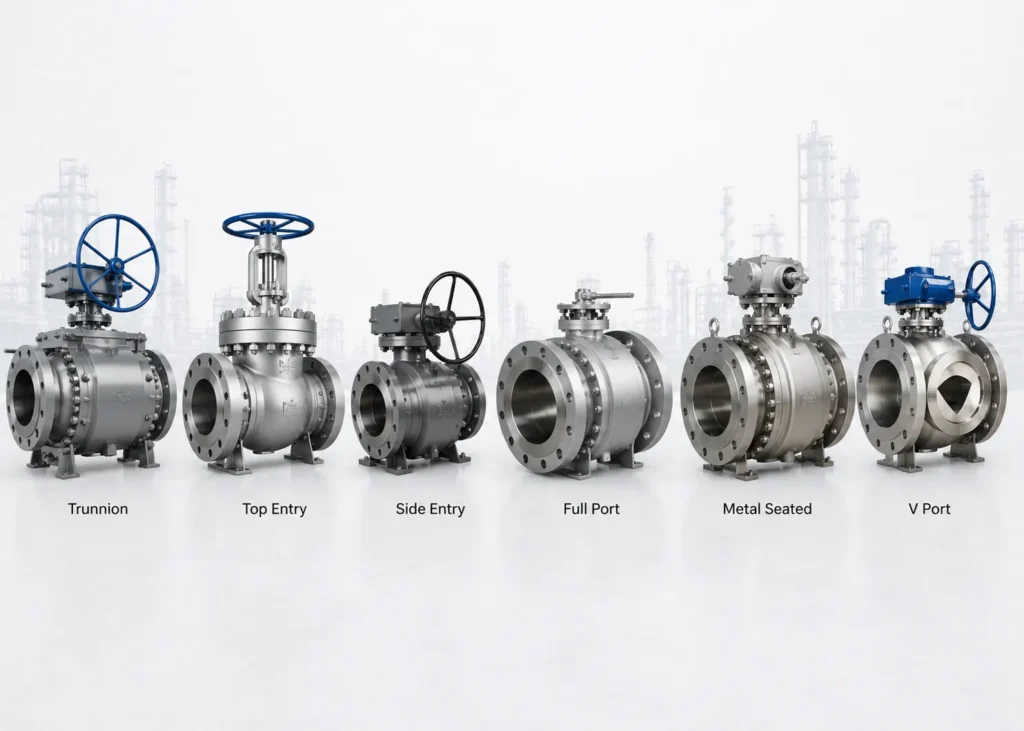
This guide explains 6 types of ball valve commonly used in industrial applications: trunnion mounted ball valve, top entry ball valve, side entry ball valve, full port ball valve, metal seated ball valve and V port ball valve. Understanding these designs makes it easier to select the right ball valve for pressure, temperature, flow and process requirements.
Industrial ball valves can be classified in several different ways. Some classifications describe how the ball is supported, some describe how the valve body is assembled, and others describe the bore or seat design. The six types below represent practical configurations frequently considered in large industrial projects.
What Is a Ball Valve?
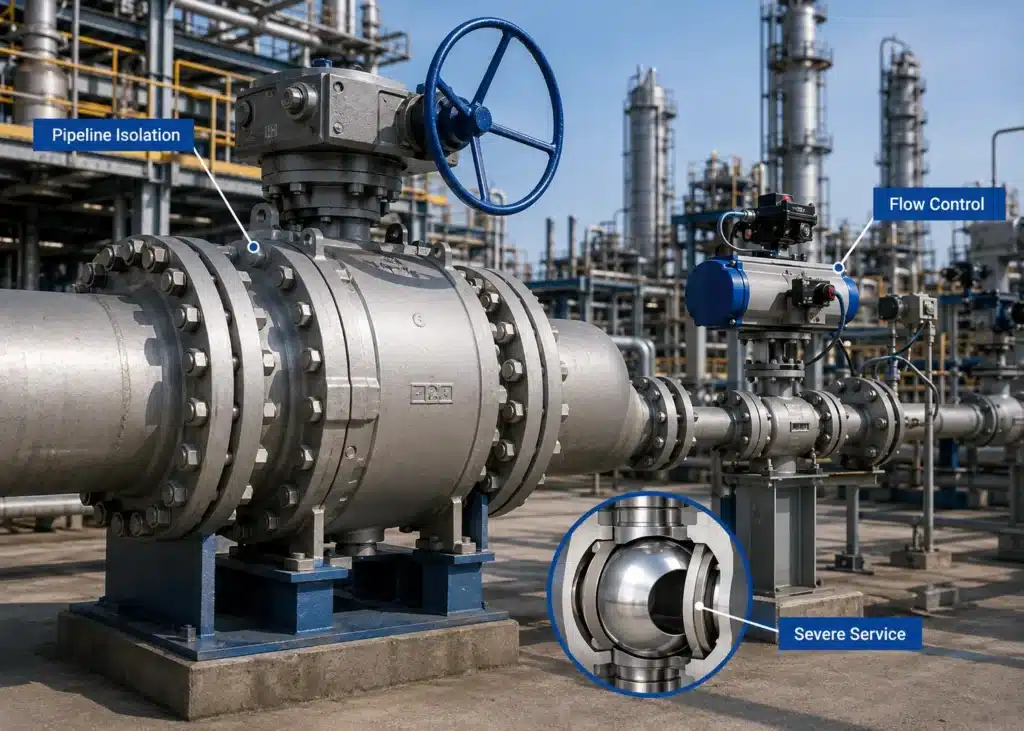
A ball valve is a quarter-turn valve that uses a spherical closure element to start or stop fluid flow. The ball contains an opening through its center. When the opening aligns with the pipeline, fluid can pass through the valve. When the ball rotates approximately 90 degrees, the solid side of the ball blocks the flow.
This simple operating principle gives the ball valve several important advantages. It can operate quickly, provide reliable isolation and offer relatively low flow resistance when fully open. These characteristics make ball valves especially suitable for industrial pipeline isolation and automated shutdown systems.
In larger or more demanding applications, however, the internal design becomes increasingly important. High pipeline pressure creates large forces on the ball and seats, while high temperature, abrasive particles or frequent operation can significantly affect sealing performance and actuator torque.
Quick Comparison of 6 Ball Valve Types
| Ball Valve Type | Main Design Feature | Uso típico |
|---|---|---|
| Trunnion Mounted Ball Valve | Ball is mechanically supported by trunnions | Large size and high-pressure pipeline service |
| Válvula de bola de entrada superior | Internal parts are accessed from the top | Critical systems requiring in-line maintenance |
| Válvula de bola de entrada lateral | Body is assembled from side sections | Oil, gas, petrochemical and transmission pipelines |
| Full Port Ball Valve | Bore is close to pipeline inside diameter | Low pressure drop and full-flow applications |
| Metal Seated Ball Valve | Metal ball-to-seat sealing surfaces | High temperature, abrasive and severe service |
| V Port Ball Valve | V-shaped opening provides characterized flow | Throttling and automatic process control |
1. Trunnion Mounted Ball Valve
A trunnion mounted ball valve is one of the most important ball valve designs for large industrial pipelines. The ball is mechanically supported at the top and bottom by a stem and trunnion arrangement, which prevents the ball from moving significantly in the direction of pipeline pressure.
Instead of relying on ball movement to produce sealing force, the seats are designed to move toward the ball. Pipeline pressure can help energize the seats and maintain contact with the ball surface.
This construction makes the trunnion mounted ball valve particularly suitable for large sizes and high-pressure applications. The supported ball reduces the load transferred directly to the seats and can help keep operating torque manageable as valve diameter increases.
Large trunnion ball valves are frequently used in natural gas transmission, crude oil pipelines, refineries, petrochemical plants, LNG systems, tank terminals and other critical isolation services.
Depending on the application, trunnion valves may incorporate double block and bleed arrangements, emergency seat sealant injection, stem sealant systems, anti-static devices, fire-safe construction and gear or actuator operation.
Where Is a Trunnion Ball Valve Used?
Trunnion mounted ball valves are commonly selected where the combination of valve size, system pressure and required shutoff performance makes a heavy-duty supported ball construction preferable. They are especially common in pipeline and process applications where valve reliability is critical to plant or transportation-system operation.
2. Top Entry Ball Valve
A top entry ball valve is designed so that the ball, seats and other important internal components can be accessed through the upper part of the valve body.
The main advantage of this construction is maintenance accessibility. In many installations, technicians can inspect or replace internal components while the main valve body remains installed between the pipeline flanges or welded connections.
This can be particularly valuable in large industrial facilities where removing a heavy ball valve from the pipeline would require cranes, pipe support modifications and significant shutdown time.
Top entry ball valves are widely considered for critical oil and gas processing systems, offshore facilities, refineries, compressor stations and other applications where maintenance downtime has a high operational cost.
Large top entry valves frequently use trunnion mounted internal construction, allowing the advantages of a supported ball to be combined with improved access to the valve internals.
The term top entry ball valve describes how the valve internals are accessed, while trunnion mounted ball valve describes how the ball itself is supported. A single industrial ball valve can therefore be both top entry and trunnion mounted.
3. Side Entry Ball Valve
A side entry ball valve uses a body assembled from two or more major sections around the ball and seat assembly. This construction is extremely common in large industrial and pipeline ball valves.
Depending on the manufacturer’s design, the valve may use two-piece, three-piece or multi-piece body construction. The body sections are bolted together to create the pressure-containing enclosure around the ball.
Side entry construction provides a practical manufacturing solution for large-diameter trunnion mounted ball valves. It also allows internal components to be assembled and inspected before the valve body sections are fully joined.
These valves are extensively used in crude oil pipelines, natural gas transmission systems, petrochemical facilities, storage terminals and other industrial services where large flanged or welded ball valves are required.
Unlike a top entry design, major internal maintenance on a side entry ball valve may require removal of the valve from the pipeline or greater disassembly of connected equipment. Maintenance strategy should therefore be considered during project design.
Válvula de bola de entrada superior frente a válvula de bola de entrada lateral
The primary difference is the way maintenance access is provided. A top entry ball valve allows internal components to be reached from the upper body opening, while a side entry design is assembled from body sections around the internal components.
Side entry designs are widely established for pipeline service and can be very economical for large production quantities. Top entry construction is often selected where in-line maintenance and reduced pipeline removal are important project considerations.
4. Full Port Ball Valve
A full port ball valve, also known as a full bore ball valve, has an opening through the ball that is approximately equal to the internal diameter of the connected pipeline.
When the valve is fully open, the fluid sees a relatively straight and unrestricted flow path. This helps reduce permanent pressure loss compared with a valve that has a significantly smaller internal bore.
Full port construction is particularly important in long pipelines, high-flow systems and applications where energy efficiency matters. It is also commonly required when pipeline pigs, cleaning tools or inspection devices must pass through the valve.
Because the ball and valve body must accommodate the larger bore, a full port ball valve is generally larger and heavier than a reduced-bore design of the same nominal pipe size.
The added material and larger closure element can increase valve cost and actuator torque, but these disadvantages may be acceptable where full pipeline flow area is required.
Typical Full Port Ball Valve Applications
Full port ball valves are common in oil and gas transmission pipelines, piggable pipeline systems, high-flow process lines, compressor stations, terminals and installations where reducing pressure loss is an important design objective.
A valve labeled with the same nominal size as the pipeline is not automatically full port. Buyers should verify the actual minimum bore diameter when full-bore performance or pigging capability is required.
5. Metal Seated Ball Valve
A metal seated ball valve uses metal sealing surfaces between the ball and seats instead of relying primarily on soft polymer seats such as PTFE.
This construction is intended for process conditions where temperature, erosion, solids or chemical exposure would quickly damage conventional soft seating materials.
Metal seated ball valves are frequently used for high-temperature fluids, steam, abrasive slurry, catalyst handling, powder, particulate media and other severe industrial applications.
Because both sealing surfaces are metallic, manufacturing accuracy and surface treatment are particularly important. The ball and seat may be hard-faced or coated to improve resistance to wear, erosion and galling.
Metal seated ball valves may require greater operating torque than comparable soft-seated valves. Actuator selection should therefore be based on the manufacturer’s specified breakaway and running torque under actual process conditions.
Shutoff expectations should also be specified clearly. Metal seated valves are designed for demanding environments, but required leakage performance should be confirmed rather than assuming that all seat technologies provide identical tightness.
When Should a Metal Seated Ball Valve Be Used?
Metal seats are commonly considered when process temperature exceeds the practical range of polymer seats, when the fluid contains abrasive particles, when flashing or erosive conditions exist, or when frequent operation would rapidly damage a softer seat material.
6. V Port Ball Valve
A V port ball valve is designed specifically for throttling and process control. Instead of the conventional circular opening used in an isolation ball valve, the ball or segment has a V-shaped opening that changes the effective flow area progressively as the valve rotates.
This geometry allows the valve to provide more predictable flow control through its operating range. The V-shaped opening creates a characterized relationship between valve position and flow capacity, making the design suitable for modulating applications.
V port ball valves are often installed with pneumatic or electric actuators and positioners as part of automatic control loops. They can be used to regulate flow, pressure, temperature or other process variables.
Compared with conventional globe control valves, a V port ball valve can provide a relatively compact rotary solution with high flow capacity. The rotary action can also make the valve attractive for applications involving some suspended solids or process media that are difficult for certain conventional control-valve trims.
Proper sizing remains essential. A V port ball valve that is significantly oversized may operate close to the closed position during normal conditions, reducing control stability and increasing sensitivity to small changes in valve position.
Typical V Port Ball Valve Applications
V port ball valves are commonly used in chemical processing, water treatment, steam and utility control, industrial process automation, flow regulation and applications requiring modulating rather than simple open-close operation.
A standard isolation ball valve should not automatically be used as a control valve. When continuous throttling or modulating service is required, a V port ball valve or another purpose-designed control valve should be evaluated according to the required flow characteristic and pressure drop.
Trunnion vs Top Entry vs Side Entry Ball Valve
These terms are often confused because they describe different aspects of valve construction. A trunnion mounted ball valve describes the way the ball is supported, while top entry and side entry describe the way the pressure-containing body is constructed and how internal parts are accessed.
A large top entry ball valve may therefore use a trunnion supported ball, and a large side entry ball valve may also use a trunnion supported ball. They are not necessarily competing classifications.
| Design | What It Describes | Main Advantage |
|---|---|---|
| Trunnion Mounted | How the ball is mechanically supported | Suitable for large size and high pressure |
| Top Entry | How internal components are accessed | Improved in-line maintenance access |
| Side Entry | How body sections are assembled | Established construction for large pipeline valves |
Soft Seated vs Metal Seated Ball Valve
Seat construction is one of the most important decisions in ball valve selection. Soft-seated valves use polymer materials such as PTFE, reinforced PTFE or PEEK, while metal-seated designs use metallic sealing surfaces.
Soft seats are widely used where very tight shutoff, relatively low torque and compatible temperature conditions are required. They are common in clean liquid and gas applications.
Metal seats are selected when temperature, abrasive particles, solids or severe operating conditions exceed the practical capability of conventional soft seats.
Neither option is universally better. The correct seat design depends on the process medium, temperature, pressure, leakage requirement and operating frequency.
Ball Valve Body Materials
Large industrial ball valves are available in a wide range of body and trim materials. Carbon steel is widely used in oil and gas, petrochemical and general process applications because it provides strong mechanical performance and broad availability.
Stainless steel ball valves are commonly selected when improved corrosion resistance is required. Duplex and super duplex stainless steels may be considered for more demanding chloride-containing environments, offshore service and selected chemical applications.
Low-temperature carbon steel, alloy steel and nickel-based alloys are also available for specialized process conditions.
Material selection should never be based only on the valve body. The ball, stem, seat, packing, gasket, springs and bolting must also be suitable for the fluid and operating temperature.
Manual, Pneumatic and Electric Ball Valve Operation
Small or moderate-size ball valves may be manually operated with a lever, while large industrial ball valves commonly use gear operators to reduce the force required from the operator.
Pneumatic actuators are widely used in oil and gas, chemical and petrochemical facilities where rapid operation and fail-safe action are required. Spring-return designs can move the valve to a predetermined position if the instrument air supply is lost.
Electric actuators are often selected where electrical power is readily available and compressed air infrastructure is limited. They are also common in water systems, remote installations and automated industrial facilities.
Actuator sizing should be based on the actual ball valve torque requirement at maximum differential pressure. Safety factors, minimum air pressure, electrical duty cycle and required operating speed should also be considered.
How to Select the Right Ball Valve
The correct ball valve should be selected from actual process conditions rather than simply from pipeline diameter. Valve size is only one part of the specification.
The first step is to define the valve function. If the requirement is critical pipeline isolation in a large size, a trunnion mounted ball valve may be appropriate. If in-line maintenance is a priority, a top entry design may offer an advantage. Where low pressure loss and pigging capability are important, a full port ball valve should be considered.
High-temperature or abrasive services may require a metal seated ball valve, while modulating flow-control applications are better suited to V port ball valve construction.
Process pressure, temperature, fluid composition and maximum differential pressure should then be defined. The valve body, trim, seats and seals must be compatible with these conditions.
Finally, the required end connection, pressure class, operation method, shutoff performance, fire-safe requirement, fugitive-emission requirement and inspection scope should be included in the purchase specification.
Ball Valve Applications
The ball valve is widely used throughout the oil and gas industry. Large trunnion ball valves are installed in transmission pipelines, gathering systems, compressor stations, terminal facilities, refineries and storage systems.
Petrochemical and chemical plants use ball valves for process isolation, utility lines, hydrocarbons, gases and automated shutdown systems. Material and seat selection depend heavily on chemical composition and operating temperature.
Power plants and industrial utility systems use ball valves in water, fuel gas and selected steam or high-temperature applications. Metal seated designs may be selected where severe temperature conditions are present.
Water and wastewater systems use large actuated ball valves where dependable isolation, automation and relatively low pressure loss are required. V port designs can also be used where controlled flow regulation is needed.
What to Check Before Ordering a Ball Valve
Industrial ball valve quotations should be compared on technical compliance before price. Two valves with the same nominal size may have very different internal designs, seat materials, bore dimensions and pressure capabilities.
Buyers should specify the required ball valve type, nominal size, pressure class, body material, ball and stem material, seat construction, end connection and bore requirement.
The process medium, operating pressure, design pressure, minimum and maximum temperature and maximum differential pressure should also be provided.
For actuated valves, the actuator type, fail position, available air pressure or electrical supply, required operating time and control accessories should be clearly stated.
Critical projects may also require fire-safe testing, anti-static design, fugitive-emission qualification, nondestructive examination, material certificates and positive material identification.
For large automated ball valves, it is usually preferable to purchase the valve, actuator, mounting components and control accessories as one factory-assembled and tested package. This provides clearer responsibility for torque sizing, mechanical compatibility and functional testing.
Ball Valve Maintenance
Proper maintenance depends on the ball valve design and process conditions. Operators should monitor stem leakage, body joint leakage, increasing operating torque, actuator alarms and deterioration in shutoff performance.
Large pipeline valves may also require periodic verification of gearbox condition, actuator function, emergency sealant systems and valve position indication.
For top entry ball valves, internal maintenance may be performed through the upper body opening when the system is properly isolated and depressurized. Side entry designs may require more extensive disassembly depending on construction.
Critical installations should maintain suitable spare seats, seals, stem packing and actuator components according to the manufacturer’s recommended spare-parts list.
Preguntas frecuentes
What are the main types of industrial ball valve?
Common industrial configurations include trunnion mounted ball valve, top entry ball valve, side entry ball valve, full port ball valve, metal seated ball valve and V port ball valve. These classifications describe different structural or functional characteristics.
Which ball valve is suitable for large high-pressure pipelines?
A trunnion mounted ball valve is commonly selected for large-diameter and high-pressure pipeline applications because the ball is mechanically supported and the seats are designed to seal against the supported ball.
¿Cuál es la ventaja de una válvula de bola de entrada superior?
The main advantage is maintenance accessibility. Internal components can often be reached from the top of the valve without removing the complete body from the pipeline.
What is the difference between top entry and side entry ball valve?
A top entry ball valve provides access to the internal components through the upper body opening. A side entry ball valve is assembled from body sections around the ball and seat assembly.
What is a full port ball valve?
A full port ball valve has an internal bore approximately equal to the inside diameter of the connected pipeline, helping reduce pressure loss and allowing higher flow capacity.
When should a metal seated ball valve be used?
Metal seated ball valves are commonly selected for high temperatures, abrasive fluids, solids, erosive service and other conditions where conventional polymer seats may not provide adequate service life.
What is a V port ball valve used for?
A V port ball valve is designed for throttling and modulating control. Its characterized opening provides more predictable flow control as the valve changes position.
Can a ball valve be electrically or pneumatically actuated?
Yes. Industrial ball valves can use pneumatic, electric or hydraulic actuators. The actuator must be sized according to valve torque, process differential pressure and required operating speed.
Conclusión
Understanding the different types of ball valve is important because each design serves a different industrial requirement. Large pipeline applications frequently use trunnion mounted construction, while top entry and side entry designs provide different approaches to body assembly and maintenance access.
A full port ball valve is preferred where low pressure loss or full-bore pipeline access is important. A metal seated ball valve is designed for high-temperature, abrasive and severe service, while the V port ball valve provides controlled throttling for automated process applications.
The best ball valve should always be selected from actual process conditions, including pressure, temperature, fluid, differential pressure, required shutoff, materials, seat design and method of operation. Correct specification at the purchasing stage can improve system reliability, reduce maintenance and provide better long-term valve performance.