


CF8M Ball Valve Guide
A CF8M ball valve is an industrial stainless steel ball valve manufactured with a cast CF8M body, offering corrosion resistance and dependable shutoff for a wide range of process applications. Commonly associated with the 316 stainless steel alloy family, CF8M is widely specified for chemical processing, water treatment, oil and gas, marine utilities and industrial piping.
From manual two-piece stainless steel ball valves to pneumatic and electric actuated CF8M ball valves, selecting the right configuration requires more than specifying the body material. Valve construction, seat material, pressure rating, temperature, connection type and actuator torque all affect performance and service life.
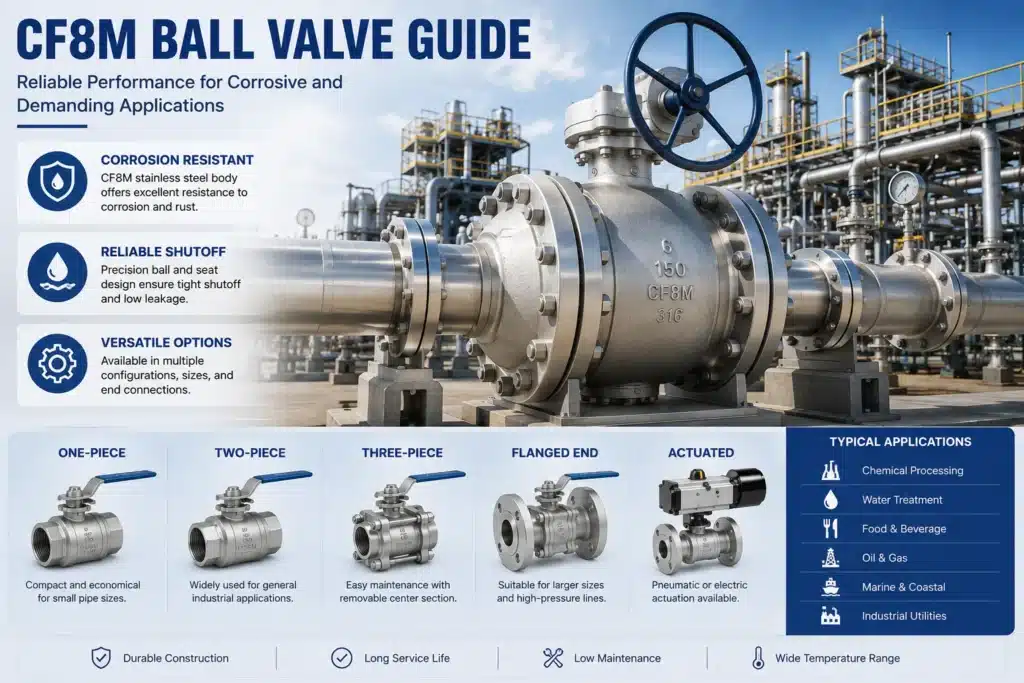
What Is a CF8M Ball Valve?
A CF8M ball valve is a quarter-turn valve whose cast pressure-containing body is manufactured from CF8M austenitic stainless steel. CF8M is commonly used for stainless steel cast valve bodies and is particularly valued where corrosion resistance is more important than with ordinary carbon steel or cast iron construction.
The designation does not automatically mean that every component inside the valve is CF8M. The ball, stem, seats, packing, body seals and fasteners may use different materials selected according to the process conditions.
CF8M Ball Valve Options for Industrial Applications
Fleyenda provides different stainless steel ball valve configurations with CF8M body options, including threaded, flanged, pneumatic and electric actuated designs. The correct configuration depends on pipeline connections, operating pressure, process media and automation requirements.
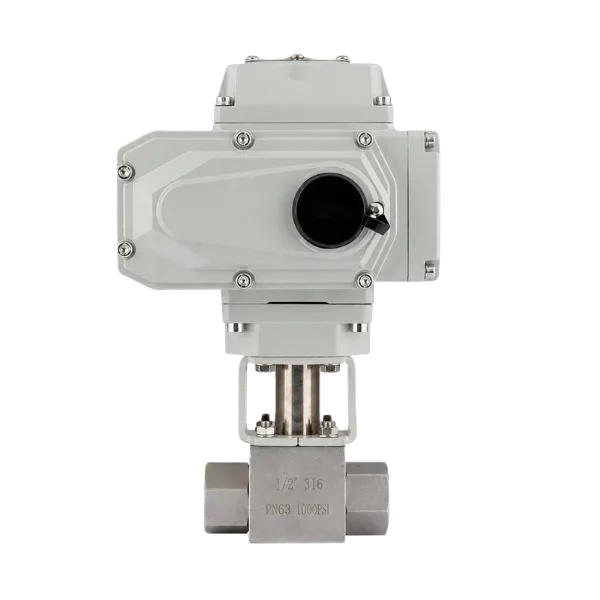
FLE-Q-2PS SERIES · ELECTRIC ACTUATED
Female Thread Electric Actuated Ball Valve
A compact CF8M stainless steel electric ball valve for threaded pipelines, water treatment equipment, packaged systems and automated industrial installations.
- Size: 1/4″–4″ / DN8–DN100
- Body: CF8M / SS316
- Pressure: PN16–PN63
- Temperature: -20°C to +180°C*
- Connection: Female Thread / NPT / BSP Options
- Operation: Electric On/Off / Selected Regulating
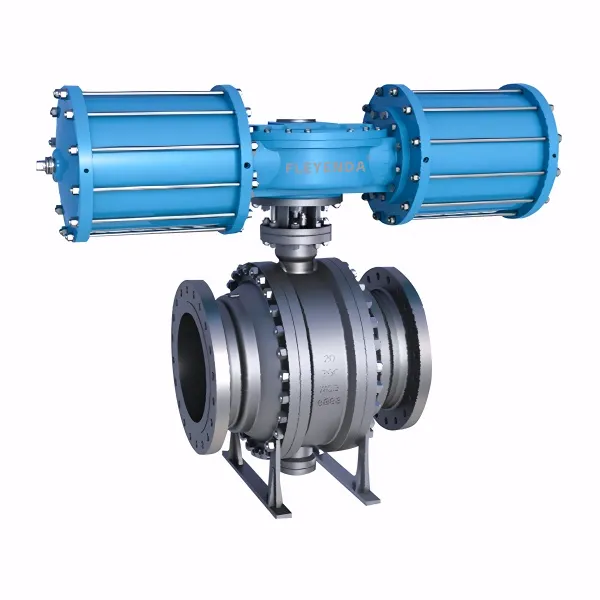
FAW-Q SERIES · HIGH-PRESSURE PNEUMATIC
Pneumatic Trunnion Mounted Ball Valve
A heavy-duty pneumatic trunnion ball valve with CF8M stainless steel body options, designed for large-diameter pipelines, high-pressure isolation and demanding industrial applications.
- Size: 2″–24″ / DN50–DN600
- Body: A105 / SS304 / SS316 / SS316L / CF8M
- Pressure: Class 150–2500 / PN16–PN420
- Temperature: -29°C to +425°C
- Connection: ANSI / DIN / JIS Flanged
- Actuator: Pneumatic Double Acting / Spring Return

FAT-VQ-F SERIES · PNEUMATIC FLOW CONTROL
Pneumatic V-Port Ball Valve
A CF8M stainless steel V-port ball valve for automated flow regulation. Its characterized V-shaped ball supports more controlled throttling in industrial process systems.
- Size: 1/2″–8″ / DN15–DN200
- Body: CF8 / CF8M
- Pressure: PN16–PN40 / 150–600 PSI
- Temperature: -20°C to +180°C
- Connection: ANSI / DIN / JIS Flanged
- Actuator: Double Acting / Spring Return
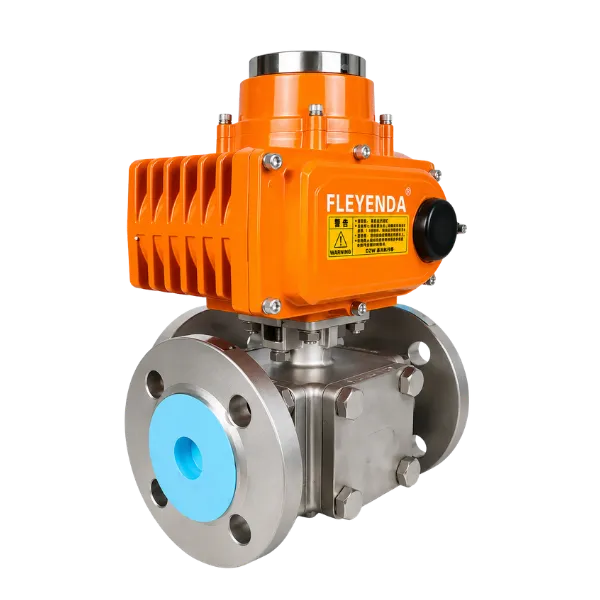
FLE-Q-TF SERIES · ELECTRIC 3-WAY
Electric 3-Way Flanged Ball Valve
A CF8M stainless steel three-way electric ball valve for automated flow diversion, distribution, bypass and selected mixing applications in industrial piping systems.
- Size: 1/2″–8″ / DN15–DN200
- Body: CF8 / CF8M / WCB
- Pressure: PN10–PN40 / ANSI Class 150–300
- Temperature: -20°C to +180°C*
- Connection: ANSI / DIN / JIS Flanged
- Configuration: L-Port / T-Port
- Actuator: Electric On/Off / Regulating Options
Send your valve size, pressure, medium, temperature and connection requirements for technical selection.
What Does CF8M Mean?
CF8M is a cast austenitic stainless steel grade commonly specified for industrial valve bodies and pressure-containing components. It is frequently associated with ASTM A351 Grade CF8M castings.
The material contains chromium and nickel together with molybdenum. The addition of molybdenum helps improve resistance to localized corrosion in many chloride-containing environments compared with CF8, which is associated with the 304 stainless steel family.
CF8M is often described commercially as the cast equivalent of 316 stainless steel. However, CF8M and wrought SS316 are separate material specifications with different manufacturing processes and chemical composition requirements.
CF8M Material Identification
CF8M normally identifies the cast valve body or another cast pressure-containing component. For industrial procurement, specify ASTM A351 CF8M where required and request material test certificates for traceability. Do not assume that every internal valve component is manufactured from CF8M.
How Does a CF8M Ball Valve Work?
A CF8M ball valve uses a spherical closure element with a circular passage through its center. The ball is positioned between two valve seats and connected to a handle or actuator through a stem.
When the ball bore aligns with the pipeline, fluid passes through the valve. Rotating the stem approximately 90 degrees moves the solid side of the ball across the flow path and shuts off the pipeline.
This quarter-turn operation makes a CF8M stainless steel ball valve suitable for fast isolation and automated pipeline control. Pneumatic and electric actuators can be installed for remote operation in industrial systems.
Soft-seated designs use polymer seats to provide tight shutoff, while metal-seated designs can be considered for elevated temperatures, abrasive particles and more demanding process conditions.
Main Components of a CF8M Ball Valve
Reliable CF8M ball valve performance depends on the complete material combination, not just the stainless steel body.
| Component | Main Function | Selection Consideration |
|---|---|---|
| CF8M Body | Contains process pressure and provides the main flow passage. | Corrosion resistance, pressure rating and casting quality. |
| Ball | Rotates to open or close the flow passage. | Material, surface finish and corrosion resistance. |
| Stem | Transfers operating torque to the ball. | Strength, corrosion resistance and anti-blowout design. |
| Seats | Seal around the ball and prevent internal leakage. | Temperature, chemical compatibility and pressure. |
| Stem Packing | Prevents external leakage around the rotating stem. | Temperature and emission requirements. |
| Body Seals | Seal joints between body sections. | Fluid compatibility and temperature. |
| Actuator | Provides automatic valve operation. | Torque, power supply, control signal and fail position. |
CF8M vs CF8 Ball Valve
CF8 and CF8M are both cast austenitic stainless steel grades frequently used for industrial ball valve bodies. The main difference is that CF8M contains molybdenum, while CF8 is associated with the 304 stainless steel family.
The molybdenum content generally gives CF8M better resistance to pitting and crevice corrosion in many chloride-containing environments. This makes CF8M a common choice for chemical processing, coastal facilities and more corrosive process-water applications.
However, CF8M is not automatically suitable for every seawater or high-chloride application. Chloride concentration, temperature, oxygen content and exposure conditions must be considered.
| Comparison | CF8 | CF8M |
|---|---|---|
| Alloy Family | 304-type cast stainless steel | 316-type cast stainless steel |
| Molybdenum | Not normally added as a principal alloying element | Contains molybdenum |
| Corrosion Resistance | Good for many general industrial fluids | Improved resistance to localized corrosion in many environments |
| Typical Applications | Water, air, food and general process service | Chemical, marine, process and more corrosive service |
CF8M vs SS316 Ball Valve
CF8M and SS316 are closely related stainless steel materials, but they are not identical designations. CF8M is a cast stainless steel grade commonly used for valve bodies, while SS316 generally refers to wrought stainless steel used for bars, plates, tubes, forgings and machined components.
A typical CF8M stainless steel ball valve may use a cast CF8M body combined with a wrought 316 or 316L ball and stem. This combination is common because different valve components are manufactured using different production methods.
For procurement and quality inspection, material certificates should identify the actual grade of each specified component rather than simply listing the complete valve as 316 stainless steel.
One-Piece CF8M Ball Valve
A one-piece CF8M ball valve uses an integral body with relatively few body joints. Its compact construction makes it an economical option for smaller threaded piping systems.
One-piece stainless steel ball valves are commonly used for water, compatible chemicals, compressed air and general utility applications. Buyers should check whether the design is full port or reduced port because many compact one-piece valves have a reduced internal bore.
Two-Piece CF8M Ball Valve
A two-piece CF8M ball valve contains a main body and a threaded or bolted body connector. This construction allows a larger internal ball and is widely available in full-port configurations.
Two-piece ball valves provide a balance between cost, flow capacity and maintenance requirements. Typical applications include process water, chemical transfer, compressed air, utility gas and general manufacturing systems.
Three-Piece CF8M Ball Valve
A three-piece CF8M ball valve has a center body section located between two end connectors. The body bolts can be removed so the center section can be serviced while the end connectors remain attached to the pipeline.
This design is useful where periodic inspection or replacement of the ball, seats and body seals is required. Weld-end three-piece valves are particularly useful in industrial systems where removing the complete valve from the pipeline would be inconvenient.
CF8M Flanged Ball Valve
A CF8M flanged ball valve uses bolted flange connections instead of threaded or welded ends. Flanged construction is widely selected for larger industrial pipelines and systems where convenient valve removal is required.
Flange drilling, facing and pressure class must match the connected piping system. Specify the applicable ANSI, ASME, DIN or JIS flange standard when requesting a quotation.
Depending on the size, pressure and manufacturer design, flanged CF8M ball valves can use either floating-ball or trunnion-mounted construction.
Floating CF8M Ball Valve
In a floating ball valve, the ball is supported primarily by the valve seats and connected to the stem from above. The ball can move slightly in the downstream direction under process pressure, helping create the shutoff seal against the downstream seat.
Floating CF8M ball valves are commonly used in small and medium pipe sizes because their construction is relatively simple and provides reliable isolation.
As valve size and differential pressure increase, the load between the ball and downstream seat also increases. This may influence the decision to use a trunnion-mounted design.
CF8M Trunnion Ball Valve
A trunnion-mounted ball valve mechanically supports the ball at its upper and lower axis. Instead of the ball moving significantly under pressure, the seats move toward the supported ball.
Trunnion construction is commonly used for larger sizes and higher-pressure pipelines because it can reduce seat loading and provide more predictable operating torque.
CF8M or other stainless steel trunnion ball valves may be selected for chemical, offshore and industrial process applications where pressure capability and corrosion resistance are both required.
Full-Port vs Reduced-Port CF8M Ball Valve
A full-port CF8M ball valve has a ball bore close to the internal diameter of the connected pipeline. This provides relatively low flow resistance when the valve is fully open.
Full-port construction is valuable where pressure loss must be minimized, high flow capacity is required or cleaning tools need to pass through the valve.
A reduced-port CF8M ball valve has a smaller internal bore. This can reduce valve weight, dimensions and operating torque, but the restriction creates additional pressure loss.
Nominal pipe size alone does not confirm the actual internal bore. Specify full port or reduced port according to the flow requirements.
CF8M Wafer Ball Valve vs Flanged Ball Valve
A CF8M wafer ball valve is designed for compact installation between compatible pipeline flanges. Its short face-to-face construction can help reduce installation space in equipment assemblies and industrial piping systems.
A CF8M flanged ball valve uses integral flange ends and bolted connections, making it suitable for pipeline systems where direct flange-to-flange connection and convenient removal are important.
| Comparison | Wafer Ball Valve | Flanged Ball Valve |
|---|---|---|
| Connection | Installed between mating flanges | Integral flanged ends |
| Installation Space | Compact face-to-face construction | Generally requires more installation length |
| Typical Use | Space-saving equipment and pipeline assemblies | Industrial process and larger pipeline systems |
| Selection Priority | Face-to-face dimensions and flange compatibility | Flange standard, pressure class and facing |
CF8M Jacketed Wafer Ball Valve and Jacketed Discharge Ball Valve
Some buyers search for a CF8M jacketed wafer ball valve or a CF8M jacketed discharge ball valve when a standard stainless steel ball valve does not meet their process requirements.
These terms describe different design considerations. CF8M identifies the cast body material, wafer describes the connection or installation style, and jacketed construction refers to an additional jacket around the valve body or designated process area.
Jacketed designs are generally considered when the process requires temperature maintenance around the valve. Buyers should identify the required jacket coverage, heating medium, jacket pressure, process temperature and discharge configuration before specifying the valve.
A standard CF8M wafer ball valve should not be treated as a jacketed valve. The material, connection and heating-jacket requirements must be specified separately.
CF8M Ball Valve Seat Materials
Seat selection often determines the practical pressure-temperature and chemical capability of a CF8M ball valve. The stainless steel body may tolerate conditions that the polymer seat cannot.
PTFE Seat
PTFE is one of the most common seat materials for stainless steel ball valves. It provides low friction and good compatibility with many water and chemical applications. The actual allowable pressure-temperature range must be confirmed from the manufacturer’s rating.
RPTFE Seat
Reinforced PTFE, often abbreviated RPTFE, contains reinforcing material intended to improve dimensional stability, wear resistance and pressure capability compared with unfilled PTFE.
PEEK Seat
PEEK is an engineering polymer selected for higher-temperature or higher-pressure service in compatible fluids. It provides greater mechanical strength than conventional PTFE-based seats, but chemical compatibility must still be checked.
Metal Seat
A metal-seated CF8M ball valve may be required for elevated temperatures, abrasive particles or severe process conditions that could damage polymer seats.
The ball and seat may receive hard-facing or protective coatings to improve erosion and wear resistance. Metal-seated ball valves usually require careful consideration of operating torque and allowable leakage.
Do Not Select a CF8M Ball Valve by Body Material Alone
The CF8M body does not automatically make the complete valve suitable for high temperature or aggressive chemicals. The ball, stem, seat, packing, body seals and fasteners must all be compatible with the actual process conditions.
CF8M Ball Valve Pressure and Temperature Ratings
CF8M ball valves are available in different pressure classes and working-pressure ratings. The correct rating depends on valve design, body wall thickness, size, end connection, seat construction and applicable manufacturing standards.
The metal body may have a higher allowable temperature than the soft seat or elastomer seal. Therefore, the complete valve pressure-temperature chart should be used instead of relying only on the CF8M material capability.
Temperature also affects operating torque. Polymer seats can expand or change mechanical properties with temperature, influencing the relationship between the ball, seat and body.
For steam or high-temperature service, the supplier should confirm that the complete CF8M ball valve, including seats, packing and body seals, is rated for the required operating conditions.
What Media Can CF8M Ball Valves Handle?
CF8M ball valves are used with a wide range of industrial fluids because the stainless steel body provides useful corrosion resistance in many process environments.
Typical services include process water, cooling water, compressed air, compatible chemicals, solvents, food-processing fluids, utility gases and selected oil or hydrocarbon applications.
Chemical compatibility must be reviewed using the exact fluid concentration and temperature. A material that performs well in a dilute chemical solution may behave differently at higher concentration or elevated temperature.
CF8M should not automatically be described as seawater-proof. Warm chloride-rich water can create localized corrosion in conventional austenitic stainless steels. Continuous seawater service may require duplex stainless steel or another more resistant alloy.
Common CF8M Ball Valve Applications
Chemical Processing
Chemical facilities use CF8M valves for compatible acids, solvents, water-treatment chemicals and general process fluids. Stainless steel construction is useful where carbon steel corrosion could contaminate the process or reduce valve life.
Water Treatment
CF8M ball valves are used for treated water, chemical dosing, filtration systems, purified-water equipment and utility lines. Seat compatibility should be checked when oxidizing chemicals or concentrated treatment chemicals are present.
Food and Beverage
Stainless steel ball valves are common in food and beverage processing because of their corrosion resistance and clean surface characteristics. Hygienic applications may require specialized sanitary valve construction rather than a standard industrial ball valve.
Industrial Utilities
Compressed air, cooling water, inert gas and general plant utility systems frequently use threaded, socket-weld or flanged CF8M ball valves.
Marine and Coastal Facilities
CF8M construction provides useful corrosion resistance for many coastal and marine utility applications. Direct continuous seawater exposure requires a more detailed corrosion evaluation.
Oil and Gas Processing
CF8M ball valves can be used for selected hydrocarbon and process services where stainless steel materials are compatible with the fluid and project requirements.
Manual, Pneumatic and Electric CF8M Ball Valves
CF8M stainless steel ball valves can be supplied with manual, pneumatic or electric operation. The correct actuation method depends on operating frequency, automation requirements, available utilities and the required fail-safe function.
| Operation | Working Principle | Typical Application |
|---|---|---|
| Manual | Hand lever or gearbox rotates the valve stem. | Local isolation and low-frequency operation. |
| Pneumatic | Compressed air drives a quarter-turn actuator. | Automated process lines and frequent operation. |
| Electric | Electric motor drives the valve through a geared actuator. | Remote operation, PLC integration and selected flow control. |
CF8M Ball Valve with Pneumatic Actuator
A CF8M pneumatic ball valve combines a cast stainless steel valve body with a pneumatic quarter-turn actuator. It is suitable for automated isolation where compressed air is available and fast opening or closing is required.
Double-acting actuators use compressed air for both opening and closing. Spring-return actuators provide a defined fail-open or fail-closed position when the air supply is lost, depending on the selected configuration.
When selecting a pneumatic actuator for a CF8M stainless steel ball valve, check the required operating torque, air supply pressure, operating frequency, accessories and fail position.
CF8M Electric Actuated Ball Valve
A CF8M electric actuated ball valve combines a stainless steel body with a motorized quarter-turn actuator. It supports remote operation and can be integrated into PLC, DCS and other industrial automation systems.
Electric actuator options may include on/off operation, modulating control, position feedback and different power supply voltages, depending on the valve and actuator configuration.
Actuator selection should be based on the valve manufacturer’s torque data at the maximum differential pressure and operating temperature. Power supply, duty cycle, control signal, enclosure protection and hazardous-area requirements should also be defined.
CF8M Body Material vs Stainless Steel Actuator
CF8M specifies the cast valve body material, not the actuator housing. If a project requires a stainless steel actuator enclosure, it should be stated as a separate actuator specification. The valve body material, actuator housing and internal trim should be identified independently in the purchase order.
Provide your required control method, torque conditions, voltage or air supply and process specifications.
CF8M Ball Valve End Connections
Threaded CF8M ball valves are widely used in smaller piping and equipment connections. The required thread standard should be identified clearly because NPT, BSPP and BSPT connections are not interchangeable.
Socket-weld ball valves provide a permanent welded connection for smaller industrial piping. Butt-weld valves are commonly used where minimizing external leakage paths is important.
Flanged CF8M ball valves provide convenient removal and are widely used in larger process piping. The flange standard, pressure class and facing must match the piping specification.
Sanitary clamp connections are available for specialized food, beverage, biotechnology and clean-process applications, although the internal valve design should also meet the hygiene requirements of the system.
How to Select a CF8M Ball Valve
The first step is confirming whether CF8M is the correct body material for the process. The decision should be based on fluid chemistry, temperature, corrosion risk and project piping specifications.
Next, determine whether the valve is intended for isolation or control. A standard full-port ball valve is generally selected for on/off service. If continuous throttling is required, a V-port or characterized ball valve may provide better control characteristics.
Pressure and temperature conditions should be checked against the complete valve rating. The selected seat and packing materials are particularly important because they may determine the practical operating temperature limit.
The required end connection, bore size and body construction should then be defined. For automated valves, provide actuator power supply or air pressure, fail position, operating time and control signal requirements.
CF8M Ball Valve RFQ Checklist
Provide the following information to help match the valve configuration with your pipeline and operating conditions.
- Nominal valve and pipe size
- Required pressure rating or pressure class
- CF8M body material specification
- Process fluid and chemical concentration
- Minimum and maximum operating temperature
- Normal and maximum differential pressure
- Full-port or reduced-port bore
- One-piece, two-piece or three-piece construction
- Floating or trunnion-mounted ball
- Ball and stem material
- PTFE, RPTFE, PEEK or metal seat
- Stem packing and body seal materials
- Threaded, socket-weld, butt-weld or flanged connection
- Required seat leakage performance
- Fire-safe or anti-static requirements
- Manual, pneumatic or electric operation
- Actuator power supply, air pressure and control signal
- Material certificates and pressure-test reports
What Should Buyers Check on a CF8M Ball Valve Quotation?
A quotation should identify more than the valve size and body material. Compare the complete bill of materials because two valves both described as CF8M ball valves may contain different balls, stems, seats, seals and fasteners.
Confirm the exact body material specification and whether a material certificate is included. For critical projects, heat-number traceability should connect the pressure-containing casting to its material documentation.
Check the seat material carefully. A lower-priced valve may use standard PTFE while another supplier has quoted reinforced PTFE or an engineering polymer for more demanding service.
Verify whether the valve is full port. Marketing descriptions and nominal size do not necessarily confirm the actual internal bore.
The quotation should also state shell testing and seat leakage testing requirements. Automated valves should include the actuator model, torque output, power or air requirement and complete mounting arrangement.
CF8M Ball Valve Manufacturing and Inspection
A cast CF8M valve body begins with controlled stainless steel melting and casting. The casting is then cleaned, heat treated where required and machined to create flange faces, threaded ends, seat pockets and body-joint surfaces.
Casting quality is important because the body forms part of the pressure boundary. Depending on project requirements, inspection can include visual examination, dimensional inspection, chemical verification, mechanical testing and nondestructive examination.
After machining, the ball, stem, seats, packing and seals are assembled into the body. The completed valve is pressure tested to verify shell integrity and seat shutoff.
For critical procurement, buyers should specify inspection and documentation requirements before production. Requesting additional certificates after manufacturing can create delays if material traceability was not maintained.
Installing a CF8M Ball Valve
Before installation, verify the valve size, pressure rating, material and end connection against the piping specification. Inspect the valve bore for packaging material, dirt or foreign objects.
The pipeline should be flushed before the valve enters service. Welding slag and metal particles can scratch the ball surface or become trapped between the ball and seat.
Flanged piping should be correctly aligned so the valve is not used to pull the pipe into position. Excessive external loads can distort the body and affect the sealing system.
For weld-end valves, follow the manufacturer’s welding instructions. Excessive heat can damage nearby polymer seats and body seals.
Automated valves require sufficient space around the actuator for electrical connections, air tubing, manual override and maintenance.
Maintaining CF8M Ball Valves
Ball valves generally require limited routine maintenance, but periodic inspection helps detect stem leakage, external corrosion, operating-torque changes and internal seat wear.
A valve that becomes progressively harder to operate may have deposits between the ball and seat, damaged seats or stem-related friction. Forcing the operator can damage the stem or actuator.
Three-piece ball valves are particularly convenient where seats and body seals require periodic replacement. The correct maintenance kit should be matched to the manufacturer and valve model because seat dimensions are not universally interchangeable.
Before disassembly, isolate the valve from pressure, drain the body cavity and confirm that hazardous fluid has been removed. Ball valves can retain process fluid inside the body cavity even after the connected pipeline is drained.
Frequently Asked Questions About CF8M Ball Valves
What is a CF8M ball valve?
A CF8M ball valve is a quarter-turn industrial valve with a cast CF8M austenitic stainless steel body. It is widely used where corrosion-resistant stainless steel construction is required.
Is CF8M the same as 316 stainless steel?
CF8M is a cast stainless steel grade closely associated with the 316 alloy family, while 316 normally refers to wrought stainless steel. They are similar in general alloy concept but are separate material specifications.
What is the difference between CF8 and CF8M ball valves?
CF8M contains molybdenum and generally provides better resistance to localized corrosion in many chloride-containing environments than CF8, which is associated with the 304 stainless steel family.
Is CF8M stainless steel suitable for seawater?
CF8M can be used in some marine and chloride-related applications, but it should not automatically be considered suitable for continuous seawater service. Temperature, chloride concentration and corrosion conditions must be evaluated.
What seat material is best for a CF8M ball valve?
The best seat depends on temperature, pressure and fluid compatibility. PTFE and RPTFE are common for general industrial service, while PEEK or metal seats may be selected for more demanding conditions.
Can CF8M ball valves be full port?
Yes. Full-port CF8M ball valves are widely available and provide a bore close to the connected pipe diameter. The actual bore should be confirmed in the technical specification.
Can a CF8M ball valve be fitted with a pneumatic actuator?
Yes. A CF8M pneumatic ball valve combines a CF8M stainless steel body with a pneumatic quarter-turn actuator. Double-acting and spring-return configurations are available depending on the selected valve and actuator combination.
Can I get an electric actuated CF8M stainless steel ball valve?
Yes. Electric actuated CF8M ball valves can be configured for remote on/off operation or selected regulating applications. Actuator torque, voltage, control signal and environmental protection should be confirmed before ordering.
What is a CF8M jacketed wafer ball valve?
It describes a valve combining a CF8M cast body, wafer-style installation and a separate heating or temperature-control jacket. These are distinct design requirements and should be confirmed in the technical specification.
What is a CF8M jacketed discharge ball valve?
A jacketed discharge ball valve is a specialized configuration intended for process systems with specific discharge and temperature-maintenance requirements. The body material, discharge design, jacket arrangement and operating conditions must be defined separately.
What pressure can a CF8M ball valve withstand?
The pressure rating depends on valve construction, nominal size, body design, connection and seat materials. Always confirm the manufacturer’s pressure-temperature rating for the complete valve.
What information is needed to quote a CF8M ball valve?
Provide valve size, pressure rating, process fluid, temperature, body material, seat material, bore type, end connection, leakage requirements and operating method. For actuated valves, also provide power supply or air pressure, control signal and fail position.
Conclusion
A CF8M ball valve combines the fast quarter-turn operation and reliable isolation of a ball valve with a cast stainless steel body designed for many corrosive industrial environments.
CF8M belongs to the molybdenum-containing austenitic stainless steel family and is commonly selected where 316-type corrosion resistance is desired. However, body material alone does not determine whether a valve is suitable for the process.
Seat material, ball and stem materials, pressure rating, temperature, port size, body construction, end connection and actuator configuration must all be evaluated. For industrial procurement, the most reliable approach is to provide complete operating data and request clear material specifications and test documentation.
Whether you need a manual CF8M ball valve, a pneumatic trunnion mounted ball valve or an electric actuated stainless steel ball valve, Fleyenda can help evaluate the required configuration against your application.