


What Are Metal Seated Ball Valves?
Metal seated ball valves are industrial ball valves that use metal-to-metal sealing surfaces between the ball and valve seats instead of relying primarily on soft polymer seats such as PTFE. They are designed for operating conditions where high temperature, abrasive particles, severe pressure drop or aggressive process media can damage conventional soft seated valves.
The basic operating principle is still the same as other ball valves. A spherical closure element rotates approximately 90 degrees between the open and closed positions. What makes metal seated ball valves different is the engineering of the ball, seats, surface coatings, spring loading and sealing contact.
These valves are commonly considered for oil and gas processing, steam, chemical plants, power generation, metallurgy, mining, slurry service and other industrial processes where the valve must continue operating under demanding mechanical or thermal conditions.
Selecting a metal seated valve is not simply a matter of replacing a soft seat with stainless steel. Temperature, differential pressure, solids concentration, particle hardness, operating frequency, leakage requirement and actuator torque all influence the correct valve design.
Metal seating is normally selected because the process conditions exceed the practical capability of conventional soft seats—not simply because metal sounds stronger.
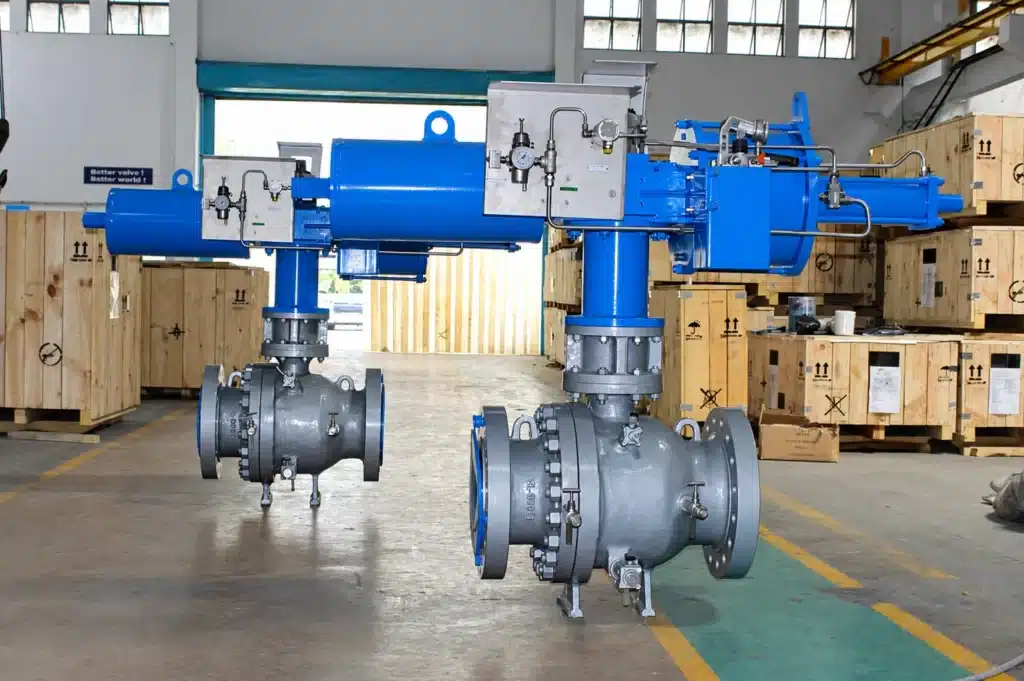
What Are Metal Seated Ball Valves?
Metal seated ball valves use engineered metallic sealing surfaces at the interface between the ball and valve seat. Depending on the design, the ball and seats may be manufactured from stainless steel, alloy steel or other materials and then treated with hard coatings to improve resistance to erosion, abrasion and galling.
In a conventional soft seated ball valve, materials such as PTFE, reinforced PTFE, PEEK or other polymers create the primary sealing contact. These materials can provide very low leakage and low operating torque, but every soft-seat material has temperature, chemical and mechanical limits.
When abrasive solids, very high temperature or severe pressure drop exceeds those limits, a metal seated design becomes a more suitable option.
Metal seated ball valves can be manufactured as floating or trunnion-supported designs, although trunnion mounted construction is widely used for larger sizes and higher-pressure industrial service because the trunnion supports the ball and reduces the seat loading created by line pressure.
How Do Metal Seated Ball Valves Work?
The valve opens and closes through approximately 90 degrees of ball rotation. When the bore of the ball aligns with the pipeline, fluid can pass through the valve. Rotating the ball one quarter turn places the solid portion of the ball against the seats and stops the flow.
The sealing mechanism, however, is more complex than the basic quarter-turn movement suggests.
The ball and seats must remain accurately matched so that sufficient contact pressure is created around the sealing surface without producing excessive operating torque. Spring-loaded seats may be used to maintain contact at low pressure, while process pressure can provide additional seat loading depending on the valve construction.
Because both sealing surfaces are metallic, surface finish and geometry are especially important. The ball and seat may be precision ground and lapped as matched components after coating.
This precision contact helps control leakage while allowing the valve to withstand conditions that would deform, soften or erode many polymer seats.
Metal Seated Ball Valve vs Soft Seated Ball Valve
Neither seat design is universally better. The correct choice depends on the operating conditions.
Soft seated valves are often preferred for clean fluids at moderate temperatures because they can provide excellent sealing with relatively low operating torque. They are widely used for water, chemicals, gases and general industrial isolation.
Metal seated ball valves become more valuable as temperature, abrasion or mechanical severity increases.
| Selection Factor | Metal Seated Ball Valve | Soft Seated Ball Valve |
|---|---|---|
| High Temperature | Better suited to severe temperature service when correctly designed | Limited by polymer seat temperature capability |
| Abrasive Solids | Hard-faced surfaces can provide improved wear resistance | Soft seats may cut, scratch or erode |
| Operating Torque | Typically higher | Typically lower |
| Seat Leakage | Depends strongly on design and specified leakage standard | Often provides very tight shut-off in clean service |
| Severe Pressure Drop | Can be engineered for demanding throttling and isolation conditions | Seat damage may become a concern in severe service |
| Cost | Usually higher due to coatings, machining and lapping | Generally more economical for standard service |
Do not specify a metal seated valve solely to obtain a “stronger” valve. For clean, moderate-temperature service, a correctly selected soft seated valve may provide lower torque and more economical sealing.
Metal Seat Materials and Hard Coatings
The performance of metal seated ball valves depends heavily on the metallurgy and surface treatment used on the ball and seats.
Stainless steels and alloy steels provide the structural base, but severe-service valves frequently use hard surface coatings to increase hardness and reduce wear.
Tungsten Carbide Coatings
Tungsten carbide coatings are commonly used where abrasion and erosion resistance are important. The hard surface helps protect the ball and seats when process media contain solids or when high velocity creates erosive conditions.
Chromium Carbide Coatings
Chromium carbide can be selected for applications combining elevated temperature with wear resistance. Actual coating suitability depends on temperature, process chemistry and the selected coating process.
Stellite and Hard-Faced Alloys
Cobalt-based hard-facing alloys such as Stellite may be considered for selected high-temperature, erosion or galling-resistant applications. Material compatibility should be checked against the actual process conditions.
Coating specification should not be separated from the base materials. Differences in thermal expansion, coating thickness, hardness and bonding method all influence long-term performance.
Ball and seat surfaces also need the correct finish. A very hard coating alone does not guarantee sealing if the two components are not machined and lapped to the required geometry.
Temperature, Pressure and Leakage Performance
High temperature is one of the most common reasons engineers consider metal seated ball valves.
Polymer seats soften, creep or lose mechanical properties as temperature increases. Metal seats can extend the practical operating range substantially, although the final temperature limit still depends on body material, stem packing, gaskets, coatings and other valve components.
High pressure also affects the seat design. Differential pressure increases forces acting on the ball and seats and can significantly increase the torque needed to operate the valve.
For this reason, pressure class alone does not determine actuator size. The maximum differential pressure across the closed or partially open valve must also be considered.
Do Metal Seated Ball Valves Provide Zero Leakage?
Metal seating should not automatically be assumed to provide the same leakage performance as a soft polymer seat.
Seat leakage depends on the valve design, surface finish, seat loading, pressure direction, temperature and the acceptance standard specified by the project.
When tight shut-off is critical, the required leakage criterion should be stated clearly in the enquiry and confirmed against the manufacturer’s tested valve configuration.
Specify the required shut-off or leakage standard in the RFQ rather than using general phrases such as “zero leakage” without defining the applicable test method.
Where Are Metal Seated Ball Valves Used?
Metal seated ball valves are primarily used in severe industrial services where conventional soft seats may experience accelerated damage.
Oil and Gas Processing
Oil and gas systems may expose valves to high pressure, hydrocarbons, suspended particles and severe differential pressure. Metal seated ball valves can be considered for selected upstream, midstream and processing applications where these conditions make soft seating unsuitable.
High-Temperature Steam and Thermal Processes
High-temperature pipelines can exceed the practical temperature range of many polymer seats. Properly engineered metal seated valves can therefore be used in steam, thermal oil and other elevated-temperature process duties.
Mining and Slurry Service
Slurry can contain abrasive mineral particles that damage soft seating surfaces. Hard-coated balls and seats provide an alternative for selected slurry isolation applications, although solids concentration, particle size and settling behavior still need to be evaluated carefully.
Metallurgy
Metal production facilities can involve high temperatures, dust, scale and demanding process media. Metal seated ball valves may be used where abrasion and heat place conventional valve seating under excessive stress.
Chemical and Petrochemical Processing
Chemical compatibility remains essential. A metal seat solves temperature or wear limitations only when the body, trim, coating, packing and gasket materials are also compatible with the process fluid.
توليد الطاقة
High temperature, pressure and frequent automation requirements can make metal seated ball valves suitable for selected steam, auxiliary process and severe-service applications in power plants.
How to Select Metal Seated Ball Valves
Selecting metal seated ball valves should begin with process data rather than valve diameter.
The manufacturer needs to understand what is passing through the valve, the normal and maximum temperatures, pressure conditions, required shut-off performance and whether solids are present.
If the fluid contains particles, particle size, hardness and concentration can materially affect coating and seat selection.
Operating frequency is also important. A valve that cycles several times per hour experiences very different wear from an emergency isolation valve that may remain stationary for months.
| Selection Parameter | What to Confirm | Why It Matters |
|---|---|---|
| Process Medium | Liquid, gas, steam or slurry composition | Determines material and coating compatibility |
| درجة الحرارة | Normal, minimum and maximum temperature | Affects seat, packing and body material |
| Pressure | Operating pressure and maximum differential pressure | Affects valve loading and actuator torque |
| Solids | Particle size, concentration and hardness | Affects abrasion and coating selection |
| Valve Function | Isolation or throttling | Changes trim and control requirements |
| Leakage Requirement | Applicable project or test standard | Defines required sealing performance |
| Cycle Frequency | Expected operations per hour, day or year | Affects wear and actuator selection |
| Actuation | Manual, electric, pneumatic or hydraulic | Determines automation and torque margin |
For severe service, provide actual process conditions to the valve manufacturer. “Metal seated ball valve DN200 Class 300” is not enough information to select the correct seats, coatings or actuator.
Actuator Torque for Metal Seated Ball Valves
Metal seated ball valves generally require more operating torque than comparable soft seated valves because the metal sealing surfaces create greater friction and seat contact force.
Torque can also increase after the valve has remained stationary for a long period, particularly in processes where solids, scale or deposits accumulate around the ball and seats.
Actuator selection should therefore be based on the valve manufacturer’s torque data for the actual pressure, temperature, seat construction and process conditions.
Using actuator torque data from a similar-size soft seated ball valve can result in an undersized actuator.
Electric, pneumatic and hydraulic actuators can all be used. The appropriate choice depends on site utilities, required operating speed, fail-safe philosophy, cycle frequency and control architecture.
For automated isolation, limit switches or position feedback should confirm that the valve has completed the required travel.
Do not size the actuator only from DN or NPS. Metal seat design, differential pressure and operating temperature can materially change the required torque.
Can Metal Seated Ball Valves Be Used for Throttling?
Some metal seated ball valves can be engineered for throttling, but an ordinary full-port isolation ball valve should not automatically be treated as a control valve.
During throttling, fluid velocity increases through the restricted opening. This can create severe erosion, vibration, noise or cavitation depending on the fluid and pressure drop.
A V-port or segmented ball valve can provide more predictable flow characteristics for modulating applications.
Metal seats and hard coatings may improve resistance to erosion, but they do not eliminate the need to calculate pressure drop, flow velocity and cavitation conditions.
When the valve is expected to operate continuously at partial opening, this duty should be clearly stated during valve selection.
Installation and Maintenance of Metal Seated Ball Valves
Metal seated ball valves depend on precision sealing surfaces, so protecting the valve from installation debris is important.
Welding slag, metal fragments and hard construction debris can scratch the ball or seats during the first operating cycle.
The pipeline should therefore be cleaned according to the project procedure before the valve enters service.
Piping alignment is also important. Excessive flange loading or pipe stress can distort the valve body and interfere with smooth ball rotation.
During commissioning, verify actuator travel, open and closed positions and operating torque under actual process pressure whenever practical.
Maintenance intervals depend strongly on service conditions. Clean high-temperature gas service may produce very different wear from abrasive slurry.
Inspection should focus on seat leakage, actuator torque trends, stem packing, body sealing and evidence of erosion around the ball and seat surfaces.
Common Metal Seated Ball Valve Selection Mistakes
One of the most common mistakes is assuming that every high-temperature application automatically requires a metal seat. The complete temperature range and available engineered soft-seat materials should first be evaluated.
Another mistake is specifying only “metal seat” without defining the ball and seat coating. Different coatings provide different levels of hardness, temperature resistance and chemical compatibility.
Leakage expectations can also cause problems. A purchaser may expect soft-seat-style shut-off from a metal seated valve without specifying the required leakage test.
Actuator undersizing is another frequent issue because metal seated valves can require substantially different torque from standard soft seated designs.
Finally, severe throttling applications should not be selected using isolation-valve criteria alone. Pressure drop, velocity, cavitation and erosion need to be evaluated as part of the valve selection.
الأسئلة الشائعة
What is a metal seated ball valve?
A metal seated ball valve uses metallic sealing surfaces between the ball and seats instead of relying primarily on polymer seats. It is commonly selected for high-temperature, abrasive or severe industrial applications.
What is the difference between metal seated and soft seated ball valves?
Soft seated valves use polymer materials such as PTFE or engineered plastics at the sealing interface. Metal seated valves use metallic surfaces, often with hard coatings, to provide improved resistance to temperature, abrasion and erosion.
Are metal seated ball valves suitable for high temperatures?
Yes, metal seated designs can be suitable for significantly higher temperatures than many soft seated valves. The actual temperature limit depends on the complete valve construction, including body, seats, coatings, stem packing and gaskets.
Can metal seated ball valves handle slurry?
They can be used in selected slurry applications, especially when hard coatings are applied to the ball and seats. Particle size, hardness, solids concentration and settling behavior should be evaluated before selection.
Do metal seated ball valves have higher torque?
They generally require more operating torque than comparable soft seated valves because of the friction and contact forces between the metallic sealing surfaces.
Are metal seated ball valves zero leakage?
Leakage performance depends on the valve design and specified test standard. Metal seating should not automatically be assumed to provide the same shut-off behavior as a soft seat, so the required leakage criterion should be specified clearly.
Can a metal seated ball valve be electrically actuated?
Yes. Electric actuators can be used when their output torque, operating time, duty cycle, environmental protection and control functions are matched to the valve requirements.
What coatings are used on metal seated ball valves?
Depending on the service, engineered coatings can include tungsten carbide, chromium carbide and other hard-facing materials. The correct coating depends on temperature, abrasion, chemistry and operating conditions.
الخلاصة
Metal seated ball valves are designed for industrial applications where temperature, abrasion, erosion or severe pressure conditions exceed the practical capabilities of conventional soft seating.
Their performance depends on much more than simply replacing a polymer seat with metal. Ball and seat metallurgy, hard coatings, precision lapping, differential pressure and leakage requirements all influence the final design.
For high-temperature or particle-laden processes, properly engineered metal seating can significantly improve valve durability. However, clean moderate-temperature applications may still be better served by a soft seated ball valve with lower torque and very tight shut-off.
Actuator selection is equally important because metal seated ball valves often require higher torque, particularly under full differential pressure or after long periods without operation.
The most reliable approach is therefore to select metal seated ball valves from complete process data—including medium, temperature, pressure, solids, leakage requirement, operating frequency and automation requirements—rather than from valve size alone.