


الصمامات التي تعمل بمحرك مقابل الصمامات اليدوية: أيهما يجب أن تختار؟
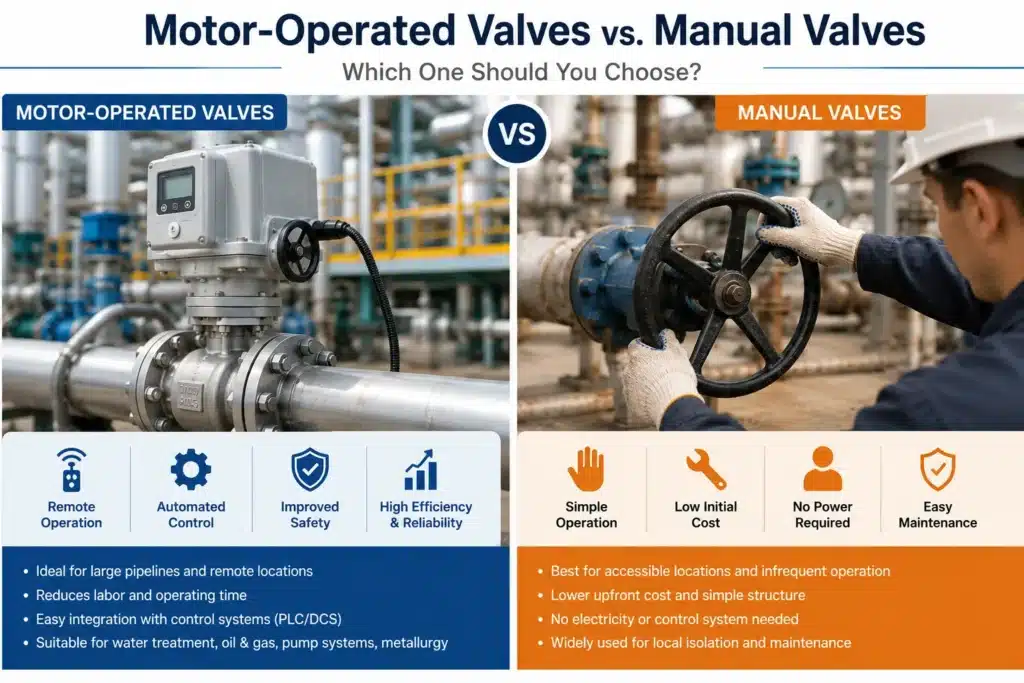
Motor-Operated Valves are increasingly used in industrial piping systems where valves must be opened, closed or positioned automatically from a local control panel, PLC or remote control room. Compared with manual valves, a motor-operated valve can reduce the need for operators to travel to the valve location and can provide more consistent operation in water treatment plants, pump stations, oil and gas facilities, metallurgical plants and packaged process equipment.
Manual valves remain highly practical for many applications. They are simple, economical and require no electrical power or control system. For valves that operate only occasionally and remain easily accessible, manual operation may still be the most efficient choice.
The decision between a motor operated valve and a manual valve should therefore not be based only on automation level. Valve size, operating frequency, accessibility, process safety, required operating speed, actuator torque, maintenance strategy, remote-control requirements and total installed cost should all be considered.
A motor-operated valve is not simply a manual valve with an electric motor added to the top. The valve torque or thrust, actuator sizing, operating time, controls, limit switches, environmental protection and failure behavior must be engineered as one complete valve package.
What Are Motor-Operated Valves?
Motor-Operated Valves, often abbreviated as MOV valves, are industrial valves operated by an electric motor-driven actuator. The actuator converts electrical energy into rotary or linear mechanical movement to open, close or position the valve.
For quarter-turn valves such as ball valves and butterfly valves, the actuator normally produces rotary torque. For multi-turn gate and globe valves, the actuator rotates the valve stem through multiple revolutions and generates the thrust required to move the closure element.
An industrial motor operated valve actuator may include an electric motor, reduction gearbox, torque switches, limit switches, position indication, local controls and manual override. More advanced MOV packages can also provide remote position feedback, digital communication and modulating control.
The term MOV is common in large industrial plants because it clearly distinguishes electrically powered valves from manually operated, pneumatic and hydraulic valve systems.
What Is a Manual Valve?
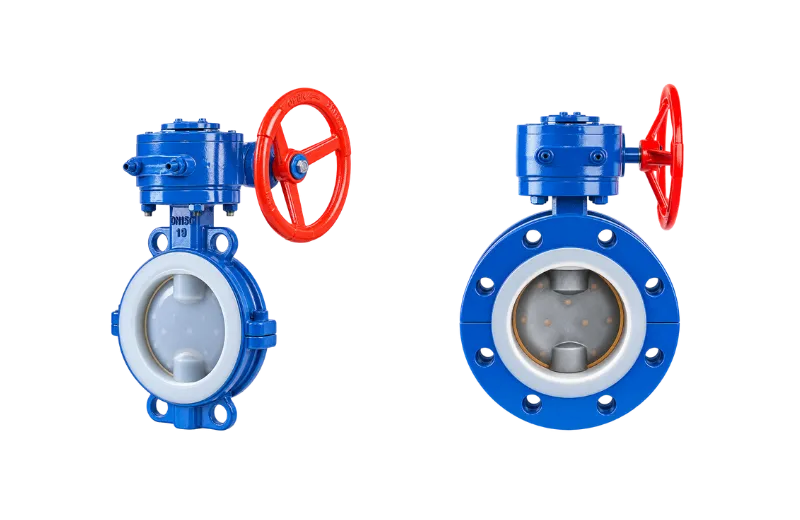
A manual valve is operated directly by a person using a lever, handwheel or manual gearbox. The operator physically supplies the force required to move the valve.
Small ball and butterfly valves often use levers because they require only approximately 90 degrees of rotation. Gate and globe valves normally use handwheels because their stems require multiple turns.
Larger industrial valves may use manual gearboxes to reduce the effort required from the operator. The gearbox increases mechanical advantage but also increases the number of handwheel turns required to move the valve.
Manual valves are simple and reliable when the operating location is accessible and the valve does not need to move frequently or automatically.
Motor-Operated Valve vs Manual Valve
The fundamental difference between a motor-operated valve and a manual valve is the source of operating force. A manual valve relies on an operator, while an MOV uses an electric motor and gearbox.
This difference affects far more than convenience. Motor operation allows a valve to become part of an automated process sequence, while manual operation normally requires direct human intervention at the installation location.
| Factor | Motor-Operated Valve | Manual Valve |
|---|---|---|
| Operating Method | Electric motor and actuator | Lever, handwheel or gearbox |
| Remote Operation | نعم | Normally no |
| الأتمتة | Can integrate with PLC or control system | Requires operator |
| Electrical Power | Required | Not required |
| Initial Cost | Higher | Lower |
| Operating Frequency | Suitable for repeated or scheduled operation | Best for infrequent operation |
| Large Valve Operation | Reduces operator effort | May require large gearbox and considerable time |
| تغذية الارتجاع للموضع | Can be transmitted remotely | Usually checked locally |
| الصيانة | Valve plus actuator maintenance | Mainly mechanical valve maintenance |
When Should You Choose Motor-Operated Valves?
Motor-Operated Valves become attractive when the valve must operate automatically, remotely or frequently. Their value increases as the difficulty or cost of manual operation increases.
A valve located several hundred meters from the control room may technically be possible to operate manually, but sending an operator to the valve every time a process condition changes may be inefficient.
The same principle applies to valves installed on elevated pipe racks, underground chambers, remote pump stations or hazardous industrial areas. Remote electrical operation can reduce routine operator access to these locations.
Large valves are another common application. The manual force required to operate a high-pressure gate valve or large ball valve may require a substantial gearbox and many handwheel turns. A properly sized electric actuator can provide more consistent operation.
When Is a Manual Valve the Better Choice?
Automation is not necessary for every industrial valve. If a valve is opened during commissioning and then remains in the same position for several years, an electric actuator may add unnecessary cost and maintenance.
Manual valves are particularly practical for local isolation around equipment that already requires an operator to be present during maintenance.
They are also useful where electrical infrastructure is unavailable or where the cost of running power and control cables would exceed the operational value of automation.
For small valves with low operating torque, manual operation may also be faster and simpler than installing a motor actuator.
Common Types of Motor-Operated Valves
Motor Operated Ball Valve
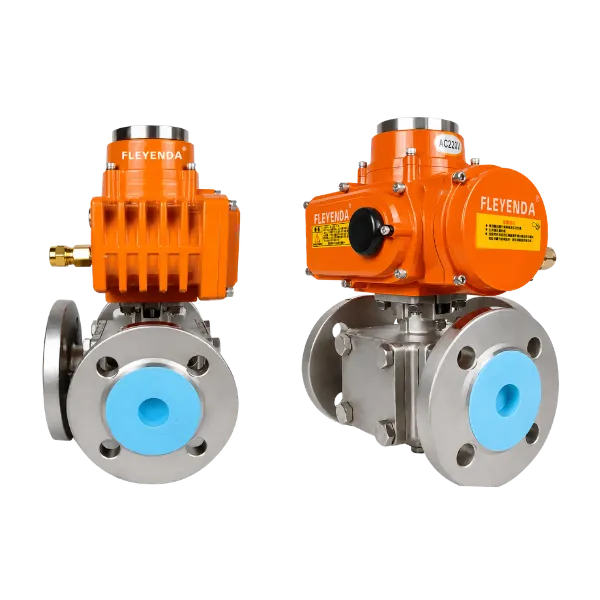
A motor operated ball valve uses a quarter-turn electric actuator to rotate the ball approximately 90 degrees between open and closed positions.
Ball valves are well suited to motor operation because their rotary movement is relatively simple and they provide reliable shutoff with low pressure loss when fully open.
Motor operated ball valves are widely used in water-treatment systems, pump equipment, oil and gas piping, process skids and industrial utilities.
Large ball valves may require high-output electric actuators, particularly when differential pressure and seat friction create significant breakaway torque.
Motor Operated Gate Valve
A motor operated gate valve uses a multi-turn electric actuator to raise or lower the gate through stem rotation.
Motor operation is particularly useful for large gate valves because manual operation can require many handwheel revolutions and significant operator effort.
MOV gate valves are common in water transmission systems, pumping stations, oil and gas facilities, power and heavy industrial piping.
Motor Operated Butterfly Valve
Butterfly valves are quarter-turn valves and can be operated using compact rotary electric actuators.
Large motor-operated butterfly valves are frequently used in water-treatment plants, cooling-water systems, pumping stations and large industrial pipelines.
Actuator torque must consider both seating torque and dynamic torque produced by fluid forces acting on the disc.
Motor Operated Globe Valve
Motor-operated globe valves can be used for automated isolation or controlled flow in suitable applications.
Because globe valves move linearly and can require significant stem thrust, actuator sizing should consider maximum differential pressure and valve trim design.
Modulating versions require actuators designed for frequent positioning rather than simple open-close duty.
On-Off MOV vs Modulating MOV
Not every motor-operated valve performs the same control function. Some MOVs only need to open or close, while others must stop at intermediate positions.
An on-off MOV is commonly used for pipeline isolation, pump sequencing, tank switching and equipment shutdown. The actuator travels between the two end positions and stops when the appropriate limit switch is reached.
A modulating motor-operated valve receives a proportional command and continuously changes its position according to process demand.
Modulating service places greater demands on actuator duty cycle, positioning accuracy, valve trim and mechanical life. A valve package designed for occasional isolation should not automatically be used for continuous control.
Actuator Torque and Thrust Sizing
Correct actuator sizing is one of the most important requirements for reliable Motor-Operated Valves.
Quarter-turn valves such as ball and butterfly valves are normally sized according to torque. Gate and globe valves may require both stem torque and axial thrust calculations depending on the actuator and stem design.
Required valve torque can change with differential pressure, temperature, seat condition, deposits and operating history. A valve that moves easily when unpressurized may require significantly more force in actual service.
The actuator should therefore be selected from valve-manufacturer torque or thrust data at the specified maximum operating condition.
An engineering margin is normally included so the actuator can accommodate variations caused by aging, friction, deposits and other service effects.
For MOV procurement, ask the supplier to provide the required valve torque or thrust and the available actuator output at the specified electrical conditions. Do not select the actuator only from valve diameter.
Manual Override on Motor-Operated Valves
Industrial MOV actuators commonly include a manual override so the valve can still be operated locally when electrical power is unavailable.
Large multi-turn actuators often use a handwheel, while quarter-turn actuators may use either a handwheel or another manual operating mechanism.
Manual override is useful during commissioning, maintenance and emergency troubleshooting. However, it should be used according to the actuator manufacturer’s instructions because improper manual operation can damage the gearbox or switches.
The presence of manual override does not make an MOV equivalent to a dedicated manual valve. Its primary operating method remains electric.
Operating Speed
Operating speed is another important difference between motor-operated and manual valves. A motor actuator provides a defined opening or closing time, while manual valve speed depends on the operator and gearbox ratio.
Faster operation is not always better. In large liquid systems, closing a valve too quickly can produce rapid changes in fluid velocity and contribute to water hammer.
Pump stations and long water pipelines may therefore require carefully controlled MOV closing times rather than the fastest available actuator.
In oil and gas shutdown systems, the required operating time may instead be determined by process safety requirements.
Motor-Operated Valves in Water Treatment
Motor-Operated Valves for water treatment are commonly used in raw-water intake systems, filtration lines, backwash systems, treated-water distribution, storage tanks and large pumping stations.
Water-treatment plants often contain many large valves distributed across a wide facility. Remote operation allows these valves to be integrated into the plant PLC or supervisory control system.
Large butterfly valves, ball valves and gate valves are particularly suitable for motor operation where frequent manual access would be inefficient.
Valve closing time should be evaluated carefully because large water systems can be sensitive to pressure surge.
Motor-Operated Valves for Pump Systems
Pump systems are one of the most practical applications for MOV valves. Motor-operated valves can provide automatic suction isolation, discharge isolation, bypass control, recirculation and system sequencing.
In packaged pump skids, the valve can be wired directly into the local control panel or PLC and coordinated with pump startup and shutdown.
The correct sequence depends on system design. Some pump applications require the discharge valve to begin opening after the pump starts, while others require the valve to be open before startup.
During shutdown, valve movement should be coordinated with pump deceleration and check-valve operation to avoid unnecessary pressure surge or reverse flow.
Motor-Operated Valves in Oil and Gas
Motor-Operated Valves for oil and gas are used in pipeline stations, tank farms, terminal facilities, process units, utility systems and remote isolation points.
Large ball and gate valves may be difficult and time-consuming to operate manually, particularly when high differential pressure creates substantial valve torque.
Electric operation allows valves to be controlled from a remote location and can provide open, closed and intermediate position feedback to the plant control system.
Oil and gas applications may also require hazardous-area actuators, fire-safe valve construction, anti-static features and defined emergency shutdown operation.
Motor-Operated Valves in Metallurgy
Metallurgical and steel plants use motor-operated valves in cooling-water systems, process-water networks, gas lines, pump stations and heavy industrial utility systems.
These facilities often contain large pipelines and valves distributed across extensive production areas. Remote motor operation can reduce the need for repeated manual operation in difficult locations.
Actuator enclosures should be suitable for the local environment, which may include dust, moisture, high ambient temperature and industrial contamination.
Where water contains scale, solids or other contaminants, valve operating torque and seat wear should also be considered during actuator sizing.
Accessibility and Operator Safety
Accessibility is one of the strongest arguments for selecting Motor-Operated Valves.
A manual valve must be reachable whenever it needs to be operated. This may require operators to climb platforms, enter valve chambers or travel to remote pipeline locations.
Motor operation allows routine valve movement from a control panel while still permitting local access for inspection and maintenance.
This does not eliminate the need for safe access to the valve, but it can significantly reduce the number of routine operating visits.
Electrical Supply and Controls
A motor-operated valve requires a reliable electrical supply and suitable control architecture.
The actuator specification should identify supply voltage, phase, frequency and any control voltage required by the internal circuitry.
On-off MOVs may use open and close commands together with limit-switch feedback. More advanced systems may also provide torque alarms, intermediate position indication or digital communication.
The control philosophy should be defined before ordering so the actuator arrives with the correct electrical configuration.
Environmental Protection
MOV actuators contain electric motors, switches, gearboxes and electrical terminals, so the operating environment must be considered carefully.
Outdoor water-treatment plants and pump stations may expose actuators to rain, humidity and temperature variation. Metallurgical plants may expose them to dust and industrial contamination.
Oil and gas facilities may require actuators suitable for hazardous electrical areas.
The enclosure and electrical certification should therefore match the actual site rather than being selected only from valve size.
Fail Position During Power Loss
One important consideration with an electric motor-operated valve is what happens if electrical power is lost.
A conventional MOV may remain in its current position when power fails. This behavior can be completely acceptable for some isolation duties but unsuitable for others.
If the process requires automatic movement to a defined safe position, a suitable fail-safe arrangement or different actuator technology may be necessary.
The required failure behavior should therefore be defined from the process safety philosophy rather than assumed from the actuator type.
Maintenance Comparison
Manual valves generally have fewer components to maintain. Inspection normally focuses on the valve body, seats, stem, packing and manual gearbox where fitted.
Motor-operated valves require the same valve maintenance plus inspection of the actuator motor, gears, electrical terminals, switches, seals and manual override.
This means MOVs have a higher maintenance burden, but that additional complexity may be justified by the operational benefits of remote control and automation.
Critical MOV valves should be periodically stroked and checked for correct limit-switch operation, torque behavior and position feedback.
Installed Cost vs Operating Cost
A manual valve usually has a lower initial purchase price because it does not require an electric actuator, control wiring, electrical protection or PLC integration.
A motor-operated valve has a higher installed cost but can reduce manual operating labor and make complex process sequences easier to automate.
The correct comparison should therefore consider lifecycle cost rather than only valve purchase price.
A remote valve that must be operated several times every day may justify motor operation quickly, while a maintenance isolation valve operated once every few years may not.
Motor-Operated Valve Selection Guide
Selecting an MOV valve should begin with the process function. Determine whether the valve provides isolation, diversion or process regulation.
Next define valve size, pressure, maximum differential pressure, process medium and temperature. These conditions determine the basic valve design, materials and required operating torque or thrust.
The actuator can then be selected according to output torque or thrust, voltage, operating time, duty cycle, environmental enclosure, control signals and position feedback.
Operating frequency and accessibility should also be considered. A valve that is easy to reach and rarely operated may not need motorization, while a remote or frequently operated valve may provide clear operational value when automated.
| Selection Factor | Motor-Operated Valve | Manual Valve |
|---|---|---|
| Valve Operates Frequently | Usually preferred | Can increase operator workload |
| Remote Location | Strong advantage | Requires local travel |
| Large Valve | Reduces manual effort | May require large gearbox |
| Automatic Process Sequence | Suitable | Not suitable without operator |
| Rare Maintenance Isolation | May be unnecessary | Often economical |
| No Electrical Supply | Requires additional infrastructure | Strong advantage |
| Remote Position Feedback | Available | Normally unavailable |
| Lowest Initial Cost | Higher | Usually lower |
What to Include in an MOV Valve RFQ
A professional MOV quotation requires both valve and actuator information. Simply requesting a “motor-operated valve” does not provide enough detail for reliable selection.
The RFQ should define valve type, nominal size, pressure rating, body material, trim material, seat material, end connection, process medium, temperature and maximum differential pressure.
The actuator specification should include power supply, output torque or thrust, operating time, duty cycle, environmental protection, manual override, control commands and required position feedback.
Pump and water applications should also include any valve timing requirements related to startup, shutdown and surge control.
For critical industrial MOVs, purchasing the valve, motor actuator, gearbox, mounting components and electrical accessories as one factory-assembled and tested package provides clearer responsibility for torque sizing, limit settings and functional performance.
Frequently Asked Questions About Motor-Operated Valves
What are Motor-Operated Valves?
Motor-Operated Valves are industrial valves equipped with electric motor actuators that open, close or position the valve automatically or remotely.
What does MOV mean in valves?
MOV commonly means Motor-Operated Valve. The term is widely used for electrically actuated industrial valves in water, oil and gas, pump, power and heavy industrial systems.
What is the difference between an MOV and a manual valve?
An MOV uses an electric motor and actuator, while a manual valve relies on a person operating a lever, handwheel or gearbox.
When should I choose a motor-operated valve?
Motor operation is particularly useful for valves that are large, remote, frequently operated, difficult to access or required to operate as part of an automatic process sequence.
When is a manual valve better?
A manual valve is often more economical for accessible valves that operate infrequently and do not need remote control or automation.
Can motor-operated valves be used with pumps?
Yes. MOVs are commonly used for pump suction and discharge isolation, bypass control, recirculation and automated startup or shutdown sequencing.
Can a motor-operated valve cause water hammer?
Rapid valve closure can contribute to pressure surge in liquid systems. MOV operating time should therefore be coordinated with pipeline and pump characteristics where water hammer is a concern.
Do Motor-Operated Valves have manual operation?
Many industrial MOV actuators include a manual override or handwheel for commissioning, maintenance and operation when electrical power is unavailable.
How is an MOV actuator sized?
Quarter-turn MOV actuators are generally sized from required valve torque, while multi-turn valves may require torque and thrust calculations. Maximum differential pressure and an appropriate engineering margin should be included.
Are Motor-Operated Valves suitable for oil and gas?
Yes. They are widely used in pipeline stations, tank farms, process units and remote isolation applications. Hazardous-area and process-safety requirements should be included in actuator selection.
الخلاصة
The choice between Motor-Operated Valves and manual valves depends on how the valve will actually be used rather than on the valve type alone.
Manual valves remain an economical and reliable choice for accessible isolation points that operate infrequently. They require no electrical infrastructure and have relatively simple maintenance requirements.
Motor-operated valves provide greater value when valves are large, remote, frequently operated or integrated into automated industrial processes. They are particularly useful in water treatment, pump systems, oil and gas and metallurgical facilities.
When an MOV is selected, the valve and actuator should be engineered as one package. Valve torque or thrust, differential pressure, operating speed, power supply, duty cycle, environmental protection, controls and failure behavior should all be defined before purchase.
For most projects, the correct question is not whether motor-operated valves are better than manual valves. The better question is whether the operational benefits of automation justify the additional equipment, controls and maintenance for that specific valve location.