


Water Treatment Valves: Engineering Challenges and Solutions
Water treatment valves isolate pipelines, regulate flow and pressure, divert process streams and prevent reverse flow throughout industrial water and wastewater treatment systems. Their selection directly affects filtration performance, chemical dosing accuracy, membrane protection, sludge handling and plant availability. For equipment manufacturers (OEMs), EPC contractors and system integrators, the engineering challenge is to match each valve and actuator to the actual process duty rather than simply specifying a pipe diameter and pressure class.
This guide examines common failure mechanisms, practical engineering solutions and the selection criteria needed to build reliable treatment equipment. The focus is on how valves behave under real operating conditions, from raw water intake to treated water distribution.
Engineering Challenges in Water Treatment Systems
Chemical corrosion and material degradation
Acids, alkalis, hypochlorite, ferric chloride and membrane cleaning chemicals can attack metallic components or degrade elastomer seals. Chloride-rich water may cause localized pitting and crevice corrosion even in stainless steel. Chemical compatibility depends on concentration, temperature, exposure duration and impurities, not simply pH. A valve that performs well in normal production may fail during a concentrated cleaning cycle, resulting in chemical leakage or contamination.
Suspended solids, sludge and abrasive wear
Wastewater treatment valves must accommodate grit, fibers, floc and variable solids loading. Particles can accumulate in body cavities, obstruct the closing element or become trapped between sealing surfaces. Abrasive slurry can progressively damage the seat and gate, increasing leakage and operating torque. Sludge that settles during shutdown can also prevent the next valve stroke. These mechanisms are particularly relevant to clarifier underflow, sludge transfer and dewatering equipment.
Water hammer, cavitation and erosion
Pump trips, rapid valve closure and check valve slam can generate hydraulic pressure waves that exceed normal operating pressure. Negative pressure transients may also threaten pipe integrity. Cavitation is a different phenomenon: vapor bubbles form where local liquid pressure falls below vapor pressure, then collapse when pressure recovers. This can damage valve trim and downstream pipework. A higher static pressure rating alone does not resolve either problem.
Leakage, cycling fatigue and unstable process control
Repeated backwash sequences, chemical injection cycles and automatic isolation place mechanical loads on seats, stem seals and actuators. Internal leakage may allow untreated water into a clean-water header; external leakage can expose operators and equipment to chemicals. Oversized control valves may operate near the closed position, where small movements produce disproportionate flow changes. The result can be unstable dosing, inconsistent membrane feed or excessive actuator cycling, increasing unplanned downtime and lifecycle cost.
Valve Requirements Across Water Treatment Processes
Water treatment plant valves should be specified by process function. An intake isolation valve, a chemical metering valve and an RO concentrate control valve face very different hydraulic and material requirements. The following matrix identifies typical starting points for engineering selection, rather than universal valve recommendations.
| Process stage | Operating challenges | Valve requirements | Recommended valve types |
|---|---|---|---|
| Raw water intake | Grit, debris, pump transients | Low head loss; reliable isolation and backflow prevention | Butterfly or gate; suitable check valve at pump discharge |
| Coagulation and flocculation | Corrosive reagents; fragile floc | Accurate reagent flow; gentle downstream handling | Diaphragm or metering control valve; isolation ball or butterfly |
| Sedimentation | Settled solids and concentrated sludge | Unobstructed discharge; resistance to solids buildup | Knife gate, suitable pinch or plug valve |
| Filtration and backwashing | Frequent switching; changing differential pressure | Repeatable switching, tight isolation, position feedback | Actuated butterfly; three-way ball for compatible routing |
| Chemical dosing | Aggressive chemicals, small flow rates | Compatible wetted parts; stable metering and non-return duty | Diaphragm or metering valve; compatible lined or polymer ball isolation; dosing check |
| Reverse osmosis (RO) | High-pressure feed, concentrate and cleaning cycles | Circuit-specific pressure rating; regulated concentrate flow | Rated ball/check; appropriately sized globe or characterized control valve |
| Membrane filtration (UF/MF) | Backwash, chemical cleaning, cross-contamination | Automated routing; chemical-compatible seals | Actuated butterfly or ball; diaphragm where appropriate |
| Sludge treatment and dewatering | Viscous, abrasive or fibrous media | Solids passage; serviceable seals and wear parts | Slurry-duty knife gate or pinch; suitable sludge control valve |
| Disinfection | Oxidizing liquids; controlled chemical injection | Reagent compatibility and injection protection | Compatible diaphragm, lined or polymer isolation; dosing check for liquid systems |
| Treated water distribution | Pressure fluctuations, reverse flow | Low loss, surge-aware closure, required water approvals | Butterfly or gate; check; pressure-control valve as required |
RO high-pressure service, chlorine gas systems and drinking-water contact require separate verification of pressure, chemical compatibility and applicable approvals. A general water-service valve is not automatically suitable for these duties.
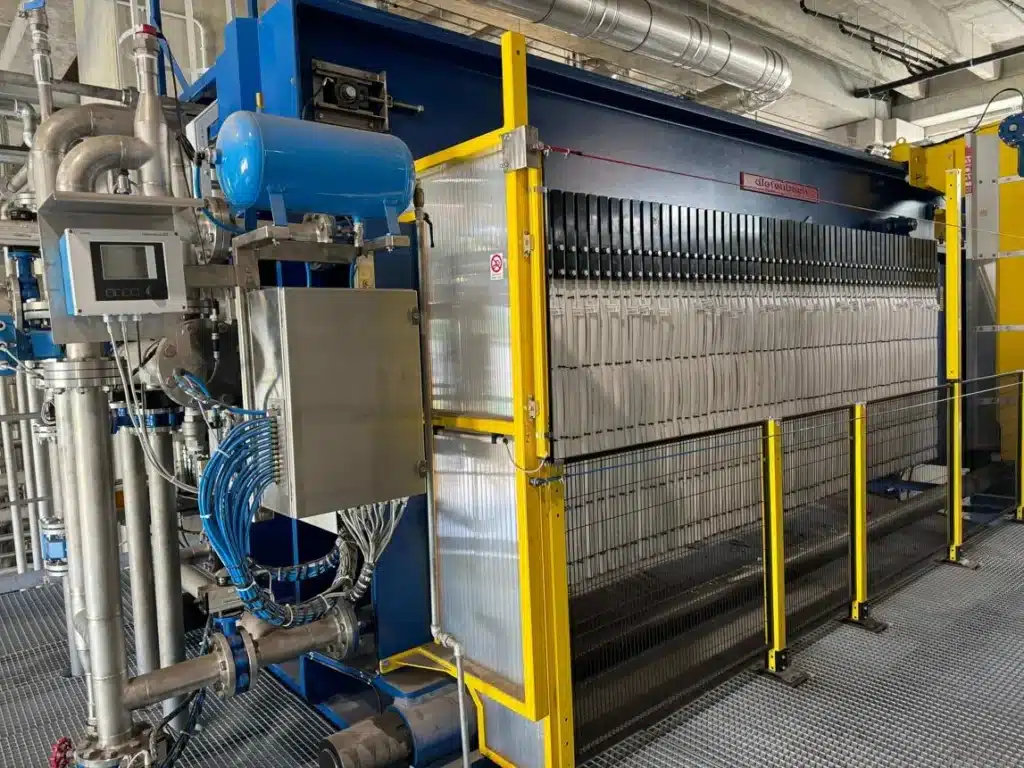
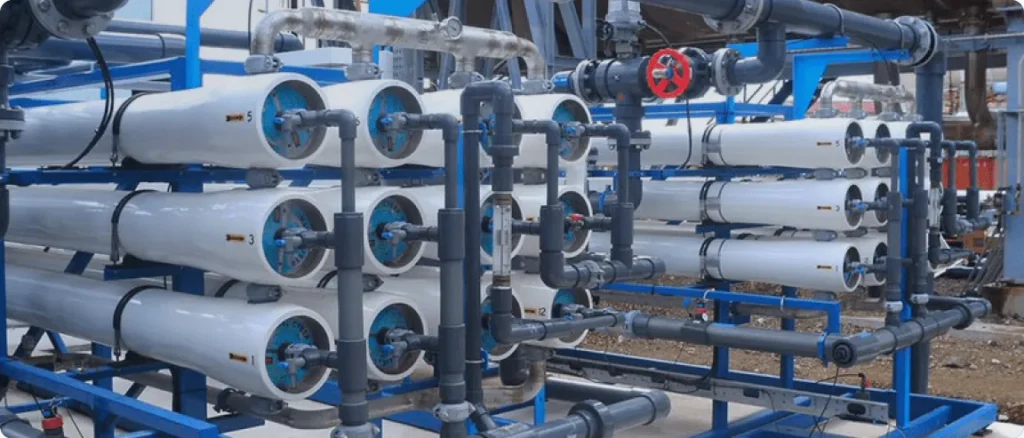
Engineered Valve Solutions for Water Treatment Challenges
1. Specify the complete wetted material system
Match the body, disc or ball, shaft, liner, seat and secondary seals to every liquid the valve will contact, including cleaning solutions. EPDM-seated iron butterfly valves are candidates for compatible water service, while PTFE- or PFA-lined designs may be considered for aggressive liquid chemicals. UPVC can suit selected low-temperature dosing circuits after pressure derating. Review oxidizer exposure, permeation, vacuum conditions and abrasion before approving a lined valve.
2. Choose a flow path that handles solids
For sludge isolation, select a knife gate or other solids-handling design that provides an adequate open passage and can close against the expected solids loading. Confirm gate thrust, sealing direction, maximum shut-off differential pressure and any flush requirements. In abrasive slurry, a conventional knife gate is not automatically equivalent to a heavy-duty slurry valve. Continuous throttling calls for a dedicated control design; standard isolation gates should not remain partially open.
3. Manage hydraulic transients and cavitation
Determine actuator stroke time from the hydraulic system, including pipe length, wave speed, flow velocity, pump inertia and check valve dynamics. Evaluate power failure and pump trip scenarios, not only normal operation. Controlled closure, coordinated pump ramping, suitable non-slam check valves and engineered surge protection can reduce transient loads. Where pressure drops are severe, evaluate pressure recovery and cavitation limits; staged pressure reduction or purpose-designed anti-cavitation trim may be necessary.
4. Size control valves using flow coefficient and differential pressure
Flow control valves for water treatment should be selected from minimum, normal and maximum flow together with upstream and downstream pressures at each operating point. Pipe size alone does not establish the required valve capacity. For preliminary sizing of turbulent, non-choked liquid flow without significant piping corrections, the US-unit relationship is:
For example, clean water at 100 US gal/min and a 4 psi valve pressure drop requires a preliminary Cv of 50 at that operating point. This is not necessarily the rated full-open Cv. Check the manufacturer’s travel-versus-Cv curve, installed characteristic, available control range and cavitation limits before choosing the valve size. V-port ball valves can provide characterized regulation; globe control valves may be preferable for more demanding pressure reduction.
5. Integrate actuation with PLC/SCADA and maintenance planning
Specify electric actuator torque or pneumatic actuator output against worst-case valve demand, including seating, breakaway, differential pressure and deposits. Confirm duty rating, enclosure protection, minimum air pressure, stroke time and the permitted stem torque. Define discrete commands and limit feedback for switching, or a compatible 4–20 mA command and position feedback for modulation. Network communication requires model-specific interface confirmation.
The fail-safe position must follow the process hazard assessment. A spring-return pneumatic actuator or suitable stored-energy electric design may be appropriate when movement after utility loss is required; a conventional electric actuator does not inherently fail open or closed. Interlock valve feedback with pumps and filter sequences. Plan seal replacement, actuator removal access and spare parts before commissioning to reduce total cost of ownership (TCO).
Specify valves around your process duty.
Share flow, media composition and operating pressures for a configuration review. Explore our Water Treatment Valve Solutions for complete equipment packages.
Recommended Water Treatment Valves and Their Applications
These five Fleyenda product families illustrate how valve geometry, materials and actuation address specific engineering problems. Listed ranges are catalog options; actual pressure-temperature limits, material combinations and operating duties must be confirmed for the ordered configuration.
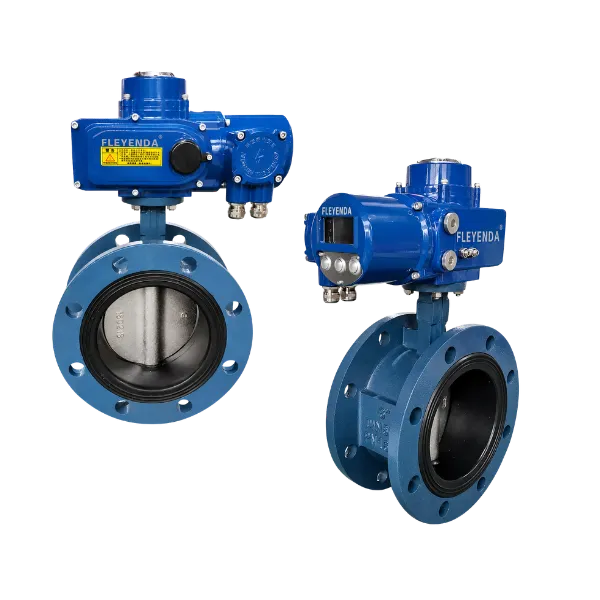
01 / Automated isolation
FLE-D-CEF Electric Cast Iron Flanged EPDM Butterfly Valve
For compatible water headers, filter isolation and backwash switching. Its quarter-turn construction supports compact automated isolation in larger lines. Confirm disc clearance, seat chemistry and surge-compatible closing time.
DN50–DN600 · PN10 / PN16 · Cast iron · EPDM seat
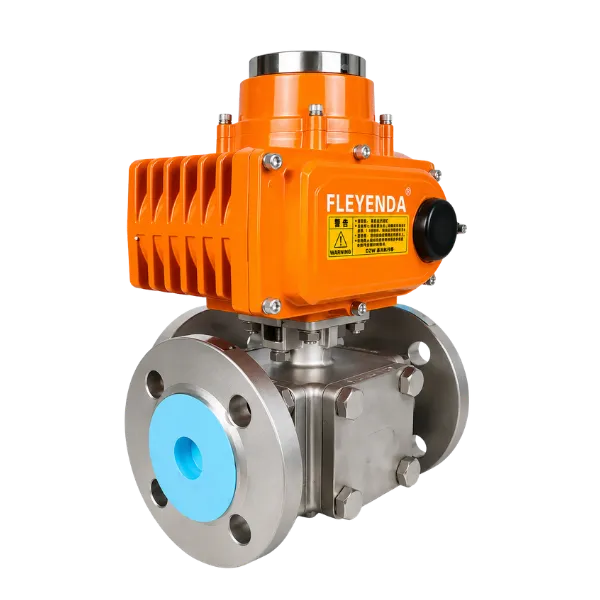
02 / Flow diversion
FLE-Q-TF Electric 3-Way Flanged Ball Valve
For compatible bypass, filter branch and cleaning-circuit routing. One rotary assembly can simplify a switching manifold where the required flow paths match the ball drilling. Confirm intermediate port connections and interlocks to prevent cross-contamination.
DN15–DN200 · PN10–PN40 · L-port / T-port · CF8 / CF8M / WCB body options
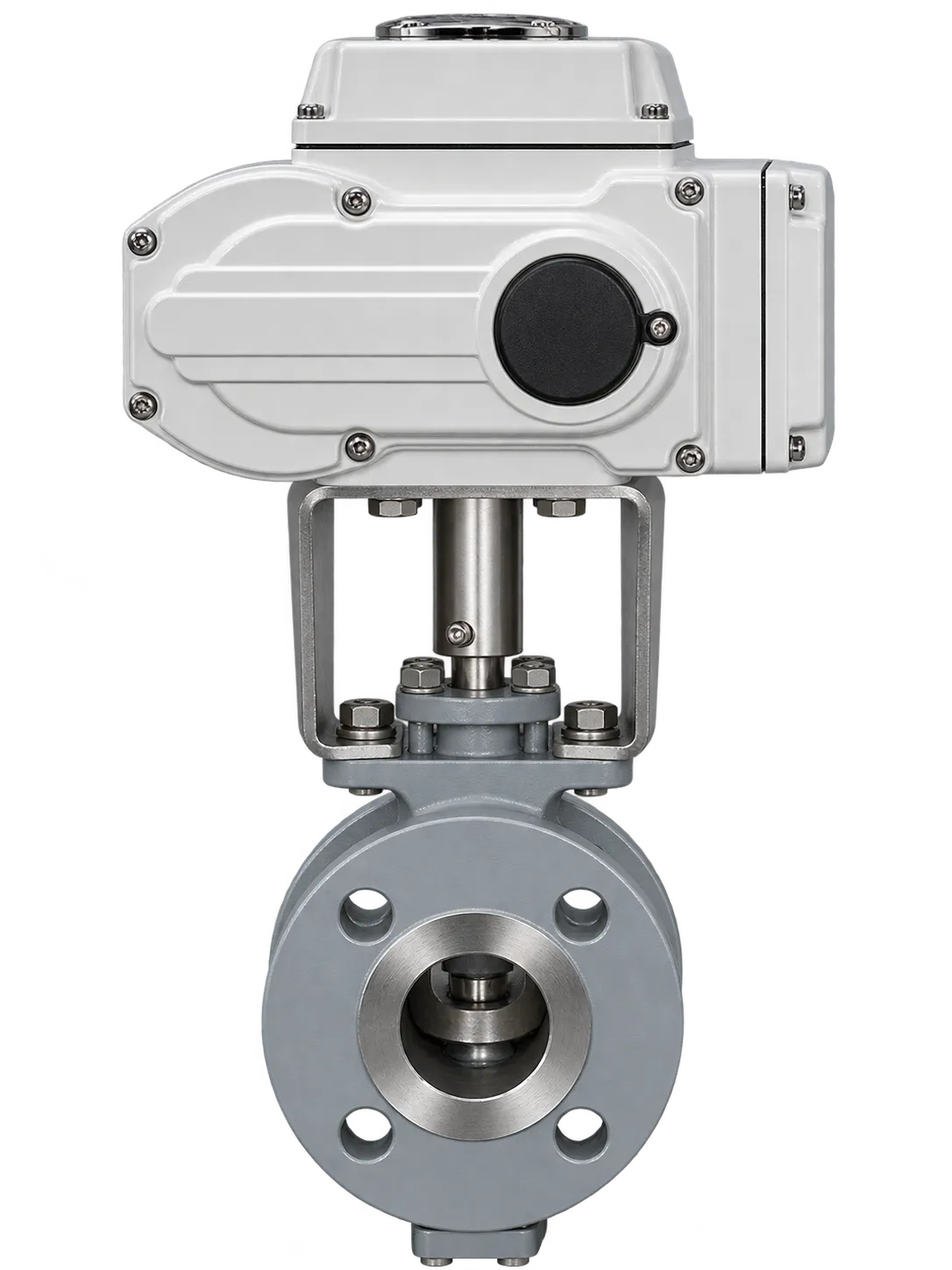
03 / Modulating control
FLE-VQ-F Electric V-Port Ball Valve
The characterized segmented ball is a candidate for variable feed flow and selected process-liquid regulation. The notch geometry enables finer adjustment than a conventional on/off ball valve in suitable duties. Confirm Cv, control range and pressure recovery.
DN25–DN300 · PN16–PN40 · 15° / 30° / 60° / 90° V-port options · 4–20 mA option
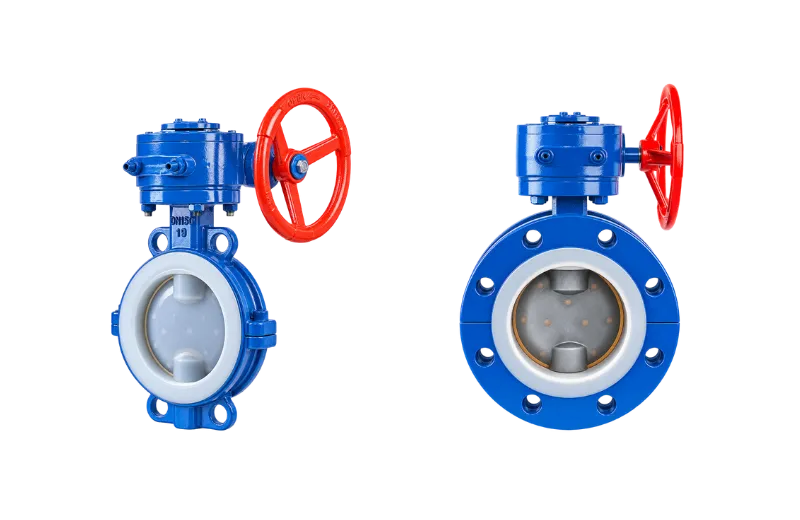
04 / Chemical compatibility
PTFE-Lined Butterfly Valve
A lined construction for compatible acid, alkali and chemical transfer or neutralization circuits. Evaluate concentration, temperature, pressure and secondary seals. Gear, electric and pneumatic configurations are listed; the image shows gear-operated examples.
DN40–DN1200 · PN6 / PN10 / PN16 or Class 150 options · Wafer / lug / flanged

05 / Solids-bearing service
Pneumatic Knife Gate Valve with Air Cylinder Actuator
For selected sludge discharge and wastewater isolation duties. The rising gate clears the main passage when open. Verify abrasion severity, sealing direction, thrust and pressure limits; use a dedicated slurry design if the duty requires it.
DN50–DN1000 series · Cast iron / WCB / CF8 / CF8M body options · Pneumatic cylinder
Need several valve types for one equipment package?
Send your P&ID, valve schedule or bill of materials for a duty-by-duty review.
How to Select the Right Valves for Water Treatment Systems
Effective water treatment valve selection begins with a process datasheet and ends with an approved valve-actuator assembly. Define the primary function first: isolation, diversion, backflow prevention or modulation. Then evaluate the normal operating envelope, cleaning and upset conditions.
| Selection factor | Required input and engineering decision |
|---|---|
| Fluid characteristics | Identify chemical composition, concentration, chlorides, pH, cleaning fluids and viscosity. |
| Pressure and temperature | Supply operating and design limits, transient pressure, vacuum and pressure-temperature derating. |
| Flow and differential pressure | Provide minimum, normal and maximum flow and corresponding inlet/outlet pressures; calculate Cv for modulation. |
| Solids loading | Report solids concentration, particle size, fibers, abrasiveness and settling tendency. |
| Body and seat materials | Check all wetted components and secondary seals against process and cleaning media. |
| Size and connections | Confirm DN/NPS, flange drilling, face-to-face dimensions, wafer disc clearance or union connections. |
| Shut-off and control | Define allowable seat leakage, flow direction, control characteristic and maximum shut-off differential. |
| Actuation and fail-safe | Specify power/air supply, I/O, frequency, torque or thrust, stroke time and failure behavior. |
| Installation and maintenance | Check envelope, orientation, removal clearance, environmental exposure and access to wear parts. |
Material compatibility: useful starting points
| المواد | Typical candidate duty | Key limitation to verify |
|---|---|---|
| Cast iron / ductile iron | Compatible water lines with appropriate lining or coating | Corrosion, pressure class, external protection; cast iron has lower impact toughness. |
| 304 / 316 / 316L stainless steel | Compatible process water and cleaning circuits | Chloride pitting, crevices, temperature and oxidizing chemicals; 316L is not universally corrosion-proof. |
| UPVC | Selected ambient-temperature chemical and water lines | Pressure derating, chemical attack, mechanical loading and joining method. |
| EPDM | Compatible water and selected dilute aqueous chemicals | Elastomer grade, oxidizers, temperature and incompatibility with many oils. |
| PTFE / PFA | Selected corrosive liquid service | Permeation, lining integrity, pressure/vacuum limits, creep and abrasion. |
Project specifications may reference ISO 5211 for part-turn actuator mounting, API 598 or EN 12266-1 for applicable valve pressure testing, and AWWA C504 for rubber-seated butterfly valves within its scope. Verify the required edition, acceptance criteria and model-specific documentation. Potable-water projects may also require jurisdiction-specific drinking-water contact approval. A design reference alone does not demonstrate product certification.
Water Treatment Valve Solutions for OEM Equipment Manufacturers
For OEMs, valve engineering affects skid footprint, wiring, assembly time and repeatability. A practical specification treats mechanical and automation interfaces as part of the equipment design, rather than purchasing a valve body first and adapting an actuator later.
- RO and membrane skids: separate high-pressure, permeate, concentrate and cleaning duties; standardize approved assemblies for repeat units.
- Chemical dosing skids: match isolation and injection components to the specific reagent and concentration, and preserve service access around metering pumps.
- Industrial filtration packages: coordinate valve sequencing, position feedback and pump interlocks to prevent unintended flow paths.
- Integrated wastewater and dewatering equipment: plan solids passage, actuator thrust and access for cleaning or seat replacement.
Fleyenda’s electric and pneumatic portfolio enables equipment designers to evaluate valve and actuator combinations together. Share mechanical drawings, control requirements and quantities to align connection dimensions, model references and repeat-order specifications. Agree spare-parts availability, lead times and change control before standardizing the equipment BOM.
Engineering Valve Support for EPC Contractors
On an EPC project, technical consistency across valve tags is as important as selecting each individual valve. A mismatch between the valve schedule, flange class, actuator voltage and approved drawing can delay installation even when the valve itself is functional.
Fleyenda invites project teams to submit their P&IDs, BOQs and valve schedules for configuration review. The published water-treatment offering covers valve-actuator selection, dimensional coordination and agreement of inspection scope. A structured procurement review should include:
- Technical review: reconcile duty, materials, pressure ratings, leakage criteria and actuation requirements tag by tag.
- Design approval: request model datasheets, dimensional drawings, actuator wiring diagrams and any required material documentation.
- Inspection and testing: agree shell and seat test requirements, functional checks, witness points and deliverable records before order release.
- Delivery and service: coordinate tag marking, packing, delivery batches and recommended spares; confirm ongoing technical support scope.
This approach helps engineering teams manage multi-type valve supply without losing traceability between the approved specification and the delivered configuration.
Why Choose Fleyenda for Water Treatment Valve Solutions?
When evaluating a water treatment valve manufacturer or supplier, OEM and EPC buyers should consider technical fit, documentation and repeatability alongside purchase price. Fleyenda publishes electric and pneumatic valve families, lined-valve configurations and application-specific actuator options. Its water treatment offering also describes machining, assembly, testing and dispatch checks, with the inspection scope agreed for the project.
By reviewing the valve and actuator together, engineering teams can coordinate mechanical fit, control interfaces and maintenance needs before procurement. Explore Fleyenda’s Industrial Water Treatment Valves for equipment-level supply and project support.
Frequently Asked Questions About Water Treatment Valves
What types of valves are used in water treatment plants?
Butterfly, ball, gate, knife gate, check, diaphragm and control valves are common. Each serves a different duty, such as main-line isolation, chemical handling, sludge discharge, backflow prevention or proportional flow regulation.
How do you select valves for wastewater treatment systems?
Start with solids loading, chemistry, pressure, temperature and the valve function. Check the passage geometry, wear resistance and sealing direction, especially for sludge and fibrous wastewater. Select the actuator against the worst credible closing load.
Which valve materials are suitable for corrosive water treatment applications?
PTFE/PFA-lined designs, selected polymers and appropriate stainless alloys are potential candidates. Compatibility must be confirmed for concentration, temperature, pressure, impurities and all wetted seals, including during cleaning.
What valves are suitable for sludge handling systems?
Knife gate and pinch valves are common isolation candidates for solids-bearing media. Confirm whether a dedicated slurry design is needed for abrasive service. Continuous sludge flow regulation requires a valve specifically rated for throttling that medium.
How can water hammer be reduced in water treatment pipelines?
Use hydraulic transient analysis to determine valve closure profiles, pump sequences, check valve dynamics and any surge devices. Slowing closure may help, but the appropriate solution depends on the system and abnormal operating scenarios.
What is the difference between electric and pneumatic valves in water treatment?
Electric actuators use electrical power; pneumatic actuators use compressed air. Selection depends on utilities, cycling demand, control accuracy, closure time and fail-safe requirements. Neither is universally superior.
How do OEM manufacturers select valves for water treatment equipment?
OEMs should define process duties and standardize approved valve-actuator assemblies against their skid drawings, control interfaces, maintenance envelope and BOM. Confirm variants for each chemical and pressure circuit.
What information is required for water treatment valve selection?
Provide medium, concentration, solids content, pressure, temperature, size, connection, flow range, differential pressure, duty, actuator supply, control signal, fail position and quantities. Add drawings and required test criteria where available.
Build Reliable Water Treatment Systems Around the Right Valve Specification
Reliable water treatment valves are selected around chemistry, hydraulics, solids loading and control requirements. Treating these variables as a single engineering problem helps reduce avoidable failures and supports consistent equipment performance over its service life.
Develop your next water treatment valve package with Fleyenda.
Send your process conditions, valve list or equipment drawings to discuss material selection, actuator configuration and project-specific requirements.