


Sanitary Ball Valves for Food and Beverage Processing
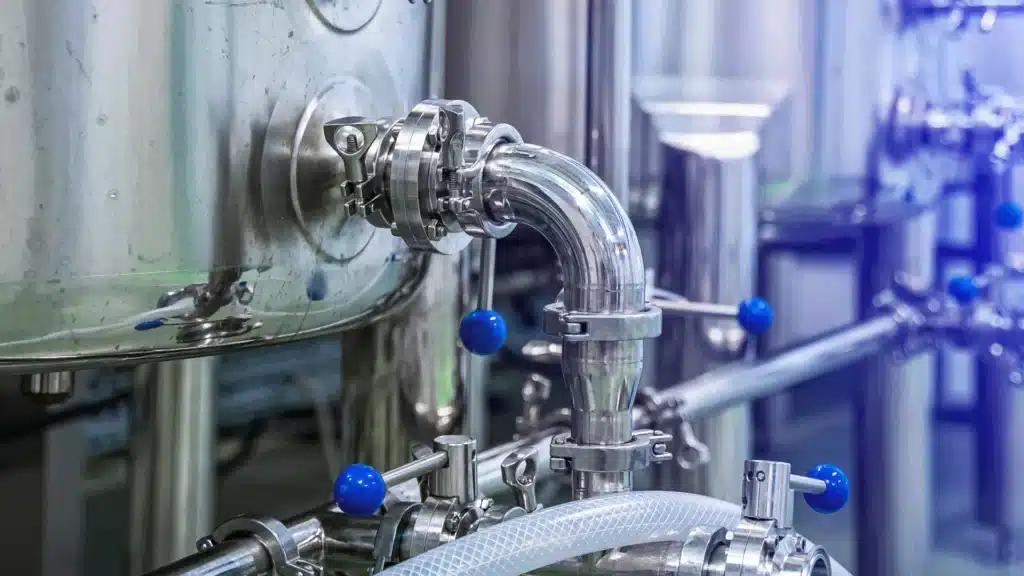
Sanitary ball valves play an important role in food and beverage processing systems, where hygienic fluid transfer, reliable pipeline isolation and efficient cleaning are essential. From dairy production and juice processing to beverage blending, edible oil transfer and automated filling lines, the right valve configuration helps maintain process consistency and simplify equipment maintenance. This guide explores how sanitary ball valves are used throughout food and beverage production, what hygienic design requirements matter, and how to select stainless steel valves for different processing applications.
Why Are Sanitary Ball Valves Important in Food Processing?
Food and beverage production requires valves that match the product medium, pipeline arrangement and cleaning procedures. Important considerations include:
Hygienic ConstructionSuitable product-contact materials and cleanable internal surfaces.
Corrosion ResistanceSS304 or SS316L options according to media and cleaning chemistry.
Easy MaintenanceTri-Clamp connections for convenient inspection and disassembly.
Automated OperationElectric actuation for remote switching and process control.
FLE-Q-3S 3-Way Tri-Clamp Sanitary Electric Ball Valve
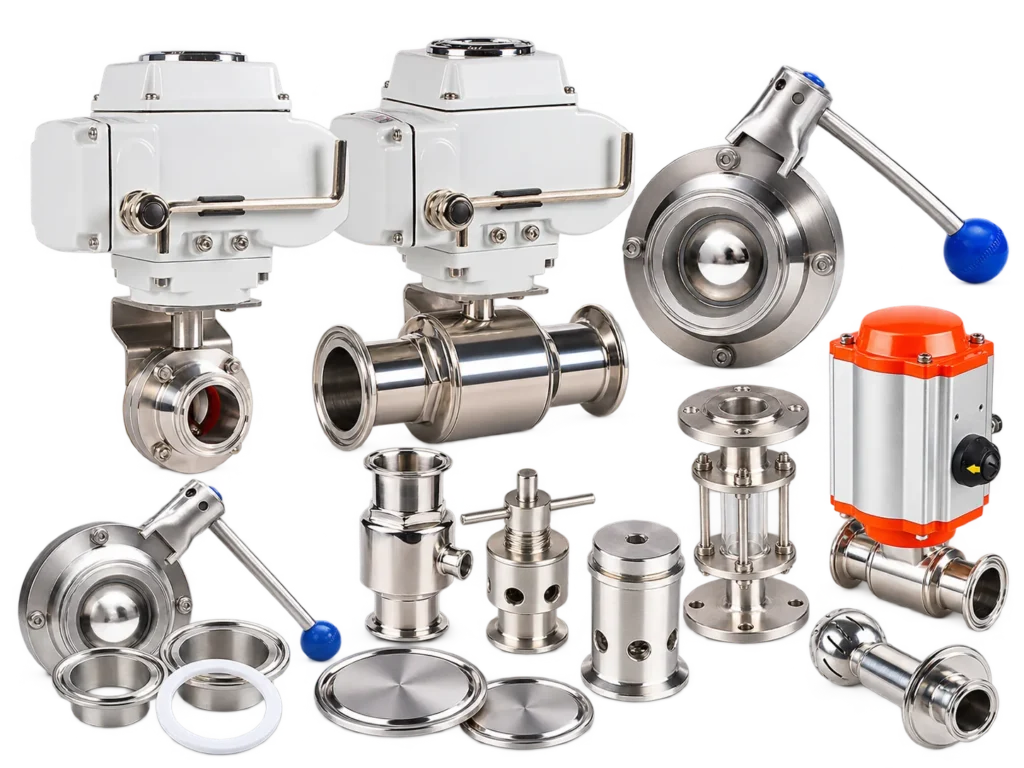
Designed for hygienic process pipelines requiring automated flow selection and diversion, the FLE-Q-3S combines stainless steel construction, quick-release Tri-Clamp connections and electric quarter-turn actuation. It provides a practical valve solution for compatible beverage, dairy and food-processing systems.

Nominal Size
Working Pressure
Working Temperature
Body Material
Three-Way Flow Switching
Supports product or utility flow selection and diversion between connected sanitary pipelines.
Tri-Clamp Connections
Quick-release connections simplify installation, inspection and maintenance in compatible hygienic piping systems.
Stainless Steel Construction
SS304 and SS316L body options with cavity-filled PTFE seat arrangement.
Electric Automation
DC24V, AC110V and AC220V options with ON/OFF, regulating and intelligent control configurations.
The FLE-Q-3S is suitable for food and beverage equipment requiring automated three-port flow routing. Its final configuration should be selected according to the product medium, cleaning cycle, required flow pattern and plant automation requirements.
1. The Role of Sanitary Ball Valves in Food and Beverage Processing
Food and beverage manufacturing involves the movement of different liquids through interconnected processing equipment. Raw materials, intermediate products, finished beverages and cleaning solutions must travel through designated pipelines under controlled operating conditions.
Sanitary ball valves are used to isolate equipment, control product transfer and redirect flow between tanks, processing vessels and production lines. Their quarter-turn operating mechanism allows relatively straightforward opening and closing, making them suitable for pipeline switching and isolation duties.
In a typical food-processing facility, sanitary valves may be installed at:
- Raw material receiving and transfer pipelines.
- Mixing tanks and ingredient preparation systems.
- Pasteurization and heat treatment equipment connections.
- Product storage tanks and distribution manifolds.
- Beverage filling and packaging equipment.
- CIP cleaning solution supply and return pipelines.
Using the correct sanitary ball valves helps organize pipeline isolation and product routing. For automated facilities, electric actuators can also reduce the need for manual valve operation and support repeatable production sequences.
However, valve selection must consider more than the stainless steel body. Product-contact surface quality, seat geometry, sealing materials, drainage and cleaning compatibility all influence hygienic performance.
2. Applications of Sanitary Ball Valves Across the Food and Beverage Industry
Different food and beverage production processes have different requirements for fluid handling, material compatibility and pipeline cleaning. Sanitary ball valves should be selected according to the characteristics of each application.
2.1 Dairy Processing and Milk Transfer
Dairy manufacturing involves receiving, filtering, pasteurizing, cooling, storing and transferring milk and other dairy products. These processes require hygienic pipeline arrangements and regular cleaning to control product residue and contamination risks.
Stainless steel sanitary ball valves can be installed at milk transfer lines, tank connections, processing equipment and distribution pipelines. Tri-Clamp connections are particularly convenient where valves need to be removed for inspection or maintenance.
For dairy applications, engineers should evaluate:
- Compatibility of valve seats and seals with milk and dairy products.
- Cleaning chemical resistance and CIP temperature.
- Internal surface condition and product residue retention.
- Pipeline drainage and connection geometry.
2.2 Juice and Beverage Production
Juice and beverage production lines handle water, fruit concentrates, syrups, flavoring ingredients and finished liquid products. Depending on the production process, different liquids may need to be directed between mixing tanks, filtration equipment, heat treatment systems and filling machines.
Sanitary ball valves provide pipeline isolation and flow routing for compatible liquid processing systems. Three-way sanitary ball valves are particularly useful when equipment requires switching between different supply or discharge paths.
For juice and beverage applications, valve material and seat compatibility should be checked against acidity, sugar concentration, flavoring ingredients and cleaning chemicals.
2.3 Brewing and Wine Processing
Brewing and wine production involve liquid transfer between fermentation vessels, storage tanks, filtration systems and packaging equipment. Different process stages may require isolation or selection between interconnected pipelines.
Stainless steel sanitary ball valves can support these transfer and isolation functions when the selected materials are compatible with the liquid and cleaning procedures.
For brewing and wine applications, attention should be given to product-contact materials, cleaning frequency, operating temperature and the risk of retaining liquid inside valve cavities.
2.4 Edible Oil and Cooking Oil Processing
Edible oil production and packaging involve transferring oils between storage tanks, filtration equipment, blending vessels and filling machines. The viscosity and chemical characteristics of different oils should be considered when selecting valve seats and seals.
Stainless steel sanitary ball valves can provide isolation and routing for compatible edible oil systems. For higher-viscosity products, engineers should also evaluate flow passage dimensions, operating torque and the potential for product retention.
2.5 Syrup, Sauce and Liquid Ingredient Processing
Syrups, sauces and concentrated food ingredients can have higher viscosity than water or ordinary beverages. Their handling requirements may therefore differ from those of low-viscosity liquids.
When selecting sanitary ball valves for these applications, consider:
- Product viscosity and temperature during transfer.
- Internal passage dimensions and flow resistance.
- Seat and seal compatibility with food ingredients.
- Cleaning procedures for sticky or residue-forming products.
- Required valve torque and actuator sizing.
3. Where Are Sanitary Ball Valves Installed in a Food Processing Line?
Understanding the production process helps engineers determine where sanitary ball valves are needed and which valve configuration is appropriate.
Raw Material Receiving
Control the transfer of milk, water, juice concentrates, edible oils and other liquid ingredients into storage or preparation systems.
Mixing and Ingredient Preparation
Isolate tanks and select pipelines supplying different ingredients to mixing vessels and blending equipment.
Processing and Filtration
Control liquid movement between filtration, heat treatment, cooling and other processing equipment.
Storage and Distribution
Direct finished or intermediate products between storage tanks, manifolds and production lines.
Filling and Packaging
Provide isolation and supply-line switching for compatible beverage and food filling systems.
CIP Cleaning
Route compatible cleaning fluids through designated cleaning circuits according to the plant’s validated cleaning procedure.
Not every process position requires the same valve. A simple isolation point may need a two-way valve, while a manifold with multiple product or utility paths may require a three-way configuration.
4. Hygienic Design Requirements for Food Grade Sanitary Ball Valves
Food grade sanitary ball valves must be evaluated as complete assemblies rather than selected solely according to body material or connection type.
Hygienic valve design aims to reduce conditions that may allow product residue, microorganisms or cleaning fluids to remain in unsuitable areas of the equipment.
Product-Contact Surface Condition
Internal surfaces that contact food or beverage products should have an appropriate finish for the intended application. Rough surfaces, damaged finishes and poorly designed transitions can make cleaning more difficult.
When specifying sanitary ball valves, request the internal surface finish and applicable inspection documentation. Do not assume a particular surface roughness value unless it is confirmed for the supplied configuration.
Drainability and Product Retention
Valve orientation, internal geometry and pipeline arrangement can affect how completely a system drains. Areas where liquid remains after processing may increase cleaning difficulty and create product cross-contamination risks.
Engineers should consider installation orientation, valve cavity design, pipeline slope and the actual cleaning flow path.
Wetted Material Compatibility
All components contacting the product must be compatible with the process medium. This includes the body, ball, seats, stem seals and gaskets.
Material selection should consider both production exposure and cleaning exposure, including detergents, alkaline solutions, acidic cleaners and sanitizing chemicals.
Hygienic Standards and Documentation
Food-processing projects may refer to hygienic engineering guidelines and standards such as EHEDG, 3-A and ASME BPE. The applicable requirements depend on the process, market, equipment design and project specifications.
Manufacturers should provide relevant technical information, material specifications and certificates for the actual valve configuration. A general reference to a standard should not be treated as proof that every supplied valve is independently certified.
For additional engineering guidance, refer to the EHEDG guideline on requirements for valves in hygienic and aseptic processes.
5. SS304 vs. SS316L Stainless Steel for Food Processing Valves
Stainless steel is widely used in sanitary ball valve construction because of its corrosion resistance, mechanical properties and suitability for many hygienic processing environments.
SS304 and SS316L are two common material options, but the correct choice depends on the product medium, cleaning chemistry and operating conditions.
| Comparison | SS304 | SS316L |
|---|---|---|
| Material Type | Austenitic stainless steel | Low-carbon austenitic stainless steel |
| Corrosion Resistance | Good in many general processing environments | Improved resistance to certain corrosive environments |
| Typical Applications | General food and beverage pipelines | More demanding chemical and cleaning environments |
| Selection Factors | Product compatibility and cleaning conditions | Chloride exposure, cleaning chemistry and corrosion requirements |
SS304 can be suitable for many general food-processing applications where the medium and cleaning conditions are relatively mild. SS316L is often considered when greater corrosion resistance is required.
However, neither grade is universally suitable for all food products or cleaning chemicals. Engineers should assess the actual chemical concentration, operating temperature and exposure time before confirming the material.
Why Seat and Seal Materials Matter
The valve seat and sealing components are particularly important in sanitary ball valves because they directly influence product isolation, operating torque and cleaning compatibility.
- PTFE: Offers broad chemical resistance and low friction, making it a common ball valve seat material.
- EPDM: Often considered for water-based media and selected cleaning environments, subject to compatibility testing.
- Silicone: Used in selected food-contact sealing applications when the formulation and specifications are suitable.
- FKM: Can be suitable for certain oils, chemicals and temperature conditions depending on the specific formulation.
Always verify the complete wetted-material specification rather than evaluating the valve by its stainless steel body alone.
6. Why Tri-Clamp Connections Are Used in Food and Beverage Systems
Tri-Clamp connections are widely used in hygienic process piping because they allow equipment to be assembled and disassembled without permanently welding every connection.
A typical Tri-Clamp connection consists of two matching ferrules, a compatible gasket and a clamp assembly. The gasket seals the mating surfaces when the clamp is tightened.
Advantages of Tri-Clamp Sanitary Ball Valves
- Convenient Installation: Clamp connections simplify valve installation in compatible hygienic pipelines.
- Easy Disassembly: Valves can be removed for inspection, cleaning or replacement where the piping layout allows access.
- Maintenance Efficiency: Components can be inspected without cutting permanent welded connections.
- Flexible Equipment Integration: Suitable for many modular food and beverage processing systems.
When specifying a sanitary Tri-Clamp ball valve, confirm the nominal connection size, actual tube outside diameter, applicable connection standard, gasket dimensions and clamp compatibility.
Tri-Clamp connections improve accessibility, but they do not automatically make an entire valve assembly hygienic. Ferrule alignment, gasket material, surface condition and correct installation remain important.
7. CIP Cleaning and Sanitary Ball Valve Compatibility
Clean-in-Place (CIP) systems are widely used in food and beverage manufacturing to clean compatible processing equipment and pipelines without dismantling the complete system.
During a typical CIP cycle, cleaning solutions circulate through selected pipelines and equipment according to a predefined cleaning procedure. The exact sequence depends on the product, plant design and validated cleaning requirements.
Sanitary ball valves used in CIP systems must be evaluated for:
- Compatibility with cleaning chemicals and their concentrations.
- Resistance to the maximum cleaning temperature.
- Seat and gasket compatibility with repeated cleaning cycles.
- Internal cavity geometry and potential product retention.
- Flow path accessibility and the actual cleaning procedure.
Can Sanitary Ball Valves Be Used in SIP Systems?
Steam-in-Place (SIP) systems use steam to sterilize compatible equipment and pipelines. Not every sanitary ball valve is automatically suitable for SIP service.
The valve body, seat, gasket, stem seal and actuator isolation arrangement must all be evaluated against the actual steam temperature, pressure and exposure time.
The FLE-Q-3S uses a cavity-filled PTFE seat arrangement intended to support cleanability in compatible applications. Its published working temperature range is -10°C to +120°C. This does not establish suitability for every high-temperature steam sterilization cycle. Confirm the complete valve configuration and cleaning procedure before specifying it for SIP duty.
8. Electric Sanitary Ball Valves for Automated Food Production
Modern food and beverage facilities increasingly use automated process equipment to improve production consistency and reduce manual intervention.
Electric sanitary ball valves provide remote pipeline switching through electric quarter-turn actuators. They can be integrated into control panels and PLC-based systems when the actuator circuit and control signals are correctly specified.
Typical Automation Functions
- Remote opening and closing of product transfer lines.
- Automated selection between storage tanks and processing equipment.
- Switching between production and compatible cleaning circuits.
- Coordination with pumps, mixing equipment and filling systems.
- Position feedback for process monitoring when supported by the selected actuator.
What to Confirm Before Selecting an Electric Actuator
For food and beverage applications, the actuator should be selected according to the actual process sequence and installation environment.
- Power supply: DC24V, AC110V or AC220V according to the plant system.
- Control mode: ON/OFF or modulating operation.
- Feedback: Open/closed position indication where required.
- Protection: Suitable enclosure rating for the installation environment.
- Failure behavior: Required fail-open, fail-closed or other arrangement, subject to actuator capability.
- Installation: Available mounting space and ISO 5211 interface compatibility.
Correct actuator sizing is also important. Required torque should account for valve size, seat material, differential pressure, operating frequency and service conditions.
9. FLE-Q-3S Sanitary Electric Ball Valve Specifications
The FLE-Q-3S is a three-way Tri-Clamp sanitary electric ball valve developed for compatible hygienic process pipelines requiring automated fluid routing.
Its stainless steel body options, cavity-filled PTFE seats and electric actuator make it a candidate for selected food, beverage and dairy applications where three-port switching is required.
| Model | FLE-Q-3S |
|---|---|
| Valve Type | 3-Way Sanitary Electric Ball Valve |
| Nominal Size | ½″–4″ (DN15–DN100) |
| Working Pressure | 0–10 bar (145 psi), subject to size and configuration |
| Working Temperature | -10°C to +120°C, subject to seat and seal selection |
| Body Material | Stainless Steel SS304 / SS316L |
| Connection | Tri-Clamp / Tri-Clover |
| Seat Arrangement | Cavity-Filled PTFE Seats |
| Applicable Media | Water, beverages, dairy, wine, edible oil and compatible CIP/SIP fluids |
| Actuator | Electric Quarter-Turn Actuator |
| Voltage Options | DC24V, AC110V, AC220V |
| Control Options | ON/OFF, Regulating, Intelligent |
| Mounting Interface | ISO 5211 |
| Design References | ASME BPE / 3-A sanitary design references, according to supplied configuration |
| Testing References | EN 12266-1 / API 598, according to applicable configuration |
| Protection Rating | IP67 Standard, IP68 Optional |
Final material selection, pressure limits, actuator configuration and applicable documentation should be confirmed against the approved technical datasheet.
10. How to Select Sanitary Ball Valves for Your Food Production Line
Choosing the right sanitary ball valves requires matching the valve configuration to the product, processing stage and cleaning procedure. The following checklist helps equipment manufacturers and plant engineers prepare a suitable specification.
1. Identify the Process Medium
Specify whether the valve will handle milk, juice, water, syrup, wine, edible oil or another liquid ingredient. Include relevant concentration, viscosity and temperature information.
2. Confirm the Pipeline Function
Determine whether the valve is required for simple isolation, product transfer, tank selection or three-way flow diversion. Provide a process diagram for multi-port applications.
3. Select the Wetted Materials
Confirm the body, ball, seats, stem seals and gaskets according to the product medium and cleaning chemicals.
4. Confirm the Hygienic Connection
Provide the Tri-Clamp size, tube outside diameter and relevant connection standard. Verify that the connection is compatible with the existing pipeline.
5. Check Pressure and Temperature
Specify normal and maximum operating pressure, process temperature and the complete CIP or SIP cleaning conditions.
6. Define Automation Requirements
Specify the power supply, control mode, actuator feedback, switching sequence and required failure behavior.
Providing these details allows the valve supplier to assess the configuration more accurately and reduce the risk of selecting an unsuitable product.
Frequently Asked Questions About Sanitary Ball Valves for Food Processing
What are sanitary ball valves used for in food and beverage processing?
Sanitary ball valves are used for pipeline isolation, liquid transfer and flow routing in food and beverage facilities. Typical applications include dairy processing, juice production, beverage blending, edible oil transfer, storage tank connections and compatible CIP systems.
Are stainless steel sanitary ball valves suitable for food contact?
Stainless steel sanitary ball valves can be suitable for food-contact applications when the complete wetted assembly, including the body, ball, seats, seals and gaskets, meets the applicable material and hygienic requirements. Verify the documentation for the specific valve configuration.
Which stainless steel is better for food processing, SS304 or SS316L?
SS304 is suitable for many general food-processing environments. SS316L provides improved resistance to certain corrosive conditions and is often considered for more demanding cleaning chemicals or process media. The correct material depends on the actual operating conditions.
Why are Tri-Clamp sanitary ball valves popular in beverage production?
Tri-Clamp connections allow convenient assembly and disassembly. They are useful in beverage production equipment where valves may need to be removed for inspection, maintenance or cleaning. Connection dimensions and gasket compatibility must be verified.
Can three-way sanitary ball valves be used for beverage flow diversion?
Yes. Three-way sanitary ball valves can support flow selection and diversion between connected production lines. The actual flow path depends on the internal ball-port configuration and actuator positions. Confirm the required connection diagram before ordering.
Can electric sanitary ball valves be controlled by a PLC?
Yes. Electric sanitary ball valves can be integrated into PLC-based systems when the selected actuator supports the required voltage, control circuit and feedback signals. Confirm the electrical interface and switching sequence before installation.
Can sanitary ball valves be used in CIP cleaning systems?
They can be used in compatible CIP applications. However, the seat, seals, internal geometry, cleaning chemicals, temperature and exposure time must be evaluated. CIP compatibility should be confirmed for the complete valve assembly and actual cleaning procedure.
What information is needed to order sanitary ball valves for food production?
Provide the valve size, process medium, body material, Tri-Clamp dimensions, operating pressure, temperature, cleaning conditions and actuation requirements. For three-way valves, include a flow diagram showing the required inlet, outlet and switching positions.
Need Sanitary Ball Valves for Your Food and Beverage Production Line?
Fleyenda provides stainless steel sanitary electric ball valve solutions for compatible food, beverage and dairy processing applications. Whether your project requires pipeline isolation, automated flow switching or three-way product routing, our team can help evaluate the valve configuration according to your process conditions.
Send us your valve size, connection dimensions, operating conditions and flow diagram for technical evaluation.
Email: inquiry@fleyendaflow.com